
BuddhistCatholicContemplativeEvangelicalGeneral ChristianHinduJewishLatter-day SaintMuslimNew VisionsProgressive Christian
Beliefs
- Buddhist
- Catholic
- Contemplative
- Evangelical
- General Christian
- Hindu
- Jewish
- Latter-day Saint
- More Voices
- Muslim
- New Visions
- Pagan
- Progressive Christian
Topics
- Religion News
- Food and Religion
- Sports and Religion
- Religious Art
- Religious Music and Entertainment
- Religious Events
- History and Religion
- Style and Religion
- Politics and Religion
- Women in Religion
- Recreation Outdoors and Religion
- Business Finance and Religion
- Careers Workplace and Religion
- Education and Religion
- Family Parenting and Religion
- Health Fitness and Religion
- Home and Religion
- Relationships and Religion
- Technology and Religion
- Travel and Religion
Columnists
- Buddhist Columnists
- Business Finance and Religion Columnists
- Careers Workplace and Religion Columnists
- Catholic Columnists
- Contemplative Columnists
- Education and Religion Columnists
- Evangelists Columnists
- Family Parenting and Religion Columnists
- General Christian Columnists
- Health Fitness and Religion Columnists
- Hindu Columnists
- History and Religion Columnists
- Home and Religion Columnists
- Jewish Columnists
- More Voices Columnists
- Latter Day Columnists
- Muslim Columnists
- New Visions Columnists
- Nonreligious Columnists
- Pagan Columnists
- Politics and Religion Columnists
- Progressive Columnists
- Recreation Outdoors and Religion Columnists
- Relationships and Religion Columnists
- Religion News Columnists
- Religious Art Columnists
- Religious Events Columnists
- Religious Music and Entertainment Columnists
- Sports and Religion Columnists
- Style and Religion Columnists
- Technology and Religion Columnists
- Travel and Religion Columnists
- Women in Religion Columnists
Resource Library
- 2026 Calendar
- Library of World Religions
- The 100 Most Holy Places on Earth
- Patheos Answers
- Podcasts
- Videos
- Faith Leaders Database
- Anglican Episcopalian
- Bahai
- Baptist
- Buddhism
- Christianity
- Confucianism
- Eastern Orthodoxy
- Hinduism
- Holiness and Pentecostal
- ISKCON
- Islam
- Judaism
- Lutheran
- Methodist
- The Church of Jesus Christ of Latter-day Saints
- New Age
- Paganism
- Presbytarian and Reformed
- Protestantism
- Religion Behind the Scenes
- Roman Catholic
- Scientology
- Shia Islam
- Sikhism
- Sufism
- Sunni Islam
- Taoism
- Zen
- See all religions
Research Tools
 Ad-Free & Subscriber Log-In Subscription Support
Ad-Free & Subscriber Log-In Subscription Support
Follow Patheos 

- Trending:
- Forgiveness
- |
- Marriage
- |
- Consciousness
- |
- Death Penalty
- |
- Election
- |
- Halloween

- Home
- More Voices
- The Right of Conscience and the Crystallization of Conscience
The Right of Conscience and the Crystallization of Conscience
Last updated on: May 4, 2015 at 1:17 pm by Carl Gregg
The Right of Conscience and the Crystallization of Conscience 2015-05-04T13:17:09-04:00 Carl Gregg
Patheos Explore the world's faith through different perspectives on religion and spirituality! Patheos has the views of the prevalent religions and spiritualities of the world.
“Crystallization of conscience” is the term the military uses for determining if a Conscientious Objector application is legitimate. I first heard that term when I was near the beginning of the seven-year period in which I served as the associate pastor and youth minister of a progressive Christian congregation in northeast Louisiana. Still early in my transition from seminary to full-time minister, I was reflecting a lot on how myself and the congregation were called to form the young people in our care to be progressive, open-minded followers of Jesus’ way in a region that often understood Christianity in a conservative, narrow-minded sense.
So when I heard that phrase, “crystallization of conscience,” I immediately thought, “What are we doing wrong in our congregations that so many people grow up in our congregations and leave with an un-crystallized conscience?” What does it mean ethically that the armed forces are mostly recruiting young people with malleable consciences? (“For the Global War on Terror, the average age of a soldier being deployed for the first time is only 19.”) And what might religious communities do differently to instill our congregants, communities, and society with a crystallized conscience for the things that make for peace?
Although I am a pragmatist not a pacifist, part of my pragmatism is to advocate for the ways that nonviolent social change has been shown to work. Gandhi, Martin Luther King, Jr., and others have shown us that large scale, nonviolent social moments can create immense change. I also recommend the book A Force More Powerful, which documents the many effective nonviolent social movements around the world in the twentieth century. Conversely, we have seen the ways that violent social change often has dire unintended consequences, sowing the seeds of future violence. Dr. King said it this way:
The ultimate weakness of violence is that it is a descending spiral, begetting the very thing it seeks to destroy.… Through violence you murder the hater, but you do not murder hate. In fact, violence merely increases hate…. Returning violence for violence multiples violence, adding deeper darkness to a night already devoid of stars…. Hate cannot drive out hate: Only love can do that.
The ethicist Stanley Hauerwas expresses the same idea differently, “Killing for peace is like screwing for virginity.” (Except that he used a much more colorful word.)
In that spirit, “wanting the things that will make for peace” might look like splitting our current military budget in half to provide equal opportunities for our young people to be as highly trained and funded in the nonviolent activist tradition of Gandhi and King at the same level at which we provide training and funding in the techniques of modern warfare. The current extraordinarily disproportionate funding we provide for our military has resulted in what is called “The Law of the Instrument”: “If the only tool you give a child is a hammer, they will find that everything they encounter needs pounding.” We need, as a nation, to see that risking death (or even dying) as a nonviolent activist working for social, economic, and environmental justice is equally as courageous and in need of support and funding as the willingness to risk death in war as a soldier. Indeed, there are many times when nonviolent activism could provide an alternative to war without sowing the seeds of future conflicts.
I recognize how far we are from realizing that vision. But if we fail to cast a vision of the world we dream about, then the unjust status quo has won on all counts already. Indeed, I’m reminded that Henry David Thoreau’s famous essay “Civil Disobedience” was inspired by the experience of spending a night in jail because of his refusal to pay taxes to protest the Mexican-American War. To again quote Dr. King, amidst all our differences and diversity, “We must learn to live together as brothers [and sisters] or perish together as fools.”
And one interim step for conscience — before we get anywhere near cutting the military budget in half — would be to advocate to change the military’s requirement that Conscience Objector status can only be granted to those whose conscience has crystallized into an opposition to “war in any form.” In contrast, a growing number of people are calling for CO status to be expanded to allow for those whose conscience objectors to particular wars.” For more information, I recommend the website of the Truth Commission on Conscience in War, whose goal is “to honor and protect freedom of conscience for our nation’s service members.” Our nation’s military hierarchy does not currently make allowances for soldiers who after enlisting come to learn new information that leads them to think that a particular war or strategy is unjust.
Another disturbing trend is that current military training has been changed to teach soldiers to practice what is called “reflexive fire,” which seeks to bypass the conscience or any conscious thought. (Keep in mind that conscience literally means “with knowledge or awareness.”) Logan Mehl-Laituri, an army veteran who served in the Iraq War as a forward observer/fire support specialist before applying to change his status to noncombatant conscientious objector, writes that reflexive fire is:
distinct from many law enforcement agencies, where trainees are taught to fire only if a target poses a credible threat…. The result of operant conditioning is that repetition can callous the individual to the moral challenge of war. It effectively hardens the hearts of service members and discourages moral clarity. This should trouble us, as reflexive fire is closely associated with post-combat depression and suicide. (34-35)
When I was a youth minister, I used the related 2007 documentary film Soldiers of Conscience as a tool for inviting young people to become more aware of their conscience and how it was (or wasn’t) being crystallized by society, the congregation, school, commercials, the media, and more. The film “profiles eight American soldiers: four who decide not to kill and become conscientious objectors, and four who believe in their duty to kill if necessary.”
Relatedly, I should emphasize that when Mehl-Laituri applied to change his status to noncombatant conscientious objector, he was not seeking discharge. Instead, based on his personal experience, he was calling on the military to expand their definition of CO Status to include those who object to a “particular war” rather than only “war in any form.” Nor was Mehl-Laituri seeking a coward’s way out. Indeed, after leaving the army, rather than retreating to the safety of home, he went to Palestine with a team of peacemakers along the lines of the ideal I described earlier who were as willing to risk their lives in nonviolent activism as military professionals are willing to risk their lives in the violence of war. This particular Peacemaker Team organization was inspired by the following call:
What would happen if we…developed a new nonviolent peacekeeping force of 100,000 persons ready to move into violent conflicts and stand peacefully between warring parties in Central America, Northern Ireland, Poland, Southern Africa, the Middle East, and Afghanistan? Frequently we would get killed by the thousands. But everyone assumes that for the sake of peace it is moral and just for soldiers to get killed by the hundreds of thousands, even millions. Do we not have as much courage and faith as soldiers?
There is much more to Mehl-Laituri’s story. If your curiosity is piqued, his book is called Reborn on the Fourth of July: The Challenge of Faith, Patriotism & Conscience.
Mehl-Laituri’s story is told from the Christian tradition, related to his growing crystallization of conscience around how the way of Jesus calls Christians to live in this time and place. From a broader perspective, Beacon Press, the Unitarian Universalist publishing house, has released an important new book titled Soul Repair: Recovering form Moral Injury after War. Moral Injury is a important new area of research, which is gaining increased recognition, including from The New York Times.
A lot of important research has gone into PTSD (Post-Traumatic Stress Disorder) from war, but PTSD is typically 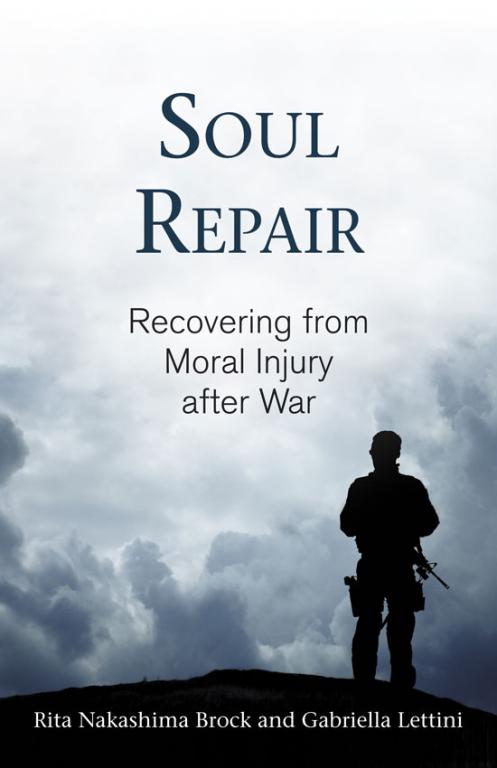 caused by exposure to trauma in the outside world. Moral Injury is about the internal struggle resulting from the violation of one’s conscience (xiii, 87). The long-term consequences of soldiers violating what they know to be right in their conscience has received far too little attention. A few month ago at the annual meeting of the American Academy of Religion when I heard Rita Nakashima Brock, one of the co-authors of Soul Repair, speak, a line from one of her interviews with veterans has struck with me as a devastating example of Moral Injury. The veteran confessed, “Feeling terrible about killing someone is a sign that I’m a moral person, and I don’t want to feel better about it because that would be a sign that I’m not a good person anymore.” Treating PTSD does not sufficiency address the full experience of many veterans returning from war zones, who have also experienced moral injury.
Brock and her co-author Gabriella Lettini write: “There’s a boot camp to prepare for war, but no boot camp to reintegrate veterans to civilian life. They were taught reflexive fire shooting, but not how to recover a shredded moral identity” (42-43).
According to historian Dean Grodzin, in the 18th-century there was a regular, state-sponsored Fast Day on a Thursday in April corresponding to the feast of Thanksgiving on a Thursday in November:
People generally behaved in a subdued manner on Fast Days and refrained from work, but their fasting was not severe. They abstained from food until evening, when they would eat a simple, usually cold, meal. During the day, they would attend one or more religious services. Ministers would preach special Fast Day sermons of admonition and reconciliation (in contrast to the celebratory ones they preached on Thanksgiving). Fast Day was the only occasion when congregations expected their minister to speak on the sins of the nation; some famous political sermons were preached on Fast Days.
Fast Day remained a legal holiday in New England, and Unitarian and Universalist churches continued to hold special Fast Day services, throughout the 19th century. For a time, both Fast Day and Thanksgiving looked as if they might go onto the national calendar; Congress or the President occasionally would call national days of fasting or thanksgiving, as events warranted.
Fall thanksgiving days grew in popularity. President Abraham Lincoln established the national November holiday with two successive annual Thanksgiving proclamations (1863, 1864). Fast days, however, began declining in popularity by mid-century. The last national fast day was called in response to President Lincoln’s assassination (1865).
We need days of celebrating, feasting, and gratitude. But even the former family holiday of Thanksgiving has been increasingly crowded out by the consumerism of Black Friday. We also need to retrieve the tradition of fast days in which we slow down, open our hearts and weep for what we have done — and for what has been done in our name — that we might recognize and recommit on that day to the things that make for peace.
For Further Study
- “Becoming a Congregation Where All Bodies Count: Memorial Day, Fallen Soldiers, and Civilian Casualties“
- “Zero Dark Thirty: Torture, Disavowal, and the Oscars“
- “Conscience, Civil Disobedience, and Holy Obedience“
The Rev. Dr. Carl Gregg is a trained spiritual director, a D.Min. graduate of San Francisco Theological Seminary, and the minister of the Unitarian Universalist Congregation of Frederick, Maryland. Follow him on Facebook (facebook.com/carlgregg) and Twitter (@carlgregg).
Learn more about Unitarian Universalism:
http://www.uua.org/beliefs/principles
Conscientious Objection to War
Previous Post

May 9, 2014
Mother’s Day for All
Next Post
June 16, 2014 "Feminist Masculinity and Father’s Day" #EachEveryWoman #AllMenCan
Browse Our Archives
Select a Category Advent Anti-Racism Archaeology Atheism Baptism Best of the Year List Book Reviews Buddhism Catholicism Christian Education Church and State Church Planting Climate Change Conscientious Objection to War Creation Spirituality Death Penalty Didache Disability Rights Discernment Easter Ecology Emergent Church Movement Empire-Critical Ethics Evolution Feminist Theology Film Reviews Gandhi Gospel of Mark Gun Control Hinduism Immigration Reform Interfaith Islam JFK Judaism Jungian Spirituality Lectionary Commentary Lent Letters to the Editor LGBT Marriage MLK Multiculturalism Mysticism Nonviolent Activism Occupy Paganism (Earth-centered Religions) Parables Paul Pluralism Politics Process Theology Quantum Physics Requiescat In Pace Seminary and Divinity School Sermon Series Retrospective Sermons Spiritual Direction Spiritual Practices Stewardship (Fundraising) The Book of J The Wheel of the Year (Paganism) Theoblogger Challenge Triathlon Uncategorized Unitarian Universalism Worship Resources Youth Ministry
Select a Month July 2026 May 2026 March 2026 November 2025 October 2025 August 2025 February 2025 December 2024 October 2024 March 2024 January 2024 December 2023 November 2023 March 2023 February 2023 January 2023 December 2022 November 2022 August 2022 March 2022 February 2022 January 2022 December 2021 September 2021 August 2021 July 2021 June 2021 May 2021 February 2021 January 2021 December 2020 August 2020 June 2020 May 2020 April 2020 March 2020 February 2020 January 2020 December 2019 November 2019 October 2019 September 2019 July 2019 June 2019 March 2019 February 2019 January 2019 December 2018 November 2018 October 2018 September 2018 June 2018 May 2018 April 2018 March 2018 February 2018 January 2018 December 2017 November 2017 October 2017 September 2017 August 2017 July 2017 June 2017 May 2017 April 2017 March 2017 February 2017 January 2017 December 2016 November 2016 October 2016 September 2016 August 2016 June 2016 May 2016 April 2016 March 2016 February 2016 January 2016 December 2015 November 2015 October 2015 September 2015 August 2015 July 2015 June 2015 May 2015 April 2015 March 2015 February 2015 January 2015 December 2014 November 2014 October 2014 August 2014 July 2014 June 2014 May 2014 April 2014 March 2014 February 2014 January 2014 December 2013 November 2013 October 2013 September 2013 August 2013 July 2013 June 2013 May 2013 April 2013 March 2013 February 2013 January 2013 December 2012 November 2012 October 2012 September 2012 August 2012 July 2012 June 2012 May 2012 April 2012 March 2012 February 2012 January 2012 December 2011 November 2011 October 2011 September 2011 August 2011 July 2011 June 2011 May 2011 April 2011 March 2011 February 2011 January 2011 December 2010 November 2010 October 2010 August 2009 July 2009 May 2009
Follow Us!
TAKE THE
Religious Wisdom Quiz
True or False: The entire city of Nineveh repented after Jonah preached to them.
Select your answer to see how you score.
TRUE FALSE
Related posts from Carl Gregg

Letting Go of Fear & Celebrating Differences: Insights...

What Do We Mean We When Say, “Building...

Rosa Parks: The Rest of the Story
“What You Say Next Will Change Your World”:...
TRENDING AT PATHEOS More Voices

Reading America at 250: A Nation Wrestles With...
As part of my own reflection on the 250th anniversary of the...

Whenever I am reading a book or listening to an argument, I...

President Trump Ban Animal Torture Videos on Facebook
Call for Stricter Regulations of Animal Abuse Content on Facebook Although President...

Draft Amendments to Address Ritual Abuse in New...
The proposed changes would make it illegal for individuals in domestic partnerships...

How Bans on LGBTQ+ Student Clubs Threaten Religious...
On June 20, 2025, the State of Texas passed Senate Bill 12....

The Truth About the Gen Z Revival
This past year, there has been a lot of media buzz surrounding...
view all More Voices blogs
Ad-Free & Subscriber Log-In Subscription Support
- About Us
- 2026 Calendar
- Videos
- Podcasts
- Library of World Religions
- Faith In Media Tracker
- Advertise With Us
- Write for Us
- Privacy Policy
- Terms of Service
- Do Not Sell My Data
- Contact Us
- Radiant Digital
- Manage Newsletter Subscriptions
- Unsubscribe From Notifications
- Sitemap
Copyright 2008-2026, Patheos. All rights reserved.
Subscription Support Ad-Free & Subscriber Log-In
Follow Patheos