
BuddhistCatholicContemplativeEvangelicalGeneral ChristianHinduJewishLatter-day SaintMuslimNew VisionsProgressive Christian
Beliefs
- Buddhist
- Catholic
- Contemplative
- Evangelical
- General Christian
- Hindu
- Jewish
- Latter-day Saint
- More Voices
- Muslim
- New Visions
- Pagan
- Progressive Christian
Topics
- Religion News
- Food and Religion
- Sports and Religion
- Religious Art
- Religious Music and Entertainment
- Religious Events
- History and Religion
- Style and Religion
- Politics and Religion
- Women in Religion
- Recreation Outdoors and Religion
- Business Finance and Religion
- Careers Workplace and Religion
- Education and Religion
- Family Parenting and Religion
- Health Fitness and Religion
- Home and Religion
- Relationships and Religion
- Technology and Religion
- Travel and Religion
Columnists
- Buddhist Columnists
- Business Finance and Religion Columnists
- Careers Workplace and Religion Columnists
- Catholic Columnists
- Contemplative Columnists
- Education and Religion Columnists
- Evangelists Columnists
- Family Parenting and Religion Columnists
- General Christian Columnists
- Health Fitness and Religion Columnists
- Hindu Columnists
- History and Religion Columnists
- Home and Religion Columnists
- Jewish Columnists
- More Voices Columnists
- Latter Day Columnists
- Muslim Columnists
- New Visions Columnists
- Nonreligious Columnists
- Pagan Columnists
- Politics and Religion Columnists
- Progressive Columnists
- Recreation Outdoors and Religion Columnists
- Relationships and Religion Columnists
- Religion News Columnists
- Religious Art Columnists
- Religious Events Columnists
- Religious Music and Entertainment Columnists
- Sports and Religion Columnists
- Style and Religion Columnists
- Technology and Religion Columnists
- Travel and Religion Columnists
- Women in Religion Columnists
Resource Library
- 2026 Calendar
- Library of World Religions
- The 100 Most Holy Places on Earth
- Patheos Answers
- Podcasts
- Videos
- Faith Leaders Database
- Anglican Episcopalian
- Bahai
- Baptist
- Buddhism
- Christianity
- Confucianism
- Eastern Orthodoxy
- Hinduism
- Holiness and Pentecostal
- ISKCON
- Islam
- Judaism
- Lutheran
- Methodist
- The Church of Jesus Christ of Latter-day Saints
- New Age
- Paganism
- Presbytarian and Reformed
- Protestantism
- Religion Behind the Scenes
- Roman Catholic
- Scientology
- Shia Islam
- Sikhism
- Sufism
- Sunni Islam
- Taoism
- Zen
- See all religions
Research Tools
 Ad-Free & Subscriber Log-In Subscription Support
Ad-Free & Subscriber Log-In Subscription Support
Follow Patheos 

- Trending:
- Forgiveness
- |
- Marriage
- |
- Consciousness
- |
- Death Penalty
- |
- Election
- |
- Halloween

- Home
- More Voices
- “Bringing the Spiritual to Its Senses”
“Bringing the Spiritual to Its Senses”
Last updated on: May 4, 2015 at 1:18 pm by Carl Gregg
“Bringing the Spiritual to Its Senses” 2015-05-04T13:18:49-04:00 Carl Gregg
Patheos Explore the world's faith through different perspectives on religion and spirituality! Patheos has the views of the prevalent religions and spiritualities of the world.
Incense fills the nostrils of a Krishna devotee in a temple in Vrindavan, India, letting him know he is in a sacred place; Muslim worshipers heed the muezzin’s amplified call to prayer from the minaret of a Moroccan mosque; a girl tastes bitter herbs at a Passover Seder in Brooklyn, reminding her of the harshness of her ancestors’ slavery in Egypt; a Greek Orthodox woman gazes reverently upon an icon of Jesus Christ and sees the gaze returned, knowing she is blessed; a Zen Buddhist acolyte strolls meditatively through gardens in Kyoto, experiencing form and emptiness. These sensual experiences are part and parcel of the stuff of religion. Myths, rituals, symbols, acts of devotion, prayer, and faith itself do not occur without sensual encounters. To learn about religion we have to come to our senses.
— Brent Plate, A History of Religion in 5 1/2 Objects: Bringing the Spiritual to Its Senses, 8
The late Andrew Greeley (1928-2013) was a Roman Catholic priest, bestselling novelist, popular columnist, and respected sociologist of religion. His breakthrough bestseller was The Cardinal Sins (1981). In the words of one review, Greeley “did for the Catholic Church what The Godfather did for the mafia.”
My favorite of his books is The Catholic Imagination in which he explores the different ways that Catholicism and 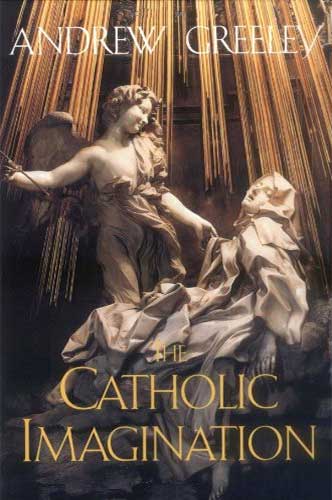 Protestantism shape the religious imaginations of those who are raised in the Christian tradition. Many Protestants grow up worshipping in brightly-lit sanctuaries with stark, blank white walls. In contrast, many Catholics grow up in more dimly-lit, dark-walled, richly-ornate spaces. Greely writes that, “Catholics live in an enchanted world, a world of statues and holy water, stained glass and votive candles, saints and religious medals, rosary beads and holy pictures.” And among the many important implications are that, the Catholic Imagination is “one of the reasons, Greeley believed, that the Catholic church over the centuries has been a great patron of the arts: It grasps the power of imagery to convey what precise doctrinal formula cannot.”
In contrast, a significant part of the Protestant Reformation that shaped the Protestant religious imagination was a rebellion against rituals, customs, and traditions that became viewed as meaningless — as either “tradition for tradition’s sake” or that religious hierarchies had come to abuse to control and extort the laity. The stripping away of meaningless or manipulative rituals led to those stark, blank white walls of Protestant worship spaces and the simplified liturgies of Protestant worship services that were much more literal and text-based than Catholic mass.
Reflecting on how the communities we have been apart of have shaped our religions imagination can help us become more aware of the ways that what we experience during our childhoods can unconsciously become our normative reference point — the standard against which all deviations are judged — even to the extent that we can sometimes find ourselves unreflectively thinking that it has always been that way since the beginning.
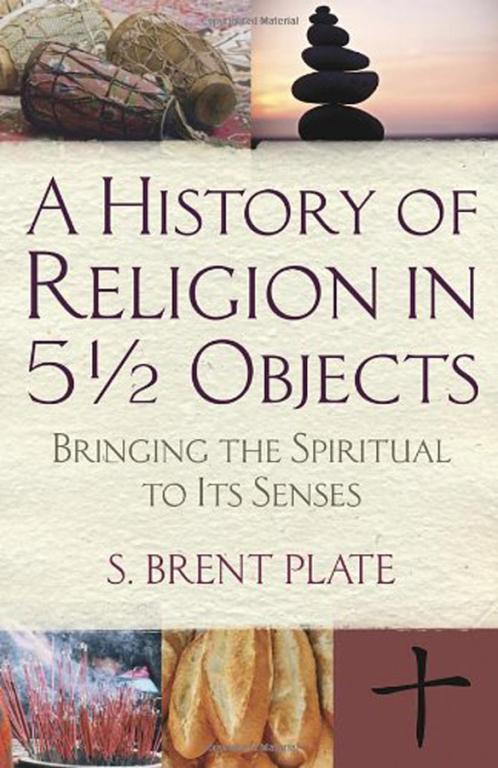 At their best, rituals invite us into a liminal, “threshold” time and space in which we become more open to an encounter with the sacred, depth dimension of life. And there is an interesting new book from Beacon Press that reflects on the role of ritual in religious traditions titled A History of Religion in 5 1/2 Objects: Bringing the Spiritual to Its Senses. The author Brent Plate reflects on the ways that often the simplest, most commonplace objects — stones, incense, drums, crosses, bread — can become invested with tremendous, even transformative, pathos and meaning.
The author claims that the “1/2” in the title is “a symbolic of our incomplete natures, the need for a human body to be made whole through relations with something outside itself” (3). And although I agree with that statement from the perspective of the Unitarian Universalist Seventh Principle (“the interdependent web of all existence”), to be honest, my perception is that making the title “A History of Religion in Five 1/2 Objects” is a bit of a marketing ploy to pique your curiosity enough to open the book and find out what he means. But even if it is a bit of a manipulation doesn’t mean it isn’t effective (it got me to open the table of contents!)— just like it’s not paranoid if they really are out to get you.
I find the book’s subtitle more direct and persuasive: “Bringing the Spiritual to Its Senses.” That’s what I find most important about ritual: simple objects — stones, incense, drums, crosses, bread — can transform our worship and ourselves through engaging our taste, touch, smell, sight, and sound. The senses can transport and transforms us. As one of my mentors taught me, worship should be a “Symphony for the Senses.”
When I think of the long history of stones in the history of religion, what immediately comes to mind are the Pyramids in Egypt, which astoundingly were constructed 4,000 years ago, or Stone Henge in England built around the same time. Or more simply cairns: those simple but often breathtakingly beautiful stacks of rocks. Or the stones built into the Jerusalem Temple, including those that remain as the Wailing Wall. Or the rock at the center of the Ka’ba in Mecca that are a central part of the Islamic pilgrimage the Hajj. But Plate’s book also reminded me of:
The discovery in the 1960s of the great stone rings of Gobekli Tepe in southeastern Turkey evidence ritual gatherings, aesthetic creations, and the use of stone more than eleven thousand years ago. Dating six thousand years before Stonehenge, and seven thousand before the…Pyramid at Giza, this is the place of the oldest known temple on earth. (39)
That’s Neolithic religion!
Plate also focuses on crosses, which Western Civilization has come to associate most strongly with Christianity. But the Egyptian ankh is one of many reminders that the cross precedes Christianity and archetypically represents the intersection of the horizontal and vertical dimensions of life, the meeting of the sacred and mundane.
Plate’s final religious ritual object is bread. And I invite you to consider that the word com–pan-ion literally means “with bread.” A companion is literally someone with whom you break bread. As you sit down to eat in the coming days I invite you to allow that ritual — that may not always involve literally break bread — of taking the first bite of your meal to remind you to be more fully present that that companion or companions with whom you are eating. Each meal is another opportunity and invitation to break down walls and build community.
For now, I’ll leave you with a final invitation. Sometime today if possible or in the next week or so, I invite you to take a leisurely walk. It can be as short as to the end of the block and back. Allow that walk to be a symphony for the senses for you. Pay attention to all that you notice through your senses. Perhaps you’ll see a particular object that resonates with you. Perhaps that object might be the start of a simple home altar in the corner of a room or the corner of the desk that can remind you to pause periodically and remember the beauty and the wonder all around us — even or especially through such common objects as stones, incense, drums, crosses, or bread. As Mary Oliver says in this poem from her collection titled Thirst:
It doesn’t have to be
the blue iris, it could be
weeds in a vacant lot, or a few
small stones; . . .
this isn’t
a contest but the doorway
into thanks, and a silence in which
another voice may speak.
The Rev. Dr. Carl Gregg is a trained spiritual director, a D.Min. graduate of San Francisco Theological Seminary, and the minister of the Unitarian Universalist Congregation of Frederick, Maryland. Follow him on Facebook (facebook.com/carlgregg) and Twitter (@carlgregg).
Learn more about Unitarian Universalism:
http://www.uua.org/beliefs/principles
Previous Post

June 19, 2014
"Fast Future: How the Millennial Generation Is Shaping Our World"
Next Post
July 8, 2014 "Find Out How Much Love the World Can Hold"
Browse Our Archives
Select a Category Advent Anti-Racism Archaeology Atheism Baptism Best of the Year List Book Reviews Buddhism Catholicism Christian Education Church and State Church Planting Climate Change Conscientious Objection to War Creation Spirituality Death Penalty Didache Disability Rights Discernment Easter Ecology Emergent Church Movement Empire-Critical Ethics Evolution Feminist Theology Film Reviews Gandhi Gospel of Mark Gun Control Hinduism Immigration Reform Interfaith Islam JFK Judaism Jungian Spirituality Lectionary Commentary Lent Letters to the Editor LGBT Marriage MLK Multiculturalism Mysticism Nonviolent Activism Occupy Paganism (Earth-centered Religions) Parables Paul Pluralism Politics Process Theology Quantum Physics Requiescat In Pace Seminary and Divinity School Sermon Series Retrospective Sermons Spiritual Direction Spiritual Practices Stewardship (Fundraising) The Book of J The Wheel of the Year (Paganism) Theoblogger Challenge Triathlon Uncategorized Unitarian Universalism Worship Resources Youth Ministry
Select a Month July 2026 May 2026 March 2026 November 2025 October 2025 August 2025 February 2025 December 2024 October 2024 March 2024 January 2024 December 2023 November 2023 March 2023 February 2023 January 2023 December 2022 November 2022 August 2022 March 2022 February 2022 January 2022 December 2021 September 2021 August 2021 July 2021 June 2021 May 2021 February 2021 January 2021 December 2020 August 2020 June 2020 May 2020 April 2020 March 2020 February 2020 January 2020 December 2019 November 2019 October 2019 September 2019 July 2019 June 2019 March 2019 February 2019 January 2019 December 2018 November 2018 October 2018 September 2018 June 2018 May 2018 April 2018 March 2018 February 2018 January 2018 December 2017 November 2017 October 2017 September 2017 August 2017 July 2017 June 2017 May 2017 April 2017 March 2017 February 2017 January 2017 December 2016 November 2016 October 2016 September 2016 August 2016 June 2016 May 2016 April 2016 March 2016 February 2016 January 2016 December 2015 November 2015 October 2015 September 2015 August 2015 July 2015 June 2015 May 2015 April 2015 March 2015 February 2015 January 2015 December 2014 November 2014 October 2014 August 2014 July 2014 June 2014 May 2014 April 2014 March 2014 February 2014 January 2014 December 2013 November 2013 October 2013 September 2013 August 2013 July 2013 June 2013 May 2013 April 2013 March 2013 February 2013 January 2013 December 2012 November 2012 October 2012 September 2012 August 2012 July 2012 June 2012 May 2012 April 2012 March 2012 February 2012 January 2012 December 2011 November 2011 October 2011 September 2011 August 2011 July 2011 June 2011 May 2011 April 2011 March 2011 February 2011 January 2011 December 2010 November 2010 October 2010 August 2009 July 2009 May 2009
Follow Us!
TAKE THE
Religious Wisdom Quiz
The light shines in the darkness, and the darkness has not ____ it.
Select your answer to see how you score.
Accepted Comprehended Extinguished Understood
Related posts from Carl Gregg

“Do You Really Want to Know?” From Pope...

Why You Should Give Yourself Permission for Self-Care:...

"Are You Living the Life You Chose?": How...
Why a 40-Hour Work Week? (It's Decreased Before....
TRENDING AT PATHEOS More Voices

Reading America at 250: A Nation Wrestles With...
As part of my own reflection on the 250th anniversary of the...

Whenever I am reading a book or listening to an argument, I...

President Trump Ban Animal Torture Videos on Facebook
Call for Stricter Regulations of Animal Abuse Content on Facebook Although President...

Draft Amendments to Address Ritual Abuse in New...
The proposed changes would make it illegal for individuals in domestic partnerships...

How Bans on LGBTQ+ Student Clubs Threaten Religious...
On June 20, 2025, the State of Texas passed Senate Bill 12....

The Truth About the Gen Z Revival
This past year, there has been a lot of media buzz surrounding...
view all More Voices blogs
Ad-Free & Subscriber Log-In Subscription Support
- About Us
- 2026 Calendar
- Videos
- Podcasts
- Library of World Religions
- Faith In Media Tracker
- Advertise With Us
- Write for Us
- Privacy Policy
- Terms of Service
- Do Not Sell My Data
- Contact Us
- Radiant Digital
- Manage Newsletter Subscriptions
- Unsubscribe From Notifications
- Sitemap
Copyright 2008-2026, Patheos. All rights reserved.
Subscription Support Ad-Free & Subscriber Log-In
Follow Patheos