
BuddhistCatholicContemplativeEvangelicalGeneral ChristianHinduJewishLatter-day SaintMuslimNew VisionsProgressive Christian
Beliefs
- Buddhist
- Catholic
- Contemplative
- Evangelical
- General Christian
- Hindu
- Jewish
- Latter-day Saint
- More Voices
- Muslim
- New Visions
- Pagan
- Progressive Christian
Topics
- Religion News
- Food and Religion
- Sports and Religion
- Religious Art
- Religious Music and Entertainment
- Religious Events
- History and Religion
- Style and Religion
- Politics and Religion
- Women in Religion
- Recreation Outdoors and Religion
- Business Finance and Religion
- Careers Workplace and Religion
- Education and Religion
- Family Parenting and Religion
- Health Fitness and Religion
- Home and Religion
- Relationships and Religion
- Technology and Religion
- Travel and Religion
Columnists
- Buddhist Columnists
- Business Finance and Religion Columnists
- Careers Workplace and Religion Columnists
- Catholic Columnists
- Contemplative Columnists
- Education and Religion Columnists
- Evangelists Columnists
- Family Parenting and Religion Columnists
- General Christian Columnists
- Health Fitness and Religion Columnists
- Hindu Columnists
- History and Religion Columnists
- Home and Religion Columnists
- Jewish Columnists
- More Voices Columnists
- Latter Day Columnists
- Muslim Columnists
- New Visions Columnists
- Nonreligious Columnists
- Pagan Columnists
- Politics and Religion Columnists
- Progressive Columnists
- Recreation Outdoors and Religion Columnists
- Relationships and Religion Columnists
- Religion News Columnists
- Religious Art Columnists
- Religious Events Columnists
- Religious Music and Entertainment Columnists
- Sports and Religion Columnists
- Style and Religion Columnists
- Technology and Religion Columnists
- Travel and Religion Columnists
- Women in Religion Columnists
Resource Library
- 2026 Calendar
- Library of World Religions
- The 100 Most Holy Places on Earth
- Patheos Answers
- Podcasts
- Videos
- Faith Leaders Database
- Anglican Episcopalian
- Bahai
- Baptist
- Buddhism
- Christianity
- Confucianism
- Eastern Orthodoxy
- Hinduism
- Holiness and Pentecostal
- ISKCON
- Islam
- Judaism
- Lutheran
- Methodist
- The Church of Jesus Christ of Latter-day Saints
- New Age
- Paganism
- Presbytarian and Reformed
- Protestantism
- Religion Behind the Scenes
- Roman Catholic
- Scientology
- Shia Islam
- Sikhism
- Sufism
- Sunni Islam
- Taoism
- Zen
- See all religions
Research Tools
 Ad-Free & Subscriber Log-In Subscription Support
Ad-Free & Subscriber Log-In Subscription Support
Follow Patheos 

- Trending:
- Forgiveness
- |
- Marriage
- |
- Consciousness
- |
- Death Penalty
- |
- Election
- |
- Halloween

- Home
- More Voices
- Religious Mystic & Rational Humanist: The Mystical Humanism of Jeffrey Kripal
Religious Mystic & Rational Humanist: The Mystical Humanism of Jeffrey Kripal
Last updated on: May 4, 2015 at 1:14 pm by Carl Gregg
Religious Mystic & Rational Humanist: The Mystical Humanism of Jeffrey Kripal 2015-05-04T13:14:41-04:00 Carl Gregg
Patheos Explore the world's faith through different perspectives on religion and spirituality! Patheos has the views of the prevalent religions and spiritualities of the world.
For days, I had been participating in the annual Bengali celebration of the goddess Kali in the streets and temples of Calcutta (now Kolkata). One morning I woke up asleep, that is, I woke up, but my body did not. I couldn’t move. I was paralyzed, like a corpse, more or less exactly like the Hindu god Shiva as he is traditionally portrayed in Tantric art, lying prostrate beneath Kali’s feet. Then those “feet” touched me. An incredibly subtle, immensely pleasurable, and terrifyingly powerful energy entered me, possessed me, completely overwhelmed me. My vibrating body felt as if I had stuck a fork in a wall socket.… Perhaps more significantly, my brain felt as if it had suddenly hooked up to some sort of occult Internet and that billions of bits of information were being downloaded into its neural net. Or better, it felt as if my entire being was being reprogrammed or rewired…. It is almost as if some kind of direct, right-brained, mind-to-mind transmission took place, as if those residual plasmic energies were encoded with ideas or structures that could not be “languaged” but could be stored and later intuited and consciously shaped in the mirror of other resonant or echoing authors until they could appear, now through the prism of the left-brain’s words, as my books.”
—Jeffrey Kripal, Mutants & Mystics, 6-8
That experience happened in 1989 in northeastern India to Dr. Jeffrey Kripal, a professor of philosophy and religious thought at Rice University in Houston, Texas. If you read the first post this four-part series on “A Journey with Four Spiritual Guides,” you may recall that Kripal’s dissertation advisor at the University of Chicago was Wendy Doniger, the renown religion scholar, whose books have been unjustly banned recently in India. Kripal is also the author of six impressive scholarly books with the University of Chicago Press and most recently of a groundbreaking textbook in Comparative Religions, which I will be blogging about further this summer.
I’ve taken the time to establish some of Kripal’s academic credentials because, to be frank, when it comes to the history of testimonies about personal religious experience, there are a lot charlatans, huckers, con artists, fakes, frauds, and imposters. But from what I can tell, Kripal is authentically telling the truth about what subjective experience felt like. And in his scholarship, he brings academic rigor to claims about religious experiences both in the past and today.
From the perspective of my tradition of Unitarian Universalism, the first of our Six Sources is “Direct experience”: what we know to be true firsthand.At the same time, I will readily grant that it is important to balance that First Source of “direct experience” with the Fifth Source: “reason and the results of science that warn us against idolatries of the mind and spirit.”
There is much to be said about the different ways science and spirituality equip us to explore and experience the world. For now, suffice it to say that modern science is a phenomenally powerful and spectacularly successful methodology for studying parts of our universe that are objective, repeatable, and independently verifiable. But it is a mistake to extrapolate from the power of the scientific method that science is the only way of obtaining trustworthy knowledge about the universe. Indeed, that past mistake is part of what postmodernism is all about.
Modernity — the modern world — was about the seeming triumph of secularization, industrialization, progress, and rationality — understanding the world as a machine: the dream that if we could just figure out how all the component parts work, then we’ll understand the whole. Postmodernity is where we find ourselves now because it turns out that science, rationality, and materialism alone — as powerful as that worldview is and continues to be — was insufficient. The universe is messier, more complex, more holistic and interconnected than modernity allowed. The postmodern world in which we find ourselves is skeptical of universal answers and open to multiple ways of obtaining knowledge.
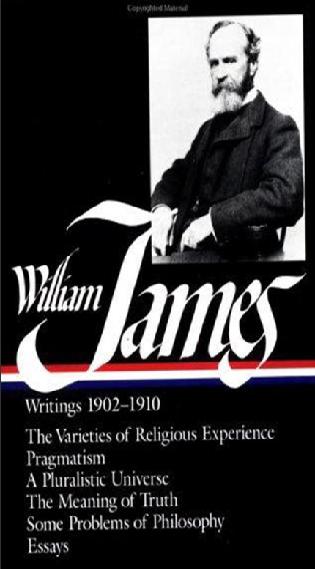
William James
As our case in point, Kripal’s direct, personal, subjective experience came unexpectedly, and cannot be reliably repeated in a laboratory. In the words of the philosopher and psychologist William James, who a century ago extensively studied The Varieties of Religious Experience, “In order to disprove the assertion that all crows are black, one white crow is sufficient.” For Kripal, his nighttime experience in 1989 in northeastern India was his one white crow: more than sufficiently convincing for him personally, even if he can’t prove it to others beyond a shadow of a doubt. Have you or someone you have known had a similar firsthand experience of the strange, the uncanny, the unrepeatable, the unasked for, but the nonetheless existentially real?
As I said earlier, this post is the fourth in a four-part series on “A Journey with Four Spiritual Guides: Krishna, Buddha, Jesus, and Ramakrishna.” And as we prepare to weave this final strand (at least for now) into the tapestry of world religions, it may be helpful to reiterate, for the sake of transparency, my own personal touchstones for navigating our postmodern world that I have blogged about previously: Pluralism, Pragmatism, and Progressivism. (These three points are drawn from Richard Rorty’s book Philosophy and Social Hope in which the subtitle of the “Afterword” is “Pragmatism, Pluralism and Postmodernism.”)
Pluralism means that I think there is more than one legitimate, life-giving way to navigate our complex world. Ultimately, many more than four guides are needed because there’s no singular way that could possibly serve all people in all times and places. That’s why I’m grateful that the “big tent” of Unitarian Universalism explicitly draws from Six Sources: personal “direct experience,” words and deeds of prophetic women and men, wisdom from the world’s religions, Jewish and Christian teachings, Humanist teachings (which includes modern science), and earth-centered traditions. From the perspective of this series of posts, some will find Krisha helpful as a spiritual guide, others Buddha, still others Jesus, Ramakrisha, or science. Few would find them all equally helpful. But a Unitarian Universalist congregation seeks to be a place in which you can accompanied, aided, and challenged by others as you seek to follow the way that is right for you at this time in your life.
Pragmatism means that I am less interested in what people say and more interested in what they do, in “what works.” Pragmatism means that “behavior is believable.” Or as Jesus said, “By their fruit you will know them” (Matthew 7:16). In regard to the various spiritual guides of the past or present, pragmatism means being skeptical about all the claims made in various religious traditions that cannot be verified in our firsthand experience today. It means, in the end, caring less about the exact historical details surrounding figures such as Krishna, Buddha, Jesus, or Ramakrisha and more about whether the teachings attributed to these figures can help with the predicaments in which I find myself and help me and the communities of which I am a part live a more beautiful, more authentic, more compassionate life.
Progressivism means that although I do not think there is any guarantee that things will get better, we should still do our best to work for a better world. Indeed, the “long run” scenario that many scientists predict does not sound much like “progress.” To quote philosopher Ray Bassier,
[O]ne trillion, trillion, trillion years from now, the accelerating expansion of the universe will have disintegrated the fabric of matter itself…. Every star in the universe will have burnt out, plunging the cosmos into a state of absolute darkness and leaving behind nothing but spent husks of collapsed matter. All free matter, whether on planetary surfaces or in interstellar space, will have decayed, eradicating any remnants of life…. [T]he stellar corpses littering the empty universe will evaporate into a brief hailstorm of elementary particles.… Only the implacable gravitational expansion will continue, driven by the currently inexplicable force called ‘dark energy’, which will keep pushing the extinguished universe deeper and deeper into an eternal and unfathomable blackness. (228)
So, yeah, that’s a little bleak. In the end, perhaps the truth is not that “Love Wins,” but that “Entropy wins.” But in the meantime, we have this life, we have one another. And regardless of what will happen one trillion, trillion, trillion years from now, I’m much more concerned with the potential for what happens if “love wins” or “compassion wins” if only in the short run. And progressivism means a commitment to do all we can to make this life better for all people — and future generations — if only locally, regionally, and provisionally.
Pluralism, Pragmatism, Progressivism. Those are the touchstones that I use to navigate our postmodern world.
If you have other or different touchstones, I would interested to hear them. But for now, along these lines, I’m pulling a small sleight-of-hand in that I would like to talk about Ramakrishna as spiritual guide less by talking directly about Ramakrishna and more by talking about Professor Jeffrey Kripal. Ramakrishna (1836-1886) is a nineteenth-century Bengali mystic, and many consider the book about him, The Gospel of Sri Ramakrishna, to be a modern religious classic. Indeed, Ramakrishna’s face is all over Calcutta to this day. And perhaps I will post at some future date focusing explicitly on Ramakrishna.
For the purposes of this post, I’m less interested in exploring yet-one-more historical religious figure who died before anyone living today was born. I’m more interested in reflecting on the religious experience and scholarship of someone like Dr. Kripal, who is very much alive and living in Texas. But here’s the twist: Kripal wrote his dissertation on Ramakrishna, and that experience of deeply immersing himself in the life and scholarship of that nineteenth-century Bengali mystic is likely part of what helped cultivate and trigger that intense religious experience described earlier. Recall that when his body was overtaken by that “incredibly subtle, immensely pleasurable, and terrifyingly powerful energy,” it was after he had been participating for days “in the annual Bengali celebration of the goddess Kali in the streets and temples of Calcutta.”
And as Western scholar of religion in India, Kripal has raised the ire of fundamentals Hindus for following in the footsteps of his doctoral advisor Wendy Doniger in bringing a post-Freudian psychoanalytic lens to the study of the Hindu Tradition. For example, the subtitle of Kripal’s dissertation is “The Mystical and the Erotic in the Life and Teachings of Ramakrishna.” And legend has it that when Kripal was defending his dissertation, one of the questions he was asked was about his preferred methodological tool. Without missing a beat, he answered, “a very big Freudian screwdriver” — pun intended, of course, because with Freud the pun is always intended even if often unconsciously.
Now, in all seriousness, I would like to take that Freudian screwdriver pun and connect it with the point made earlier about both the power and the limitations of the scientific method. In the words of the twentieth-century Indian mystic Bhagwan Rajneesh (1931–1990), “Freud only got to the third chakra.” The implication is that Freud (and science) generally is right, but it doesn’t go far enough. And indeed that may be a limit intrinsic to the scientific method, which functions best when the object of study is repeatable and verifiable in laboratory conditions.
And when we translate the first three chakras into more familiar scientific terms, we get “the anal, genital, and digestive.” For example, think of those Freudian terms that have captured the popular imagination such as “anal-retentive and Oedipal Complex.” These areas relate especially to our unconscious motives relate to “sexual desire, greed” as well as “shame, disgust, and fear.” But I don’t want us to get lost on the psychotherapist’s couch. The point is that rational science is better at addressing the aspects of the human condition represented by those first three chakras — the anal, genital, and digestive — than it is at addressing the subjective, poetic, interspirituality of “mystical love” in the fourth (or heart) chakra, the “still-speaking ecstasy” of the throat chakra into the “near-absorptive state” (or “third eye” opening) of the sixth chakra, to the “complete absorption,” unitive state of the seventh chakra.
 Now from the opposite direction, just as spiritual teachers have criticized scientists for only getting to the “third chakra,” many orthodox religions are rightly criticized for stopping “just above the waist” — that is, many traditional religions do well with the mystical love for the divine, but their approaches to the anal, genital, and digestive parts of the human condition (the parts “below the waist”) are often nonsensical, inhumane, and unrealistic to say the least. I would invite you to consider that as the reason why there is so much excitement about any mention of Jesus and Mary Magdalene. Although I do not think that the historical Jesus was married to Mary Magdalene, I do think that archetypally the mentioning of Mary Magdalene and Jesus exposes that the orthodox tradition about Jesus, for the most part, stops “just above the waist.” (It’s an problem one Yale scholar calls “Sex and the Single Savior.”) If your primary image of the sacred is a celibate male individual, there is an unconscious knowledge that there are huge aspects of the human condition that image of the divine neglects, especially if you are female or non-celibate male. Invoking the name of Mary Magdalene fascinates many people for precisely that reason: she reminds us of a huge gap in orthodox Christianity.
And I do have a future Easter post in the works (perhaps for 2015) on “The Resurrection of Mary Magdalene.” But for now my point is that Unitarian Universalism is in a prime position to bridge the gap between science and spirituality — to be a place where the full spectrum of the human condition can be taken seriously. William James, whose “white crow” analogy I mentioned earlier, called such an approach “radical empiricism”: “a faithfulness to the full data of human experience that refuses to ignore anomalies simply because they cannot be fit into the reigning scientism of the day.” This approach doesn’t mean, of course, that ‘anything goes.’ And there are good reasons to continue to be skeptical of strands of spirituality that are “superficial, flaky, anti-intellectual, and socially disengaged.”
Kripal calls himself a “Mystical Humanist,” a term I like quite a lot, and which I take to mean someone who is (1) primarily interest in the mystical experiences of humans in this world, as opposed to someone who is primarily interested the revelations of a God “out there” somewhere and (2) who wants to bring the humanist concern with reason and rationality to bear on mystical experiences. (As a brief aside, this perspective of mystical humanism very much relates to the second half of the post from a few weeks ago on Feuerbach.)
For Kripal, as a result of speaking boldly about his “direct experience,” he has had many other professional religious scholars tell him privately about their similar experiences — which has led him to wonder “how it is that these experiences, which seem to be so meaningful, energizing, and creative, are so seldom allowed a clear voice in public, published scholarship.” He tells the story of seeing a sign in a divinity school that read “Please report suspicious activity to the Dean of Students Office.” Except that someone had crossed out suspicious and written in “religious.” And I invite you to consider that we fall short of our full potential as a movement if we stop at at the third chakra, and report all religious activity as suspicious.
As I’ve said, science is an incredibly powerful way of coming to understand the world, but it is most effective for repeatable events, observable by independent third-parties. But scholars like Kripal and mystics through the ages invite us to consider that there are equally important truths about the world that are strange, uncanny, subjective, and experienced directly in an individual’s firsthand experience. In Kripal’s words:
The limits of scientific materialism here are captured in the joke about the man searching for his car keys. Another man comes up and asks where he thinks he lost them. “In the basement,” he answers. “So why are you looking out here in the driveway?” he asks in confusion. “Oh, because the light is much better here.”
Although we should continue to look for rationalist explanations on which we can focus the full light of day, mystics remind us that “there might really be something worth looking for in the dark.” And Kripal invites us to consider that we make a mistake if we too quickly dismiss all claims about spiritual experience as “irrationalism,” “anecdote,” or “pseudoscience.”
Moreover, in our postmodern world, science itself in both the theory of relativity and quantum physics has showed us just how strange and uncanny the universe is. As the scientist J. B. S. Haldane famously said, “My own suspicion is that the universe is not only queerer than we suppose, but queerer than we can suppose.” Finding ourselves in such a universe, we can use all the help we can get — from both science and spirituality — to find our way forward together and to make the most of this life and this world. I don’t know where that journey of science and spirituality will take us; no one does in advance. That’s part of the excitement. But I do know that I’m grateful to be on that journey with many of you.
For Further Reading
- Carl Gregg, “The First Source: Direct Experience”
- Jeffrey Kripal, “Introductory Essay”
- Kripal, “Body of Written Work”
Notes
- “In order to disprove the assertion that all crows are black…” — William James on Psychical Research, ed. Gardner Murphy and Robert O. Ballou (1973), 40-41.
- “a very big Freudian screwdriver” — Jeffrey Kripal, Comparing Religions: Coming to Terms, 204.
- “Freud only got to the third chakra” — Kripal, Esalen: America and the Religion of No Religion, 144.
- The descriptions of the chakras are from Kripal, Kali’s Child: The Mystical and the Erotic in the Life and Teachings of Ramakrishna (1995/1998), 43-44.
- “just above the waist” — Kripal, Roads of Excess, Palaces of Wisdom: Eroticism and Reflexivity in the Study of Mysticism, 343.
- “radical empiricism” — Kripal, Esalen, 7.
- “superficial, flaky, anti-intellectual, and socially disengaged.” — Kripal, Esalen, 474.
- “Mystical Humanism” — The Serpent’s Gift: Gnostic Reflections on the Study of Religion, 171
- “Please report suspicious activity…” — Kripal, Roads of Excess, Palaces of Wisdom, 25.
- “The limits of scientific materialism” — Kripal, Authors of the Impossible: The Paranormal and the Sacred, 261.
- “The Universe is not only queerer than we suppose, but queerer than we can suppose” — J. B. S. Haldane’s Possible Worlds and Other Papers (1927), 286.
The Rev. Dr. Carl Gregg is a trained spiritual director, a D.Min. graduate of San Francisco Theological Seminary, and the minister of the Unitarian Universalist Congregation of Frederick, Maryland. Follow him on Facebook (facebook.com/carlgregg) and Twitter (@carlgregg).
Learn more about Unitarian Universalism:
http://www.uua.org/beliefs/principles
Previous Post

March 18, 2014
The Life Tradition versus the Death Tradition in Christianity
Next Post
April 8, 2014 Aronofsky’s Noah: from “Hope in Heaven” to “Hope in Grandchildren”
Browse Our Archives
Select a Category Advent Anti-Racism Archaeology Atheism Baptism Best of the Year List Book Reviews Buddhism Catholicism Christian Education Church and State Church Planting Climate Change Conscientious Objection to War Creation Spirituality Death Penalty Didache Disability Rights Discernment Easter Ecology Emergent Church Movement Empire-Critical Ethics Evolution Feminist Theology Film Reviews Gandhi Gospel of Mark Gun Control Hinduism Immigration Reform Interfaith Islam JFK Judaism Jungian Spirituality Lectionary Commentary Lent Letters to the Editor LGBT Marriage MLK Multiculturalism Mysticism Nonviolent Activism Occupy Paganism (Earth-centered Religions) Parables Paul Pluralism Politics Process Theology Quantum Physics Requiescat In Pace Seminary and Divinity School Sermon Series Retrospective Sermons Spiritual Direction Spiritual Practices Stewardship (Fundraising) The Book of J The Wheel of the Year (Paganism) Theoblogger Challenge Triathlon Uncategorized Unitarian Universalism Worship Resources Youth Ministry
Select a Month July 2026 May 2026 March 2026 November 2025 October 2025 August 2025 February 2025 December 2024 October 2024 March 2024 January 2024 December 2023 November 2023 March 2023 February 2023 January 2023 December 2022 November 2022 August 2022 March 2022 February 2022 January 2022 December 2021 September 2021 August 2021 July 2021 June 2021 May 2021 February 2021 January 2021 December 2020 August 2020 June 2020 May 2020 April 2020 March 2020 February 2020 January 2020 December 2019 November 2019 October 2019 September 2019 July 2019 June 2019 March 2019 February 2019 January 2019 December 2018 November 2018 October 2018 September 2018 June 2018 May 2018 April 2018 March 2018 February 2018 January 2018 December 2017 November 2017 October 2017 September 2017 August 2017 July 2017 June 2017 May 2017 April 2017 March 2017 February 2017 January 2017 December 2016 November 2016 October 2016 September 2016 August 2016 June 2016 May 2016 April 2016 March 2016 February 2016 January 2016 December 2015 November 2015 October 2015 September 2015 August 2015 July 2015 June 2015 May 2015 April 2015 March 2015 February 2015 January 2015 December 2014 November 2014 October 2014 August 2014 July 2014 June 2014 May 2014 April 2014 March 2014 February 2014 January 2014 December 2013 November 2013 October 2013 September 2013 August 2013 July 2013 June 2013 May 2013 April 2013 March 2013 February 2013 January 2013 December 2012 November 2012 October 2012 September 2012 August 2012 July 2012 June 2012 May 2012 April 2012 March 2012 February 2012 January 2012 December 2011 November 2011 October 2011 September 2011 August 2011 July 2011 June 2011 May 2011 April 2011 March 2011 February 2011 January 2011 December 2010 November 2010 October 2010 August 2009 July 2009 May 2009
Follow Us!
TAKE THE
Religious Wisdom Quiz
Peter was staying where when he saw the vision of the great sheet with all the animals?
Select your answer to see how you score.
Bethabara With Cornelius With Simon the Tanner Joppa
Related posts from Carl Gregg

Peak Spiritual Experiences, Psychedelics, & Consciousness Research

"How the Founding Fathers Became Infallible and Our...

Vampires, Witches, & NPR: The Legacy of Margot...

“Do You Really Want to Know?” From Pope...
TRENDING AT PATHEOS More Voices

Reading America at 250: A Nation Wrestles With...
As part of my own reflection on the 250th anniversary of the...

Whenever I am reading a book or listening to an argument, I...

President Trump Ban Animal Torture Videos on Facebook
Call for Stricter Regulations of Animal Abuse Content on Facebook Although President...

Draft Amendments to Address Ritual Abuse in New...
The proposed changes would make it illegal for individuals in domestic partnerships...

How Bans on LGBTQ+ Student Clubs Threaten Religious...
On June 20, 2025, the State of Texas passed Senate Bill 12....

The Truth About the Gen Z Revival
This past year, there has been a lot of media buzz surrounding...
view all More Voices blogs
Ad-Free & Subscriber Log-In Subscription Support
- About Us
- 2026 Calendar
- Videos
- Podcasts
- Library of World Religions
- Faith In Media Tracker
- Advertise With Us
- Write for Us
- Privacy Policy
- Terms of Service
- Do Not Sell My Data
- Contact Us
- Radiant Digital
- Manage Newsletter Subscriptions
- Unsubscribe From Notifications
- Sitemap
Copyright 2008-2026, Patheos. All rights reserved.
Subscription Support Ad-Free & Subscriber Log-In
Follow Patheos