
BuddhistCatholicContemplativeEvangelicalGeneral ChristianHinduJewishLatter-day SaintMuslimNew VisionsProgressive Christian
Beliefs
- Buddhist
- Catholic
- Contemplative
- Evangelical
- General Christian
- Hindu
- Jewish
- Latter-day Saint
- More Voices
- Muslim
- New Visions
- Pagan
- Progressive Christian
Topics
- Religion News
- Food and Religion
- Sports and Religion
- Religious Art
- Religious Music and Entertainment
- Religious Events
- History and Religion
- Style and Religion
- Politics and Religion
- Women in Religion
- Recreation Outdoors and Religion
- Business Finance and Religion
- Careers Workplace and Religion
- Education and Religion
- Family Parenting and Religion
- Health Fitness and Religion
- Home and Religion
- Relationships and Religion
- Technology and Religion
- Travel and Religion
Columnists
- Buddhist Columnists
- Business Finance and Religion Columnists
- Careers Workplace and Religion Columnists
- Catholic Columnists
- Contemplative Columnists
- Education and Religion Columnists
- Evangelists Columnists
- Family Parenting and Religion Columnists
- General Christian Columnists
- Health Fitness and Religion Columnists
- Hindu Columnists
- History and Religion Columnists
- Home and Religion Columnists
- Jewish Columnists
- More Voices Columnists
- Latter Day Columnists
- Muslim Columnists
- New Visions Columnists
- Nonreligious Columnists
- Pagan Columnists
- Politics and Religion Columnists
- Progressive Columnists
- Recreation Outdoors and Religion Columnists
- Relationships and Religion Columnists
- Religion News Columnists
- Religious Art Columnists
- Religious Events Columnists
- Religious Music and Entertainment Columnists
- Sports and Religion Columnists
- Style and Religion Columnists
- Technology and Religion Columnists
- Travel and Religion Columnists
- Women in Religion Columnists
Resource Library
- 2026 Calendar
- Library of World Religions
- The 100 Most Holy Places on Earth
- Patheos Answers
- Podcasts
- Videos
- Faith Leaders Database
- Anglican Episcopalian
- Bahai
- Baptist
- Buddhism
- Christianity
- Confucianism
- Eastern Orthodoxy
- Hinduism
- Holiness and Pentecostal
- ISKCON
- Islam
- Judaism
- Lutheran
- Methodist
- The Church of Jesus Christ of Latter-day Saints
- New Age
- Paganism
- Presbytarian and Reformed
- Protestantism
- Religion Behind the Scenes
- Roman Catholic
- Scientology
- Shia Islam
- Sikhism
- Sufism
- Sunni Islam
- Taoism
- Zen
- See all religions
Research Tools
 Ad-Free & Subscriber Log-In Subscription Support
Ad-Free & Subscriber Log-In Subscription Support
Follow Patheos 

- Trending:
- Forgiveness
- |
- Marriage
- |
- Consciousness
- |
- Death Penalty
- |
- Election
- |
- Halloween

- Home
- More Voices
- A Journey with Four Spiritual Guides: Krishna
A Journey with Four Spiritual Guides: Krishna
Last updated on: December 27, 2014 at 8:52 am by Carl Gregg
A Journey with Four Spiritual Guides: Krishna 2014-12-27T08:52:22-05:00 Carl Gregg
Patheos Explore the world's faith through different perspectives on religion and spirituality! Patheos has the views of the prevalent religions and spiritualities of the world.
The Rigveda from the Hindu tradition is the oldest religious text still in continuous use, dating to more than 3,000 years ago. One of its well-known passages proclaims**, “The wise speak of what is One in many ways.”** In that spirit, the Indologist Wendy Doniger has joked that the only way to briefly answer the question, “Are Hindus monotheists or polytheists?” is to say yes “(which is actually the answer to most either/or questions about Hinduism.)” On one hand, there are lots of gods (which supports the polytheism camp), but on the other hand, there is a strong sense of monism: an “ultimate oneness of the divine…a unitary substratum” of which there are many polytheistic manifestations.
Doniger relatedly tells the story of Christian Jesuit missionaries to India in the late 16th-century who misunderstood the Hindu tendency toward pluralism when they send word back to Rome that they had converted the emperor of India to Christianity. The emperor was indeed sympathetic to Christian theology. Indeed, he “sponsored religious debates between different Muslim groups, Parsis, Hindus, Sikhs, Jains, Jews, Jesuits, and Materialists.” The Jesuits mistakenly thought they had converted the emperor to their exclusivistic form of Christianity, but then “they saw him going into a mosque. Horrified, they asked him, was he not a Christian? Of course, he said; but I’m also a Muslim. He could encompass them, but they could not encompass him.”As an old poem says,
[They] drew a circle that shut me out —
Heretic, rebel, a thing to flout.
But love and I had the wit to win:
We drew a circle and took him In!
This post is the first in a four-part series inspired by Andrew Harvey’s book A Walk with Four Spiritual Guides: Krishna, Buddha, Jesus, and Ramakrishna. Turning our attention to the first of these four spiritual guides, Krisha is from the Hindu tradition: the world’s third-largest religion with adherents totaling approximately 900 million. By comparison, Christianity and Islam are larger at 2.1 billion and 1.5 billion respectively. Buddhism and Judaism are smaller with 376 million and 14 million adherents respectively. (If you are wondering, there are approximately 800,000 Unitarian Universalists worldwide.)
Additionally, you’ll perhaps note that I used the term “Hindu tradition” instead of Hinduism for reasons that I’ll clarify shortly. And there is a sense in which I intend to use this post as a way of exploring the Hindu tradition generally than about Krisha in particular. But to make sure that the title isn’t false advertising, let me focus on Krisha, if only briefly, before I get carried away talking about the Hindu tradition more broadly.
To play on that last adverb, the Hindu tradition is indeed stunningly board, wide, and deep. It is so widely diverse and rich that for those of us raised in one narrow path of Western monotheism, it can be intimidatingly hard to know where to even begin. As one scholar jokes, “Where Einstein remarked that God does not play dice with the universe, Hindu texts state that god — Shiva — does indeed play die, and cheats, at that!” And given this broad, diverse religious history, Andrew Harvey wisely chose Krishna as the first of his four spiritual guides.
Krisha, according to tradition, is an incarnation (or avatar) of Vishnu. And Vishnu is part of the so-called “Hindu Trinity” of Brahma the creator, Vishnu the sustainer, and Shiva the destroyer. And if you are looking for an accessible entry point into the Hindu tradition, one of the better ones is the Bhagavad Gita. The Gita, written around 100 CE, is part of a long epic poem known as the Mahabharata — many times longer than than the Iliad and the Odyssey combined. (I should also note that there are also much earlier Hindu scriptures such as the Vedas and the Upanishads, the earliest of which date to around 1500 – 1000 BCE.)
In the Gita, the charioteer in the story turns out to be the god Krisha, whose name literally translates as “black” or “dark blue,” which is why you will often see Krishna depicted in traditional art with black-skin or blue-skin. And the following practice is one way of using the Bhagavad Gita to experience a spiritual journey with Krisha as your guide:
- [R]ead it through [the] first time just as a very interesting story: Who is Krishna? Who is [the other main character] Arjuna? And how do they find themselves in this peculiar predicament, sitting in a chariot, out on a battlefield? . . .
- [R]ead it again…identifying with Arjuna;…listen to Krishna telling you how it all is regarding your own battleground.
- Then, when you are ready [read the Gita a third time] identifying with Krishna…..
But as I said earlier, the Gita or even Krisha is merely one small corner of the expansive, dynamic, multi-layered Hindu tradition that spans at least four millennia.
And as you may have seen in the news, the nature of the complex tapestry that is the Hindu tradition has been hotly 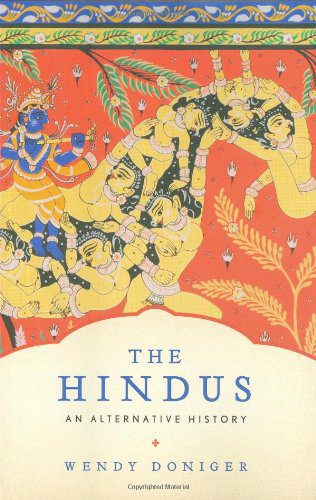 contested in recent decades. Most recently, a New York Times headline read, “Penguin Withdraws Book by American Scholar of Hinduism to Settle Lawsuit.” The book in question is The Hindus: An Alternative History by Wendy Doniger. And perhaps it is important to note that Dr. Doniger is not a fly-by-night scholar. She is the Mircea Eliade Distinguished Service Professor of the History of Religions at the University of Chicago. In addition to earning a masters and Ph.D. at Harvard, she has a D.Phil. from Oxford, and has published more than 30 books. And while such renown does not put her beyond questioning, it does make the destruction of her scholarship by a major publisher a serious concern. I should add, however, that the book is only banned in India. You can still buy it in the U.S. — although be forewarned, it weighs in at 800 pages. Coincidentally, Dr. Doniger has a new book being published tomorrow by Oxford University Press titled On Hinduism, and I can only hope that all this controversy leads to unprecedented book sales and interest in her ongoing scholarship. Fascinatingly, even as her previous book is being pulped, this new book is already (not yet published in the U.S.) is in its second printing in India.
At issue is less Doniger’s scholarship and more Section 295a of the Indian penal code, which outlaws acts “intended to outrage religious feelings.” But Dr. Doniger may have the last laugh. On her side is the demonstrably pluralistic history of the Hindu tradition, and she has an ideal vehicle to underscore that truth as the editor of the Hinduism section of The Norton Anthology of World Religions, a 4,000 page volume due to be published this November. As she says clearly, “It’s not me, I’m collecting these texts. It’s the texts these people won’t like. I’ve made a point of putting in a lot of them, so people will see Hinduism is…what I say it is” — a diverse, polymorphic, multi-layered tapestry of beliefs and practices. As a Washington Postarticle put it:
According to Hindu nationalists, there is one unchanging and eternal Hinduism, which just so happens to be their own. Doniger’s alternative history, which heeds the voices of women and Dalits (”untouchables”) and observes changes in the tradition over time, shows that there are nearly as many Hinduisms as there are Hindus. To her, Hinduism is a polyphonic symphony. To [the Hindu fundamentalists behind the law suit], it is one note, played over and over again…. [T]his is not a victory for ‘Hinduism’ over its American despisers. It is a victory of one group of Hindus over another”
And to consider the larger context, this most recent pulping of Dr. Doniger’s books is part of a larger trend that goes back to the banning in India a few decades ago of Salman Rushdie’s novel The Satanic Verses and continuing through to the attacks on the scholarship of Wendy Doniger’s doctoral student Jeffrey Kripal (who may be my current favorite religion scholar) and who wrote a brilliant psychoanalytic study of Ramakrishna. (I’ll explore that controversy in the fourth part of this series.)
I mentioned earlier, for example, that I was intentionally using the term Hindu tradition instead of Hinduism because Hinduism is a particularly contested and problematic term. There’s a reason, for example, that Doniger’s controversial book is titled “The Hindus: An Alternative History.” Notice the all-important pluralization of the word Hindu. There was not (and never has been) — despite fundamentalist claims the contrary — one, pure Hindu tradition. There was original diversity.
For similar reasons, Bart Ehrman gave his bestselling book about the heresies of the Christian tradition the plural title Lost Christianities. Or as the Harvard historian of religion Karen King puts it:
The beginning is often portrayed as the ideal to which Christianity should aspire and conform. Here Jesus spoke to his disciples and the gospel was preached in truth. Here the churches were formed in the power of the Spirit and Christians lived in unity and love with one another…. But what happens if we tell the story differently? What if the beginning was a time of grappling and experimentation? What if the meaning of the gospel was not clear and Christians struggled to understand who Jesus was…?
In the beginning, diversity.
And that messy reality is even more true for the Hindus than for Jews and Christians. And in the face of that truth, there is a delicious boldness in Doniger’s decision to name her latest 600-page book On Hinduism. As she says playfully, “The name ‘Hinduism’ that we now use is of recent and European construction. But it is Eurocentric to assume that when Europeans made the name they made the game.” Hinduism is a term that European colonialists imposed on the wide diversity of cultural groups living in and around the Indus River, but there were overlapping religious practices and sensibilities these diverse groups shared prior to the Europeans arrived. But whereas the European colonialists sought to classify these people groups by religion, these same people living around the Indus River tended to divide themselves not by religion, but “on the basis of locality, language, caste, occupation, and sect.” That continues to be the case today, although to confuse the matter Hindu has become “the word that most Hindu do use now to refer to themselves.”
We well-intentioned religious progressives do well to known that there are literal and metaphorical land mines out there in the world of religious pluralism. Being aware of these controversial areas can lesson the chances of unintentionally repeating the offenses of European colonialism — of treating a world religion as ours to use in whatever way we want on our terms without respecting the history, heritage, and original adherents of that faith. At the same time, the banning of Doniger’s important scholarship is a reminder that we make a mistake in the opposite direction if we allow fundamentalists to referee inter-religious interaction, allowing them to prevent to positive parts that can come from diverse cultures interacting.
To give an ironic example of the odd interplay of these dynamics, yoga as we know it today is arguably a product of the colonialist blending of cultures. Although some of the philosophic principles of yoga go back millennia, “Contemporary postural yoga was invented in India in the nineteenth century…. And transnational yoga is “compounded of the unlikely mix of British body-building and physical culture, American transcendentalism and Christian science, naturopathy, Swedish gymnastics and the YMCA, grated onto a rehabilitated form of postural yoga.”Again, as is almost always the case, the truth behind the history of religious beliefs and practices is complex and messy.
To give you another example of that sort of unintended, ironic twists that life sometimes brings, Professor Doniger tells the story of how she stumbled backward into navigating these treacherous intercultural waters at the intersection of Hinduism and Western world. She writes:
One of the many reasons why I took up the study of ancient Hinduism and Sankrit as a freshman at Radcliffe in 1958 was to…avoid politics, to hide in an arcane subject…. [M]y reasoning seems to have resembled that of the man who, in the 1930s, realized that a great war was gathering in Europe and decided to escape it by moving to a far-off place no one had heard of or cared about — Iwo Jima (smack in the middle of the South Pacific theater of war).
And regarding an incident more than a decade before this current book banning in which a Hindu fundamentalist threw an egg at her during a lecture — “(He missed.)” — Doniger says that,
The Sanskrit texts [cited in my lecture] were written at a time of glorious sexual openness and insight, and I have often focused on precisely those parts of the texts… The irony is that I have praised these texts and translated them in such a way that many people outside the Hindu tradition — people who would otherwise go on thinking that Hinduism is nothing but a caste system that mistreats the Untouchables — have come to learn about it and to admire the beauty, complexity and wisdom of the Hindu texts…. To the accusation that I cited a part of the Hindu textual tradition that one Hindu “had never heard of,” my reply was: “Yes! And it’s my intention to go on doing just that.”
She concludes, “After half a century of studying and engaging with Hinduism, I’m not about to be silenced by a few (bad) eggs.”
I should also add that my own explorations of the Hindu tradition from a progressive perspective has resulted in an experience similar (but on a much smaller scale) to that of Doniger and Kripal of stumbling backward into a crowd of Hindu fundamentalists. In 2012, my editor at Patheos asked me to review a book on my blog by an author, who I later came to discover is a Hindu fundamentalist with a rabid cohort of Internet defenders. After three days in which more than thirty-five lengthy comments were posted, it soon became clear that I was talking in circles with my fundamentalist interlocutors. I kept up for posterity the comments that had been posted to that point, then closed the comments section on that particular post. I’m a big supporter of interfaith dialogue, but genuine dialogue requires an openness, a vulnerability, a willingness to potentially be persuaded. The opposite of genuine dialogue is a two non-intersecting monologues. Engaging in that sort of debate makes me feel like I’m beating my head against a wall: the wall is unaffected, but my head begins to hurt.
The invitation is to find a way — not always easy and not always even possible in the short run — to transcend the terms of closed debate into a vulnerability that unexpectedly opens the heart of both yourself and the other:
[They] drew a circle that shut me out —
Heretic, rebel, a thing to flout.
But love and I had the wit to win:
We drew a circle and took [them] In!
Related Posts
Notes
- “Are Hindus monotheists or polytheists?” — Wendy Doniger, On Hinduism, 10.
- “converted the emperor of India to Christianity” — Doniger, 15.
- “Shiva — does indeed play die, and cheats” — Doniger 33, fn xxi.
- “Hindu Trinity” — Doniger, “Three (or More) Forms of the Three (or More)-fold Path in On Hinduism, 21-35.
- Guide to reading the Gita — Ram Dass, Paths to God: Living the Bhagavad Gita, 9-10.
- Karen King, The Gospel of Mary Magdala, 158.
- “‘Hinduism’ that we now use is of recent and European construction” — Doniger, 3.
- “Hinduism is a term that European colonialists imposed” — Doniger, 6-7.
- “Contemporary postural yoga” — Doniger, 120.
- “I took up the study of ancient Hinduism and Sankrit” —Doniger, 572.
- “The Sanskrit texts” — Doniger, 573-4.
- “After half a century of studying” — Doniger, 576.
The Rev. Dr. Carl Gregg is a trained spiritual director, a D.Min. graduate of San Francisco Theological Seminary, and the minister of the Unitarian Universalist Congregation of Frederick, Maryland. Follow him on Facebook (facebook.com/carlgregg) and Twitter (@carlgregg).
Learn more about Unitarian Universalism:
http://www.uua.org/beliefs/principles
Previous Post

February 17, 2014
"Atheism for Lent": The Spiritual Practice of Doubt
Next Post
March 11, 2014 Becoming a Buddha, not a Buddhist
Browse Our Archives
Select a Category Advent Anti-Racism Archaeology Atheism Baptism Best of the Year List Book Reviews Buddhism Catholicism Christian Education Church and State Church Planting Climate Change Conscientious Objection to War Creation Spirituality Death Penalty Didache Disability Rights Discernment Easter Ecology Emergent Church Movement Empire-Critical Ethics Evolution Feminist Theology Film Reviews Gandhi Gospel of Mark Gun Control Hinduism Immigration Reform Interfaith Islam JFK Judaism Jungian Spirituality Lectionary Commentary Lent Letters to the Editor LGBT Marriage MLK Multiculturalism Mysticism Nonviolent Activism Occupy Paganism (Earth-centered Religions) Parables Paul Pluralism Politics Process Theology Quantum Physics Requiescat In Pace Seminary and Divinity School Sermon Series Retrospective Sermons Spiritual Direction Spiritual Practices Stewardship (Fundraising) The Book of J The Wheel of the Year (Paganism) Theoblogger Challenge Triathlon Uncategorized Unitarian Universalism Worship Resources Youth Ministry
Select a Month July 2026 May 2026 March 2026 November 2025 October 2025 August 2025 February 2025 December 2024 October 2024 March 2024 January 2024 December 2023 November 2023 March 2023 February 2023 January 2023 December 2022 November 2022 August 2022 March 2022 February 2022 January 2022 December 2021 September 2021 August 2021 July 2021 June 2021 May 2021 February 2021 January 2021 December 2020 August 2020 June 2020 May 2020 April 2020 March 2020 February 2020 January 2020 December 2019 November 2019 October 2019 September 2019 July 2019 June 2019 March 2019 February 2019 January 2019 December 2018 November 2018 October 2018 September 2018 June 2018 May 2018 April 2018 March 2018 February 2018 January 2018 December 2017 November 2017 October 2017 September 2017 August 2017 July 2017 June 2017 May 2017 April 2017 March 2017 February 2017 January 2017 December 2016 November 2016 October 2016 September 2016 August 2016 June 2016 May 2016 April 2016 March 2016 February 2016 January 2016 December 2015 November 2015 October 2015 September 2015 August 2015 July 2015 June 2015 May 2015 April 2015 March 2015 February 2015 January 2015 December 2014 November 2014 October 2014 August 2014 July 2014 June 2014 May 2014 April 2014 March 2014 February 2014 January 2014 December 2013 November 2013 October 2013 September 2013 August 2013 July 2013 June 2013 May 2013 April 2013 March 2013 February 2013 January 2013 December 2012 November 2012 October 2012 September 2012 August 2012 July 2012 June 2012 May 2012 April 2012 March 2012 February 2012 January 2012 December 2011 November 2011 October 2011 September 2011 August 2011 July 2011 June 2011 May 2011 April 2011 March 2011 February 2011 January 2011 December 2010 November 2010 October 2010 August 2009 July 2009 May 2009
Follow Us!
TAKE THE
Religious Wisdom Quiz
True or False: The parable of the Prodigal Son appears only in Luke's Gospel.
Select your answer to see how you score.
FALSE TRUE
Related posts from Carl Gregg

Did the Exodus Happen? And What It Means...

Reading the Same Text Differently with Jews &...

Tectonic Shifts in the Global Religious Landscape since...
Scientific Rigor and Spiritual Evolution: The Work of...
TRENDING AT PATHEOS More Voices

Reading America at 250: A Nation Wrestles With...
As part of my own reflection on the 250th anniversary of the...

Whenever I am reading a book or listening to an argument, I...

President Trump Ban Animal Torture Videos on Facebook
Call for Stricter Regulations of Animal Abuse Content on Facebook Although President...

Draft Amendments to Address Ritual Abuse in New...
The proposed changes would make it illegal for individuals in domestic partnerships...

How Bans on LGBTQ+ Student Clubs Threaten Religious...
On June 20, 2025, the State of Texas passed Senate Bill 12....

The Truth About the Gen Z Revival
This past year, there has been a lot of media buzz surrounding...
view all More Voices blogs
Ad-Free & Subscriber Log-In Subscription Support
- About Us
- 2026 Calendar
- Videos
- Podcasts
- Library of World Religions
- Faith In Media Tracker
- Advertise With Us
- Write for Us
- Privacy Policy
- Terms of Service
- Do Not Sell My Data
- Contact Us
- Radiant Digital
- Manage Newsletter Subscriptions
- Unsubscribe From Notifications
- Sitemap
Copyright 2008-2026, Patheos. All rights reserved.
Subscription Support Ad-Free & Subscriber Log-In
Follow Patheos