
BuddhistCatholicContemplativeEvangelicalGeneral ChristianHinduJewishLatter-day SaintMuslimNew VisionsProgressive Christian
Beliefs
- Buddhist
- Catholic
- Contemplative
- Evangelical
- General Christian
- Hindu
- Jewish
- Latter-day Saint
- More Voices
- Muslim
- New Visions
- Pagan
- Progressive Christian
Topics
- Religion News
- Food and Religion
- Sports and Religion
- Religious Art
- Religious Music and Entertainment
- Religious Events
- History and Religion
- Style and Religion
- Politics and Religion
- Women in Religion
- Recreation Outdoors and Religion
- Business Finance and Religion
- Careers Workplace and Religion
- Education and Religion
- Family Parenting and Religion
- Health Fitness and Religion
- Home and Religion
- Relationships and Religion
- Technology and Religion
- Travel and Religion
Columnists
- Buddhist Columnists
- Business Finance and Religion Columnists
- Careers Workplace and Religion Columnists
- Catholic Columnists
- Contemplative Columnists
- Education and Religion Columnists
- Evangelists Columnists
- Family Parenting and Religion Columnists
- General Christian Columnists
- Health Fitness and Religion Columnists
- Hindu Columnists
- History and Religion Columnists
- Home and Religion Columnists
- Jewish Columnists
- More Voices Columnists
- Latter Day Columnists
- Muslim Columnists
- New Visions Columnists
- Nonreligious Columnists
- Pagan Columnists
- Politics and Religion Columnists
- Progressive Columnists
- Recreation Outdoors and Religion Columnists
- Relationships and Religion Columnists
- Religion News Columnists
- Religious Art Columnists
- Religious Events Columnists
- Religious Music and Entertainment Columnists
- Sports and Religion Columnists
- Style and Religion Columnists
- Technology and Religion Columnists
- Travel and Religion Columnists
- Women in Religion Columnists
Resource Library
- 2026 Calendar
- Library of World Religions
- The 100 Most Holy Places on Earth
- Patheos Answers
- Podcasts
- Videos
- Faith Leaders Database
- Anglican Episcopalian
- Bahai
- Baptist
- Buddhism
- Christianity
- Confucianism
- Eastern Orthodoxy
- Hinduism
- Holiness and Pentecostal
- ISKCON
- Islam
- Judaism
- Lutheran
- Methodist
- The Church of Jesus Christ of Latter-day Saints
- New Age
- Paganism
- Presbytarian and Reformed
- Protestantism
- Religion Behind the Scenes
- Roman Catholic
- Scientology
- Shia Islam
- Sikhism
- Sufism
- Sunni Islam
- Taoism
- Zen
- See all religions
Research Tools
 Ad-Free & Subscriber Log-In Subscription Support
Ad-Free & Subscriber Log-In Subscription Support
Follow Patheos 

- Trending:
- Forgiveness
- |
- Marriage
- |
- Consciousness
- |
- Death Penalty
- |
- Election
- |
- Halloween

- Home
- More Voices
- Evolutionary Religion
Evolutionary Religion
Last updated on: February 10, 2014 at 11:11 am by Carl Gregg
Evolutionary Religion 2014-02-10T11:11:32-05:00 Carl Gregg
Patheos Explore the world's faith through different perspectives on religion and spirituality! Patheos has the views of the prevalent religions and spiritualities of the world.
A tradition has arisen in many progressive congregations of having a worship service near Charles Darwin’s birthday (February 12) with an annual focus on the ways that evolution impacts, influences, and informs the practice of religion in the twenty-first century. A related tradition around Darwin’s birthday is an annual surge in “Religion versus Science” stories across all forms of media. For the most part, these “Religion versus Science” debates produce more heat than light.
The most prominent example I’ve seen this year is the debate last week at the Creation Museum in Kentucky between Ken Ham, a Biblical literalist and young-Earth Creationist, versus Bill Nye “the Science Guy.” At this point I have seen so many similar debates that I could not muster any interest in this one. But don’t get me wrong, the challenge of integrating scientific evolution with traditional religion is a tremendously important intellectual challenge, but it was the great challenge of the late nineteenth- and early twentieth-century. Here in the early twenty-first century, we find ourselves living more than 150 years after the publication in 1859 of Darwin’s landmark book On the Origin of Species by Means of Natural Selection.
In the words of one snarky blog post, “According to a [2012] Gallup poll, 46% of Americans believe in Creationism, 32% of Americans believe in God-guided evolution, and 15% of Americans are actually right.” (I warned you this particular blogger was sarcastic.) Briefly on that middle category of “God-guided evolution,” it all depends on what you mean by the word “God,” and I’ve posted previously on the subject of “Do We Need a Moratorium on the Word ‘God,’” but I need to set those concerns aside for today. Suffice it to say for the focus of this post, the fact that “46% of Americans believe in Creationism” is a compelling reason to continue having these “Religion versus Science” debates, although I worry about the problem of false equivalency: that by putting a Creationist behind a podium on one side of the stage across from a legitimate scientist that one has already elevated the Creationist position to a much higher position than it deserves, making it appear to be a serious intellectual alternative to the scientific theory of evolution, when it is not.
At the same time, evolution has a public relations problem. Those who believe in the value of both religion and science need to do a better job of publicly showing that a robust, life-giving “Evolutionary Religion” is both desirable and possible. As one commentator on this most recent Creation vs. Evolution debate said, Ken Ham, president of the $27 million dollar Creation Museum — as well as others in the camp of biblical literalism and young-Earth Creationism — are most “insidiously wrong on one important aspect: [Ham] insists evolution is anti-religious. But it’s not; it’s just anti-his-religion.” Evolution does undermine religious fundamentalism, but that’s a good thing.
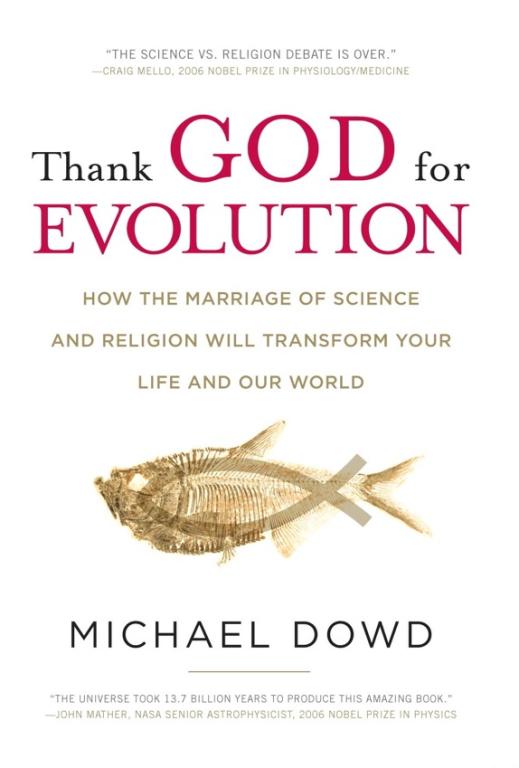 The Rev. Michael Dowd, a former pastor in the progressive Christian denomination the United Church of Christ is a self-proclaimed “itinerant evolutionary evangelist.” In his provocatively titled book Thank God for Evolution, he makes an important distinction between flat-earth religion and evolutionary religion. Dowd defines flat-earth religion as
any perspective in which the metaphors and theology still in use came into being…when there was no reliable way for humans to comprehend the world around them by means of science-based public revelation. Religious traditions that are scripturally based, and whose texts have not changed substantially since the time of Copernicus, Galileo, Newton, Darwin, Einstein, Hubble, Crick, Dawkins, and Hawking become, necessarily, flat-earth faiths when interpreted literally.
As a shorthand, I like to think of flat-earth faiths as B.C. not “Before Christ,” but “Before Copernicus.”
Before preceding, I should perhaps also add that in drawing a distinction between flat-earth faith and evolutionary religion, I am by no means saying that we should abandon all the metaphors and theology that arose “Before Copernicus.” There are many compelling reasons and appropriate times to take ancient theologies seriously, metaphorically, and archetypally, but we often go awry when flat-earth metaphors and theories are taken literally. And, for now, setting aside flat-earth faith, I would like to spend some time exploring the notion that a robust, life-giving “Evolutionary Religion” is both desirable and possible.
To give Evolutionary Religion the public image it needs and deserves — as a robust, meaningful, life-giving alternative to flat-earth faith — a vital step is learning to better claim and proclaim humanity’s place on the current cusp of our 13.7 billion-year-old Universe Story in way that is attractive and compelling for the “46% of Americans [who] believe in Creationism,” many of whom also have been erroneously sold the myth that religion and science are incompatible.
Let me begin with setting the stage of how we can begin to conceptually grasp that immensity of big history and deep time in order to cultivate an evolutionary consciousness worthy of the cosmic scope in which we find ourselves. David Christian, a history professor at San Diego State University, in his book Maps of Time: An Introduction to Big History,
has the ingenious idea of collapsing the history of the universe by a factor of 1 billion, so that each billion years is reduced to one year as a way of giving human meaning to those vast expanses of time. Thus the big bang, beginning the universe, began 13.5 years ago; the sun and solar system, 4.5 years ago; the first living organisms on earth, single-cell organisms, between 4 and 3.5 years ago; multicellular organisms, 7 months ago; Homo sapiens, about 50 minutes ago; agricultural communities, 5 minutes ago; and the great explosion of science and technology, in the midst of which we live, within the last second. Out of the 13.5 “years” of the life of the universe, historians have devoted themselves to the last 3 minutes and mostly to the last minute or less….
One of the lessons some philosophers take from this Big History perspective is that we human beings are radically decentered from the way we used to be able to think about ourselves as being at the center of the universe in those Creation stories that are “B.C.” (“Before Copernicus”).
Moreover, even after Copernicus, even after his 1543 publication of On the Revolution of the Heavenly Spheres, there was so much we didn’t (and still don’t) know. Dowd writes:
Consider that a hundred years ago we had no idea that atoms were created in the bellies of stars, nor that our Sun was a third- or fourth-generation star. We also didn’t know that stars were organized into galaxies. Even two decades ago, before the Hubble Space telescope, we could not have conceived that galaxies number a quarter of a trillion! [For many you,] your grandparents and great-grandparents did not know that the continents slowly slide around the Earth on vast tectonic plates, nor that genetic information is stories within the architecture of a double helix molecule.
We need Evolutionary Religion that is dynamic, changing, and evolving — what some call an “Ancient-Future” Religion that reaches back to retrieve the best of what has come before from the world’s religious traditions and is open to the best insights of modern knowledge. My own tradition of Unitarian Universalism is not the only way of exploring Evolutionary Religion, but it is one robust way.
To that end, allow me to briefly say a bit more about how we can talk about Evolutionary Religion in a way that is both compelling and attractive to many if not to all. First of all, there is an attraction in honesty — in responding to the truth of twenty-first century science with openness and curiosity not with a reactionary fear of change. And there is good news even in the radical decentering of humans. Realizing that we are not the height of creation or the center of the universe — and responding with an increased humility — is a good and desirable view if there is to be a future for our species on this one planet.
As I’ve heard it said, Darwin invited us to see that, “We humans are not a little lower than the angels, but only a little higher than the apes.” Indeed, a study published in 2002 on “Functional DNA in Humans and Chimpanzees Shows They are More Similar to Each Other than Either Is to Other Apes” notes that
we share over 99 percent of our genes with the chimpanzees…and “a movement is emerging in the scientific community to recognize the close evolutionary relationship between humans and chimpanzees by placing them in the same genus, which by the rules of zoological nomenclature must be Homo
as in Homo sapiens, the scientific name for our species. The good news of this scientific revelation is how deeply a part of nature we are. And this close kinship with other animals makes the importance of our UU Seventh Principle all the more clear: “Respect for the interdependent web of all existence of which we are a part.” I would even go so far as to say that Darwin’s decentering of humanity and the related realization that we are only a little higher than the apes makes the claim about interdependence we explored last week from Dr. Martin Luther King, Jr. all the more expansive and profound: regarding not only our fellow human beings, but also all of nature on this one earth, “We are caught in an inescapable network of mutuality, tied in a single garment of destiny. Whatever affects one directly, affects all indirectly.” That’s good news. That’s Evolutionary Religion we can believe in for the twenty-first century.
In the same breath, however, we must also name that the overall failure of our species since the Industrial Revolution to recognize and take responsibility for our interdependence with nature and to respect that we are “tied in a single garment of destiny” has resulted in human-caused climate change that poses a dire threat to our future. There is an increasing use of the term “Anthropocene” (similar to the word anthropology for the study of humans) to describe a new era of geologic time in which the dominant force shaping the Earth is humanity.
To help mitigate the coming climate crisis from the perspective of Evolutionary Religion, Michael Dowd likes to point out that everything in the universe is made from the same basic material. So there is a real sense in which we humans “are stardust evolved to the place that it can now think about itself and tell its own story.” Dowd continues by relaying a story that instead of responsibly living in light of our interdependence,
we are inadvertently destroying our larger body [the Earth] because we lack evolutionary guidance. We’re acting like cancer cells, rather than immune cells…. A cancer cell is a normal cell that…loses its genetic memory. Cut off from the wisdom of millions of years of developmental guidance, it stops cooperating with the rest of the body. It experiences itself as separate from the body, overpopulates, and proceeds to consume the very organisms that support it…. We call our society a consumer society, and to consume something is to eat it up, right? [W]e are consuming the planet because, like cancer cells, we’ve been trying to live without evolutionary wisdom…. [The invitation is to] assume an entirely new role within the body of Life — as an immune system, searching out problem areas and protecting our communities.
The choice is up to us. And the stories we choose to tell — flat-earth stories or evolutionary stories — help shape whether or not we will leave behind a world that is hospitable a few generations hence.
The challenge of integrating scientific evolution with traditional religion was the great challenge of the late nineteenth- and early twentieth-century. Here in the early twenty-first century our challenge is to face the reality of Big History — 13.7 billion year-old big, 400 billion galaxies big. And we are called to face the reality of Big History with what Dowd calls “Big Integrity”:
seeing our place in the universe with “Deep-time eyes,”
embracing the world with a “Global Heart,”
experiencing the expanse of the universe in a spirit of awe worthy of the vast cosmos.
I’m grateful to be with so many of you on the journey of Evolutionary Religion.
Notes
- flat-earth religion and evolutionary religion — Michael Dowd’s uses the terms “flat-earth faith” and “evolutionary faith” in Thank God for Evolution, 73.
- mahakapala — Robert Bellah, Religion in Human Evolution: From the Paleolithic to the Axial Age, 620.
- The summary paragraph of David Christian’s Maps of Time: An Introduction to Big History (502-503) is from Bellah, 51.
- Consider that a hundred years ago — Dowd, 50.
- “we share over 99 percent of our genes” — Quoted in Bellah, 121.
- “stardust evolved to the place that is can now think about itself” — Dowd, 53.
- “we are inadvertently destroying our larger body” — Dowd, 291-292.
For Further Reading
Carl Gregg, “Why Is There Something Instead of Nothing?” (March 4, 2013), available at http://www.patheos.com/blogs/carlgregg/2013/03/why-is-there-something-instead-of-nothing/.
The Rev. Dr. Carl Gregg is a trained spiritual director, a D.Min. graduate of San Francisco Theological Seminary, and the minister of the Unitarian Universalist Congregation of Frederick, Maryland. Follow him on Facebook (facebook.com/carlgregg) and Twitter (@carlgregg).
Learn more about Unitarian Universalism:
http://www.uua.org/beliefs/principles
Previous Post

February 3, 2014
"Seneca Falls, Selma, Stonewall": Claiming Our Social Justice Story
Next Post
February 17, 2014 "Atheism for Lent": The Spiritual Practice of Doubt
Browse Our Archives
Select a Category Advent Anti-Racism Archaeology Atheism Baptism Best of the Year List Book Reviews Buddhism Catholicism Christian Education Church and State Church Planting Climate Change Conscientious Objection to War Creation Spirituality Death Penalty Didache Disability Rights Discernment Easter Ecology Emergent Church Movement Empire-Critical Ethics Evolution Feminist Theology Film Reviews Gandhi Gospel of Mark Gun Control Hinduism Immigration Reform Interfaith Islam JFK Judaism Jungian Spirituality Lectionary Commentary Lent Letters to the Editor LGBT Marriage MLK Multiculturalism Mysticism Nonviolent Activism Occupy Paganism (Earth-centered Religions) Parables Paul Pluralism Politics Process Theology Quantum Physics Requiescat In Pace Seminary and Divinity School Sermon Series Retrospective Sermons Spiritual Direction Spiritual Practices Stewardship (Fundraising) The Book of J The Wheel of the Year (Paganism) Theoblogger Challenge Triathlon Uncategorized Unitarian Universalism Worship Resources Youth Ministry
Select a Month July 2026 May 2026 March 2026 November 2025 October 2025 August 2025 February 2025 December 2024 October 2024 March 2024 January 2024 December 2023 November 2023 March 2023 February 2023 January 2023 December 2022 November 2022 August 2022 March 2022 February 2022 January 2022 December 2021 September 2021 August 2021 July 2021 June 2021 May 2021 February 2021 January 2021 December 2020 August 2020 June 2020 May 2020 April 2020 March 2020 February 2020 January 2020 December 2019 November 2019 October 2019 September 2019 July 2019 June 2019 March 2019 February 2019 January 2019 December 2018 November 2018 October 2018 September 2018 June 2018 May 2018 April 2018 March 2018 February 2018 January 2018 December 2017 November 2017 October 2017 September 2017 August 2017 July 2017 June 2017 May 2017 April 2017 March 2017 February 2017 January 2017 December 2016 November 2016 October 2016 September 2016 August 2016 June 2016 May 2016 April 2016 March 2016 February 2016 January 2016 December 2015 November 2015 October 2015 September 2015 August 2015 July 2015 June 2015 May 2015 April 2015 March 2015 February 2015 January 2015 December 2014 November 2014 October 2014 August 2014 July 2014 June 2014 May 2014 April 2014 March 2014 February 2014 January 2014 December 2013 November 2013 October 2013 September 2013 August 2013 July 2013 June 2013 May 2013 April 2013 March 2013 February 2013 January 2013 December 2012 November 2012 October 2012 September 2012 August 2012 July 2012 June 2012 May 2012 April 2012 March 2012 February 2012 January 2012 December 2011 November 2011 October 2011 September 2011 August 2011 July 2011 June 2011 May 2011 April 2011 March 2011 February 2011 January 2011 December 2010 November 2010 October 2010 August 2009 July 2009 May 2009
Follow Us!
TAKE THE
Religious Wisdom Quiz
What did the angel tell Mary she would name her son?
Select your answer to see how you score.
John Jesus Peter Immanuel
Related posts from Carl Gregg

Peak Spiritual Experiences, Psychedelics, & Consciousness Research

Why Peter Singer Hates on Guide Dogs &...

"How the Founding Fathers Became Infallible and Our...

Vampires, Witches, & NPR: The Legacy of Margot...
TRENDING AT PATHEOS More Voices

Reading America at 250: A Nation Wrestles With...
As part of my own reflection on the 250th anniversary of the...

Whenever I am reading a book or listening to an argument, I...

President Trump Ban Animal Torture Videos on Facebook
Call for Stricter Regulations of Animal Abuse Content on Facebook Although President...

Draft Amendments to Address Ritual Abuse in New...
The proposed changes would make it illegal for individuals in domestic partnerships...

How Bans on LGBTQ+ Student Clubs Threaten Religious...
On June 20, 2025, the State of Texas passed Senate Bill 12....

The Truth About the Gen Z Revival
This past year, there has been a lot of media buzz surrounding...
view all More Voices blogs
Ad-Free & Subscriber Log-In Subscription Support
- About Us
- 2026 Calendar
- Videos
- Podcasts
- Library of World Religions
- Faith In Media Tracker
- Advertise With Us
- Write for Us
- Privacy Policy
- Terms of Service
- Do Not Sell My Data
- Contact Us
- Radiant Digital
- Manage Newsletter Subscriptions
- Unsubscribe From Notifications
- Sitemap
Copyright 2008-2026, Patheos. All rights reserved.
Subscription Support Ad-Free & Subscriber Log-In
Follow Patheos