
BuddhistCatholicContemplativeEvangelicalGeneral ChristianHinduJewishLatter-day SaintMuslimNew VisionsProgressive Christian
Beliefs
- Buddhist
- Catholic
- Contemplative
- Evangelical
- General Christian
- Hindu
- Jewish
- Latter-day Saint
- More Voices
- Muslim
- New Visions
- Pagan
- Progressive Christian
Topics
- Religion News
- Food and Religion
- Sports and Religion
- Religious Art
- Religious Music and Entertainment
- Religious Events
- History and Religion
- Style and Religion
- Politics and Religion
- Women in Religion
- Recreation Outdoors and Religion
- Business Finance and Religion
- Careers Workplace and Religion
- Education and Religion
- Family Parenting and Religion
- Health Fitness and Religion
- Home and Religion
- Relationships and Religion
- Technology and Religion
- Travel and Religion
Columnists
- Buddhist Columnists
- Business Finance and Religion Columnists
- Careers Workplace and Religion Columnists
- Catholic Columnists
- Contemplative Columnists
- Education and Religion Columnists
- Evangelists Columnists
- Family Parenting and Religion Columnists
- General Christian Columnists
- Health Fitness and Religion Columnists
- Hindu Columnists
- History and Religion Columnists
- Home and Religion Columnists
- Jewish Columnists
- More Voices Columnists
- Latter Day Columnists
- Muslim Columnists
- New Visions Columnists
- Nonreligious Columnists
- Pagan Columnists
- Politics and Religion Columnists
- Progressive Columnists
- Recreation Outdoors and Religion Columnists
- Relationships and Religion Columnists
- Religion News Columnists
- Religious Art Columnists
- Religious Events Columnists
- Religious Music and Entertainment Columnists
- Sports and Religion Columnists
- Style and Religion Columnists
- Technology and Religion Columnists
- Travel and Religion Columnists
- Women in Religion Columnists
Resource Library
- 2026 Calendar
- Library of World Religions
- The 100 Most Holy Places on Earth
- Patheos Answers
- Podcasts
- Videos
- Faith Leaders Database
- Anglican Episcopalian
- Bahai
- Baptist
- Buddhism
- Christianity
- Confucianism
- Eastern Orthodoxy
- Hinduism
- Holiness and Pentecostal
- ISKCON
- Islam
- Judaism
- Lutheran
- Methodist
- The Church of Jesus Christ of Latter-day Saints
- New Age
- Paganism
- Presbytarian and Reformed
- Protestantism
- Religion Behind the Scenes
- Roman Catholic
- Scientology
- Shia Islam
- Sikhism
- Sufism
- Sunni Islam
- Taoism
- Zen
- See all religions
Research Tools
 Ad-Free & Subscriber Log-In Subscription Support
Ad-Free & Subscriber Log-In Subscription Support
Follow Patheos 

- Trending:
- Forgiveness
- |
- Marriage
- |
- Consciousness
- |
- Death Penalty
- |
- Election
- |
- Halloween

- Home
- More Voices
- “Help, Thanks, Wow,” Part 1 of 3
“Help, Thanks, Wow,” Part 1 of 3
Last updated on: January 29, 2014 at 10:12 am by Carl Gregg
“Help, Thanks, Wow,” Part 1 of 3 2014-01-29T10:12:10-05:00 Carl Gregg
Patheos Explore the world's faith through different perspectives on religion and spirituality! Patheos has the views of the prevalent religions and spiritualities of the world.
This post is the first in a series of three posts inspired by Anne Lamott’s book Help, Thanks, Wow
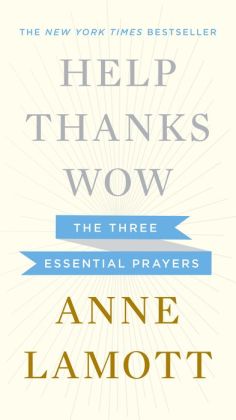 Anne Lamott is a social justice activist and bestselling author, known for her autobiographical books. I first encountered her through a book she published more than a decade ago titled Traveling Mercies: Some Thoughts on Faith, which helped establish her reputation as a provocative and hilarious writer on spirituality.
From that book, one of the lines that resonated most with me was her confession that, “Here are the two best prayers I know: ‘Help me, help me, help me,’ and ‘Thank you, thank you, thank you.’” Given the memorable resonance of that line, I wasn’t surprised that years later she expanded that one sentence into a short book titled, Help, Thanks, Wow: The Three Essential Prayers.
As a whole, I suspect many liberals are more comfortable with the final two of Lamott’s three prayers (“Thanks” and “Wow”) than with the first one (“Help”). The word “prayer” in general, for many people, implies that there is “Someone” or “some aspect of reality” that is affected, impacted, or changed by our prayers, and such claims trigger skeptical alarms for the dedicated rationalists among us.
And back when I was a Progressive Christian minister, one allowance I would make for such concerns, was to be intentional about directing attention to the aspect of our experience that we can control most directly: our actions. Thus, whenever I was asked to pray publicly, I would often insert some version of the following sentence (which is not original to me): “We trust your wisdom, God, concerning how our petitions are to be answered, and show us how we may contribute to alleviating the needs of those for whom we pray.” In other words, to quote a book title from the New Monastic Movement, the invitation is “Becoming the answer to our prayers.”
In that spirit, Pope Francis has awed the world — and was named Time Magazine’s “Person of the Year” — for not only praying to God, but more importantly practicing radical acts of loving kindness for the poor and marginalized. And this vital shift from praying for help to concrete acts of helping others in need invokes Pope Francis’ namesake and recalls the original twelfth-century “Prayer of St. Francis of Assisi,” a prayer, which challenges us even today to do our part to alleviate the needs of those for whom we pray. In the original St. Francis’ words:
Make me an instrument of Your peace;
Where there is hatred, let me sow love;
Where there is injury, pardon;
Where there is error, truth;
Where there is doubt, faith;
Where there is despair, hope;
Where there is darkness, light;
And where there is sadness, joy….
Grant that I may not so much seek To be consoled as to console;
To be understood as to understand;
To be loved as to love….
All this being said, however, my intention is not to duck the question of whether petitionary prayer “works.” Indeed, my observation is that even within the as-a-whole highly liberal Unitarian Universalist movement in which I am involved, many more UUs than you might think find praying for help to be comforting, even efficacious.
As a middle ground, however, I know that many religious progressives find the Quaker saying to be helpful: saying to someone in need that, “I’m holding you in the light.” Regarding the meaning of this saying, the Quaker singer-songwriter Carrie Newcomer writes that,
What is intended by this phrase is to let the person know that in your daily mediation you will hold them in your heart. When I sit in silent prayer or meditation I usually don’t have a lot to “say.” For me silent prayer or meditation is an opening. I open my heart and all the dark places and let in The Light. I try to tune my heart and ears to something other than the noise and distraction of the world. Often this feeling of opening stays with me and I feel it in the simplest moments of my day. So when I say, “I will hold you in the Light” it means I will daily open my heart and send my love and concern into the Light, into the living space around you.…
May we become the answer to our prayers.
May we become an instrument of Peace.
May we always hold one another in the Light.
The Rev. Dr. Carl Gregg is a trained spiritual director, a D.Min. graduate of San Francisco Theological Seminary, and the minister of the Unitarian Universalist Congregation of Frederick, Maryland. Follow him on Facebook (facebook.com/carlgregg) and Twitter (@carlgregg).
Learn more about Unitarian Universalism:
http://www.uua.org/beliefs/principles
Previous Post

January 27, 2014
Why Jung Threw the Yijing (or I Ching) and Why Might You?
Next Post
January 30, 2014 "Help, Thanks, Wow," Part 2 of 3
Browse Our Archives
Select a Category Advent Anti-Racism Archaeology Atheism Baptism Best of the Year List Book Reviews Buddhism Catholicism Christian Education Church and State Church Planting Climate Change Conscientious Objection to War Creation Spirituality Death Penalty Didache Disability Rights Discernment Easter Ecology Emergent Church Movement Empire-Critical Ethics Evolution Feminist Theology Film Reviews Gandhi Gospel of Mark Gun Control Hinduism Immigration Reform Interfaith Islam JFK Judaism Jungian Spirituality Lectionary Commentary Lent Letters to the Editor LGBT Marriage MLK Multiculturalism Mysticism Nonviolent Activism Occupy Paganism (Earth-centered Religions) Parables Paul Pluralism Politics Process Theology Quantum Physics Requiescat In Pace Seminary and Divinity School Sermon Series Retrospective Sermons Spiritual Direction Spiritual Practices Stewardship (Fundraising) The Book of J The Wheel of the Year (Paganism) Theoblogger Challenge Triathlon Uncategorized Unitarian Universalism Worship Resources Youth Ministry
Select a Month July 2026 May 2026 March 2026 November 2025 October 2025 August 2025 February 2025 December 2024 October 2024 March 2024 January 2024 December 2023 November 2023 March 2023 February 2023 January 2023 December 2022 November 2022 August 2022 March 2022 February 2022 January 2022 December 2021 September 2021 August 2021 July 2021 June 2021 May 2021 February 2021 January 2021 December 2020 August 2020 June 2020 May 2020 April 2020 March 2020 February 2020 January 2020 December 2019 November 2019 October 2019 September 2019 July 2019 June 2019 March 2019 February 2019 January 2019 December 2018 November 2018 October 2018 September 2018 June 2018 May 2018 April 2018 March 2018 February 2018 January 2018 December 2017 November 2017 October 2017 September 2017 August 2017 July 2017 June 2017 May 2017 April 2017 March 2017 February 2017 January 2017 December 2016 November 2016 October 2016 September 2016 August 2016 June 2016 May 2016 April 2016 March 2016 February 2016 January 2016 December 2015 November 2015 October 2015 September 2015 August 2015 July 2015 June 2015 May 2015 April 2015 March 2015 February 2015 January 2015 December 2014 November 2014 October 2014 August 2014 July 2014 June 2014 May 2014 April 2014 March 2014 February 2014 January 2014 December 2013 November 2013 October 2013 September 2013 August 2013 July 2013 June 2013 May 2013 April 2013 March 2013 February 2013 January 2013 December 2012 November 2012 October 2012 September 2012 August 2012 July 2012 June 2012 May 2012 April 2012 March 2012 February 2012 January 2012 December 2011 November 2011 October 2011 September 2011 August 2011 July 2011 June 2011 May 2011 April 2011 March 2011 February 2011 January 2011 December 2010 November 2010 October 2010 August 2009 July 2009 May 2009
Follow Us!
TAKE THE
Religious Wisdom Quiz
What is the correct order for putting off the old self and putting on the new self as described in Colossians?
Select your answer to see how you score.
Clothe yourself with compassion, put on the new self, put to death earthly nature, rid yourself of anger Put on the new self, put to death earthly nature, clothe yourself with compassion, rid yourself of anger Put to death earthly nature, rid yourself of anger/rage/malice, take off the old self, put on the new self, clothe yourself with compassion Rid yourself of anger, take off the old self, put to death earthly nature, put on the new self
Related posts from Carl Gregg

Reading America at 250: A Nation Wrestles With...


Andrew Holocek on the Power of Darkness

The Stories That Shape Us: Myths, Archetypes, &...
TRENDING AT PATHEOS More Voices

Reading America at 250: A Nation Wrestles With...
As part of my own reflection on the 250th anniversary of the...

Whenever I am reading a book or listening to an argument, I...

President Trump Ban Animal Torture Videos on Facebook
Call for Stricter Regulations of Animal Abuse Content on Facebook Although President...

Draft Amendments to Address Ritual Abuse in New...
The proposed changes would make it illegal for individuals in domestic partnerships...

How Bans on LGBTQ+ Student Clubs Threaten Religious...
On June 20, 2025, the State of Texas passed Senate Bill 12....

The Truth About the Gen Z Revival
This past year, there has been a lot of media buzz surrounding...
view all More Voices blogs
Ad-Free & Subscriber Log-In Subscription Support
- About Us
- 2026 Calendar
- Videos
- Podcasts
- Library of World Religions
- Faith In Media Tracker
- Advertise With Us
- Write for Us
- Privacy Policy
- Terms of Service
- Do Not Sell My Data
- Contact Us
- Radiant Digital
- Manage Newsletter Subscriptions
- Unsubscribe From Notifications
- Sitemap
Copyright 2008-2026, Patheos. All rights reserved.
Subscription Support Ad-Free & Subscriber Log-In
Follow Patheos