
BuddhistCatholicContemplativeEvangelicalGeneral ChristianHinduJewishLatter-day SaintMuslimNew VisionsProgressive Christian
Beliefs
- Buddhist
- Catholic
- Contemplative
- Evangelical
- General Christian
- Hindu
- Jewish
- Latter-day Saint
- More Voices
- Muslim
- New Visions
- Pagan
- Progressive Christian
Topics
- Religion News
- Food and Religion
- Sports and Religion
- Religious Art
- Religious Music and Entertainment
- Religious Events
- History and Religion
- Style and Religion
- Politics and Religion
- Women in Religion
- Recreation Outdoors and Religion
- Business Finance and Religion
- Careers Workplace and Religion
- Education and Religion
- Family Parenting and Religion
- Health Fitness and Religion
- Home and Religion
- Relationships and Religion
- Technology and Religion
- Travel and Religion
Columnists
- Buddhist Columnists
- Business Finance and Religion Columnists
- Careers Workplace and Religion Columnists
- Catholic Columnists
- Contemplative Columnists
- Education and Religion Columnists
- Evangelists Columnists
- Family Parenting and Religion Columnists
- General Christian Columnists
- Health Fitness and Religion Columnists
- Hindu Columnists
- History and Religion Columnists
- Home and Religion Columnists
- Jewish Columnists
- More Voices Columnists
- Latter Day Columnists
- Muslim Columnists
- New Visions Columnists
- Nonreligious Columnists
- Pagan Columnists
- Politics and Religion Columnists
- Progressive Columnists
- Recreation Outdoors and Religion Columnists
- Relationships and Religion Columnists
- Religion News Columnists
- Religious Art Columnists
- Religious Events Columnists
- Religious Music and Entertainment Columnists
- Sports and Religion Columnists
- Style and Religion Columnists
- Technology and Religion Columnists
- Travel and Religion Columnists
- Women in Religion Columnists
Resource Library
- 2026 Calendar
- Library of World Religions
- The 100 Most Holy Places on Earth
- Patheos Answers
- Podcasts
- Videos
- Faith Leaders Database
- Anglican Episcopalian
- Bahai
- Baptist
- Buddhism
- Christianity
- Confucianism
- Eastern Orthodoxy
- Hinduism
- Holiness and Pentecostal
- ISKCON
- Islam
- Judaism
- Lutheran
- Methodist
- The Church of Jesus Christ of Latter-day Saints
- New Age
- Paganism
- Presbytarian and Reformed
- Protestantism
- Religion Behind the Scenes
- Roman Catholic
- Scientology
- Shia Islam
- Sikhism
- Sufism
- Sunni Islam
- Taoism
- Zen
- See all religions
Research Tools
 Ad-Free & Subscriber Log-In Subscription Support
Ad-Free & Subscriber Log-In Subscription Support
Follow Patheos 

- Trending:
- Forgiveness
- |
- Marriage
- |
- Consciousness
- |
- Death Penalty
- |
- Election
- |
- Halloween

- Home
- More Voices
- Slowing Down for the Holidays
Slowing Down for the Holidays
Last updated on: December 23, 2013 at 10:57 am by Carl Gregg
Slowing Down for the Holidays 2013-12-23T10:57:37-05:00 Carl Gregg
Patheos Explore the world's faith through different perspectives on religion and spirituality! Patheos has the views of the prevalent religions and spiritualities of the world.
The word“holiday,” it turns out, is a conflation of the words “holy” and “day.”You can see the root words visually, of course, by simply turning the “i” in holiday into a “y.” And, indeed, the original intention of a holiday is to celebrate a holy day,a day “set apart” from our normal routine. And at its best, holidays can be a form of sacred time.
Holidays have the potential to be sacramental holy days that reconnect us with the Sacred, the Divine, or the Holy (as we understand and experience the reality toward which those words point). And holidays are a time for reconnection with those we love, those who love us, and our own deepest self. At the same time, as we all know, holidays can also be like opening a big, gift-wrapped box of stress and conflict. So this morning, as we prepare to enter into into the final stretch of the holiday season, I would like to invite us to reflect on the ways we each might be able to to make our respective holidays more authentically holy days of rest, rejuvenation, and reconnection.
Turning back the calendar a month to remind ourselves of one of our most recent national holidays, we saw how the commercialization of the Thanksgiving holiday is making that day increasingly less holy and set-apart, especially for low-income retail workers. And one of my colleagues posted on Facebook that, “In the midst of Black Friday, Small Business Saturday, and Cyber-Monday (what’s next — Credit Debt Tuesday and Loan Consolidation Wednesday?)” That comment invites us to see that choosing to celebrate the holidays as simple, slow, set apart holy days can be one of the most subversive practices you can do to begin resisting the forces of commercialization and commodification that threaten to invade every moment of our lives.
In the 18th-century, Jean Pierre de Caussade (a Jesuit priest, the same order as today’s Pope Francis) wrote a spiritual classic titled The Sacrament of the Present Moment about how being present to the fullness of each present moment can connect us to the sacred depths that infuse every aspect of our life if we slow down enough to notice. Similarly, the late Gerald May, a psychiatrist and spiritual teacher, describes the sacrament of the present moment this way:
one is not lost in memories of the past or fantasies of the future, but is directly conscious of what comes to awareness in the here-and-now. When memories, fears, hopes or plans happen within contemplation, they do not take one out of the moment. Instead, one has a subtle, soft appreciation that they are part of what is happening right now, right here.
The second quality is openness, a simple receptiveness to all the thoughts, feelings, sights, sounds and other perceptions that each moment brings. In contemplation, one is not concentrating, focusing on one “important” thing to the exclusion of other “distracting” things. Nor is one avoiding, denying, or distorting what is given. Instead, there is a gentle willingness to acknowledge whatever comes.
In contrast, however, to the sacrament of the present moment that can transform a holiday (or an ordinary day) 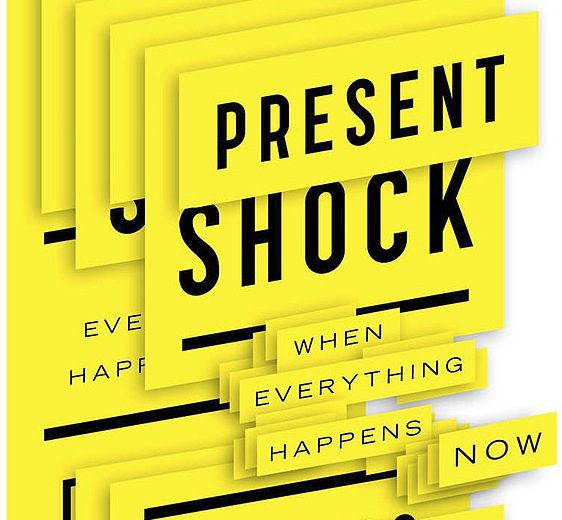 into a holy day, the more common experience of our own time is described in Douglas Rushkoff’s recent book Present Shock: When Everything Happens Now. Rushkoff writes that, “Our society has reoriented itself to the present moment. Everything is live, real time, and always-on. It’s not a mere speeding up…. It’s more a diminishment of anything that isn’t happening right now — and the onslaught of everything that supposedly is” (2). In particular, the deep, extended focus needed for long-term projects that can take us to the next level in our life or work is often increasingly difficult to carve out when we’re constantly distracted with pinging minutiae in the present: a phone call, a text message, an email, a Facebook comment.
And distinct from all the spiritual writing that calls us to mindfully and heart-fully embrace the fullness of each present moment, with all the technological devices and demands on our time, Rushkoff writes,
we are not approaching some Zen state of an infinite moment, completely at one with our surroundings, connected to others, and aware of ourselves on any fundamental level. Rather, we tend to exist in a distracted present, where forces on the periphery are magnified and those immediately before us are ignored. (4)
Whereas the sacrament of the present moment, invites us into a greater fullness, connection, and depth, present shock leaves us distracted, fragmented, and always on the shallow surface of our self. Most distressingly, Rushkoff reports that the 24/7 demands on our time and the ways we have set ourselves up to be potentially called/texted/emailed/Facebooked, etc. at anytime — with no time off — have resulted in a increase in average citizens “experienc[ing] symptoms formerly limited to air traffic controllers and 911 emergency operators” (99). In other words, being “crazy busy” all the time is making us crazy unhealthy.
We all have our different versions of this struggle, part of our life that are easier or harder for us individually in regard to self-care. For me, it’s fairly easy — and I’ve found vitally important for me to avoid exhaustion — to get approximately 8 hours of sleep most nights. (It helps, I’m sure, that Magin and I don’t yet have any children.) But it’s also easy for me, especially if I’m traveling or have a lot of special events in my schedule, to skip exercising or meditating. And I am working on being more intentional about not letting those important components of my long-term health slip — sometimes for days or even weeks at a time — between the cracks of my schedule. As we near the beginning of a new year, what do you need to let go of or prioritize more intentionally for your long-term health or to reconnect to your family, friends, or deepest self?
There’s an old story about a pilgrim visiting a Zen master. The student bows to the master, asks her to teach him the practice of Zen. He then proceeds to ramble on about the many Buddhist sutras he had studied in preparation for meeting with the master. The master listens patiently and then begins to make tea. When it was ready, she pours the tea into the pilgrim’s cup until it begins to overflow and run all over the floor. The would-be student see what is happening and shouts, “Stop, stop! The cup is full; you can’t get anymore in.” The master stops pouring and says: “You are like this cup; you are full of ideas about Buddha’s Way. You come and ask for teaching, but your cup is full; I can’t put anything in. Before I can teach you, you’ll have to empty your cup.” Like the overflowing tea cup that spills messily onto the floor, overcommitting leaves us fragmented, over-saturated, and internally scattered.
In a similar vein to that Zen story, I had an experience a few years ago on a cold day early in January 2009. I entered a classroom in San Anselmo, California for the first day of a program in Art of Spiritual Direction. The director of the program began his opening lecture with these words, “We’re going to start slowly, so that later we can slow down.” I still remember that opening line now, years later, because his invitation to us was so counter-intuitive.
More than 30 of us had traveled from all across the county for the first in a series of three annual three-week intensive residencies. We had completed all our assigned reading in advance, so I expected him to say that we would hit the ground running then sprint to the finish line to make the most of our time together in person. And we did work hard and learn a lot, but there was also a crucial sense in which he was inviting us to experiment with a profoundly counter-cultural perspective: “We’re going to start slowly, so that later we can slow down.” The singer-songwriter Carrie Newcomer expresses a similar sentiment in lyric-form when she confesses that she’s “Been traveling faster than my soul can go.” I suspect many of you can identify with that feeling of “traveling faster than my soul can go.” The holidays are a chance to catch back up with your soul: you inner sense of calm, connection, and peace.
For now I’ll give you just one example of how, during that first three-week intensive, we were challenged to “to start slowly, so that later we can slow down” in order to give ourselves the opportunity to let go of the surface distractions and sink more deeply into the sacrament of the present moment. In this case, we were invited to read the Bible in a particular way, although this same technique could be fruitfully applied to any text you find sacred from any of the world’s religions to poetry to an inspiring scientific insight. In the case of the program I was in, each day in both morning and evening chapel, a scripture was read aloud twice. All the verses were from Acts chapter 16. The catch was that we read only one verse a day. On the first day, we read Acts 16:1. The second day, Acts 16:2 — and so on. I have read the Bible contemplatively before, but moving through Acts 16:1-15 at the pace of one verse each weekday over the course of three weeks was an entirely new way of experiencing scripture.
In our culture, we most often read (or skim) texts for information. But in this case, we were being challenged to read the text not for information, but for formation — not just to glean information about the passage’s historical context, but to be formed by the meaning that emerged from the ways the words and phrases intersected with our life.
So, Monday morning, day one, I’m sitting in chapel, and the scripture is read: “Paul went on also to Derbe and to Lystra, where there was a disciple named Timothy, the son of a Jewish woman who was a believer; but his father was a Greek.” Then we heard it read a second time, followed by a time of silent reflection. That’s it. One verse. And that was far from the oddest verse.
During the closing program, a group of students performed a skit that spoofed this one-verse-a-day practice. The winner of the stupidest scripture was day eight, when the verse was Acts chapter 16, verse eight: “so, passing by Mysia, they went down to Troas.” Hearing anything profound yet? Seriously…notice the voices in your head. You might be hearing, “Where is Mysia? Where is Troas?” Even after eight days, my first reaction to this verse was “Wow. That was short.” My second reaction was to intellectualize the passage with questions of geography. But as I sat with the verse in silence for a full ten minutes, what stood out to me was the phrase, “passing by.” How did Paul and Timothy discern to pass by Mysia and go instead to Troas? More importantly, from there I heard an invitation to reflect on what I was called to pass by in my own life.
And I would argue that I received much more benefit from spending 10 minutes reflecting contemplatively on this one verse of only nine words that I would have gotten from an hour skimming historical commentaries on the whole of Acts 16. Similarly, Dorothy Day, the political activist and co-founder of the Catholic Worker Movement, famously said that as much as she cared passionately about politics, there were times in her life when she only read the newspaper once a week on Sundays. In so doing, she kept up on the major flow of current events without getting lost in the day-to-day rabbit trails that often lead no where and which have become even more common in our 24-hour-a-day news cycle. Day found that this practice freed her to spend time the other days of the week — that she might have spent reading the paper — delving into classic works of literature and studies of classic spiritual works.
From a different perspective, some of you may remember the story from back in 2007 when the world-famous, virtuoso violinist Joshua Bell participated in a social experiment. A hidden camera was set-up, and Bell play a 45-minute concert on his $3.5 million Stradivarius violin starting at 7:51am on Friday, January 12 at L’Enfant Plaza in Washington, D.C. Of the more than a thousand people that passed by, “Twenty-seven gave money, most of them on the run — for a total of $32 and change. That leaves the 1,070 people who hurried by, oblivious, many only three feet away, few even turning to look.” And although I realize that this impromptu concert is anecdotal, I still think about this story periodically as a reminder to slow down and notice all the unexpected beauty there is to savor in this world, and to shift my experience of the world from “present shock” to the sacrament of the present moment. Similarly, regarding the potential of transforming our holidays into holy days, the singer-songwriter David Lamotte writes that “There’s no time like the present, no present like time.” He means, of course, that far more valuable that any present we can buy is the gift of being fully present to our friends and family on holidays that can become for us holy days.
Relatedly, a recent New York Times article was titled, “Step Away From the Phone!” It includes the story of a group of friends who all stack their phones in the middle of the table when they meet at a restaurants so that no one is distracted during the meal, a family who all toss their smart phones into a vintage milk tin when they come home until after dinner, and individuals who have banned digital devices from the bedroom both to avoid distractions during the night and to not have technology be way they start their day. As wonderfully helpful as technology can be, digital detoxing is equally important and even empowering. One high-end party planner reported a trend in banning cell phones during parties except in an area outside beside the smoking area. She says, “Public cellphone use has reached an uncivilized fever pitch, so now it’s chicer behavior to exempt yourself from that. You’re not answerable 24/7, and that’s a powerful and luxurious statement.”
Yesterday was Winter Solstice, the shortest day and longest night of the year, marking the official beginning of winter. And last year about this time, I blogged about “Can You Feel the Wheel of the Year Turning? A Spirituality of Winter.” In that post, I invited you to consider that at this time of year, spiritual practices of darkness, silence, letting go, and saying “No” can be particularly fruitful.
If a spirituality of winter is about the inward journey, when is the last time you spent some quality time with yourself, being attentive to what is going on inside of you? If a spirituality of winter is about simplicity, is there anything you feel led to let go in your life? As we enter fully into the season of bare trees and stark landscapes, we have the opportunity to see the transformation of the external world as an invitation to ask what we need to allow to fall away from our lives.
In this season, are there ways that you feel led to give yourself permission to let go of distractions and experience the sacrament of the present moment? In so doing, may you and yours experience the upcoming holidays as holy days.
Notes: I remember the story about Dorothy Day from reading William Miller’s biography of her life; however, I have been unable to find the reference in my notes about the book. I will continue looking and post the reference when and if I find it. If anyone knows an explicit reference to this story, please let me know.
The Rev. Dr. Carl Gregg is a trained spiritual director, a D.Min. graduate of San Francisco Theological Seminary, and the minister of the Unitarian Universalist Congregation of Frederick, Maryland. Follow him on Facebook (facebook.com/carlgregg) and Twitter (@carlgregg).
Learn more about Unitarian Universalism:
http://www.uua.org/beliefs/principles
Previous Post

December 8, 2013
Best of 2013: Books, Music, Film, and More
Next Post
January 2, 2014 The Promise and Perils of More Yoga in the New Year
Browse Our Archives
Select a Category Advent Anti-Racism Archaeology Atheism Baptism Best of the Year List Book Reviews Buddhism Catholicism Christian Education Church and State Church Planting Climate Change Conscientious Objection to War Creation Spirituality Death Penalty Didache Disability Rights Discernment Easter Ecology Emergent Church Movement Empire-Critical Ethics Evolution Feminist Theology Film Reviews Gandhi Gospel of Mark Gun Control Hinduism Immigration Reform Interfaith Islam JFK Judaism Jungian Spirituality Lectionary Commentary Lent Letters to the Editor LGBT Marriage MLK Multiculturalism Mysticism Nonviolent Activism Occupy Paganism (Earth-centered Religions) Parables Paul Pluralism Politics Process Theology Quantum Physics Requiescat In Pace Seminary and Divinity School Sermon Series Retrospective Sermons Spiritual Direction Spiritual Practices Stewardship (Fundraising) The Book of J The Wheel of the Year (Paganism) Theoblogger Challenge Triathlon Uncategorized Unitarian Universalism Worship Resources Youth Ministry
Select a Month July 2026 May 2026 March 2026 November 2025 October 2025 August 2025 February 2025 December 2024 October 2024 March 2024 January 2024 December 2023 November 2023 March 2023 February 2023 January 2023 December 2022 November 2022 August 2022 March 2022 February 2022 January 2022 December 2021 September 2021 August 2021 July 2021 June 2021 May 2021 February 2021 January 2021 December 2020 August 2020 June 2020 May 2020 April 2020 March 2020 February 2020 January 2020 December 2019 November 2019 October 2019 September 2019 July 2019 June 2019 March 2019 February 2019 January 2019 December 2018 November 2018 October 2018 September 2018 June 2018 May 2018 April 2018 March 2018 February 2018 January 2018 December 2017 November 2017 October 2017 September 2017 August 2017 July 2017 June 2017 May 2017 April 2017 March 2017 February 2017 January 2017 December 2016 November 2016 October 2016 September 2016 August 2016 June 2016 May 2016 April 2016 March 2016 February 2016 January 2016 December 2015 November 2015 October 2015 September 2015 August 2015 July 2015 June 2015 May 2015 April 2015 March 2015 February 2015 January 2015 December 2014 November 2014 October 2014 August 2014 July 2014 June 2014 May 2014 April 2014 March 2014 February 2014 January 2014 December 2013 November 2013 October 2013 September 2013 August 2013 July 2013 June 2013 May 2013 April 2013 March 2013 February 2013 January 2013 December 2012 November 2012 October 2012 September 2012 August 2012 July 2012 June 2012 May 2012 April 2012 March 2012 February 2012 January 2012 December 2011 November 2011 October 2011 September 2011 August 2011 July 2011 June 2011 May 2011 April 2011 March 2011 February 2011 January 2011 December 2010 November 2010 October 2010 August 2009 July 2009 May 2009
Follow Us!
TAKE THE
Religious Wisdom Quiz
What is the last book of the Bible?
Select your answer to see how you score.
Exodus Matthew Genesis Revelation
Related posts from Carl Gregg

Reading America at 250: A Nation Wrestles With...


Andrew Holocek on the Power of Darkness

The Stories That Shape Us: Myths, Archetypes, &...
TRENDING AT PATHEOS More Voices

Reading America at 250: A Nation Wrestles With...
As part of my own reflection on the 250th anniversary of the...

Whenever I am reading a book or listening to an argument, I...

President Trump Ban Animal Torture Videos on Facebook
Call for Stricter Regulations of Animal Abuse Content on Facebook Although President...

Draft Amendments to Address Ritual Abuse in New...
The proposed changes would make it illegal for individuals in domestic partnerships...

How Bans on LGBTQ+ Student Clubs Threaten Religious...
On June 20, 2025, the State of Texas passed Senate Bill 12....

The Truth About the Gen Z Revival
This past year, there has been a lot of media buzz surrounding...
view all More Voices blogs
Ad-Free & Subscriber Log-In Subscription Support
- About Us
- 2026 Calendar
- Videos
- Podcasts
- Library of World Religions
- Faith In Media Tracker
- Advertise With Us
- Write for Us
- Privacy Policy
- Terms of Service
- Do Not Sell My Data
- Contact Us
- Radiant Digital
- Manage Newsletter Subscriptions
- Unsubscribe From Notifications
- Sitemap
Copyright 2008-2026, Patheos. All rights reserved.
Subscription Support Ad-Free & Subscriber Log-In
Follow Patheos