
BuddhistCatholicContemplativeEvangelicalGeneral ChristianHinduJewishLatter-day SaintMuslimNew VisionsProgressive Christian
Beliefs
- Buddhist
- Catholic
- Contemplative
- Evangelical
- General Christian
- Hindu
- Jewish
- Latter-day Saint
- More Voices
- Muslim
- New Visions
- Pagan
- Progressive Christian
Topics
- Religion News
- Food and Religion
- Sports and Religion
- Religious Art
- Religious Music and Entertainment
- Religious Events
- History and Religion
- Style and Religion
- Politics and Religion
- Women in Religion
- Recreation Outdoors and Religion
- Business Finance and Religion
- Careers Workplace and Religion
- Education and Religion
- Family Parenting and Religion
- Health Fitness and Religion
- Home and Religion
- Relationships and Religion
- Technology and Religion
- Travel and Religion
Columnists
- Buddhist Columnists
- Business Finance and Religion Columnists
- Careers Workplace and Religion Columnists
- Catholic Columnists
- Contemplative Columnists
- Education and Religion Columnists
- Evangelists Columnists
- Family Parenting and Religion Columnists
- General Christian Columnists
- Health Fitness and Religion Columnists
- Hindu Columnists
- History and Religion Columnists
- Home and Religion Columnists
- Jewish Columnists
- More Voices Columnists
- Latter Day Columnists
- Muslim Columnists
- New Visions Columnists
- Nonreligious Columnists
- Pagan Columnists
- Politics and Religion Columnists
- Progressive Columnists
- Recreation Outdoors and Religion Columnists
- Relationships and Religion Columnists
- Religion News Columnists
- Religious Art Columnists
- Religious Events Columnists
- Religious Music and Entertainment Columnists
- Sports and Religion Columnists
- Style and Religion Columnists
- Technology and Religion Columnists
- Travel and Religion Columnists
- Women in Religion Columnists
Resource Library
- 2026 Calendar
- Library of World Religions
- The 100 Most Holy Places on Earth
- Patheos Answers
- Podcasts
- Videos
- Faith Leaders Database
- Anglican Episcopalian
- Bahai
- Baptist
- Buddhism
- Christianity
- Confucianism
- Eastern Orthodoxy
- Hinduism
- Holiness and Pentecostal
- ISKCON
- Islam
- Judaism
- Lutheran
- Methodist
- The Church of Jesus Christ of Latter-day Saints
- New Age
- Paganism
- Presbytarian and Reformed
- Protestantism
- Religion Behind the Scenes
- Roman Catholic
- Scientology
- Shia Islam
- Sikhism
- Sufism
- Sunni Islam
- Taoism
- Zen
- See all religions
Research Tools
 Ad-Free & Subscriber Log-In Subscription Support
Ad-Free & Subscriber Log-In Subscription Support
Follow Patheos 

- Trending:
- Forgiveness
- |
- Marriage
- |
- Consciousness
- |
- Death Penalty
- |
- Election
- |
- Halloween

- Home
- More Voices
- New Lectionary Resource for Progressive Christians
New Lectionary Resource for Progressive Christians
Last updated on: November 13, 2013 at 6:34 pm by Carl Gregg
New Lectionary Resource for Progressive Christians 2013-11-13T18:34:18-05:00 Carl Gregg
Patheos Explore the world's faith through different perspectives on religion and spirituality! Patheos has the views of the prevalent religions and spiritualities of the world.
December 1, 2013 marks the beginning of a new three-year lectionary cycle in Christian congregations. For a new perspective on these texts, this guest post is from a member of my congregation, who is in the middle of publishing a trilogy of resources: Theology from Exile: Commentary on the Revised Common Lectionary for an Emerging Christianity by Sea Raven, D.Min.:
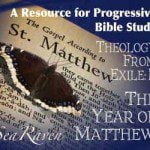
Volume 1 The Year of Luke (published January 2013)
Volume 2 The Year of Matthew (September 2013)
Volume 3 The Year of Mark (forthcoming October 2014)
This series is for “believers in exile,” who are drawn to the social justice mandate found in Jesus’s teachings, but no longer find meaning in orthodox interpretations of Old and New Testament scripture. The project is grounded in the biblical scholarship of Karen Armstrong, Marcus J. Borg, John Dominic Crossan, and the Jesus Seminar, as well as the transforming work of Rev. Dr. Matthew Fox, whose theology of Creation Spirituality has reclaimed Catholic mysticism for postmodern cosmology. Four questions are introduced in The Year of Luke and continue in The Year of Matthew:
What is the nature of God? Violent or nonviolent?
What is the nature of Jesus’s message? Inclusive or exclusive?
What is faith? Literal belief, or commitment to the great work of justice-compassion?
What is deliverance? Salvation from hell, or liberation from injustice?
These questions define the difference between the normalcy of civilization and its retributive systems of control, and participation in the ongoing program of restoring God’s distributive justice-compassion, as taught by Jesus: The answers for the authoritarian right (Empire) are: violent, exclusive, literal belief, and salvation from hell in the next life. The answers for the countering partnership on the left (Covenant) are nonviolent, inclusive, commitment to the great work, and liberation from injustice in this life, here and now. These answers provide guideposts to the authentic teachings of Jesus, and to a faith that might swing the balance to sustainable, conscious life on Planet Earth.
The context for the above four questions is the postmodern era of the late twentieth and early twenty-first centuries. Generally, historians speak about time in terms of premodern, modern, and postmodern. Premodern refers to the time before the Enlightenment and Descartes. The modern era (post-Enlightenment) lasted for about 350 years. During that time, God was a separate being or entity who created the universe, and proclaimed humanity to be the fulfillment of God’s creativity. The “postmodern” era might be argued to have actually begun with Charles Darwin. But regardless of the timing, “postmodern” means the time in which humanity began and continues to deal with the nature of the universe as science has defined it. “God” as a separate being who intervenes in human life from “heaven” somewhere beyond Antares no longer makes intellectual sense.
This leads to another term that has migrated from postmodern science into postmodern spiritual and religious language. In common usage, “cosmology” means the science or theory of the universe. But the term as used by Rev. Dr. Matthew Fox in his ground-breaking theology of original blessing goes beyond the scientific. Cosmology for Fox means humanity’s intellectual understanding of the nature of the universe. “Cosmology,” as Fox (and this writer, among others) uses the term, describes the mind-set of premodern, modern, and postmodern people, as each of these evolutions of human thought has understood our place in and our relationship to the universe and to God. If, as John Shelby Spong argues, Christianity is to have any relevance at all to postmodern spirituality, changes in focus and metaphor must be made.
As these essays have developed, beginning with Year C, a slight modification to the third question has emerged: What is faith? Literal belief, or trust and commitment to the great work of justice-compassion? The postmodern meaning of faith is usually belief, regardless of the circumstances. The more basic meaning is trust – either in a person’s (or God’s) word, or actions, or in a process set in motion by a god, a prophet, or a leader. The Apostle Paul’s letters make little or no sense to postmodern minds unless the distinction between faith as literal belief and faith as trust is clear. Further, as literal belief becomes untenable in the third millennium of the Common Era, Christian “faith” is increasingly confronted with John Shelby Spong’s challenge to change or die. To the extent that Christian “faith” continues to mean “literal belief,” the twenty-first century is a “post-Christian” era.
In addition to the four questions, the theme that determines these interpretations of the lectionary readings is the meaning of justice. Civilization defines justice as retribution – payback; an eye for an eye. But the deeper meaning of justice is distributive: the rain falls on the good, the bad, and the ugly without partiality. Civilization does not use that definition except in cases where there is clearly injustice if partiality enters the picture. The classic example is that in the United States in the first quarter of the twenty-first century, if you are rich, white, and male your chances of serving jail time for possessing cocaine is an order of magnitude less than if you are poor, black, and female, charged with possessing marijuana.
The positive understanding of distributive justice is contained in the term distributive justice-compassion. The normal development of civilizations has historically led to systems for assuring safety and security of citizens. But as any reader of Charles Dickens must be aware, those systems often exclude the poor, the uneducated, those who are presumed to have no economic or social power (women, minorities). Members of societies who are denied access to those powers often become ensnared in activities deemed anti-social or criminal in order to survive. Distributive justice-compassion would not demand payback or retribution for such activities, but would provide solutions: reeducation, rehabilitation, redress of grievances. Distributive justice-compassion holds sway in the Covenant relationship with the non-violent, inclusive, kenotic realm or kingdom of God. Justice as retribution/pay-back holds sway in the normal march of humanity into civilization. The short-hand term for the seemingly inevitable systems of injustice that are the result of that march is “Empire.”
The Apostle Paul was convinced that Jesus’s resurrection was the resurrection of a spiritual, mystical body, which was automatically part of the kingdom of God – and that we who are living today can also participate in that kingdom if we choose God’s nonviolent distributive justice instead of the violent imperial theology of piety, war, victory. In God’s kingdom of distributive justice, no one is judged by circumstance, but everyone is presumed to be transformed – or at least capable of transformation. The classic Biblical example is Luke’s story of the Prodigal Son (Luke 15:1–32). Like it or not, the prodigal son’s brother learned there is no place in his father’s house for payback, for getting even, for locking people up and throwing away the key, for the death penalty. In God’s realm of distributive justice the assumption is rehabilitation and hope; in God’s realm of distributive justice the assumption is that everyone has access to power and the assurance of food, clothing, shelter, medical care, and peace regardless of who they are or where they come from. Paul writes in his second letter to the Corinthians that “there is a new creation: everything old has passed away; see, everything has become new!” John Dominic Crossan suggests “What better deserves the title of a new creation than the abnormalcy of a share-world replacing the normalcy of a greed-world?” Because the coming of God’s justice is ongoing – for upwards of two thousand years now – we are called to participate in a new creation– a new paradigm – a world based on letting go, and sharing (distributive justice-compassion), rather than keeping and greed.
Third, in this series of commentaries “God” is understood as non-theistic and “kenotic.” Kenosis classically means “emptiness.” As a Christian term it has been defined as in Philippians 2:6-7: “[A]lthough [the Anointed One] was born in the image of God, [he] did not regard ‘being like God’ as something to use for his own advantage, but rid himself of such vain pretension and accepted a servant’s lot. . . . [H]e was born like all human beings. . . .” In John Dominic Crossan’s words, a kenotic god is “the beating heart of the Universe, whose presence is justice and life, and whose absence is injustice and death.” In these commentaries, kenotic “god” becomes interchangeable with kenotic “servant,” as the creative force that both contains and is contained by the universe. In answer to the four questions, the nature of that force is nonviolent; Jesus’s message is inclusive, faith is trust in an inclusive, non-violent universe, and deliverance is liberation from injustice. The context for human personal, social, and political life then becomes a Covenant with justice and life, and commitment to the ongoing struggle for liberation from injustice.
Finally, too much of Christian fundamentalism has become United States domestic and foreign policy. We can’t counter it if we don’t know the Biblical story in its context. While much of the history of the creation of the New Testament may be “old hat” to graduates of liberal Christian seminaries, lay folk must know something of the scholarship that is doing its best to lead Christianity out of the clutches of fundamentalism. The continued existence of a Christian “faith” as a religious system of belief is clearly under siege by twenty-first century Biblical scholarship as well as the continuing evolution of scientific knowledge. The question addressed by this series of commentaries is whether and how ancestral scriptures remain relevant and revelatory to twenty-first century cosmology.
Previous Post

November 7, 2013
After Trauma & Loss: What (Not) To Say
Next Post
November 13, 2013 Lost Christianities and Banned Books of the Bible
Browse Our Archives
Select a Category Advent Anti-Racism Archaeology Atheism Baptism Best of the Year List Book Reviews Buddhism Catholicism Christian Education Church and State Church Planting Climate Change Conscientious Objection to War Creation Spirituality Death Penalty Didache Disability Rights Discernment Easter Ecology Emergent Church Movement Empire-Critical Ethics Evolution Feminist Theology Film Reviews Gandhi Gospel of Mark Gun Control Hinduism Immigration Reform Interfaith Islam JFK Judaism Jungian Spirituality Lectionary Commentary Lent Letters to the Editor LGBT Marriage MLK Multiculturalism Mysticism Nonviolent Activism Occupy Paganism (Earth-centered Religions) Parables Paul Pluralism Politics Process Theology Quantum Physics Requiescat In Pace Seminary and Divinity School Sermon Series Retrospective Sermons Spiritual Direction Spiritual Practices Stewardship (Fundraising) The Book of J The Wheel of the Year (Paganism) Theoblogger Challenge Triathlon Uncategorized Unitarian Universalism Worship Resources Youth Ministry
Select a Month July 2026 May 2026 March 2026 November 2025 October 2025 August 2025 February 2025 December 2024 October 2024 March 2024 January 2024 December 2023 November 2023 March 2023 February 2023 January 2023 December 2022 November 2022 August 2022 March 2022 February 2022 January 2022 December 2021 September 2021 August 2021 July 2021 June 2021 May 2021 February 2021 January 2021 December 2020 August 2020 June 2020 May 2020 April 2020 March 2020 February 2020 January 2020 December 2019 November 2019 October 2019 September 2019 July 2019 June 2019 March 2019 February 2019 January 2019 December 2018 November 2018 October 2018 September 2018 June 2018 May 2018 April 2018 March 2018 February 2018 January 2018 December 2017 November 2017 October 2017 September 2017 August 2017 July 2017 June 2017 May 2017 April 2017 March 2017 February 2017 January 2017 December 2016 November 2016 October 2016 September 2016 August 2016 June 2016 May 2016 April 2016 March 2016 February 2016 January 2016 December 2015 November 2015 October 2015 September 2015 August 2015 July 2015 June 2015 May 2015 April 2015 March 2015 February 2015 January 2015 December 2014 November 2014 October 2014 August 2014 July 2014 June 2014 May 2014 April 2014 March 2014 February 2014 January 2014 December 2013 November 2013 October 2013 September 2013 August 2013 July 2013 June 2013 May 2013 April 2013 March 2013 February 2013 January 2013 December 2012 November 2012 October 2012 September 2012 August 2012 July 2012 June 2012 May 2012 April 2012 March 2012 February 2012 January 2012 December 2011 November 2011 October 2011 September 2011 August 2011 July 2011 June 2011 May 2011 April 2011 March 2011 February 2011 January 2011 December 2010 November 2010 October 2010 August 2009 July 2009 May 2009
Follow Us!
TAKE THE
Religious Wisdom Quiz
Who said, "The joy of the Lord is your strength"?
Select your answer to see how you score.
Paul Solomon David Nehemiah
Related posts from Carl Gregg

Reading America at 250: A Nation Wrestles With...


Andrew Holocek on the Power of Darkness

The Stories That Shape Us: Myths, Archetypes, &...
TRENDING AT PATHEOS More Voices

Reading America at 250: A Nation Wrestles With...
As part of my own reflection on the 250th anniversary of the...

Whenever I am reading a book or listening to an argument, I...

President Trump Ban Animal Torture Videos on Facebook
Call for Stricter Regulations of Animal Abuse Content on Facebook Although President...

Draft Amendments to Address Ritual Abuse in New...
The proposed changes would make it illegal for individuals in domestic partnerships...

How Bans on LGBTQ+ Student Clubs Threaten Religious...
On June 20, 2025, the State of Texas passed Senate Bill 12....

The Truth About the Gen Z Revival
This past year, there has been a lot of media buzz surrounding...
view all More Voices blogs
Ad-Free & Subscriber Log-In Subscription Support
- About Us
- 2026 Calendar
- Videos
- Podcasts
- Library of World Religions
- Faith In Media Tracker
- Advertise With Us
- Write for Us
- Privacy Policy
- Terms of Service
- Do Not Sell My Data
- Contact Us
- Radiant Digital
- Manage Newsletter Subscriptions
- Unsubscribe From Notifications
- Sitemap
Copyright 2008-2026, Patheos. All rights reserved.
Subscription Support Ad-Free & Subscriber Log-In
Follow Patheos