
BuddhistCatholicContemplativeEvangelicalGeneral ChristianHinduJewishLatter-day SaintMuslimNew VisionsProgressive Christian
Beliefs
- Buddhist
- Catholic
- Contemplative
- Evangelical
- General Christian
- Hindu
- Jewish
- Latter-day Saint
- More Voices
- Muslim
- New Visions
- Pagan
- Progressive Christian
Topics
- Religion News
- Food and Religion
- Sports and Religion
- Religious Art
- Religious Music and Entertainment
- Religious Events
- History and Religion
- Style and Religion
- Politics and Religion
- Women in Religion
- Recreation Outdoors and Religion
- Business Finance and Religion
- Careers Workplace and Religion
- Education and Religion
- Family Parenting and Religion
- Health Fitness and Religion
- Home and Religion
- Relationships and Religion
- Technology and Religion
- Travel and Religion
Columnists
- Buddhist Columnists
- Business Finance and Religion Columnists
- Careers Workplace and Religion Columnists
- Catholic Columnists
- Contemplative Columnists
- Education and Religion Columnists
- Evangelists Columnists
- Family Parenting and Religion Columnists
- General Christian Columnists
- Health Fitness and Religion Columnists
- Hindu Columnists
- History and Religion Columnists
- Home and Religion Columnists
- Jewish Columnists
- More Voices Columnists
- Latter Day Columnists
- Muslim Columnists
- New Visions Columnists
- Nonreligious Columnists
- Pagan Columnists
- Politics and Religion Columnists
- Progressive Columnists
- Recreation Outdoors and Religion Columnists
- Relationships and Religion Columnists
- Religion News Columnists
- Religious Art Columnists
- Religious Events Columnists
- Religious Music and Entertainment Columnists
- Sports and Religion Columnists
- Style and Religion Columnists
- Technology and Religion Columnists
- Travel and Religion Columnists
- Women in Religion Columnists
Resource Library
- 2026 Calendar
- Library of World Religions
- The 100 Most Holy Places on Earth
- Patheos Answers
- Podcasts
- Videos
- Faith Leaders Database
- Anglican Episcopalian
- Bahai
- Baptist
- Buddhism
- Christianity
- Confucianism
- Eastern Orthodoxy
- Hinduism
- Holiness and Pentecostal
- ISKCON
- Islam
- Judaism
- Lutheran
- Methodist
- The Church of Jesus Christ of Latter-day Saints
- New Age
- Paganism
- Presbytarian and Reformed
- Protestantism
- Religion Behind the Scenes
- Roman Catholic
- Scientology
- Shia Islam
- Sikhism
- Sufism
- Sunni Islam
- Taoism
- Zen
- See all religions
Research Tools
 Ad-Free & Subscriber Log-In Subscription Support
Ad-Free & Subscriber Log-In Subscription Support
Follow Patheos 

- Trending:
- Forgiveness
- |
- Marriage
- |
- Consciousness
- |
- Death Penalty
- |
- Election
- |
- Halloween

- Home
- More Voices
- “Who’s In Charge Here?”: The Dance between Shared Ministry and Authority
“Who’s In Charge Here?”: The Dance between Shared Ministry and Authority
Last updated on: July 13, 2013 at 9:59 pm by Carl Gregg
“Who’s In Charge Here?”: The Dance between Shared Ministry and Authority 2013-07-13T21:59:44-04:00 Carl Gregg
Patheos Explore the world's faith through different perspectives on religion and spirituality! Patheos has the views of the prevalent religions and spiritualities of the world.
Unitarian Universalists are heirs to a proud tradition of heretics bucking unjust authority. As in the ancient adage often attributed to Augustine, “An unjust law is no law at all.” Americans also have historic anti-authoritarian roots. As a nation we recently celebrated the 237 anniversary of our Independence Day, when we commemorate bucking the authority of the British monarchy: the slogan “No taxation without representation” is rooted in the same idea that, “An unjust law is no law at all.” As Jefferson (one of a handful of U.S. Presidents that many UUs often claim as among their own) wrote in the Declaration of Independence:
We hold these truths to be self-evident, that all men are created equal, that they are endowed by their Creator with certain unalienable Rights, that among these are Life, Liberty and the pursuit of Happiness. — That to secure these rights, Governments are instituted among Men, deriving their just powers from the consent of the governed, — That whenever any Form of Government becomes destructive of these ends, it is the Right of the People to alter or to abolish it, and to institute new Government, laying its foundation on such principles and organizing its powers in such form, as to them shall seem most likely to effect their Safety and Happiness….. The history of the present King of Great Britain is a history of repeated injuries and usurpations, all having in direct object the establishment of an absolute Tyranny over these States. To prove this, let Facts be submitted to a candid world. [And then continues a long list of grievances.]
So from many difference sources, both religious and secular, Unitarian Universalists and other religious liberals, have inherited a suspicion of authority. And I suspect that if I were to invite you, in the comments section, to name authority figures that have disrespected you, marginalized you, manipulated you, or taken advantage of you, I suspect that many readers of this blog could quickly make a long list — perhaps starting with former babysitters and continuing on to abusive bosses, corrupt politicians and many other negative authority figures. And I’m grateful for that part of my religious and civil heritage that encourages the questioning of authority.
At the same time, there is more to our relationship with authority. I invite you to pause in your reading, and remember some authority figures from your past and present that you do respect, who deserve their position, and whose leadership help you and others accomplish more than you likely would have on your own. Who are the positive authority figures in your life?
~ ~ ~
At the summer camp I attended when I was younger, there would often be a song or album that became inexplicably popular for a few weeks — not in the rest of world, but just among some part of the camp population. And sometime in the mid-90s, for whatever odd confluence of reasons, John Cougar Mellencamp’s 1983 album Uh-Huh — at least a decade after its initial release — became an unexpected hit in that small corner of western North Carolina. Some of you may remember some of the singles from that album: “Cumblin’ Down” and “Pink Houses.” But the big hit that summer was track three: “Authority Song.”
That song had the sound of a fairly defiant anthem, and the chorus goes, “I fight authority, Authority always wins / Well, I fight authority, Authority always wins / Well, I’ve been doing it since I was a young kid I come out grinnin’ / Well, I fight authority, Authority always wins.” I heard that song a lot that summer, and after a few weeks I suddenly realized that although the music sounds like an anti-authoritarian protest song, the lyrics are incredibly depressing. Over and over Mellencamp sings, “I fight authority, Authority always wins.” I remember thinking to myself, “Authority always win? This song is a terrible!” Catchy…but a terrible message
I’m reminded of a political cartoon I saw about a month ago with two panels. Both panels show the same person, but the caption above the left-hand panel says, “Then” and shows a scruffy-looking hippie with long brown hair, a bushy beard, and circular, John Lennon-style glasses. He has on a leather vest over a white T-shirt that says, “Question Authority.” His left-hand is raised in a peace sign.
The caption over the right-hand panel says, “Now,” and depicts the same man, presumably forty or fifty years later. He’s wearing a T-shirt with the Obama campaign logo that has a slogan pasted in underneath it: “Question Anyone Questioning Authority.” And instead of a peace sign, he’s holding a subpoena.”
During a national political campaign, everyone wants to be perceived as a “Washington Outsider,” who is questioning authority and seeking to “Subvert the Dominant Paradigm.” But once you are in power, it is easy to find yourself, “Questing anyone who questions your authority.”
Looking to recent headlines, we’ve seen President Obama visiting with relatives of Nelson Mandela, who may be on his deathbed. Talk about questioning authority: Mandela served 27 years in prison for his anti-colonial and anti-apartheid activism before being vindicated through his election as the first black President of South Africa. Or to look at Egypt, where opinions vary widely about whether the Egyptian people were wise to overthrow their first democratically-elected President. But from President Obama’s conflicts with Congress to Egypt’s struggle to live into the full promise of the Arab Spring — and to our own daily work with various authority figures in our own lives — the dance is a tricky between authority and accountability, cooperation and control.
Earlier I invited you to consider, “Who are (or have been) positive authority figures in your life?” For myself, I can think of a few professors I had over the years that — even though they were grading me — I just wanted to sit at their feet and soak in their lifetime of knowledge. And the fact that they were grading me — had some authority over me and could impose consequences on me — only made me focus more intently, research more thoroughly, and revise many more times than I would have if left to my own devices to explore the given subject area. That’s a good, healthy authority figure as far as I’m concerned, which isn’t to say that I didn’t have professors that were boring, unfair, or who burdened us with useless busywork.
Or to give another example, although there is much to criticize about the racially-based “Stop-and-frisk” tactics that many police departments are employing, when a strange man (who happened to be white) grabbed my wife Magin’s arm a few weeks ago and started randomly yelling at her (when all she was doing was walking in a straight line down a public sidewalk toward the Louisville Convention Center in the middle of the afternoon), she was grateful that three uniformed officers were pedaling by on bikes at that precise moment. She yelled for them, and the three burly officers confronted the man harassing her, and she was able to proceed safely to meet me a few blocks away.
And although there is much more to be said about authority in general, in politics, and in life, I would like us to turn our focus to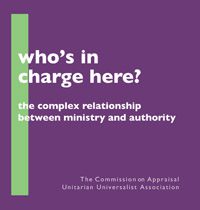 authority in Unitarian Universalism and in UU congregational life — and I suspect there will be strong parallels to the situation in other liberal and progressive congregations. My impetus for bringing up this subject is that the Unitarian Universalist Association’s Commission on Appraisal released a new report a few weeks ago titled Who’s in Charge Here?: The Complex Relationship Between Ministry and Authority. (For those interested in the nerdy details of UUA governance,The Commission on Appraisal is a nine-member committee of elected volunteers, who are charged with conducting independent reviews of any aspect of the UUA that it deems of worth and interest. And this commission publishes a report about what it has learned at least once every four years.)
Ironically, I can’t help wondering if the choice to focus on authority the past four years was affected by the rejection of the Commission of Appraisal’s last proposal four years ago, back in 2009, to revise Article II of the UUA Bylaws (the “Principles and Purposes”). One major objection was the recommendation to change the “Six Sources” to three paragraphs. The recommendation to even consider the proposal failed by thirteen votes. The dance is a tricky between authority and accountability, cooperation and control.
In an adaptation of the Commission on Appraisal report’s title, I’ve titled this post, “Who’s In Charge Here? The Dance between Shared Ministry and Authority.” The term “Shared Ministry” is a buzzword in some circles for what congregational life at its best should be. Basically what it means that we should avoid a perception that ministry is only something that paid, professional ministers do — or the equally harmful perception that my job is to simply tell you what to do, and then sit back and relax as you do it. To me, naming “Shared Ministry” as a congregation’s ideal way of being together is the difference between asking someone, “Will you do this for me?” and “Will you help me do this?” And to me the difference between those two approaches is all the difference in the world. Shared Ministry is about partnership — and power-with instead of power-over. The approach of shared ministry says that we are together in this work of transforming ourselves and of transforming this world.
There are 10,000 worthy things that any given congregation could do at any one time, but if a congregation tried to do all 10,000 of those things, their attention and energy would likely end up scattered. And likely less would be accomplished than if the focus were on only three, four, or five goals — which, of course, does not preclude individuals and small groups continuing to work on whatever parts of those 10,000 things they wish to do.
But as Unitarian Universalists (or religious progressive more generally), our independent streak — the same essential trait that empowers us to question authority — can make us much better at pursuing our individual goals than in joining to accomplish a few major things that are only possible with all of us working together as a congregation. And that complex dance with authority comes into play whenever some individual or group tries to herd the cats.
The Commission on Appraisal writes that, “we have come to understand authority as the ability to influence and cause growth and change in an institution, or to block and derail growth and change in an institution” (73). And that catalyst for change or the derailment of change can come from any part of the shared ministry: the minister, the board, committees, or individual members.
Rev. Fred Muir, who has been the minister of the Unitarian Universalist Church of Annapolis for almost 30 years — and who has helped that congregation grow and mature and who has been active on the continental level of the UUA as well — wrote last year that he sees three major factors holding back Unitarian Universalist congregations from living into their full potential. He writes:
First, we are being held back and stymied — really, we are being held captive — by a persistent, pervasive, disturbing and disruptive commitment to individualism that misguides our ability to engage the changing times; Second, we cling to a Unitarian Universalist exceptionalism that is often insulting to others and undermines our good news; Third, we refuse to acknowledge and treat our allergy to authority and power, though all the symptoms compromise a healthy future.
There is a lot more to be said about those three critiques, and I encourage you to read Rev. Muir’s full essay, but for now I want to move from his criticism to part of his suggested solution.
We spend much time as UUs talking about our Seven Principles and Six Sources. But Rev. Muir says that we too often miss the context in which those Principles and Sources are found. We too often forget the sentence that introduces the Seven Principles in their official context of the UUA Bylaws: “We, the member congregations of the Unitarian Universalist Association, covenant to affirm and promote.” Take note of that word covenant. See also the final sentence in the paragraph after the Sources: “As free congregations we enter into this covenant, promising to one another our mutual trust and support.” Notice the repetition of that word covenant, and the promise of mutual trust and support. The parallel situation at the congregational level is that as free individuals we are invited to enter into membership in a UU congregation, promising to one another our mutual trust and support. We UUs tend to be good at the free individual part, but Rev. Muir invites us to consider how much more might be possible if we were to spend more time emphasizing what becomes possible when free individuals invest themselves in a covenant of mutual trust and support.
In the spirit of what might be accomplished in the longterm through a congregation living into a covenant of mutual trust an support, I will close with a reflection that I’ve adapted from Ken Untener. The original was written as part of a homily in a mass for deceased priests. He writes:
It helps, now and then, to step back and take a long view. The [Beloved Community] is not only beyond our efforts, it is even beyond our vision. We accomplish in our lifetime only a tiny fraction of the magnificent enterprise that is [work we are called to]. Nothing we do is complete, which is a way of saying that the [Beloved Community] always lies beyond us. No statement says all that could be said. No [covenant] fully expresses our faith. No confession brings perfection. No pastoral visit brings wholeness. No program accomplishes the [congregation’s] mission. No set of goals and objectives includes everything. It may be incomplete, but it is a beginning, a step along the way…. We may never see the end results…. We are workers, not master builders; ministers, not messiahs. We are prophets of a future not our own. This is what we are about. We plant the seeds that one day will grow. We water seeds already planted, knowing that they hold future promise. We lay foundations that will need further development. We provide yeast that produces far beyond our capabilities. We cannot do everything, and there is a sense of liberation in realizing that. This enables us to do something, and to do it very well.
Notes
1 Previous Commission on Appraisal reports are available online at: http://www.uua.org/uuagovernance/committees/coa/185525.shtml.
2 “It helps, now and then, to step back and take a long view….” — quoted in “The Peace Pulpit: Homiles” by Bishop Thomas J. Gumbleton, available at http://www.nationalcatholicreporter.org/peace/pfg032804.htm. An excerpt about the background of the quote:
Wednesday was the anniversary of the assassination of Archbishop Oscar Romero. For the reflection that day, Bishop Untener included a passage titled “The mystery of the Romero Prayer.” The mystery is that the words of the prayer are attributed to Oscar Romero, but they were never spoken by him. They were, in fact, spoken by John Cardinal Dearden in November of 1979. They come from a homily he gave at a Mass for deceased priests. But what is even more important to know is that they were words drafted for Cardinal Dearden by Ken Untener. They are really his words, and they show us an insight that I think is very important.
The Rev. Dr. Carl Gregg is a trained spiritual director, a D.Min. graduate of San Francisco Theological Seminary, and the minister of the Unitarian Universalist Congregation of Frederick, Maryland. Follow him on Facebook (facebook.com/carlgregg) and Twitter (@carlgregg).
Learn more about Unitarian Universalism:
http://www.uua.org/beliefs/principles
Previous Post

June 22, 2013
"Standing Your Sacred Ground": Highlights from Eboo Patel's Ware Lecture
Next Post
July 15, 2013 Conscience, Civil Disobedience, and Holy Obedience
Browse Our Archives
Select a Category Advent Anti-Racism Archaeology Atheism Baptism Best of the Year List Book Reviews Buddhism Catholicism Christian Education Church and State Church Planting Climate Change Conscientious Objection to War Creation Spirituality Death Penalty Didache Disability Rights Discernment Easter Ecology Emergent Church Movement Empire-Critical Ethics Evolution Feminist Theology Film Reviews Gandhi Gospel of Mark Gun Control Hinduism Immigration Reform Interfaith Islam JFK Judaism Jungian Spirituality Lectionary Commentary Lent Letters to the Editor LGBT Marriage MLK Multiculturalism Mysticism Nonviolent Activism Occupy Paganism (Earth-centered Religions) Parables Paul Pluralism Politics Process Theology Quantum Physics Requiescat In Pace Seminary and Divinity School Sermon Series Retrospective Sermons Spiritual Direction Spiritual Practices Stewardship (Fundraising) The Book of J The Wheel of the Year (Paganism) Theoblogger Challenge Triathlon Uncategorized Unitarian Universalism Worship Resources Youth Ministry
Select a Month July 2026 May 2026 March 2026 November 2025 October 2025 August 2025 February 2025 December 2024 October 2024 March 2024 January 2024 December 2023 November 2023 March 2023 February 2023 January 2023 December 2022 November 2022 August 2022 March 2022 February 2022 January 2022 December 2021 September 2021 August 2021 July 2021 June 2021 May 2021 February 2021 January 2021 December 2020 August 2020 June 2020 May 2020 April 2020 March 2020 February 2020 January 2020 December 2019 November 2019 October 2019 September 2019 July 2019 June 2019 March 2019 February 2019 January 2019 December 2018 November 2018 October 2018 September 2018 June 2018 May 2018 April 2018 March 2018 February 2018 January 2018 December 2017 November 2017 October 2017 September 2017 August 2017 July 2017 June 2017 May 2017 April 2017 March 2017 February 2017 January 2017 December 2016 November 2016 October 2016 September 2016 August 2016 June 2016 May 2016 April 2016 March 2016 February 2016 January 2016 December 2015 November 2015 October 2015 September 2015 August 2015 July 2015 June 2015 May 2015 April 2015 March 2015 February 2015 January 2015 December 2014 November 2014 October 2014 August 2014 July 2014 June 2014 May 2014 April 2014 March 2014 February 2014 January 2014 December 2013 November 2013 October 2013 September 2013 August 2013 July 2013 June 2013 May 2013 April 2013 March 2013 February 2013 January 2013 December 2012 November 2012 October 2012 September 2012 August 2012 July 2012 June 2012 May 2012 April 2012 March 2012 February 2012 January 2012 December 2011 November 2011 October 2011 September 2011 August 2011 July 2011 June 2011 May 2011 April 2011 March 2011 February 2011 January 2011 December 2010 November 2010 October 2010 August 2009 July 2009 May 2009
Follow Us!
TAKE THE
Religious Wisdom Quiz
What city is known as the Holy City, sacred to Jews, Christians, and Muslims?
Select your answer to see how you score.
Athens Cairo Rome Jerusalem
Related posts from Carl Gregg

Peak Spiritual Experiences, Psychedelics, & Consciousness Research

"How the Founding Fathers Became Infallible and Our...

Vampires, Witches, & NPR: The Legacy of Margot...

“Do You Really Want to Know?” From Pope...
TRENDING AT PATHEOS More Voices

Reading America at 250: A Nation Wrestles With...
As part of my own reflection on the 250th anniversary of the...

Whenever I am reading a book or listening to an argument, I...

President Trump Ban Animal Torture Videos on Facebook
Call for Stricter Regulations of Animal Abuse Content on Facebook Although President...

Draft Amendments to Address Ritual Abuse in New...
The proposed changes would make it illegal for individuals in domestic partnerships...

How Bans on LGBTQ+ Student Clubs Threaten Religious...
On June 20, 2025, the State of Texas passed Senate Bill 12....

The Truth About the Gen Z Revival
This past year, there has been a lot of media buzz surrounding...
view all More Voices blogs
Ad-Free & Subscriber Log-In Subscription Support
- About Us
- 2026 Calendar
- Videos
- Podcasts
- Library of World Religions
- Faith In Media Tracker
- Advertise With Us
- Write for Us
- Privacy Policy
- Terms of Service
- Do Not Sell My Data
- Contact Us
- Radiant Digital
- Manage Newsletter Subscriptions
- Unsubscribe From Notifications
- Sitemap
Copyright 2008-2026, Patheos. All rights reserved.
Subscription Support Ad-Free & Subscriber Log-In
Follow Patheos