
BuddhistCatholicContemplativeEvangelicalGeneral ChristianHinduJewishLatter-day SaintMuslimNew VisionsProgressive Christian
Beliefs
- Buddhist
- Catholic
- Contemplative
- Evangelical
- General Christian
- Hindu
- Jewish
- Latter-day Saint
- More Voices
- Muslim
- New Visions
- Pagan
- Progressive Christian
Topics
- Religion News
- Food and Religion
- Sports and Religion
- Religious Art
- Religious Music and Entertainment
- Religious Events
- History and Religion
- Style and Religion
- Politics and Religion
- Women in Religion
- Recreation Outdoors and Religion
- Business Finance and Religion
- Careers Workplace and Religion
- Education and Religion
- Family Parenting and Religion
- Health Fitness and Religion
- Home and Religion
- Relationships and Religion
- Technology and Religion
- Travel and Religion
Columnists
- Buddhist Columnists
- Business Finance and Religion Columnists
- Careers Workplace and Religion Columnists
- Catholic Columnists
- Contemplative Columnists
- Education and Religion Columnists
- Evangelists Columnists
- Family Parenting and Religion Columnists
- General Christian Columnists
- Health Fitness and Religion Columnists
- Hindu Columnists
- History and Religion Columnists
- Home and Religion Columnists
- Jewish Columnists
- More Voices Columnists
- Latter Day Columnists
- Muslim Columnists
- New Visions Columnists
- Nonreligious Columnists
- Pagan Columnists
- Politics and Religion Columnists
- Progressive Columnists
- Recreation Outdoors and Religion Columnists
- Relationships and Religion Columnists
- Religion News Columnists
- Religious Art Columnists
- Religious Events Columnists
- Religious Music and Entertainment Columnists
- Sports and Religion Columnists
- Style and Religion Columnists
- Technology and Religion Columnists
- Travel and Religion Columnists
- Women in Religion Columnists
Resource Library
- 2026 Calendar
- Library of World Religions
- The 100 Most Holy Places on Earth
- Patheos Answers
- Podcasts
- Videos
- Faith Leaders Database
- Anglican Episcopalian
- Bahai
- Baptist
- Buddhism
- Christianity
- Confucianism
- Eastern Orthodoxy
- Hinduism
- Holiness and Pentecostal
- ISKCON
- Islam
- Judaism
- Lutheran
- Methodist
- The Church of Jesus Christ of Latter-day Saints
- New Age
- Paganism
- Presbytarian and Reformed
- Protestantism
- Religion Behind the Scenes
- Roman Catholic
- Scientology
- Shia Islam
- Sikhism
- Sufism
- Sunni Islam
- Taoism
- Zen
- See all religions
Research Tools
 Ad-Free & Subscriber Log-In Subscription Support
Ad-Free & Subscriber Log-In Subscription Support
Follow Patheos 

- Trending:
- Forgiveness
- |
- Marriage
- |
- Consciousness
- |
- Death Penalty
- |
- Election
- |
- Halloween

- Home
- More Voices
- We Are All Weird: What You Can Do To Stop Bullying
We Are All Weird: What You Can Do To Stop Bullying
Last updated on: June 3, 2013 at 7:36 pm by Carl Gregg
We Are All Weird: What You Can Do To Stop Bullying 2013-06-03T19:36:09-04:00 Carl Gregg
Patheos Explore the world's faith through different perspectives on religion and spirituality! Patheos has the views of the prevalent religions and spiritualities of the world.
My kids are thirteen and ten, and I’m never sure I’m getting any of this right. Lately I’ve taken to letting my older son
walk or bike by himself to a friend’s house — it’s exactly six blocks away. I’ve also let him have limited email privacy while talking to him about what he’s writing and to whom. (By limited, I meant that I promised not to read message to a particular close friend if he asked me not to.) I’m feeling my way here like everyone else. But I am as concerned about doing too much as I am about doing too little because, as hard as it is to recognize this, my boys have to learn to fend for themselves. They have to figure out when it makes sense to push back against cruelty or to hold their own worst impulses in check. They have to figure out when to ask for help and when to intervene on behalf of someone who needs it. I can take every opportunity they give me to weigh in or coach from the sidelines but I can’t take them out of life’s game.
That’s why character and empathy are the qualities I care most about instilling in my children. To me, the effort to prevent bullying isn’t primarily about punishment, and it’s definitely not about some kumbaya dream of the perfect childhood. It’s about learning how to make it through life’s rough patches, and how to help other people through them, too…. Michael Chabon [has written], “For the most part the young adventurer sets forth equipped only with the fragmentary map — marked HERE THERE BE TYGERS and MEAN KID WITH AIR RIFLE — that he or she has been able to construct out of a patchwork of personal misfortune, bedtime reading, and the accumulated local lore of the neighborhood children.” I want my kids — all kids — to have the best map they can make and the fortitude to find their way.
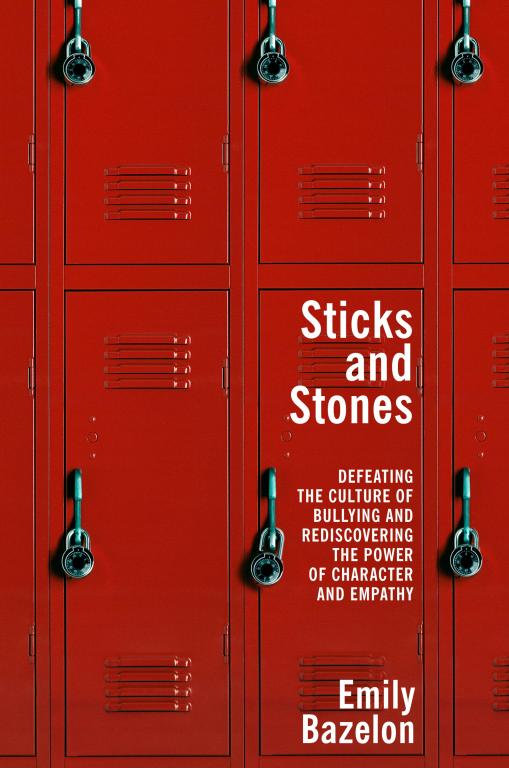
— Emily Bazelon, Sticks and Stones: Defeating the Culture of Bullying and Rediscovering the Power of Character and Empathy
For whatever confluence of reasons, I was not particularly bullied during my childhood. To be clear, I wasn’t the first one to get picked for sports. And I tended to fit in more with the drama club, band geeks, and misfits than I did with the popular kids. From what I recall, middle school (7th and 8th grade, in my corner of South Carolina) was the time that I remember as being the most precarious and toxic environment: the time when I remember feeling least confident about myself, caring the most what other people thought of me, and feeling at the same time like I had the least control over what people thought. Middle School is the time I remember feeling like I needed to be the most on guard against putting myself in a position in which someone might bully me, and knowing that also was not all within my control. So if you or someone you love is in a similar position, the most hopeful advice I can give you is that there are many reasons to expect that it will get better, especially as you graduate or go to college and have more control over what you do and whom you surround yourself with.
Thinking back to elementary school, when I was in fifth or sixth grade, after being absent for a few days due to a stomach virus, I returned to find that a classmate had blamed a misunderstanding on me, scapegoating me in my absence. Since I had no idea that anything had happened and had had no opportunity to present my side of the story, I could not understand why everyone was mad at me in the schoolyard that morning. I managed to figure out what had happened only minutes before the opening school bell rang that day, but to complicate matters, the person who had told the lies about me was late to school that day. I remember seething throughout the morning, and planning to confront the student in question during recess. Fortunately, other students diffused the situation before then. But if that situation had played out differently a bullying dynamic could have arisen. And I’m grateful to those students who intervened to keep that situation from escalating.
Similarly, I can remember being on a swing set around that time, and a group of students approached and starting taunting a new girl to the school that was swinging beside me. In recent weeks she had often responded to such taunting with fierce anger, which only encouraged her tormentors. When the taunting started again right in front of me, I remember whispering under my breath “Don’t.” She didn’t respond to their taunts, and they fortunately walked away. After they left, I remember turning to her in surprise, and asking, “Why didn’t you respond to them?” She said, “I heard you say not to.” I was stunned. That was one of the first times I remember feeling how powerful such a small act of intervention can be: how much influence an individual can sometimes have to escalate or diffuse a building conflict. Some people call this a shift from being a bystander to an “upstander.”
That student to whom I whispered “Don’t” was a victim of bullying. I, for the most part, was not. The difference is repetition. Emily Bazelon, whom you heard an excerpt from earlier in the spoken meditation, has written a book on Bullying titled Sticks and Stones: Defeating the Culture of Bullying and Rediscovering the Power of Character and Empathy. She notes that the standard definition of bullying was set, starting in the late 1970s by a Swedish psychologist, who noted three primary criteria: “it has to be [1] verbal or physical aggression that was [2] repeated over time and that [3] involved a power [imbalance].”
Interestingly if you look back to the 1600s, the word “bully” originally meant “sweetheart” or “darling” — such as in the line from Shakespeare’s Henry V, “From my hart strings I love the lovely bully.” The bard meant that the character in question was professing love for a sweetheart or darling — not some Stockholm Syndrome-like situation of victims or hostages feeling love for their abusers or captors. But related to the vagaries of language over time, the comedian John Fugelsang has argued that in our own day, the word “bullying” has become drained of the seriousness of its meaning. And from reading and listening to many contemporary stories of bullying, one common theme is parents’ chagrin at not having their children’s claims of bullying taken seriously. For these reasons Fugelsang has said that,
Bullying is a flaccid, outdated, Archies comic-era term. It’s so quaint and toothless — like saying DeNiro bullied Nick Nolte’s family in Cape Fear. It doesn’t do justice to the kind of brutalizing that would drive a kid to kill him or herself…. The word dates back to 1693. It’s had a good run. Call it peer abuse, Unamerican persecution, criminal harassment. Call it anything that makes people take it seriously….
Along these lines, psychologists have noted that asking children or teenagers, “How many of you have been bullied” often will not get a response. But,
When you start breaking it down by behaviors: ‘Raise your hand if someone has spread rumors about you. Raise your hand if you’ve watched someone being ostracized in the last week. Raise your hand if someone has called you a (derogatory name) this week. Many hands will shoot up.’ Get creative to get kids talking. ‘Hey, how are things going on the team, morale-wise? . . . Do kids sit in cliques during lunch at your school?”
According to the U.S. Department of Education, “Thirteen million children are bullied each year in the U.S., and 3 million stay home from school because they feel unsafe.” So perhaps Fugelsang is right that if the powers that be in a particular situation aren’t taking claims about bullying seriously, one strategy is to change the language we use to talk about bullying to try to better communicate the severity of the problem.
Related to how serious bullying can be, my colleague The Rev. Debra Haffner tweeted recently that, “the person who bullied me in elementary school’s birthday was on my [Facebook] timeline today. Amazing how seeing her name STILL hurts.” Those longtime wounds from bullying that continue to fester years later are all the more reason that we need to create systems that foster empathy and encourage the character necessary to diffuse verbal and physical aggression before it becomes a repeated pattern of abuse — before it becomes bullying. As I’ve sometimes heard the old saying reinvented: “Sticks and stones can break my bones, but words can really hurt me.”
According to The New York Times:
Researchers found that victims of bullying in childhood were 4.3 times more likely to have an anxiety disorder as adults, compared to those with no history of bullying or being bullied. Bullies who were also victims were particularly troubled: they were 14.5 times more likely to develop panic disorder as adults, compared to those who did not experience bullying, and 4.8 times more likely to experience depression. Men who were both bullies and victims were 18.5 times more likely to have had suicidal thoughts in adulthood, compared to the participants who had not been bullied or perpetuators. Their female counterparts were 26.7 times more likely to have developed agoraphobia [anxiety in situations where the sufferer perceives the environment as being difficult to escape or get help], compared to children not exposed to bullying. Bullies who were not victims of bullying were 4.1 times more likely to have antisocial personality disorder as adults than those never exposed to bullying in their youth. The effects persisted even after the researchers accounted for pre-existing psychiatric problems or other factors that might have contributed to psychiatric disorders, like physical or sexual abuse, poverty and family instability…. Bullying is not a harmless rite of passage, but inflicts lasting psychiatric damage on a par with certain family dysfunctions…. “The pattern…is similar to patterns we see when a child is abused or maltreated or treated very harshly within the family setting.”
And in today’s world of smart phones and almost-constant Internet connection, the new frontier of cyberbullying has made bullying almost impossible to escape for some victims.
And although this post is principally focused on bullying during childhood and young adulthood, there are many workplaces and home environments in which bullying continues into adulthood. And arguably the greatest cause of childhood bullying is precisely adults who bully children. The lyrics from the musical South Pacific come to mind that,
You’ve got to be taught to hate and fear, / You’ve got to be taught from year to year, / It’s got to be drummed in your dear little ear, You’ve got to be carefully taught. // You’ve got to be taught to be afraid / Of people whose eyes are oddly made, / And people whose skin is a diff’rent shade, / You’ve got to be carefully taught. // You’ve got to be taught before it’s too late, / Before you are six or seven or eight, / To hate all the people your relatives hate, / You’ve got to be carefully taught!
And tragically some of the worst offenders in creating a culture of bullying are our politicians and celebrities. To name only two of many recent examples, I would argue that the only reason that John Kerry is our current Secretary of State (although I don’t have any major issue with the selection of Kerry) is that Susan Rice was relentlessly bullied by partisan politicians until she declined her candidacy for Secretary of State. Or looking to the arena of sports, Coach Mike Rice at Rutgers was recently fired when it was uncovered that he had a repeated pattern for years of “shoving players around, firing basketballs at them, and screaming” homophobic slurs. And to name only one example from talk radio, Rush Limbaugh viciously bullied attorney and activist Sandra Fluke regarding her testimony about the insurance contraception mandate. When our politicians, coaches, and so-called celebrities are bullies instead of statesmen and mentors, is there any surprise that that there is an epidemic of bullying in our culture?
The good news is that an increasing number of people are seeking to change our “culture of bullying” into what Emily Bazelon calls a “culture of character and empathy.” As one example of this trend, back in 2002, there were 1,391 English-language books tagged with the keyword “bullying” according to Worldcat, a catalogue of libraries around the world. As of last year, 500 new books had been added on bullying in just the past ten years. And in only one post it would be impossible for me to do justice even to the last hundred pages on “Solutions” in Emily Bazelon’s book or to the last hundred pages on “What We Can Do” in the book Bully, which is based on the powerful 2011 documentary of the same name. But I would recommend those two resources as a good starting point if you or someone you love is in a bullying situation.
Looking to the largest spheres of “where can we go from here,” some anti-bullying activists are seeking to pass laws to regulate bullying. And there is reason for hope on this front of tangible social change having already been accomplished: “Before 1999, no states had laws that clearly addressed bullying; now forty-nine do.” That’s a sea change on the state-level in only fifteen years that parallels that increase we noted earlier in the number of books being published about bullying in the last decade. (The current holdout is Montana, and I do not know the current politics on the ground in that state that have prevented an anti-bullying law from being passed there.)
Looking to the federal level, anyone seeking to intervene in a seemingly intractable bullying situation should know about the 1999 Supreme Court case Davis v. Monroe County Board of Education, which “extended to schools the rules about sexual harassment that applied in the workplace.” Writing for the majority, Justice Sandra Day O’Connor write that, “a school could be held liable for showing ‘deliberate indifference’ to harassment that ‘is so severe, pervasive, and objectively offensive’ that it deprives victims of access to education.” In addition, “The U.S. Department of Education made it clear that a gay student could also seek the protection of Title IX” of the federal Civil Rights Act to stop harassment.
The main weakness, however, of the 49 state-level anti-bullying laws is that they are a patchwork of 49 different approaches: “[The] bills vary in their definitions of bullying, their requirements, and the protection afforded to students. A 2011 report by the U.S. Department of Education showed that only a handful of states follow best practices shown to be effective in reducing bullying.” So the next step many anti-bullying activists are seeking is a federal anti-bullying law. Attempts have been made to pass such a law annually since 2003, and the most recent iteration, the “Safe Schools Improvement Act” has currently been referred to a committee. That act “would solidify the requirement for schools to address bullying and hold them accountable to collect data on the incidence and response.”
There’s much more to say about for preventing bullying and for stopping it once it starts, but for now, let me end for now with a notion from my favorite marketing guru Seth Godin, who has written a book titled We Are All Weird. There’s something deeply right about that notion: we are all weird. As an example, the headlines come to mind about the Boy Scouts of America voting to allow openly gay young people as members, while continuing to exclude openly gay adult leaders. One of the arguments I’ve heard repeatedly over the years from more traditional groups working against equal rights of Lesbian, Gay, Bisexual, and Transgender citizens is that the ultimate goal of such human rights work is to make being “lesbian, gay, bisexual, and transgender” normal. And the only thing I know is to say that they’re exactly right. That is the end goal: to reveal the truth that all families have value — adopted families, single-parent families, families with two moms or two dads, families with a transgender parents, families with straight kids, families with gay kids, families with no kids, and all sorts of other family variations. All families have value.
Working to build a culture that doesn’t just tolerate diversity, but that accepts and celebrates diversity, is the greatest contribution we can make to ending a culture of bullying and creating a “culture of character and empathy” — a culture where it is the norm that “we’re all weird.” I’m grateful to be a part of the Unitarian Universalist movement in particular, and of progressive groups more generally, that are committed to turning that dream into a reality for all families — and to creating a world that is safe for all of us in all our diversity, including and especially our children.
Notes
1 bystanders — for more see Emily Bazelon, Sticks and Stones, 122-124. See also Barbara Coloroso, The Bully, the Bullied, and the Bystander: From Preschool to HighSchool–How Parents and Teachers Can Help Break the Cycle (Updated Edition): “Bullying is a learned behavior. The bully, the bullied and the bystander are three characters in a tragic play, and the scripts can be rewritten, the plot changed.”
2 standard definition of bullying — Bazelon, 28-29.
3 John Fugelsang, “Bullying vs. Free Speech,” available at https://www.youtube.com/watch?v=xjK2w3m1Uw4.
4 asking children or teenagers, “How many of you have been bullied” often will not get a response — Heidi Stevens, “Bullied to tears, bored to death: Relentless coverage threatens to diminish bullying” (November 28, 2012), available at http://articles.chicagotribune.com/2012-11-28/features/sc-fam-1127-teen-bully-20121127_1_rosalind-wiseman-prevalence-of-social-media-media-and-school.
5 “Thirteen million children are bullied” — quoted in Stevens, “Bullied to tears.”
6 Follow Debra Haffner on Twitter at @RevDebra: “Jewish Unitarian Universalist minister, sexologist. President of @ReligiousInst Community….” She also discusses bullying in her book From Diapers to Dating: A Parent’s Guide to Raising Sexually Healthy Children.
7 “The pattern…is similar to patterns we see when a child is abused” — Catherine Saint Louis, “Effects of Bullying Last Into Adulthood, Study Finds” (February 20, 2013), available at http://well.blogs.nytimes.com/2013/02/20/effects-of-bullying-last-into-adulthood-study-finds/.
8 Josh Voorhees, “Susan Rice Withdraws Her Name From Consideration To Be Next Secretary of State” (December 13, 2012), available at http://www.slate.com/blogs/the_slatest/2012/12/13/susan_rice_secretary_of_state_un_ambassador_takes_name_out_of_running.html.
9 Emily Bazelon, “The Basketball Bully Rutgers coach Mike Rice helps draw the line between acting like a jerk and abusing your players” (April 3, 2013), available at http://www.slate.com/articles/sports/sports_nut/2013/04/mike_rice_fired_the_rutgers_coach_helps_draw_the_line_between_acting_like.html.
10 Andrea Mitchell, “Rush Limbaugh Is A ‘Bully With A Megaphone’” (May 22, 2012), available at http://www.huffingtonpost.com/2012/05/22/andrea-mitchell-more-rush-limbaugh-bully_n_1535527.html. For an alternative paradigm, see http://www.stoppolarizingtalk.org/.
11 keyword “bullying” — Leslie Kaufman, “Publishers Revel in Youthful Cruelty” (March 26, 2013), available at http://www.nytimes.com/2013/03/27/books/bullying-becomes-hot-and-profitable-topic-for-publishers.html.
12 Bully (2011): PG-13, 99 minutes: “Exploring the subject of school bullying from a personal angle, this eye-opening documentary tracks the stories of five different families whose children are struggling to defend themselves on a near-daily basis.” (Currently available via streaming on Netflix Instant.)
13 Regarding the many resources available on preventing bullying, see in particular the “Social and Emotional Learning” model in Bully: An Action Plan for Teachers, Parents, and Communities to Combat the Bullying Crisis, 231ff. See also the Public Health approach in Bazelon, 232-234.
14 On state laws, see Bazelon 11.
15 The paragraph on federal court cases, follows Bazelon, 151.
16 On a federal anti-bullying law, see Kerry Kennedy and Deborah Temkin, “The Time Is Now for a Federal Anti-Bullying Law” (March 3, 2013), available at http://www.huffingtonpost.com/kerry-kennedy/the-time-is-now-for-a-fed_b_2813122.html. The following is a more extended excerpt:
In 1973, child abuse legislation was much at the same point we are today with bullying prevention legislation. Nearly all states by that time had some form of child abuse law, yet each defined child abuse differently and provided different reporting and assistance procedures and regulations. Each state recognized the need for such legislation, just like nearly all states have with bullying today, yet these differences made it hard for the federal government to provide resources, training, tools and other assistance that would serve the needs of each state. With varying definitions, collecting accurate date to understand the issue was also impossible. There was a clear need for a federal definition and federal guidance on the minimum requirements surrounding child abuse, and, in 1974 the first Child Abuse Prevention and Treatment Act (CAPTA) was enacted. CAPTA has made it possible for more consistent and accurate accounting of child abuse and more sustained, collaborative and evidence-based efforts towards its prevention. It is time we do the same for bullying. Just as we know the horrible effects child abuse can have on a child’s current and future well-being, emerging evidence shows us that bullying by peers can have many of the same results that persist long after the bullying has ended. Bullying prevents children from receiving an education, a human right we must vigorously defend. We must take action now, and pass the Safe Schools Improvement Act.
See also http://www.govtrack.us/congress/bills/113/s403.
17 Seth Godin, “Destabilizing the bullying power structure” (February 19, 2013), available at http://sethgodin.typepad.com/seths_blog/2013/02/destabilizing-the-bullying-power-structure.html.
18 On the shift toward normalizing diversity, see also Bazelon, 158-159.
The Rev. Dr. Carl Gregg is a trained spiritual director, a D.Min. graduate of San Francisco Theological Seminary, and the minister of the Unitarian Universalist Congregation of Frederick, Maryland. Follow him on Facebook (facebook.com/carlgregg) and Twitter (@carlgregg).
Learn more about Unitarian Universalism:
http://www.uua.org/beliefs/principles
Previous Post

May 26, 2013
All Bodies Count: Memorial Day, Fallen Soldiers & Civilian Casualties
Next Post
June 9, 2013 Living the Bhagavad Gita
Browse Our Archives
Select a Category Advent Anti-Racism Archaeology Atheism Baptism Best of the Year List Book Reviews Buddhism Catholicism Christian Education Church and State Church Planting Climate Change Conscientious Objection to War Creation Spirituality Death Penalty Didache Disability Rights Discernment Easter Ecology Emergent Church Movement Empire-Critical Ethics Evolution Feminist Theology Film Reviews Gandhi Gospel of Mark Gun Control Hinduism Immigration Reform Interfaith Islam JFK Judaism Jungian Spirituality Lectionary Commentary Lent Letters to the Editor LGBT Marriage MLK Multiculturalism Mysticism Nonviolent Activism Occupy Paganism (Earth-centered Religions) Parables Paul Pluralism Politics Process Theology Quantum Physics Requiescat In Pace Seminary and Divinity School Sermon Series Retrospective Sermons Spiritual Direction Spiritual Practices Stewardship (Fundraising) The Book of J The Wheel of the Year (Paganism) Theoblogger Challenge Triathlon Uncategorized Unitarian Universalism Worship Resources Youth Ministry
Select a Month July 2026 May 2026 March 2026 November 2025 October 2025 August 2025 February 2025 December 2024 October 2024 March 2024 January 2024 December 2023 November 2023 March 2023 February 2023 January 2023 December 2022 November 2022 August 2022 March 2022 February 2022 January 2022 December 2021 September 2021 August 2021 July 2021 June 2021 May 2021 February 2021 January 2021 December 2020 August 2020 June 2020 May 2020 April 2020 March 2020 February 2020 January 2020 December 2019 November 2019 October 2019 September 2019 July 2019 June 2019 March 2019 February 2019 January 2019 December 2018 November 2018 October 2018 September 2018 June 2018 May 2018 April 2018 March 2018 February 2018 January 2018 December 2017 November 2017 October 2017 September 2017 August 2017 July 2017 June 2017 May 2017 April 2017 March 2017 February 2017 January 2017 December 2016 November 2016 October 2016 September 2016 August 2016 June 2016 May 2016 April 2016 March 2016 February 2016 January 2016 December 2015 November 2015 October 2015 September 2015 August 2015 July 2015 June 2015 May 2015 April 2015 March 2015 February 2015 January 2015 December 2014 November 2014 October 2014 August 2014 July 2014 June 2014 May 2014 April 2014 March 2014 February 2014 January 2014 December 2013 November 2013 October 2013 September 2013 August 2013 July 2013 June 2013 May 2013 April 2013 March 2013 February 2013 January 2013 December 2012 November 2012 October 2012 September 2012 August 2012 July 2012 June 2012 May 2012 April 2012 March 2012 February 2012 January 2012 December 2011 November 2011 October 2011 September 2011 August 2011 July 2011 June 2011 May 2011 April 2011 March 2011 February 2011 January 2011 December 2010 November 2010 October 2010 August 2009 July 2009 May 2009
Follow Us!
TAKE THE
Religious Wisdom Quiz
What is the main theme of Galatians?
Select your answer to see how you score.
Love above faith Justification by faith Spiritual gifts Church discipline
Related posts from Carl Gregg

What Do We Mean We When Say, “Building...

Margaret Fuller: The Stories We Tell Matter

"Feminist Masculinity and Father’s Day" #EachEveryWoman #AllMenCan

Religious Mystic & Rational Humanist: The Mystical Humanism...
TRENDING AT PATHEOS More Voices

Reading America at 250: A Nation Wrestles With...
As part of my own reflection on the 250th anniversary of the...

Whenever I am reading a book or listening to an argument, I...

President Trump Ban Animal Torture Videos on Facebook
Call for Stricter Regulations of Animal Abuse Content on Facebook Although President...

Draft Amendments to Address Ritual Abuse in New...
The proposed changes would make it illegal for individuals in domestic partnerships...

How Bans on LGBTQ+ Student Clubs Threaten Religious...
On June 20, 2025, the State of Texas passed Senate Bill 12....

The Truth About the Gen Z Revival
This past year, there has been a lot of media buzz surrounding...
view all More Voices blogs
Ad-Free & Subscriber Log-In Subscription Support
- About Us
- 2026 Calendar
- Videos
- Podcasts
- Library of World Religions
- Faith In Media Tracker
- Advertise With Us
- Write for Us
- Privacy Policy
- Terms of Service
- Do Not Sell My Data
- Contact Us
- Radiant Digital
- Manage Newsletter Subscriptions
- Unsubscribe From Notifications
- Sitemap
Copyright 2008-2026, Patheos. All rights reserved.
Subscription Support Ad-Free & Subscriber Log-In
Follow Patheos