
BuddhistCatholicContemplativeEvangelicalGeneral ChristianHinduJewishLatter-day SaintMuslimNew VisionsProgressive Christian
Beliefs
- Buddhist
- Catholic
- Contemplative
- Evangelical
- General Christian
- Hindu
- Jewish
- Latter-day Saint
- More Voices
- Muslim
- New Visions
- Pagan
- Progressive Christian
Topics
- Religion News
- Food and Religion
- Sports and Religion
- Religious Art
- Religious Music and Entertainment
- Religious Events
- History and Religion
- Style and Religion
- Politics and Religion
- Women in Religion
- Recreation Outdoors and Religion
- Business Finance and Religion
- Careers Workplace and Religion
- Education and Religion
- Family Parenting and Religion
- Health Fitness and Religion
- Home and Religion
- Relationships and Religion
- Technology and Religion
- Travel and Religion
Columnists
- Buddhist Columnists
- Business Finance and Religion Columnists
- Careers Workplace and Religion Columnists
- Catholic Columnists
- Contemplative Columnists
- Education and Religion Columnists
- Evangelists Columnists
- Family Parenting and Religion Columnists
- General Christian Columnists
- Health Fitness and Religion Columnists
- Hindu Columnists
- History and Religion Columnists
- Home and Religion Columnists
- Jewish Columnists
- More Voices Columnists
- Latter Day Columnists
- Muslim Columnists
- New Visions Columnists
- Nonreligious Columnists
- Pagan Columnists
- Politics and Religion Columnists
- Progressive Columnists
- Recreation Outdoors and Religion Columnists
- Relationships and Religion Columnists
- Religion News Columnists
- Religious Art Columnists
- Religious Events Columnists
- Religious Music and Entertainment Columnists
- Sports and Religion Columnists
- Style and Religion Columnists
- Technology and Religion Columnists
- Travel and Religion Columnists
- Women in Religion Columnists
Resource Library
- 2026 Calendar
- Library of World Religions
- The 100 Most Holy Places on Earth
- Patheos Answers
- Podcasts
- Videos
- Faith Leaders Database
- Anglican Episcopalian
- Bahai
- Baptist
- Buddhism
- Christianity
- Confucianism
- Eastern Orthodoxy
- Hinduism
- Holiness and Pentecostal
- ISKCON
- Islam
- Judaism
- Lutheran
- Methodist
- The Church of Jesus Christ of Latter-day Saints
- New Age
- Paganism
- Presbytarian and Reformed
- Protestantism
- Religion Behind the Scenes
- Roman Catholic
- Scientology
- Shia Islam
- Sikhism
- Sufism
- Sunni Islam
- Taoism
- Zen
- See all religions
Research Tools
 Ad-Free & Subscriber Log-In Subscription Support
Ad-Free & Subscriber Log-In Subscription Support
Follow Patheos 

- Trending:
- Forgiveness
- |
- Marriage
- |
- Consciousness
- |
- Death Penalty
- |
- Election
- |
- Halloween

- Home
- More Voices
- Living the Bhagavad Gita
Living the Bhagavad Gita
Last updated on: June 9, 2013 at 8:13 pm by Carl Gregg
Living the Bhagavad Gita 2013-06-09T20:13:04-04:00 Carl Gregg
Patheos Explore the world's faith through different perspectives on religion and spirituality! Patheos has the views of the prevalent religions and spiritualities of the world.
They live in wisdom who see themselves in all and all in them, who have renounced every selfish desire and sense
craving tormenting the heart. Neither agitated by grief nor hankering after pleasure, they live free from lust and fear and anger. Established in meditation, they are truly wise. Fettered no more by selfish attachments, they are neither elated by good fortune nor depressed by bad. Such are the seers…. When you keep thinking about sense objects, attachment comes. Attachment breeds desire, the lust of possession that burns to anger. Anger clouds the judgement; you can no longer learn from past mistakes. Lost is the power to choose between what is wise and what is unwise…. But when you move amidst the world of sense, free from attachment and aversion alike, there comes the peace in which all sorrows end, and you live in the wisdom of the Self. The disunited mind is far from wise; how can it meditate? How be at peace? When you know no peace, how can you know joy? When you let your mind follow the call of the senses, they carry away your better judgement as storms drive a boat off its charted course on the sea. Use all your power to free the senses from attachment and aversion alike, and live in the full wisdom of the Self. Such a sage awakens to light in the night of all creatures. That which the world calls day is the night of ignorance to the wise. As rivers flow into the ocean but cannot make the vast ocean overflow, so flow the streams of the sense-world into the sea of peace that is the sage. But this is not so with the desirer of desires. They are forever free who renounce all selfish desires and break away from the ego-cage of “I”, “me”, and “mine” to be united [in the place of the infinite spirit]….
—The Bhagavad Gita, 2:55-72
Unitarian Universalism draws from Six Sources: direct experience, prophetic words and deeds, wisdom from the world’s religions, Jewish and Christian teachings, Humanist teachings (that includes reason and science), and Earth-centered traditions. This post draws from the third of the Six Sources: “Wisdom from the world’s religions which inspires us in our ethical and spiritual life” — specifically from Hinduism.
And before I move too quickly into a discussion of the Bhagavad Gita, it may be important to make a few introductory remarks about Hinduism. At the most general level, the term Hinduism itself is highly contested. Many scholars see the term Hinduism as a product of 19-century British colonialism. Europeans needed a name for the exotic cultural and religious practices that they encountered on the other side of the Indus River. And there is a strong sense in which the single name Hinduism masks the diversity of religions on the Indian subcontinent and makes it seem like there is far more commonality than is the case, especially historically.
Also of significance, in November, our nation elected its first Hindu member of Congress, Tulsi Gabbard from Hawaii. Gabbard writes that,
[I] was raised in a multicultural, multirace, multifaith family [that allowed me] to spend a lot of time studying and contemplating upon both the Bhagavad-Gita and the teachings of Jesus Christ in the New Testament. My attempts to work for the welfare of others and the planet is the core of my spiritual practice. Also, every morning I take time to remember my relationship with God through the practice of yoga meditation and reading verses from the Bhagavad-Gita. From the perspective of the Bhagavad-Gita, the spiritual path as I have described here is known as karma yoga and bhakti yoga.
It sounds to me like she would make a great Unitarian Universalist!
Historically, the connections between Unitarianism and Hinduism run deep. At the same time that those 19th-century British colonialists were coining the problematic term Hinduism, many Transcendentalist were becoming fascinated with writings from the East. Ralph Waldo Emerson, journaled in 1845 that
I owed — my friend and I owed — a magnificent day to the Bhagavat Geeta. It was the first of books, it was as if an empire spoke to us, nothing small or unworthy, but large, serene, consistent, the voice of an old intelligence which in another age and climate had pondered and thus disposed of the same questions which exercise us.
Similarly, Henry David Thoreau took a copy of the Bhagavad Gita with him to Walden Pond. And he wrote in Walden that:
In the morning I bathe my intellect in the stupendous and cosmogonal philosophy of the Bhagvat-Geeta, since whose composition years of the gods have elapsed, and in comparison with which our modern world and its literature seem puny and trivial; and I doubt if that philosophy is not to be referred to a previous state of existence, so remote is its sublimity from our conceptions. I lay down the book and go to my well for water, and lo! there I meet the servant of the Bramin, priest of Brahma and Vishnu and Indra, who still sits in his temple on the Ganges reading the Vedas, or dwells at the root of a tree with his crust and water jug. I meet his servant come to draw water for his master, and our buckets as it were grate together in the same well. The pure Walden water is mingled with the sacred water of the Ganges.
Both Emerson and Thoreau were reading Charles Wilkins’ 1785 translation of the Bhagavad Gita. It’s remarkable that less than a decade after the American Revolution, copies of the Bhagavad Gita were circulating in English.
Thomas Merton and E.M. Forster also wrote about the Gita, and T.S. Eliot favorably compared the Gita’s poetry to Dante’s Divine Comedy. Mohandas Gandhi is probably the most familiar figure that was deeply influenced by the Bhagavad Gita. Gandhi wrote:
When doubts haunt me, when disappointments stare me in the face, and I see no ray of hope on the horizon, I turn to the Bhagavad Gita and find a verse to comfort me, and I immediately begin to smile in the midst of overwhelming sorrow. Those who meditate on the Gita will derive fresh joy and new meaning from it every day.
So what is the Bhagavad Gita? It is a philosophical poem, whose title literally means “Song of the Lord.” The Lord in question is Krishna, who is an incarnation of Vishnu — who, in turn, is part of the so-called Hindu Trinity of Brahma the creator, Vishnu the sustainer, and Shiva the destroyer.
The Gita is set on the eve of a great battle in which Prince Arjuna is preparing to fight some of his own family members, who have usurped his right to the throne. His charioteer turns out to be Krishna, and the Gita is Krishna’s advice to Arjuna. Most mystics see the Arjuna’s war with his family as an allegory for the how one must battle one’s own self as part of the spiritual journey.
I have only read the entire Gita once. It is relatively short, and only takes a few hours to read, even if you read slowly and contemplatively. And I’m intrigued by the following suggestion for how to read the Gita that I plan to try at some future point. If any of you try this method at some point, I would be interested to hear about your experience in the comments section:
[R]ead it through [the] first time just as a very interesting story: Who is Krishna? Who is Arjuna? And how do they find themselves in this peculiar predicament, sitting in a chariot, out on a battlefield? . . .
[R]ead it again…identifying with Arjuna; that is, once you have figured out what your own conflict is, your own spiritual struggle, then use that as the framework, and listen to Krishna telling you how it all is regarding your own battleground.
Then, when you are ready [read the Gita a third time] identifying with Krishna…. Now, that last reading may raise some interesting problems for you…. Maybe you’ll be reading along, and you’ll come to a line and you’ll think to yourself, “I would never say that!” …Take both the line as it is written and the line as you think it ought to be, and you sit with both those thoughts…. Those are the lines that will turn out to be the richest ones for you, because they will show you where you’re holding on, where your secret stash of attachment lies.
Related to this idea of become more aware of your hidden attachments, scholars have argued that the major theme of the Gita is summed up in one word: renunciation. But it is important to qualify that in English the word renunciation has more of a pejorative connotation than it does in the context of the Gita. The Gita “teaches that we can become free by giving up not material things, but selfish attachment to material things…. It asks us to renounce not the enjoyment of life, but the clinging to selfish enjoyment whatever it may cost others.” In short, motivation matters.
For example, if the point was renunciation, then fasting, celibacy, or abstaining from drugs or alcohol would be sufficient in and of themselves. But what students of the Gita find is that if you give up food, sex, or alcohol while you are still attached to those things — or from an ego-driven motivation (because you want to be seen as the sort of person who fasts or is celibate) — then you’ll likely find yourself obsessing about food, drugs, or alcohol the entire time you are fasting or obsessing about sex the entire time you are supposed to be celibate. In contrast the goal of the Gita is to do any activity without attachment, from a place of inner freedom: to eat food (or not), to have sex (or not), to use drugs (or not) with intentionality and without attachments to either way. Gandhi said it this way: “Renounce and enjoy!”
Similarly, Ram Dass, in his lectures on the Bhagavad Gita, says:
It isn’t better to give up sex, or better to fast; we don’t do renunciation practices to be good — that’s falling into the…trap of being attached to being somebody nice. We renounce things because we want to give them up. We do it because we see how they’re holding us, and we’ve identified ourselves with something that’s much more interesting than the immediate gratification, the next chocolate bar. We renounce things when our desire to get on with the journey is stronger than our desire for the next ice cream soda.
Ram Dass is being a bit flippant there, but along these lines, he tells an interesting story about his own journey to find the right balance regarding attachments.
He had become a vegetarian for many of the usual reasons: to eat a healthier diet, to reduce the number of living beings required to sustain his existence, and to have less of an impact on the environment by eating lower on the food chain. But at a certain point he realized that some ego had crept into his vegetarianism, and that his vegetarian diet had become at least partially about the pride and superiority he felt about being a vegetarian.
So he decided to undercut that feeling in a dramatic way. Since Ram Dass was raised Jewish, he decided not only to eat meat, but also to go to a Chinese restaurant and order spareribs — which, of course, is not just meat, but pork and a violation of Jewish kosher laws. He offered a blessing over his food that he had learned from his Hindu guru, then dived in.
As he was finishing his meal, a stranger approached him, and said that he had been struck by the beauty of the blessing Ram Dass had offered over his food, and felt compelled to speak with him before leaving. It turns out that the man was a fundamentalist Christian, and they ended up having a fascinating conversation about religion. And Ram Dass writes:
Finally he said, “Well, I’m just so delighted to have met you, it’s been wonderful. There’s just one more thing I wanted to ask you. I’ve had a lot of question about my diet, what I ought to be eating and not eating, so I’m just curious — what’s your diet like? What do you eat?” And I looked down, and right there in front of me was this big pile of bones. I would have done anything to be able to push it away and say, “Well, of course I’m a vegetarian, and…” But there it was. I had to face the fact of who I was at that moment.
Ram Dass says that the lesson he took from that encounter was, “I can’t be phony holy anymore. I’ve just got to be where I [am].” I’m drawn to this story both because I am a longtime vegetarian, and because it is a poignant and hilarious example of how complicated the dance can be of sorting through our attachments — and how renunciation can also be unhealthy and pathological, depending on the circumstances.
I also wanted to elaborate briefly about Ram Dass’ teaching that, “We renounce things because we want to give them up. We do it because we see how they’re holding us, and we’ve identified ourselves with something that’s much more interesting than the immediate gratification.” The “identification of our self with something that’s more interesting than immediate gratification” is related to the Unitarian Universalist Seventh Principle of “the interdependent web of all existence of which we are a part.” And the Gita teaches that our motivation shouldn’t come from selfish reasons alone, but from acting through the experiential knowledge that our self is part of an interdependent web, such that our actions arise out of not only what is best for ourselves, but also what is best for ourselves and others — both/and, not either/or.
Relatedly, Ram Dass tells another story about a debate he got into with his father about set of records titled Love, Serve, Remember that Ram Dass released in the wake of the success of his book Remember, Be Here Now. His father said that he was impressed with all the work Ram Dass had put into producing an attractive, quality record, but he couldn’t understand why he was selling the six record set for only $4.50, when the market value was probably $15 or at least $9. Keep in mind that at this point, Ram Dass had sold about 10,000 sets, so you can do the math about the difference in return at those different price points.
His father was a high-priced lawyer, and Ram Dass responded by asking his father about how much he charged his Uncle Henry for a difficult case that Ram Dass knew his father had recently spent many hours on. Ram Dass writes that,
“My father looked at me as if I’d gone crazy. He said, “What! — are you out of your mind?! Of course I didn’t charge him — Uncle Henry is family.” Ram Dass said, ‘Well, Dad, that’s my predicament. If you show me anybody who isn’t Uncle Henry, I’ll happily rip him off.’ Once it’s all ‘us,’ it immediately changes the way we deal with other people. How can it not?”
Now, I’m not saying that is an easy lesson to apply, but our world desperately needs less “me” and more “we.” We need more people whose actions arise out of a felt sense of being a part of the interdependent web of all existence.
And perhaps for some people, the wisdom of the Bhagavad Gita can be part of that journey from unhealthy independence to a healthy interdependence. Of course, as with any text that is at least 2,500 years old, there are tensions between the Bhagavad Gita and 21st-century knowledge, but Unitarian Universalism recognizes that perhaps especially in today’s world of advanced technology, we also need the “Wisdom from the world’s religions.” For now, I’ll give the final word to the Gita, drawing again from the end of the second chapter, which Mahatma Gandhi said contained the Gita’s essence. As you read these ancient words, pay particular attention to any word or phrase that particularly resonates with you. What wisdom might the Gita have for you today?
They live in wisdom who see themselves in all and all in them, who have renounced every selfish desire and sense craving tormenting the heart. Neither agitated by grief nor hankering after pleasure, they live free from lust and fear and anger. Established in meditation, they are truly wise. Fettered no more by selfish attachments, they are neither elated by good fortune nor depressed by bad. Such are the seers…. When you keep thinking about sense objects, attachment comes. Attachment breeds desire, the lust of possession that burns to anger. Anger clouds the judgement; you can no longer learn from past mistakes. Lost is the power to choose between what is wise and what is unwise…. But when you move amidst the world of sense, free from attachment and aversion alike, there comes the peace in which all sorrows end, and you live in the wisdom of the Self…. As rivers flow into the ocean but cannot make the vast ocean overflow, so flow the streams of the sense-world into the sea of peace that is the sage. But this is not so with the desirer of desires. They are forever free who renounce all selfish desires and break away from the ego-cage of “I,”, “me,” and “mine” to be united [in the place of the infinite spirit].
Notes
1 “The term Hinduism as a product of 19-century British colonialism” — see Rethinking Religion in India: The Colonial Construction of Hinduism (Routledge South Asian Religion), edited by Esther Bloch, et al.
2 Tulsi Gabbard — Mark Oppenheimer, “Politicians Who Reject Labels Based on Religion” (November 9, 2012), available at http://www.nytimes.com/2012/11/10/us/politics/politicians-who-speak-of-religion-in-unaccustomed-ways.html.
3 Emerson on the Gita — Barbara Miller, The Bhagavad-Gita, 155
4 Thoreau on the Gita — Barbara Miller, The Bhagavad-Gita, 156.
5 Charles Wilkins’ 1785 translation of the Bhagavad Gita — Barbara Miller, The Bhagavad-Gita, 15.
6 Merton, Forster, and Eliot on the Gita — Barbara Miller, The Bhagavad-Gita, 14.
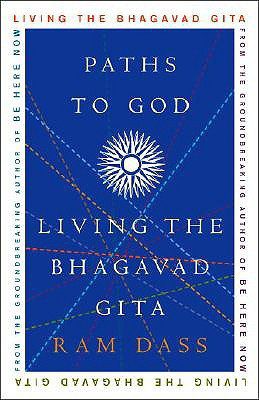
7 Gandhi’s “When doubts haunt me….” — Ram Dass, Paths to God: Living the Bhagavad Gita, xvii. This post’s title is an allusion to Ram Dass’ subtitle.
8 “Most mystics see the Arjuna’s struggle with his own family as an allegory for the how one must battle one’s own self as part of the spiritual journey” — Eknath Easwaran, The Bhagavad Gita (Classics of Indian Spirituality), 72-75.
9 Process of reading through the Gita three times — Ram Dass, Paths to God: Living the Bhagavad Gita, 9-10.
10 “the major theme of the Gita is summed up in one word: renunciation.” — Eknath Easwaran, The Bhagavad Gita (Classics of Indian Spirituality), 51.
11 The Gita “teaches that we can become free by giving up not material things, but selfish attachment to material things…” — Eknath Easwaran, The Bhagavad Gita (Classics of Indian Spirituality), 51.
12 the goal of the Gita is to do any activity without attachment — Ram Dass, Paths to God: Living the Bhagavad Gita, 133-136.136.
13 “Renounce and enjoy!” — Eknath Easwaran, The Bhagavad Gita (Classics of Indian Spirituality), 55.
14 “It isn’t better to give up sex, or better to fast; we don’t do renunciation practices to be good” — Ram Dass, Paths to God: Living the Bhagavad Gita, 133. For more on Ram Dass, see Carl Gregg, “Ram Dass and ‘Jesus as Guru’” (November 9, 2010), available at http://www.patheos.com/blogs/carlgregg/2010/11/book-review-ram-dass-and-jesus-as-guru/.
15 “I what’s your diet like? What do you eat?” And I looked down, and right there in front of me was this big pile of bones.” — Ram Dass, Paths to God: Living the Bhagavad Gita, 141-142.
16 “If you show me anybody who isn’t Uncle Henry, I’ll happily rip him off.” — Ram Dass, Paths to God: Living the Bhagavad Gita, 24.
The Rev. Dr. Carl Gregg is a trained spiritual director, a D.Min. graduate of San Francisco Theological Seminary, and the minister of the Unitarian Universalist Congregation of Frederick, Maryland. Follow him on Facebook (facebook.com/carlgregg) and Twitter (@carlgregg).
Learn more about Unitarian Universalism:
http://www.uua.org/beliefs/principles
Previous Post

June 3, 2013
We Are All Weird: What You Can Do To Stop Bullying
Next Post
June 10, 2013 Summer Reading Recommendations
Browse Our Archives
Select a Category Advent Anti-Racism Archaeology Atheism Baptism Best of the Year List Book Reviews Buddhism Catholicism Christian Education Church and State Church Planting Climate Change Conscientious Objection to War Creation Spirituality Death Penalty Didache Disability Rights Discernment Easter Ecology Emergent Church Movement Empire-Critical Ethics Evolution Feminist Theology Film Reviews Gandhi Gospel of Mark Gun Control Hinduism Immigration Reform Interfaith Islam JFK Judaism Jungian Spirituality Lectionary Commentary Lent Letters to the Editor LGBT Marriage MLK Multiculturalism Mysticism Nonviolent Activism Occupy Paganism (Earth-centered Religions) Parables Paul Pluralism Politics Process Theology Quantum Physics Requiescat In Pace Seminary and Divinity School Sermon Series Retrospective Sermons Spiritual Direction Spiritual Practices Stewardship (Fundraising) The Book of J The Wheel of the Year (Paganism) Theoblogger Challenge Triathlon Uncategorized Unitarian Universalism Worship Resources Youth Ministry
Select a Month July 2026 May 2026 March 2026 November 2025 October 2025 August 2025 February 2025 December 2024 October 2024 March 2024 January 2024 December 2023 November 2023 March 2023 February 2023 January 2023 December 2022 November 2022 August 2022 March 2022 February 2022 January 2022 December 2021 September 2021 August 2021 July 2021 June 2021 May 2021 February 2021 January 2021 December 2020 August 2020 June 2020 May 2020 April 2020 March 2020 February 2020 January 2020 December 2019 November 2019 October 2019 September 2019 July 2019 June 2019 March 2019 February 2019 January 2019 December 2018 November 2018 October 2018 September 2018 June 2018 May 2018 April 2018 March 2018 February 2018 January 2018 December 2017 November 2017 October 2017 September 2017 August 2017 July 2017 June 2017 May 2017 April 2017 March 2017 February 2017 January 2017 December 2016 November 2016 October 2016 September 2016 August 2016 June 2016 May 2016 April 2016 March 2016 February 2016 January 2016 December 2015 November 2015 October 2015 September 2015 August 2015 July 2015 June 2015 May 2015 April 2015 March 2015 February 2015 January 2015 December 2014 November 2014 October 2014 August 2014 July 2014 June 2014 May 2014 April 2014 March 2014 February 2014 January 2014 December 2013 November 2013 October 2013 September 2013 August 2013 July 2013 June 2013 May 2013 April 2013 March 2013 February 2013 January 2013 December 2012 November 2012 October 2012 September 2012 August 2012 July 2012 June 2012 May 2012 April 2012 March 2012 February 2012 January 2012 December 2011 November 2011 October 2011 September 2011 August 2011 July 2011 June 2011 May 2011 April 2011 March 2011 February 2011 January 2011 December 2010 November 2010 October 2010 August 2009 July 2009 May 2009
Follow Us!
TAKE THE
Religious Wisdom Quiz
In the Parable of the Ten Virgins, what were the wise ones prepared for?
Select your answer to see how you score.
A king The Sabbath The bridegroom A feast
Related posts from Carl Gregg

Vampires, Witches, & NPR: The Legacy of Margot...

Why You Should Give Yourself Permission for Self-Care:...

"Are You Living the Life You Chose?": How...

Why a 40-Hour Work Week? (It's Decreased Before....
TRENDING AT PATHEOS More Voices

Reading America at 250: A Nation Wrestles With...
As part of my own reflection on the 250th anniversary of the...

Whenever I am reading a book or listening to an argument, I...

President Trump Ban Animal Torture Videos on Facebook
Call for Stricter Regulations of Animal Abuse Content on Facebook Although President...

Draft Amendments to Address Ritual Abuse in New...
The proposed changes would make it illegal for individuals in domestic partnerships...

How Bans on LGBTQ+ Student Clubs Threaten Religious...
On June 20, 2025, the State of Texas passed Senate Bill 12....

The Truth About the Gen Z Revival
This past year, there has been a lot of media buzz surrounding...
view all More Voices blogs
Ad-Free & Subscriber Log-In Subscription Support
- About Us
- 2026 Calendar
- Videos
- Podcasts
- Library of World Religions
- Faith In Media Tracker
- Advertise With Us
- Write for Us
- Privacy Policy
- Terms of Service
- Do Not Sell My Data
- Contact Us
- Radiant Digital
- Manage Newsletter Subscriptions
- Unsubscribe From Notifications
- Sitemap
Copyright 2008-2026, Patheos. All rights reserved.
Subscription Support Ad-Free & Subscriber Log-In
Follow Patheos