
BuddhistCatholicContemplativeEvangelicalGeneral ChristianHinduJewishLatter-day SaintMuslimNew VisionsProgressive Christian
Beliefs
- Buddhist
- Catholic
- Contemplative
- Evangelical
- General Christian
- Hindu
- Jewish
- Latter-day Saint
- More Voices
- Muslim
- New Visions
- Pagan
- Progressive Christian
Topics
- Religion News
- Food and Religion
- Sports and Religion
- Religious Art
- Religious Music and Entertainment
- Religious Events
- History and Religion
- Style and Religion
- Politics and Religion
- Women in Religion
- Recreation Outdoors and Religion
- Business Finance and Religion
- Careers Workplace and Religion
- Education and Religion
- Family Parenting and Religion
- Health Fitness and Religion
- Home and Religion
- Relationships and Religion
- Technology and Religion
- Travel and Religion
Columnists
- Buddhist Columnists
- Business Finance and Religion Columnists
- Careers Workplace and Religion Columnists
- Catholic Columnists
- Contemplative Columnists
- Education and Religion Columnists
- Evangelists Columnists
- Family Parenting and Religion Columnists
- General Christian Columnists
- Health Fitness and Religion Columnists
- Hindu Columnists
- History and Religion Columnists
- Home and Religion Columnists
- Jewish Columnists
- More Voices Columnists
- Latter Day Columnists
- Muslim Columnists
- New Visions Columnists
- Nonreligious Columnists
- Pagan Columnists
- Politics and Religion Columnists
- Progressive Columnists
- Recreation Outdoors and Religion Columnists
- Relationships and Religion Columnists
- Religion News Columnists
- Religious Art Columnists
- Religious Events Columnists
- Religious Music and Entertainment Columnists
- Sports and Religion Columnists
- Style and Religion Columnists
- Technology and Religion Columnists
- Travel and Religion Columnists
- Women in Religion Columnists
Resource Library
- 2026 Calendar
- Library of World Religions
- The 100 Most Holy Places on Earth
- Patheos Answers
- Podcasts
- Videos
- Faith Leaders Database
- Anglican Episcopalian
- Bahai
- Baptist
- Buddhism
- Christianity
- Confucianism
- Eastern Orthodoxy
- Hinduism
- Holiness and Pentecostal
- ISKCON
- Islam
- Judaism
- Lutheran
- Methodist
- The Church of Jesus Christ of Latter-day Saints
- New Age
- Paganism
- Presbytarian and Reformed
- Protestantism
- Religion Behind the Scenes
- Roman Catholic
- Scientology
- Shia Islam
- Sikhism
- Sufism
- Sunni Islam
- Taoism
- Zen
- See all religions
Research Tools
 Ad-Free & Subscriber Log-In Subscription Support
Ad-Free & Subscriber Log-In Subscription Support
Follow Patheos 

- Trending:
- Forgiveness
- |
- Marriage
- |
- Consciousness
- |
- Death Penalty
- |
- Election
- |
- Halloween

- Home
- More Voices
- How to Motivate Members of Your Congregation to Do More
How to Motivate Members of Your Congregation to Do More
Last updated on: June 21, 2013 at 3:38 pm by Carl Gregg
How to Motivate Members of Your Congregation to Do More 2013-06-21T15:38:46-04:00 Carl Gregg
Patheos Explore the world's faith through different perspectives on religion and spirituality! Patheos has the views of the prevalent religions and spiritualities of the world.
At each year’s Unitarian Universalist Association annual General Assembly (GA), multiple official events happen concurrently from 7:00 a.m. to almost midnight each day. Yesterday was the first full day of this year’s GA, and by far the most helpful and practical event I attended was a workshop led by Mark Bernstein, a Regional Consultant for Growth Development, on “Beyond Contentment: Motivating Members to Do More.” My understanding is that a video recording of his presentation will eventually be posted online, but in the meantime, the following are my notes from his 75 minute presentation:
- People do not join a congregation in the hope that someday they will be blessed with the opportunity to make coffee for other members of the congregation, or to chair a committee. They are hurting, curious, or in need of a spiritual community.
Insights from “Management Theory”
What employees want the following from their jobs:
- leadership
- validation
- pride in their work
- trusting relationship
- teamwork,
- commitment to quality,
- involvement,
- personal and professional recognition.
Five greatest predictions of staff satisfaction:
- confidence in the leadership,
- proud to work for the agency,
- trust in what the agency tells me,
- valued at the agency,
- treats me like a person not a number.
(Note: money never shows up at the top of these lists, which are generated from anonymous surveys.)
Insights from book Contented Cows Give Better Milk: The Plain Truth about Employee Engagement and Your Bottom Line
What employees want:
- meaningful work
- high standards
- clear sense of purpose and direction
- balanced “worth-its” (investments in them, and freedom to complete task as the individual believes is best)
- level playing field (not being exploited)
- be and feel competent
Applying Maslow’s “Hierarchy of Needs” to Workplace
(Herzberg’s Motivation-Hygiene Theory)
“Hygiene Factors”
- policies
- supervision
- relationships
- work conditions
- salary
- security
“Motivation Factors”
- achievement
- recognitions
- work itself
- responsibility
- advancement
- personal growth
The critical point is that the opposite of job dissatisfaction is elimination of dissatisfaction. And the elimination of dissatisfactory hygiene factors does not motivate to achieve excellence. For example, getting paid more money does decrease dissatisfaction about getting inadequately paid, but a salary increase does not motivate an employee to either work harder or create job satisfaction.
“Hygiene Factors” in a Unitarian Universalist congregation (or in a similarly religious progressive setting):
- relationships
- covenants
- music
- worship
- pastoral care
- programming (all ages)
- coffee
Note that improving these “hygiene factors” will, at most, eliminate dissatisfaction with these factors; it will decrease the likelihood of these factors driving people away from your congregation. [Also note the strong correlation between the above “hygiene factors” and the “wish list” generated by most congregations that are in search for a new minister, and consider what that insight says about ministers can and can’t do/fix/change!]
“Motivation Factors” in a Unitarian Universalist congregation:
- achievement
- affiliation (connection with others in meaningful ways)
- power/authority [CoA report]
- link to advancing larger movement of UUism (“our life-saving faith”)
- responsibility
- meaning
- affirmation (recognition)
- personal growth
Note: these motivation factors are what will make people stay in your congregation, become active, and keep coming back.
Creating Highly Motivated Participation in Congregational Life
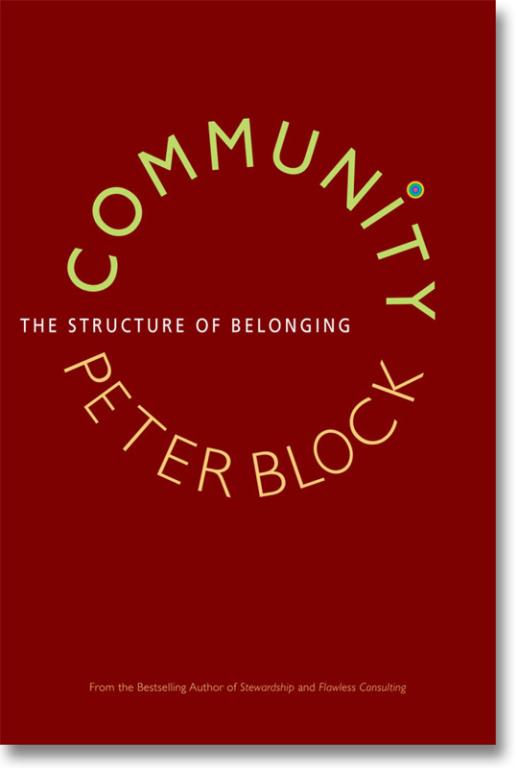 Highly Recommended Book: Peter Block, Community: The Structure of Belonging
- Cultivate Felt Sense of “Ownership” in the Congregation’s present and future.
- People need to feel ownership in room: Is this still my congregation which I can help co-create?
- Ownership asks us to act as if we are creating what exists in the world. We are cause, not effect.
- Need to feel like they are making a contribution or connecting with a a transcendent purpose larger than themselves.
- Recognition of sharing of gifts.
Ask powerful questions that evoke choice for accountability and commitment. Powerful questions do the following:
- Force person to become actor, instead of only a spectator
- Engage in an intimate way, confront them with their freedom, and invite to co-create future of the congregation with you.
- Ambiguous (not attempt to precisely define term, allowing person to define according to personal experience)
- Evokes anxiety: anything that that really matters makes us anxious.
How to Ask “Powerful Questions”
“When you discover your mission, you will feel its demand. It will fill you with enthusiasm and a burning desire to get to work on it.” —Clement Stone
We are not defined by deficiencies or what is missing. We are defined by what is present. — Appreciative Inquiry
Weak Questions Powerful Questions (Weak questions maintain dominance of questioner, who already knows the “right” answer to the simple question being asked.) (People are not a problem to be solved, but a mystery from which ever-greater truth and growth can emerge.) How do we get people to serve on the board? What gifts do you hold that you are willing to bring to this congregation? How do we get people to accept the move to two services? What are you willing to give up to move forward? (In answering you act) How do we get people to give more money? What is the commitment that you bring to this congregation? How do we get people to attend annual meetings? How valuable do we want your involvement with this congregation to be? For a new member class: What do you risk by becoming a member of this congregation? *(Anything of value comes with a cost)*How valuable an experience do you plan for this experience to be? Contribution and purpose: How do you feel called to live out your UU beliefs?What are you called to do as a member of this congregation? Acknowledgement of Gifts What is the gift(s) that you wish to share with other members of this congregation? (How will you acknowledge the fits that other members bring forth into the congregation? Need to constantly acknowledge contributions people make.)
Strategies for recruiting
- Test the waters with a asking for a one-time commitment. Test-drive with no strings attached, no pressure to join the team. If they like it, they can come back. Low-pressure environment.
- Make sure congregation knows that volunteers are needed. (Name what you would do if you had more volunteers.)
- Advertise areas that need more volunteers.
- Start a “connection desk,” where people can go to find out ways to get involved in the congregation. Mention in every service.
- Empower members to do their own recruitment.
- Recruit mini-recruiters.
- Write and share job descriptions, so that people know that they are signing up for something that is specific and doable.
- Ask people to take on tasks, not to serve on committees
- Set term limits on tenure in which any one person can service on any given committee and perhaps have committee heads elected by the congregation
- If you request that someone take on a leadership role, offer a system of support that is already in place.
- Acknowledge efforts of volunteers with mentions in at worship, in the newsletter, order of service, and celebratory events.
- UU Fellowship of Centre, Hospitality Teams [LINK]
GINE (“Good Idea No Energy”: don’t move forward until “x” number willing to invest time, not just because one person suggests it (and sometimes doesn’t even have energy themselves for acting on idea)
Four Vital Discernment Questions”:
- What is your passion?
- What are your gifts (born with)?
- What are your talents (developed)?
- What would you be willing to teach at least one other person?
“If you want to build a ship, don’t drum up people together to collect wood, and don’t assign them tasks and work, but rather teach them to long for the endless immensity of the sea.” -—Antoine de Saint-Exupery
The Rev. Dr. Carl Gregg is a trained spiritual director, a D.Min. graduate of San Francisco Theological Seminary, and the minister of the Unitarian Universalist Congregation of Frederick, Maryland. Follow him on Facebook (facebook.com/carlgregg) and Twitter (@carlgregg).
Learn more about Unitarian Universalism:
http://www.uua.org/beliefs/principles
Previous Post

June 18, 2013
Spiritual and Religious: Highlights from Lillian Daniel among the UUs
Next Post
June 22, 2013 "Standing Your Sacred Ground": Highlights from Eboo Patel's Ware Lecture
Browse Our Archives
Select a Category Advent Anti-Racism Archaeology Atheism Baptism Best of the Year List Book Reviews Buddhism Catholicism Christian Education Church and State Church Planting Climate Change Conscientious Objection to War Creation Spirituality Death Penalty Didache Disability Rights Discernment Easter Ecology Emergent Church Movement Empire-Critical Ethics Evolution Feminist Theology Film Reviews Gandhi Gospel of Mark Gun Control Hinduism Immigration Reform Interfaith Islam JFK Judaism Jungian Spirituality Lectionary Commentary Lent Letters to the Editor LGBT Marriage MLK Multiculturalism Mysticism Nonviolent Activism Occupy Paganism (Earth-centered Religions) Parables Paul Pluralism Politics Process Theology Quantum Physics Requiescat In Pace Seminary and Divinity School Sermon Series Retrospective Sermons Spiritual Direction Spiritual Practices Stewardship (Fundraising) The Book of J The Wheel of the Year (Paganism) Theoblogger Challenge Triathlon Uncategorized Unitarian Universalism Worship Resources Youth Ministry
Select a Month July 2026 May 2026 March 2026 November 2025 October 2025 August 2025 February 2025 December 2024 October 2024 March 2024 January 2024 December 2023 November 2023 March 2023 February 2023 January 2023 December 2022 November 2022 August 2022 March 2022 February 2022 January 2022 December 2021 September 2021 August 2021 July 2021 June 2021 May 2021 February 2021 January 2021 December 2020 August 2020 June 2020 May 2020 April 2020 March 2020 February 2020 January 2020 December 2019 November 2019 October 2019 September 2019 July 2019 June 2019 March 2019 February 2019 January 2019 December 2018 November 2018 October 2018 September 2018 June 2018 May 2018 April 2018 March 2018 February 2018 January 2018 December 2017 November 2017 October 2017 September 2017 August 2017 July 2017 June 2017 May 2017 April 2017 March 2017 February 2017 January 2017 December 2016 November 2016 October 2016 September 2016 August 2016 June 2016 May 2016 April 2016 March 2016 February 2016 January 2016 December 2015 November 2015 October 2015 September 2015 August 2015 July 2015 June 2015 May 2015 April 2015 March 2015 February 2015 January 2015 December 2014 November 2014 October 2014 August 2014 July 2014 June 2014 May 2014 April 2014 March 2014 February 2014 January 2014 December 2013 November 2013 October 2013 September 2013 August 2013 July 2013 June 2013 May 2013 April 2013 March 2013 February 2013 January 2013 December 2012 November 2012 October 2012 September 2012 August 2012 July 2012 June 2012 May 2012 April 2012 March 2012 February 2012 January 2012 December 2011 November 2011 October 2011 September 2011 August 2011 July 2011 June 2011 May 2011 April 2011 March 2011 February 2011 January 2011 December 2010 November 2010 October 2010 August 2009 July 2009 May 2009
Follow Us!
TAKE THE
Religious Wisdom Quiz
Who found Moses' basket in the Nile?
Select your answer to see how you score.
Pharaoh's daughter Miriam Zipporah Jochebed
Related posts from Carl Gregg

Peak Spiritual Experiences, Psychedelics, & Consciousness Research

"How the Founding Fathers Became Infallible and Our...

Vampires, Witches, & NPR: The Legacy of Margot...

“Do You Really Want to Know?” From Pope...
TRENDING AT PATHEOS More Voices

Reading America at 250: A Nation Wrestles With...
As part of my own reflection on the 250th anniversary of the...

Whenever I am reading a book or listening to an argument, I...

President Trump Ban Animal Torture Videos on Facebook
Call for Stricter Regulations of Animal Abuse Content on Facebook Although President...

Draft Amendments to Address Ritual Abuse in New...
The proposed changes would make it illegal for individuals in domestic partnerships...

How Bans on LGBTQ+ Student Clubs Threaten Religious...
On June 20, 2025, the State of Texas passed Senate Bill 12....

The Truth About the Gen Z Revival
This past year, there has been a lot of media buzz surrounding...
view all More Voices blogs
Ad-Free & Subscriber Log-In Subscription Support
- About Us
- 2026 Calendar
- Videos
- Podcasts
- Library of World Religions
- Faith In Media Tracker
- Advertise With Us
- Write for Us
- Privacy Policy
- Terms of Service
- Do Not Sell My Data
- Contact Us
- Radiant Digital
- Manage Newsletter Subscriptions
- Unsubscribe From Notifications
- Sitemap
Copyright 2008-2026, Patheos. All rights reserved.
Subscription Support Ad-Free & Subscriber Log-In
Follow Patheos