
BuddhistCatholicContemplativeEvangelicalGeneral ChristianHinduJewishLatter-day SaintMuslimNew VisionsProgressive Christian
Beliefs
- Buddhist
- Catholic
- Contemplative
- Evangelical
- General Christian
- Hindu
- Jewish
- Latter-day Saint
- More Voices
- Muslim
- New Visions
- Pagan
- Progressive Christian
Topics
- Religion News
- Food and Religion
- Sports and Religion
- Religious Art
- Religious Music and Entertainment
- Religious Events
- History and Religion
- Style and Religion
- Politics and Religion
- Women in Religion
- Recreation Outdoors and Religion
- Business Finance and Religion
- Careers Workplace and Religion
- Education and Religion
- Family Parenting and Religion
- Health Fitness and Religion
- Home and Religion
- Relationships and Religion
- Technology and Religion
- Travel and Religion
Columnists
- Buddhist Columnists
- Business Finance and Religion Columnists
- Careers Workplace and Religion Columnists
- Catholic Columnists
- Contemplative Columnists
- Education and Religion Columnists
- Evangelists Columnists
- Family Parenting and Religion Columnists
- General Christian Columnists
- Health Fitness and Religion Columnists
- Hindu Columnists
- History and Religion Columnists
- Home and Religion Columnists
- Jewish Columnists
- More Voices Columnists
- Latter Day Columnists
- Muslim Columnists
- New Visions Columnists
- Nonreligious Columnists
- Pagan Columnists
- Politics and Religion Columnists
- Progressive Columnists
- Recreation Outdoors and Religion Columnists
- Relationships and Religion Columnists
- Religion News Columnists
- Religious Art Columnists
- Religious Events Columnists
- Religious Music and Entertainment Columnists
- Sports and Religion Columnists
- Style and Religion Columnists
- Technology and Religion Columnists
- Travel and Religion Columnists
- Women in Religion Columnists
Resource Library
- 2026 Calendar
- Library of World Religions
- The 100 Most Holy Places on Earth
- Patheos Answers
- Podcasts
- Videos
- Faith Leaders Database
- Anglican Episcopalian
- Bahai
- Baptist
- Buddhism
- Christianity
- Confucianism
- Eastern Orthodoxy
- Hinduism
- Holiness and Pentecostal
- ISKCON
- Islam
- Judaism
- Lutheran
- Methodist
- The Church of Jesus Christ of Latter-day Saints
- New Age
- Paganism
- Presbytarian and Reformed
- Protestantism
- Religion Behind the Scenes
- Roman Catholic
- Scientology
- Shia Islam
- Sikhism
- Sufism
- Sunni Islam
- Taoism
- Zen
- See all religions
Research Tools
 Ad-Free & Subscriber Log-In Subscription Support
Ad-Free & Subscriber Log-In Subscription Support
Follow Patheos 

- Trending:
- Forgiveness
- |
- Marriage
- |
- Consciousness
- |
- Death Penalty
- |
- Election
- |
- Halloween

- Home
- More Voices
- Pragmatic Buddhism, Westernized Dharma, 21st-century Sangha
Pragmatic Buddhism, Westernized Dharma, 21st-century Sangha
Last updated on: May 9, 2013 at 11:07 am by Carl Gregg
Pragmatic Buddhism, Westernized Dharma, 21st-century Sangha 2013-05-09T11:07:44-04:00 Carl Gregg
Patheos Explore the world's faith through different perspectives on religion and spirituality! Patheos has the views of the prevalent religions and spiritualities of the world.
When I was about fifteen years old, I accidentally ran into some of the classic early meditation experiences described
in the ancient texts and my reluctant spiritual quest began. I did not realize what had happened, nor did I realize that I had crossed something like a point of no return, something I would later call “The Arising and Passing Away.” I knew that I had had a very strange dream with bright lights, that my entire body and world had seemed to explode like fireworks, and that afterwards I somehow had to find something, but I had no idea what that was. I philosophized frantically for years until I finally began to realize that no amount of thinking was going to solve my deeper spiritual issues and complete the cycle of practice that had already started….
In 1994, I began going on intensive meditation retreats and doing a lot of daily practice. I also ran into some very odd and interesting experiences, and began to look around for more guidance on how to proceed and keep things in perspective. Good teachers were few and far away, their time limited and often expensive to obtain, and their answers to my questions were often guarded and cryptic….
Frustrated, I turned to books, reading extensively, poring over texts…. I also came to the profound realization that they have actually worked all of this stuff out. Those darn Buddhists have come up with very simple techniques that lead directly to remarkable results if you follow instructions and get the dose high enough. While some people don’t like this sort of cookbook approach to meditation, I am so grateful for their recipes that words fail to express my profound gratitude for the success they have afforded me.
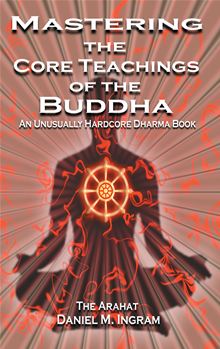
—Daniel Ingram, Mastering the Core Teachings of the Buddha:
An Unusually Hardcore Dharma Book, 11-12
This post’s title is a play on the “Three Jewels” of Buddhism: Buddha, Dharma, and Sangha. Loosely translated, we could say that those three jewels are Awakening (“Buddha” means “Awakened One”), Teaching (“Dharma” means teaching or the path to Awakening or Enlightenment), and Community (“Sangha” means the community of Buddhist practitioners). Those Three Jewels of Buddha, Dharma, and Sangha are also known as a the “Three Refuges” — they are the three things in which Buddhist practitioners can choose to take refuge: awakening, teaching, and community.
But just like the various other religious groups in this country, there are many different types of Buddhist communities. And it is always interesting to hear stories of people who, for example, flee a conservative Christian church only to discover in shock that there are strains of Buddhism with just as much rigidity, sexism, and hierarchy as the fundamentalist Christianity they were fleeing. Of course, it’s similarly fascinating to hear stories of individuals raised in a traditionalist sect of a religion who come to discover the mystical, experiential strands in their own traditions of which they were previously unaware: Sufism in Islam, Kabbalah in Judaism, and the contemplative strains in the Christian tradition.
And my interest this morning is in the type of Buddhism that is sometimes called Pragmatic Buddhism, which emphasizes what individuals can test in the crucible of their own firsthand experience. I’m less interested, other than academically, in rituals and traditions that have built up over the centuries in various Buddhist cultures, and that often have no connection to Siddhartha Gautama, the historical Buddha. Likewise, I’m interested in Westernized Dharma, Buddhist teachings that seek to integrate Western psychology, modern science, and contemporary technology. And I’m interested in twenty-first-century sangha, a Buddhist community that is of, by, and for us in this time and place.
One of many helpful guides that I have found is Daniel Ingram. Ingram is an M.D., a board-certified emergency medicine physician with a master’s degree in Public Health. He is the author of Mastering the Core Teachings of the Buddha: An Unusually Hardcore Dharma Book. However let me say upfront that I wouldn’t recommend that most people rush out to read his book. Unless hardcore Buddhist practice is right for you at this time, there are easier and better places to start.
Personally, I’m drawn both to Ingram’s pragmatism and directness about what, in his experience, does (and doesn’t) contribute to the full depths of transformation, concentration, and insight that Buddhism can offer. While there are many great introductory Buddhist books out there (and I’m grateful for many of them) there can be a temptation to stay on the surface of religious traditions. And Unitarian Universalists, as well as other religious liberals, may be particularly susceptible to that temptation to only experiment with the light, easy, and accessible aspects of world religions — only rarely delving into the heavier, harder, and less accessible aspects, even though some of the richest parts of religious traditions may only come to fruition through focused practice and study.
Pragmatic Buddhism is interested in stripping away unnecessary hindrances of dogma, ritual, hierarchy, and myth that have built up in some forms of Buddhism. And, for anyone who is wondering, yes, there is a parallel irony that both Buddhism and Christianity, in some quarters, have become dominated by dogma, rituals, and hierarchy that in many cases would be anathema to the historical Buddha and the historical Jesus. At the same time, I would readily affirm that innovations have come to light in the last few millennia of which Siddhartha Gautama and Jesus of Nazareth had no conception. But that’s why I’m drawn to pragmatism. I’m open to using all the tools at our disposal as wisely and skillfully as we are able.
Buddhists refer to that approach as “Skillful means” or “expedient means.” The approach that is useful at one time may not be useful later. As the old Buddhist parable tells us, just because a raft helps you cross a river, doesn’t mean that you have to carry that raft with you forever. Using a raft to cross the river safely is skillful means. So is too the wisdom to leave that raft at the river’s edge once you have crossed. So there may be times when ritual, myth, dogma, and hierarchy have their uses, and using them may be skillful means. But many religious communities fall into danger when they forget that those forms are merely skillful means and not ends in themselves. There are also times and places where it is wise to leave those rituals, myths, dogmas, and hierarchies by the side of the river in gratitude for their help, but also in recognition that to maintain them would be a burdensome encumbrance if, for instance, the next stage of your journey will take you through landscape (literally or metaphorically) where a raft isn’t needed. (Are there perhaps some previously skillful means in your life that you might benefit from letting go of?)
Having introduced Pragmatic Buddhism, I would like to at least briefly give you a taste of Ingram’s “Unusually Hardcore Dharma” as an example of what is possible for twenty-first century Buddhist practitioners. First, it may be helpful to name how much of a time commitment we may be talking about. Just as you need to train in increasingly large regular increments to become a concert pianist or Ironman triathlete, so too, most people who seek Awakening or Enlightenment, commit to regular training. And Ingram’s rule of thumb is similar to what I have seen in other contemplative traditions: perhaps only ten minutes per day at first, building up to perhaps twenty minutes twice a day, all the way eventually to 1-2 hours per day.
This practice allows you to strengthen your concentration skills, which allows you to stabilize what Buddhists call the “Monkey Mind.” The most I’ve ever been able to work into my schedule is 45 minutes twice a day, but that was before starting work on my dissertation. Most of us can’t do it all. And if you find yourself always falling asleep when you try to meditate, the best spiritual practice for you at this time may be committing to 8 hours a sleep a night before worrying about starting a meditation practice.
If you are currently pursuing an advanced degree, training for a marathon, starting a new job, or becoming a first-time parent, it may be not be right time to try to meditate for two hours a day. However, a high stress time could be precisely the time to commit to meditation 10-20 minute a day. I’ve heard many different busy people say, “I’m too busy not to meditate and go to the gym” (if only for thirty minutes, a few times a week) because mindfulness and exercise are keeping them sane and grounded amidst a maelstrom of commitments.
But I promised that Ingram was hardcore, so here’s an example of what it could look like to take your meditation practice to the next level. Ingram writes:
let’s say you could allocate 365 hours out of one year to formal meditation practice. Given a choice, I would be more inclined to take half of those hours, about 182, and do a ten-day retreat practicing hard and consistently eighteen hours a day with minimal breaks at the beginning of the year, and then spend half an hour meditating each of the other days. I would be much more likely to cross into some interesting territory early on and overcome some of the initial hurdles than if I spent one hour each day for that year practicing well. The amount of time and effort is the same, but the effect is likely to be quite different….. I recommend greater than five-day retreats when possible.
Perhaps now is also the time to mention that when you start listening to world-class meditators, you start hearing about things like three-year retreats — seriously! However, most of us have too many commitments to job, family, or mortgages such that a five- or ten-day retreat once a year would be a challenge, much less a three-year retreat. But here’s where pragmatism can helpfully come in again.
As you study religious traditions, it is important to become aware of what is sometimes called a “Monastic Bias,” a prejudice that the purest, most advanced forms of spirituality are only achievable by an isolated individual that is usually some form of hermit, living on the edge of a cloistered monastic community. But this monastic bias is increasingly being questioned.
I often remind couples whose wedding I will be officiating that marriage, at its best, is a school for love. The challenge and the invitation of marriage is to continually choose to love your partner. I’ve, likewise, sometimes heard children described as little Zen masters, who are naturally adept at triggering our shadow sides. As you may have seen me quote before, “Our family members are particularly good at pushing our buttons, because they are the ones who sewed our buttons on in the first place.” The point is that all parts of our life — from neurotic family members and obnoxious bosses and from stressed-out partners to high-demand children — all parts of our life are invitations to practice mindfulness and compassion if you choose to bring that intentionality to your experience.
I invite you to consider the possibility that bringing three-years of daily mindful, compassionate intentionality to your marriage, parenting, work (or any relationship, including your relationship with yourself) could be even more beneficial to your spiritual growth than a three-year retreat sequestered in the mountains. How much easier is it, for instance, to seemingly experience that you love all of humanity than to concretely and patiently love the same messy, complex, complicated set of people day after day, year after year? And I invite you to consider that the point of logging hours on your meditation cushion is not sufficient in and of itself if it doesn’t lead to greater mindfulness and compassion in the rest of your life.
Arguably someone who spends three years actively trying to practice mindfulness and compassion in every part of their life may be much better than living Buddhism in the world than someone who spends three years meditating in a highly-controlled retreat environment. That retreatant will likely have tremendous insight into reality, but will likely not be well equipped to reintegrate and live out those insights in the Western world. And speaking at least for myself and a growing number of others, my interest not in an esoteric Buddhism, but in Pragmatic Buddhism, Westernized Dharma, and a twenty-first-century Sangha.
Now there’s, of course, a lot more to be said about Buddhism, which is a 2,500 year old tradition. And Buddhists love lists, so we could explore much longer and with great benefit about the 3 Characteristics of Reality, the 4 Noble Truths, or the 8-fold Path, but since we’ve dipped our toes briefly into one teacher’s perspective on hardcore dharma, I want to be sure not to leave you with the frequent misimpression that if you were to become a hardcore Buddhist practitioner, meditate for 2 hours each day, go on a ten-day retreat each year, and experience Enlightenment, then you and your life would not be perfect as a result. You would presumably lessen your suffering, better understand the nature of reality, and increase your compassion, but neither you nor your life would be perfect. Ingram writes:
if we were to look to the life of Buddha, who by definition is as enlightened as it gets in Buddhism, lots of bad things happened to him, at least according to the texts. He had chronic headaches and back pain, got illnesses, was attacked by bandits, people tried to kill him, his own order broke into warring factions, people harassed him, and so forth and so on.
Does that sound a little like the life of Jesus, Gandhi, Martin Luther King, Jr., and so many others, who had great spiritual insights, but who still had conflict in the world — including in the case of all the figures I named being killed for their beliefs. We can’t control the vicissitudes of the world, but we can learn to respond to whatever comes our way with greater mindfulness, insight, and compassion.
For now, I leave you with this Buddhist blessing:
May you be filled with loving-kindness.
May you be well.
May you be peaceful and at ease.
May you be whole.
May we be filled with loving-kindness.
May we be well.
May we be peaceful and at ease.
May we be whole.
Notes
1 To read or listen to free interview with Daniel Ingram, see http://www.buddhistgeeks.com/author/daniel-ingram/.
2 For a free copy of Ingram’s book, see http://integrateddaniel.info/book/.
3 “easier and better places to start” — For one of many lists of Western Buddhist teachers, see “Wanna Check out Buddhism? Top 10 Buddhist Teachers Living in America,” available at http://www.huffingtonpost.com/waylon-lewis/wanna-check-out-buddhism_b_148960.html.
4 “anathema to the historical Buddha” — see Ingram, 117-120, 126.
5 “1-2 hours per day” — Ingram, 31.
6 “greater than five-day retreats when possible” — Ingram, 94.
7 For a model of how to integrate Buddhist practice and modern life, see http://www.buddhistgeeks.com/liferetreat/.
8 “not in an esoteric Buddhism” — Ingram, 141.
9 “look to the life of Buddha” — Ingram, 340.
For Further Reading
Bhante Henepola Gunaratana, Mindfulness in Plain English, 20th Anniversary Edition:
If you’d like to read about meditation and then go back to your regular life, don’t get this book. Gunaratana, a monk from Sri Lanka and venerated teacher of Buddhism, warns us that vipassana meditation is “meant to revolutionize the whole of your life experience.” In one of the best nuts-and-bolts meditation manuals, he lays out the fundamentals of basic Buddhist meditation, the how, what, where, when, and why, including common problems and how to deal with them. His 52 years as a Buddhist monk make Mindfulness in Plain English an authority on a living tradition, and his years of teaching in America and elsewhere give it the clarity and straightforwardness that has made it so popular. If you’d like to learn the practice of meditation, you can’t do better. With over a quarter of a million copies sold, Mindfulness in Plain English is one of the most influential books in the burgeoning field of mindfulness and a classic introduction to meditation.
The Rev. Dr. Carl Gregg is a trained spiritual director, a D.Min. graduate of San Francisco Theological Seminary, and the minister of the Unitarian Universalist Congregation of Frederick, Maryland. Follow him on Facebook (facebook.com/carlgregg) and Twitter (@carlgregg).
Learn more about Unitarian Universalism:
http://www.uua.org/beliefs/principles
Previous Post

April 22, 2013
Wendell Berry, Climate Change, and Earth Breathing
Next Post
May 9, 2013 Poetically Dwelling on the Earth as a Mortal
Browse Our Archives
Select a Category Advent Anti-Racism Archaeology Atheism Baptism Best of the Year List Book Reviews Buddhism Catholicism Christian Education Church and State Church Planting Climate Change Conscientious Objection to War Creation Spirituality Death Penalty Didache Disability Rights Discernment Easter Ecology Emergent Church Movement Empire-Critical Ethics Evolution Feminist Theology Film Reviews Gandhi Gospel of Mark Gun Control Hinduism Immigration Reform Interfaith Islam JFK Judaism Jungian Spirituality Lectionary Commentary Lent Letters to the Editor LGBT Marriage MLK Multiculturalism Mysticism Nonviolent Activism Occupy Paganism (Earth-centered Religions) Parables Paul Pluralism Politics Process Theology Quantum Physics Requiescat In Pace Seminary and Divinity School Sermon Series Retrospective Sermons Spiritual Direction Spiritual Practices Stewardship (Fundraising) The Book of J The Wheel of the Year (Paganism) Theoblogger Challenge Triathlon Uncategorized Unitarian Universalism Worship Resources Youth Ministry
Select a Month July 2026 May 2026 March 2026 November 2025 October 2025 August 2025 February 2025 December 2024 October 2024 March 2024 January 2024 December 2023 November 2023 March 2023 February 2023 January 2023 December 2022 November 2022 August 2022 March 2022 February 2022 January 2022 December 2021 September 2021 August 2021 July 2021 June 2021 May 2021 February 2021 January 2021 December 2020 August 2020 June 2020 May 2020 April 2020 March 2020 February 2020 January 2020 December 2019 November 2019 October 2019 September 2019 July 2019 June 2019 March 2019 February 2019 January 2019 December 2018 November 2018 October 2018 September 2018 June 2018 May 2018 April 2018 March 2018 February 2018 January 2018 December 2017 November 2017 October 2017 September 2017 August 2017 July 2017 June 2017 May 2017 April 2017 March 2017 February 2017 January 2017 December 2016 November 2016 October 2016 September 2016 August 2016 June 2016 May 2016 April 2016 March 2016 February 2016 January 2016 December 2015 November 2015 October 2015 September 2015 August 2015 July 2015 June 2015 May 2015 April 2015 March 2015 February 2015 January 2015 December 2014 November 2014 October 2014 August 2014 July 2014 June 2014 May 2014 April 2014 March 2014 February 2014 January 2014 December 2013 November 2013 October 2013 September 2013 August 2013 July 2013 June 2013 May 2013 April 2013 March 2013 February 2013 January 2013 December 2012 November 2012 October 2012 September 2012 August 2012 July 2012 June 2012 May 2012 April 2012 March 2012 February 2012 January 2012 December 2011 November 2011 October 2011 September 2011 August 2011 July 2011 June 2011 May 2011 April 2011 March 2011 February 2011 January 2011 December 2010 November 2010 October 2010 August 2009 July 2009 May 2009
Follow Us!
TAKE THE
Religious Wisdom Quiz
What city is known as the Holy City, sacred to Jews, Christians, and Muslims?
Select your answer to see how you score.
Athens Cairo Rome Jerusalem
Related posts from Carl Gregg

Peak Spiritual Experiences, Psychedelics, & Consciousness Research
Beyond “McMindfulness”: How Not To Get Stuck in...
In the Face of Despair — Choosing Hope,...
Lodro Rinzler’s Millennial Hipster Buddhism
TRENDING AT PATHEOS More Voices

Reading America at 250: A Nation Wrestles With...
As part of my own reflection on the 250th anniversary of the...

Whenever I am reading a book or listening to an argument, I...

President Trump Ban Animal Torture Videos on Facebook
Call for Stricter Regulations of Animal Abuse Content on Facebook Although President...

Draft Amendments to Address Ritual Abuse in New...
The proposed changes would make it illegal for individuals in domestic partnerships...

How Bans on LGBTQ+ Student Clubs Threaten Religious...
On June 20, 2025, the State of Texas passed Senate Bill 12....

The Truth About the Gen Z Revival
This past year, there has been a lot of media buzz surrounding...
view all More Voices blogs
Ad-Free & Subscriber Log-In Subscription Support
- About Us
- 2026 Calendar
- Videos
- Podcasts
- Library of World Religions
- Faith In Media Tracker
- Advertise With Us
- Write for Us
- Privacy Policy
- Terms of Service
- Do Not Sell My Data
- Contact Us
- Radiant Digital
- Manage Newsletter Subscriptions
- Unsubscribe From Notifications
- Sitemap
Copyright 2008-2026, Patheos. All rights reserved.
Subscription Support Ad-Free & Subscriber Log-In
Follow Patheos