
BuddhistCatholicContemplativeEvangelicalGeneral ChristianHinduJewishLatter-day SaintMuslimNew VisionsProgressive Christian
Beliefs
- Buddhist
- Catholic
- Contemplative
- Evangelical
- General Christian
- Hindu
- Jewish
- Latter-day Saint
- More Voices
- Muslim
- New Visions
- Pagan
- Progressive Christian
Topics
- Religion News
- Food and Religion
- Sports and Religion
- Religious Art
- Religious Music and Entertainment
- Religious Events
- History and Religion
- Style and Religion
- Politics and Religion
- Women in Religion
- Recreation Outdoors and Religion
- Business Finance and Religion
- Careers Workplace and Religion
- Education and Religion
- Family Parenting and Religion
- Health Fitness and Religion
- Home and Religion
- Relationships and Religion
- Technology and Religion
- Travel and Religion
Columnists
- Buddhist Columnists
- Business Finance and Religion Columnists
- Careers Workplace and Religion Columnists
- Catholic Columnists
- Contemplative Columnists
- Education and Religion Columnists
- Evangelists Columnists
- Family Parenting and Religion Columnists
- General Christian Columnists
- Health Fitness and Religion Columnists
- Hindu Columnists
- History and Religion Columnists
- Home and Religion Columnists
- Jewish Columnists
- More Voices Columnists
- Latter Day Columnists
- Muslim Columnists
- New Visions Columnists
- Nonreligious Columnists
- Pagan Columnists
- Politics and Religion Columnists
- Progressive Columnists
- Recreation Outdoors and Religion Columnists
- Relationships and Religion Columnists
- Religion News Columnists
- Religious Art Columnists
- Religious Events Columnists
- Religious Music and Entertainment Columnists
- Sports and Religion Columnists
- Style and Religion Columnists
- Technology and Religion Columnists
- Travel and Religion Columnists
- Women in Religion Columnists
Resource Library
- 2026 Calendar
- Library of World Religions
- The 100 Most Holy Places on Earth
- Patheos Answers
- Podcasts
- Videos
- Faith Leaders Database
- Anglican Episcopalian
- Bahai
- Baptist
- Buddhism
- Christianity
- Confucianism
- Eastern Orthodoxy
- Hinduism
- Holiness and Pentecostal
- ISKCON
- Islam
- Judaism
- Lutheran
- Methodist
- The Church of Jesus Christ of Latter-day Saints
- New Age
- Paganism
- Presbytarian and Reformed
- Protestantism
- Religion Behind the Scenes
- Roman Catholic
- Scientology
- Shia Islam
- Sikhism
- Sufism
- Sunni Islam
- Taoism
- Zen
- See all religions
Research Tools
 Ad-Free & Subscriber Log-In Subscription Support
Ad-Free & Subscriber Log-In Subscription Support
Follow Patheos 

- Trending:
- Forgiveness
- |
- Marriage
- |
- Consciousness
- |
- Death Penalty
- |
- Election
- |
- Halloween

- Home
- More Voices
- Poetically Dwelling on the Earth as a Mortal
Poetically Dwelling on the Earth as a Mortal
Last updated on: December 27, 2014 at 9:16 am by Carl Gregg
Poetically Dwelling on the Earth as a Mortal 2014-12-27T09:16:10-05:00 Carl Gregg
Patheos Explore the world's faith through different perspectives on religion and spirituality! Patheos has the views of the prevalent religions and spiritualities of the world.
I am a religious skeptic. I don’t believe in Yahweh, Allah, Krishna, or Ogun; nor do I believe in the resurrection of bodies
two days dead and buried, nor water changing into wine, nor men walking about unharmed in fiery furnaces. Likewise for angels, ghosts, demons, statues that weep milk, and miraculous cures effected by the blessed water of Lourdes. About my skepticism, I feel neither pride nor shame; it’s not an achievement, nor is it a failing. It’s just a fact about me . . . a fact that doesn’t have much to do with the way I actually live my life….
Given what we . . . know about the world, all these things just don’t seem sensible to me. Crucial evidence for them is lacking, and important contrary evidence is routinely ignored or patronized…. I used to believe in some of these things, I admit, just as I used to believe in [Old St. Nick] and in the value of intercollegiate athletics; but for good or for ill, the world I’ve come to inhabit in my mid-fifties hasn’t supported my earlier — and somewhat nicer — conceptions of it.
Not that I think that all who do still believe in the things I’ve mentioned are crazy or irrational or naive: there are perfectly good anthropological and psychological explanations for such belief (and for my unbelief too, naturally)…. [N]one of us — skeptic or believer — is in a position to throw large stones. Each of us has to live in the world she thinks she sees, staring and squinting to the limits of her vision. Lots of us will turn out to be wrong about some of the things we think are most important to us. But finally we have to call ‘ em like we see’ em, and then live with — and of course argue about — the results.
—James Edwards, “A Skeptical Perspective”
A few weeks ago I posted on “The Spirituality of Spring: Creativity as Spiritual Practice.” And in that post, I quoted the groundbreaking modern dancer and choreographer Martha Graham (1894-1991), who said,
There is a vitality, a life force, a quickening that is translated through you into action, and because there is only one of you in all time, this expression is unique. If you block it, it will never exist through any other medium and be lost. The world will not have it. It is not your business to determine how good it is; nor how valuable it is; nor how it compares with other expressions. It is your business to keep it yours, clearly and directly, to keep the channel open.
In this follow-up post, I would like to pickup on that thread of keeping the channel open of the unique vitality, creativity, and imagination that is expressed in, with, and through each one of us.
Part of why I scheduled this topic is in response to reading and reflecting on poetry in April, which is National Poetry month. Creativity is found in many different forms — from the social and emotional intelligence of how we interact with one another, to the inventiveness of athletic prowess in sports, to all forms of artistic expression. But the genre of poetry is particularly ripe for exploring human beings as channels of creativity because poetry often results in a playfulness of form, expanding the boundaries of language, and gesturing toward new ways of experiencing ourselves and the world. Indeed, our English word poem derives from the ancient Greek word poiesis (ποίησις), which is a verb meaning “to make” — in the sense of something new being brought into the world.
And the title of this post comes from a poem by the 19th-century German Romantic poet Johann Hölderlin (1770-1843). A century later, the philosopher Martin Heidegger (1889-1976) published on essay on Hölderlin’s poem titled, “Poetically Man Dwells.” And although there is a lot to be said about Hölderlin and Heidegger, I want to skip ahead to the 21st-century and Jim Edwards, the undergraduate professor who introduced me to Hölderlin, Heidegger, and many other creative seekers of wisdom through the ages.
Many lectures, sermons, and blog posts are forgettable. They may well be meaningful and useful at the time, but occasionally a something you hear or read (for whatever combination of reasons) is both meaningful and memorable — that is, some idea, word, or phrase, sticks with you, even years later. For me, Dr. Edwards’ classes had a much higher percentage than most classes I’ve taken of moments that were both meaningful and memorable. And that’s not an opinion unique to me. I attended Furman University in Greenville, South Carolina, which is a liberal arts college that places high value of teaching. And despite a large number of highly talented and dedicated professors, Dr. Edwards, in 2011, become the only faculty member in Furman history to receive the university’s meritorious teaching award for a second time.
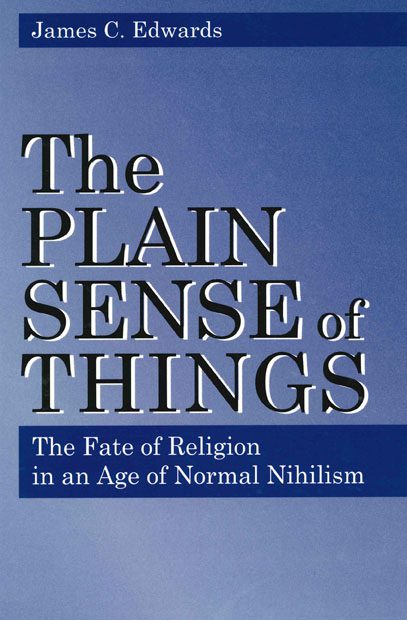
And one of many phrases that has stuck with me from Dr. Edwards — even now, almost two decades later — is his attempt to name what he had learned in his many decades of teaching and studying philosophy about what it should mean to be religious as citizens of the 21st-century — in light of all that we know about ourselves and universe from Copernicus, Darwin, Freud, Einstein, Hubble, and many other paradigm-shifting thinkers. In his book The Plain Sense of Things: The Fate of Religion in an Age of Normal Nihilism, Edwards writes, alluding to Hölderlin and Heidegger, “What should it mean for us to be religious? I have answered it thus: to dwell poetically on the earth as a moral.” And I would like to us to offer that phrase to you — “to dwell poetically on the earth as a mortal” — that together we might explore, if only briefly, how it might point us toward meaning and shape for our own lives.
Perhaps one reason that Edwards’ suggestion has stuck with me of what it should mean for us to be religious in the early 21st-century is that Edwards was also the most well-known, articulate, and matter-of-fact of atheist at my college. And although these days there seems to be a new headline everyday about the “Rise of the Nones,” who identify as “spiritual, but not religious,” back in the 1990s in South Carolina, outspoken atheists were rare. I had a few good friends in high school that were self-professed agnostics, but Dr. Edwards was — if not the first atheist I knew well — then certainly the first atheist I met who made atheism seem like a serious, well-considered worldview that a healthy, thoughtful, compassionate adult could choose.
I remember him challenging us in class by saying that atheism, his skepticism, and his lack of traditional religious belief had little to the do with the way he lived his life. The flip slide of that point was (at least for most people in the Western world in the 21st-century) that most people’s religious belief also don’t have that much to do what the way they live their lives. Most people’s socio-economic status affects the car they drive, the size how they live in, and how they spend their time much more than their religious beliefs. If the opposite were the case (if people’s religious beliefs were the primary determinative factor in their lives), then you would presumably see a much smaller wealth gap in this allegedly highly Christian country, and much more aid based on need instead of perceived merit. To name only one of many examples, the second chapter of The Book of Acts gives us this vision of the early church:
44 All who believed were together and had all things in common; 45 they would sell their possessions and goods and distribute the proceeds to all, as any had need.
Edwards challenged me to see much more clearly than I had previously how easy it was for a growing number of people to be “good without God” as well as to see how many supposedly religious people seemed to worship money and status more than God.
Perhaps I should add that Edwards would likely qualify that, despite his atheism, he was not a humanist per se. If anything, Edwards is a thoroughgoing pragmatist (who believes in emphasizing “what works”) and a committed historicist (meaning that our lives and worldviews are deeply influenced by the contingencies of the historical context into which we are born). Edwards has written, for example, that
My failure to believe in some large things (such as God) doesn’t necessarily mean that I do believe in some other large things (such as “Humanity” or “Science” or “Reason.” [in the sense of those concepts transcending a historical context]) If I can be said to “believe in” anything at all, it’s a series of fairly small things: I believe in keeping the Kirtland’s Warblers alive, in keeping (most of) one’s promises, in cultivating a decent regard for the truth, in offering kindnesses to strangers (including the strangers within ourselves), in making things better for the sick and the poor, in preserving a healthy vulgarity, and so forth.
Given this background, my interest was piqued when I would hear Edwards, the staunch atheist and committed pragmatist, say, “What should it mean for us to be religious?” And I was equally intrigued by his answer: “to dwell poetically on the earth as a moral.” As an atheist, Edwards’ choice to use that word “religious” is intentional, and I suspect it is related to his historicism. For better or worse, we live in a time in which our culture has a strong and complex religious history from which to draw. And as an inheritor of this history, Edwards writes, “we need and luckily still have available to us, practices that can contain, concentrate, and transmit the sacramental energies — energies for limitation in the face of hubris and for transformation in the face of complacency — that used to be bound up in the stories of the gods.”
That word practice is important here because what we do is almost always more important that what we say we believe. As the social psychologists tell us, “Behavior is believable.” So what are these practices that are still available to us with which we can be religious without also being dishonest to 21st-century knowledge? Yes, some of those practices do look like poetry and other forms of art, but as important as it is to create time and space to keep the channel open for that unique vitality, creativity, and imagination that is expressed in, with, and through each one of us — it’s important to name that it would be exhausting to try and spectacularly creative all the time.
Along these lines, the novelist Norman Maclean, used to tell this story about the physicist A. A. Michelson:
When I was a young teacher and still thought of myself as a billiards player, I had the pleasure of watching Albert Abraham Michelson play billiards nearly every noon. He was by then one of our national idols, having been the first American to win the Nobel Prize in science (for the measurement of the speed of light, among other things). To me, he took on added luster because he was the best amateur billiards player I had ever seen. One noon, while he was still shaking his head at himself for missing an easy shot after he had had a run of thirty-five or thirty-six, I said to him, “You are a fine billiards play, Mr. Michelson.” He shook his head at himself and said, “No, I am getting old. I can still make the long three-cushion shots, but I’m losing my touch on the short ones. He chalked up, but instead of taking the next shot, he finished what he had to say, “Billiards, though is a good game, but billiards is not as good a game as chess.” Still chalking his cue, he said, “Chess, though, is not as good a game as painting.” He made it final by saying, “But painting is not as good a game as physics.” Then he hung up his cue and went home to spend the afternoon painting under the large tree on his front lawn.
For me, the equivalent might be to say that Ultimate Frisbee is a good game. But frisbee is not as good a game as watching and discussing excellent films. And film criticism is not as good a game as preaching sermons, teaching classes, and writing books. Then perhaps I would go home and watching a film.
What would the equivalent practices be for you — that allow you to dwell poetically on the earth as a mortal? What are your practices of authenticity? The practices that make you feel grateful, more alive, more yourself, and more connected to other people and to the world? What people, place, or things do you need more of (or less of) to make time and space for your poetic practices?
Edwards also points to Thoreau’s Walden as an example of how we can learn to see even the simplest parts of our lives an invitations to dwell poetically. Thoreau writes, “I got up early and bathed in the pond; that was a religious exercise.”
Those of us fortunate enough to have regular access to a shower with a cascade of hot water whenever we want it: that shower is an invitation not to one more thing to do before we get out the door in the morning. That hot shower is an invitation to gratitude, to savoring, to refreshment and renewal; it’s an invitation to dwell poetically on this earth. It’s an invitation to experience a depth dimension in bathing, walking the dog, cooking, and other seemingly mundane activities, and see those experiences potentially as religious experiences that connect us to what Unitarian Universalists call the “interdependent web of all existence.” And how we treat all the little parts of our lives matters because, for the most part, that’s what adds up to our life. As Annie Dillard has said, “How we spend our days is, of course, how we spend our lives.”
As we sit with this invitation to dwell more poetically on this earth and to more intentionally keep the channel open of the unique vitality, creativity, and imagination that is expressed in, with, and through each one of us, it is significant to note that Edwards, the self-avowed atheist, goes so far as to use the word grace to describe what it has felt like to him to attempt to dwell more poetically on this earth. In considering where creativity comes from, he writes,
I cannot survey the contents of my imagination as I can the contents of my sock-drawer. What appears in my imagination appears spontaneously, as unpredictably as a river floodtide in spring. I can ask for water, but I cannot make it rain. I can work and work on my lines, but I cannot add a cubit to the stature of even a single sentence. That, if it comes, is grace.
I think here that he means grace in a certain sense of “giveness” — that comes free, gratis, like a gift.
To that end, and in the spirit of National Poetry Month (even though it is now May!), I invite you to hear a poem from Jan Richardson titled “Blessing in the Chaos.” As you listen to this poem, I invite you reflect on what it feels like inside yourself when you open yourself to imagination and creativity. Richardson writes:
To all that is chaotic
in you,
let there come silence.Let there be
a calming
of the clamoring,
a stilling
of the voices that
have laid their claim
on you….Let there be
an opening
into the quiet
that lies beneath
the chaos,
where you find
the peace
you did not think
possible
and see what shimmers
within the storm.
Those are good words, but I want to give the last words to Jim Edwards.
First, I invite you to consider the conclusion that Edwards chose for a lecture he was invited to give in 1984 on the subject of “What Really Matters?” He chosen, in that case, to give his last words to Thoreau, again from Walden. To me, these words particularly speak to the mortality part — the sense that each of us has a limited time — to “dwell poetically on the earth as a mortal.” Thoreau writes, “Be it life or death, we crave only reality. If we are really dying, let us hear the rattle in our throats and feel cold in the extremities; if we are alive, let us go about our business.”
A decade after that speech on “What Really Matters,” Edwards wrote the final sentences to his book The Plain Sense of Things: The Fate of Religion in an Age of Normal Nihilism. These concluding words are in many ways a contemporary updating of Thoreau’s musings from a century-and-a-half earlier. They are Edwards’ attempt to suggest how he — and perhaps we as well — can find meaning in midst this complex and messy life:
What should it means for us to be religious? I have answered it thus: to dwell poetically on the earth as a mortal. That the question and its proper answer might at some time be unintelligible or trivial is not the point, so far as I can see. This is our life: Should we not live it as simply and sincerely and joyfully as we can?
Notes
1 Ogun — a deity is the Yoruba religion from the region around modern Nigeria.
2 James Edwards, “A Skeptical Perspective” in Furman Studies: Furman University’s Religious Identity (1997), 160-161.
3Agnes De Mille, Martha: The Life and Work of Martha Graham: A Biography.
4 “My failure to believe in some large things” — James Edwards, “A Skeptical Perspective” in Furman Studies: Furman University’s Religious Identity (1997), 162.
5 “we need and luckily still have available to us” — James C. Edwards, The Plain Sense of Things: The Fate of Religion in an Age of Normal Nihilism, ix.
6 Norman Maclean — James C. Edwards, The Plain Sense of Things: The Fate of Religion in an Age of Normal Nihilism, 223. See also, “Norman Maclean Learns From the Master,” available in http://www.laphamsquarterly.org/voices-in-time/norman-maclean-learns-from-the-master.php?page=all.
7 James C. Edwards, The Plain Sense of Things: The Fate of Religion in an Age of Normal Nihilism, 210.
8 “What Really Matters?” — James C. Edwards, “The Common Ground of Athens and Jerusalem” (1984), available at http://www2.furman.edu/sites/chaplaincy/LDJohnsonLectureSeries/Documents/Edwardslecture.pdf.
The Rev. Dr. Carl Gregg is a trained spiritual director, a D.Min. graduate of San Francisco Theological Seminary, and the minister of the Unitarian Universalist Congregation of Frederick, Maryland. Follow him on Facebook (facebook.com/carlgregg) and Twitter (@carlgregg).
Learn more about Unitarian Universalism:
http://www.uua.org/beliefs/principles
Previous Post

May 6, 2013
Pragmatic Buddhism, Westernized Dharma, 21st-century Sangha
Next Post
May 26, 2013 All Bodies Count: Memorial Day, Fallen Soldiers & Civilian Casualties
Browse Our Archives
Select a Category Advent Anti-Racism Archaeology Atheism Baptism Best of the Year List Book Reviews Buddhism Catholicism Christian Education Church and State Church Planting Climate Change Conscientious Objection to War Creation Spirituality Death Penalty Didache Disability Rights Discernment Easter Ecology Emergent Church Movement Empire-Critical Ethics Evolution Feminist Theology Film Reviews Gandhi Gospel of Mark Gun Control Hinduism Immigration Reform Interfaith Islam JFK Judaism Jungian Spirituality Lectionary Commentary Lent Letters to the Editor LGBT Marriage MLK Multiculturalism Mysticism Nonviolent Activism Occupy Paganism (Earth-centered Religions) Parables Paul Pluralism Politics Process Theology Quantum Physics Requiescat In Pace Seminary and Divinity School Sermon Series Retrospective Sermons Spiritual Direction Spiritual Practices Stewardship (Fundraising) The Book of J The Wheel of the Year (Paganism) Theoblogger Challenge Triathlon Uncategorized Unitarian Universalism Worship Resources Youth Ministry
Select a Month July 2026 May 2026 March 2026 November 2025 October 2025 August 2025 February 2025 December 2024 October 2024 March 2024 January 2024 December 2023 November 2023 March 2023 February 2023 January 2023 December 2022 November 2022 August 2022 March 2022 February 2022 January 2022 December 2021 September 2021 August 2021 July 2021 June 2021 May 2021 February 2021 January 2021 December 2020 August 2020 June 2020 May 2020 April 2020 March 2020 February 2020 January 2020 December 2019 November 2019 October 2019 September 2019 July 2019 June 2019 March 2019 February 2019 January 2019 December 2018 November 2018 October 2018 September 2018 June 2018 May 2018 April 2018 March 2018 February 2018 January 2018 December 2017 November 2017 October 2017 September 2017 August 2017 July 2017 June 2017 May 2017 April 2017 March 2017 February 2017 January 2017 December 2016 November 2016 October 2016 September 2016 August 2016 June 2016 May 2016 April 2016 March 2016 February 2016 January 2016 December 2015 November 2015 October 2015 September 2015 August 2015 July 2015 June 2015 May 2015 April 2015 March 2015 February 2015 January 2015 December 2014 November 2014 October 2014 August 2014 July 2014 June 2014 May 2014 April 2014 March 2014 February 2014 January 2014 December 2013 November 2013 October 2013 September 2013 August 2013 July 2013 June 2013 May 2013 April 2013 March 2013 February 2013 January 2013 December 2012 November 2012 October 2012 September 2012 August 2012 July 2012 June 2012 May 2012 April 2012 March 2012 February 2012 January 2012 December 2011 November 2011 October 2011 September 2011 August 2011 July 2011 June 2011 May 2011 April 2011 March 2011 February 2011 January 2011 December 2010 November 2010 October 2010 August 2009 July 2009 May 2009
Follow Us!
TAKE THE
Religious Wisdom Quiz
What city is known as the Holy City, sacred to Jews, Christians, and Muslims?
Select your answer to see how you score.
Athens Cairo Rome Jerusalem
Related posts from Carl Gregg

Vampires, Witches, & NPR: The Legacy of Margot...

Why You Should Give Yourself Permission for Self-Care:...

"Are You Living the Life You Chose?": How...
TRENDING AT PATHEOS More Voices

Reading America at 250: A Nation Wrestles With...
As part of my own reflection on the 250th anniversary of the...

Whenever I am reading a book or listening to an argument, I...

President Trump Ban Animal Torture Videos on Facebook
Call for Stricter Regulations of Animal Abuse Content on Facebook Although President...

Draft Amendments to Address Ritual Abuse in New...
The proposed changes would make it illegal for individuals in domestic partnerships...

How Bans on LGBTQ+ Student Clubs Threaten Religious...
On June 20, 2025, the State of Texas passed Senate Bill 12....

The Truth About the Gen Z Revival
This past year, there has been a lot of media buzz surrounding...
view all More Voices blogs
Ad-Free & Subscriber Log-In Subscription Support
- About Us
- 2026 Calendar
- Videos
- Podcasts
- Library of World Religions
- Faith In Media Tracker
- Advertise With Us
- Write for Us
- Privacy Policy
- Terms of Service
- Do Not Sell My Data
- Contact Us
- Radiant Digital
- Manage Newsletter Subscriptions
- Unsubscribe From Notifications
- Sitemap
Copyright 2008-2026, Patheos. All rights reserved.
Subscription Support Ad-Free & Subscriber Log-In
Follow Patheos