
BuddhistCatholicContemplativeEvangelicalGeneral ChristianHinduJewishLatter-day SaintMuslimNew VisionsProgressive Christian
Beliefs
- Buddhist
- Catholic
- Contemplative
- Evangelical
- General Christian
- Hindu
- Jewish
- Latter-day Saint
- More Voices
- Muslim
- New Visions
- Pagan
- Progressive Christian
Topics
- Religion News
- Food and Religion
- Sports and Religion
- Religious Art
- Religious Music and Entertainment
- Religious Events
- History and Religion
- Style and Religion
- Politics and Religion
- Women in Religion
- Recreation Outdoors and Religion
- Business Finance and Religion
- Careers Workplace and Religion
- Education and Religion
- Family Parenting and Religion
- Health Fitness and Religion
- Home and Religion
- Relationships and Religion
- Technology and Religion
- Travel and Religion
Columnists
- Buddhist Columnists
- Business Finance and Religion Columnists
- Careers Workplace and Religion Columnists
- Catholic Columnists
- Contemplative Columnists
- Education and Religion Columnists
- Evangelists Columnists
- Family Parenting and Religion Columnists
- General Christian Columnists
- Health Fitness and Religion Columnists
- Hindu Columnists
- History and Religion Columnists
- Home and Religion Columnists
- Jewish Columnists
- More Voices Columnists
- Latter Day Columnists
- Muslim Columnists
- New Visions Columnists
- Nonreligious Columnists
- Pagan Columnists
- Politics and Religion Columnists
- Progressive Columnists
- Recreation Outdoors and Religion Columnists
- Relationships and Religion Columnists
- Religion News Columnists
- Religious Art Columnists
- Religious Events Columnists
- Religious Music and Entertainment Columnists
- Sports and Religion Columnists
- Style and Religion Columnists
- Technology and Religion Columnists
- Travel and Religion Columnists
- Women in Religion Columnists
Resource Library
- 2026 Calendar
- Library of World Religions
- The 100 Most Holy Places on Earth
- Patheos Answers
- Podcasts
- Videos
- Faith Leaders Database
- Anglican Episcopalian
- Bahai
- Baptist
- Buddhism
- Christianity
- Confucianism
- Eastern Orthodoxy
- Hinduism
- Holiness and Pentecostal
- ISKCON
- Islam
- Judaism
- Lutheran
- Methodist
- The Church of Jesus Christ of Latter-day Saints
- New Age
- Paganism
- Presbytarian and Reformed
- Protestantism
- Religion Behind the Scenes
- Roman Catholic
- Scientology
- Shia Islam
- Sikhism
- Sufism
- Sunni Islam
- Taoism
- Zen
- See all religions
Research Tools
 Ad-Free & Subscriber Log-In Subscription Support
Ad-Free & Subscriber Log-In Subscription Support
Follow Patheos 

- Trending:
- Forgiveness
- |
- Marriage
- |
- Consciousness
- |
- Death Penalty
- |
- Election
- |
- Halloween

- Home
- More Voices
- What Is Our Conveyer Belt? Stages of Faith
What Is Our Conveyer Belt? Stages of Faith
Last updated on: March 21, 2013 at 1:45 am by Carl Gregg
What Is Our Conveyer Belt? Stages of Faith 2013-03-21T01:45:55-04:00 Carl Gregg
Patheos Explore the world's faith through different perspectives on religion and spirituality! Patheos has the views of the prevalent religions and spiritualities of the world.
This post’s title (“What Is Our Conveyer Belt?”) is a reference to a chapter in philosopher Ken Wilber’s book Integral Spirituality. One of Wilber’s particular interests is in stages of development. Both individually and in groups there is potential to progress through stages of development along many different lines.
For example, there are stages of kinesthetic development as babies learn to first hold their neck up, then roll over, crawl, walk, and run — and some people even reach Olympic levels of kinesthetic development that most of us will never reach.There are also stages of cognitive development as babies learn to differentiate their sense of self from their environment, then to talk, read, and write — leading all the way up to world-class levels of cognitive development that most of us will never reach like Nobel Prize-level inventiveness. Similarly, we can outlines the stages of moral, emotional, or aesthetic development. The focus of this post will be on some of the stages of spiritual development.
One framework that Wilber offers for thinking about stages of development is the metaphor of a conveyer belt. He invites readers to consider the “conveyer belts,” so to speak, that facilitate progress through stages of development in the various organizations of which we are a part. For example, one traditional conveyer belt for cognitive development is preschool all the way through graduate program to research laboratories and think tanks. Traditional conveyer belts for kinesthetic development are community sports programs all the way through specialized professional training camps. We have art schools for aesthetic development and therapy for emotional development.
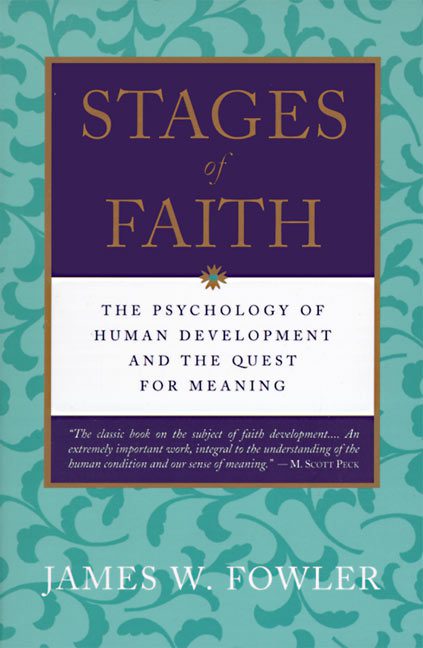 To reflect on Wilber’s metaphor of a conveyer belt, I would like to use the lens of James Fowler’s classic 1981 book Stages of Faith. Fowler highlights six potential stages of faith development that span the course of a human life, although technically he has seven stages because he begins with “Stage 0, Primal or Undifferentiated” faith, which lasts from birth through age two.
Barring any traumatic events, most of us continue naturally around age three into “Stage 1, Intuitive-Projective” faith. This early childhood faith is characterized by intuition, imagination, and emotion. Next, the growing ability to think concretely and rationally that arises around the same time most children enter elementary school is precisely what catapults many into “Stage 2, Mythic-Literal” faith.
Instead of the freewheeling fantasy characteristic of “Stage 1, Intuitive-Projective,” “Stage 2, Mythic-Literal” involves a more wooden, concrete understanding of myths and stories. For example, a child listening to traditional religious stories may well literally think of God as a super-sized human, who lives above the sky.
The transition to “Stage 3, Synthetic-Conventional” faith is triggered by adolescence. As a child grows and experiences more of the world, the messiness, complexity, and diversity of life challenge the simplistic, literal understandings of childhood faith. Cognitively, adolescents are also better able than egocentric children to empathetically sense what life is like from the perspective of other people.
For better or worse, an increased ability to consider how other people see you often leads to conformity in an attempt to seem less different or strange. In Stage 3, as the name “Synthetic-Conventional” suggests, you begin to synthesize the conventions around you. Or, as Fowler’s cute jingle goes, “As I see you seeing me, I construct the me I think you see.” In other words, instead of looking inward for our particular gifts and graces, our natural tendency in adolescence is, for the most part, to build our identity based on trends, fads, and how we think others want us to be. The tragedy, of course, is that most people don’t even know what they truly want for themselves — much less what they really want and need from others. So, to construct your identity on your perception of what others want is to build your house on shifting sand that is often unable to withstand the storms life brings.
I mentioned earlier that “Stage 3, Synthetic-Conventional” faith usually begins in the teenage years, but unfortunately many adults remain in this stage of faith development for most of their lives — even as, at the same time, they may continue to development kinesthetic, emotionally, aesthetically, etc. This dynamic of different levels of develop in different areas within the same person helps explain professional athletes, who may be at the height of kinesthetic development, but who are essentially adolescent in their faith development. Similarly, one could be incredibly accomplish in cognitive development, but have an underdevelopment aesthetically regarding an appreciation for art and beauty. Or there are wise spiritual teachers (who are legitimately insightful spiritual practitioners), who simultaneously have underdeveloped moral sides leading, for example, to sexual abuse.
And although some individuals and groups do experience an arrested development in Stage 3, the movement to “Stage 4, Individuative-Reflective” faith does begin for many people in early adulthood. As we enter our twenties or thirties, many people “leave home” either literally or metaphorically — that is, their primary source of authority moves from outside the self (their friends and family) to inside the self. They begin to “individuate,” to become autonomous individuals; they separate from the herd and take individual responsibility for reflecting on who they are and what they are able to do in the world. This shift is vital, but difficult, which is why some never fully enter this stage. For some this change begins as one goes to college or leaves home to start an independent life. For others, an unexpected “train wreck” of sorts forces their hands: a death, an illness, an accident, a loss, a divorce can lead to a situation where one’s childhood theology — often the dominant theology of one’s friends, family, and community — is no longer adequate.
Whereas stage four “early adulthood” faith is characterized by independence, freedom, and a sense of limitless, untapped potential, Stage 5 faith is the equivalent of a mid-life crisis, when many slam full force into their weaknesses, limits, and mortality. To enter into a mature “Stage Five, Conjunctive,” “both/and” faith, we must learn to embrace paradox, diversity, and irreconcilable differences. At this mid-life stage of faith that we have the potential to recognize and live out the paradoxical truth of the unity that lies underneath our surface diversity — a unity that does not insist on uniformity.
Finally, according to James Fowler’s research there is “Stage 6, Universalizing” faith. Ken Wilber’s Integral Spirituality goes on to identify stages beyond Fowler’s “Stage 6,” but for this post we’ll stick with Fowler’s framework for considering a conveyer belt for faith development. For Fowler, “Stage 6” represents the living saints and wise elders, whose lives call us to become more than we thought humanly possible. These Stage 6 sages are universalizing because they reach beyond their tribes to embody the boundary-less compassion, insight, and wisdom that is the core of human potential — think of Martin Luther King, Jr. and Mohandas Gandhi, Dorothy Day and Aung San Suu Kyi, Nelson Mandela and Thich Nhat Hanh. (All of these figures, of course, despite their high levels of spiritual or moral achievement, have other areas that were underdeveloped if you study their biographies.)
Having briefly surveyed Fowler’s Stages of Faith, I would like to reflect on the implications in a Unitarian Universalist setting using Wilber’s metaphor of a conveyer belt. Most UU congregations are quite good at helping individuals own the power of “Stage 4, Individuative-Reflective” faith. If someone comes to us wounded from the pressures to conform in earlier Mythic-Literal or Synthetic-Conventional stages, we are well equipped and well-practiced in serving as a catalyst for individuals maturing from childhood and adolescent stages of faith into what could be called “adult” stages of faith.
To use my congregation as an example, our religious diversity (which is typical for many UU congregations) — which ranges from Atheism to Paganism and Christianity to Buddhism — makes us a natural conduit for helping individuals transition into Stage Five, “Conjunctive” faith. Simply being amidst the religious pluralism of the congregation is an important component of our conveyer belt of faith development. And at our best, our Conjunctive stage of faith results in us not merely being a collection of individuals, but instead something greater that the sum of our parts. And we end up experiencing heights collectively that are greater than any of us would likely achieve individually in isolation.
This insight makes me particularly grateful for all those professionals and volunteers in progressive, open-minded religious education. In more conservative faith traditions, there can often be significant conflict that develops when someone raised in a Stage 3, “Synthetic-Conventional” faith leave home and goes to college. Many people have tragically had the experience in earlier adulthood of feeling like that had to choose either their religious tradition or the new perspectives they are learning in college or out in the world; they get the sense that it isn’t possible to have both. In contrast, Unitarian Universalism (as well as fortunately a number of other progressive faith traditions) teach that you can have both: you can continue to your faith development and simultaneously embrace the best of modern scientific knowledge. There is a power in a conveyer belt that encourages children to learn, grow, and question for their entire lives.
But perhaps at this point it is helpful to emphasize that faith development is rarely a linear progression. It is more like a spiral in which you experience aspects of previous stages even as you begin to experience glimpses of the next stage. And the same dynamic is true of us (or any group) collectively: our progress of development is less linear than like a spiral. And as I said earlier, the religious pluralism in many UU congregationsmakes us naturally comfortable in Stage Five, “Conjunctive,” “both/and faith. And when I consider that from the perspective of Wilber’s Conveyer Belt, the question I would invite us to consider is do we spend more time spiraling back toward the individualism of Stage 4, “Individuative-Reflective” faith or do we spend more time working collectively toward the Beloved Community of Stage 6, “Universalizing” faith?
Along these lines there was an article in the winter issue of UU World called “The End of iChurch.” The iChurch in the title has the ironically lower cased “i” of the iPhone, iPod, or iPad. It’s ironically lower-cased, of course, because those devices — despite the ways they do legitimately connect us through social media — can also contribute profoundly to the narcissism of upper-case “I” individualism. But an un-ironic, upper-case I-Pod, I-Phone, or I-Pad probably wouldn’t sell as well!
This article on “The End of iChurch” is from a longer essay by Fred Muir, who has been the minister of the UU Congregation in Annapolis, Maryland for almost 30 years. Fred cares deeply about the past, present, and future of Unitarian Universalism, and to adapt Fred’s work into Fowler’s terminology, Fred is concerned that our rightful love of our First Principle (“The inherent worth and dignity of every person”) has unintentionally kept us spiraling backward into the isolated individualism of Stage 4 faith instead of committing us to the hard work of Stage 6: building the Beloved Community.
In considering how we might build a better conveyer belt that would help us move more consistently in the direction not of iChurch, but of Beloved Community, Fred highlights a neglected sentence in our Unitarian Universalist Bylaws. We UUs often list our Seven Principles and Six Sources (as you can see on the back cover of your Order of Service), but often missing is a final sentence that is found in the version of the Principles and Sources found in the Bylaws: “As free congregations we enter into this covenant, promising to one another our mutual trust and support.”
We are skilled as Unitarian Universalists at telling the story of iChurch, of reassuring individuals that our intentions are always to operate by persuasion, not coercion — and that we defend each individual’s right to follow the dictates of his or her conscience. That story of iChurch is profoundly true and important.
But Rev. Fred Muir points out the power of telling an additional story — a narrative that leans toward our more recent Seventh Principle: “Respect for the interdependent web of all existence.” He invites us to consider that just as individualism helped us become experts at iChurch, so too might the practice of covenant help us become better at building the Beloved Community. Importantly, there is a distinction between creed (which emphasizes “we believe”) and covenant (which emphasizes that around which “we unite”).
Remember the final line that is often missing from our Principles and Sources: “As free congregations we enter into this covenant, promising to one another our mutual trust and support.” The parallel movement is that as free individuals we have the opportunity to enter into covenant, promising to one another our mutual trust and support. In so doing, we retain the liberty to follow our conscience, but that story of individuality doesn’t have to be the only story we tell or the only goal we set. Through committing to this congregation and in committing to improving our surrounding community and world, we have the opportunity to become more than the sum of our parts. We have the opportunity to see what might emerge from committing “our mutual trust and support.”
Notes
1 I have been working with Fowler’s Stages of Faith: The Psychology of Human Development and the Quest for Meaning periodically since a weekend retreat in college on this topic more than a decade ago. The notes I used for this post are not keyed directly to page numbers in the text, and my brief summary of the stages is combined from notes from the book, retreat notes, and subsequent lectures. So I recommend the original text for those interested in more information and details.
2 For a recent example of high levels of spiritual development and low levels of moral development in the same person (beyond the now well-document example of the Roman Catholic Church Sex Abuse Scandal), see “Zen Groups Distressed by Accusations Against Teacher,” available at http://www.nytimes.com/2013/02/12/world/asia/zen-buddhists-roiled-by-accusations-against-teacher.html?pagewanted=all&_r=0.
3 Fredric Muir, “The end of iChurch: To build Beloved Community, Unitarian Universalism needs a new narrative” (Winter 2012), available at http://www.uuworld.org/ideas/articles/279318.shtml?utm_source=f. This article is a brief excerpt. The full original lecture is recommended to appreciate the full context of Muir’s observations and recommendations: “From iChurch to Beloved Community: Ecclesiology and Justice,” available at https://uuma.site-ym.com/page/BSE2012/?.
4 To read the UUA Bylaws, visit http://www.uua.org/uuagovernance/bylaws/articleii/6906.shtml.
5 On the distinction between creed (“we believe”) and covenant (“we unite”), see Redeeming Time: Endowing Your Church with the Power of Covenant (Skinner House Books), 40.
The Rev. Dr. Carl Gregg is a trained spiritual director, a D.Min. graduate of San Francisco Theological Seminary, and the minister of the Unitarian Universalist Congregation of Frederick, Maryland. Follow him on Facebook (facebook.com/carlgregg) and Twitter (@carlgregg).
Learn more about Unitarian Universalism:
http://www.uua.org/beliefs/principles/index.shtml
Previous Post

March 11, 2013
Preventing Gun Violence
Next Post
April 1, 2013 Practice Resurrection
Browse Our Archives
Select a Category Advent Anti-Racism Archaeology Atheism Baptism Best of the Year List Book Reviews Buddhism Catholicism Christian Education Church and State Church Planting Climate Change Conscientious Objection to War Creation Spirituality Death Penalty Didache Disability Rights Discernment Easter Ecology Emergent Church Movement Empire-Critical Ethics Evolution Feminist Theology Film Reviews Gandhi Gospel of Mark Gun Control Hinduism Immigration Reform Interfaith Islam JFK Judaism Jungian Spirituality Lectionary Commentary Lent Letters to the Editor LGBT Marriage MLK Multiculturalism Mysticism Nonviolent Activism Occupy Paganism (Earth-centered Religions) Parables Paul Pluralism Politics Process Theology Quantum Physics Requiescat In Pace Seminary and Divinity School Sermon Series Retrospective Sermons Spiritual Direction Spiritual Practices Stewardship (Fundraising) The Book of J The Wheel of the Year (Paganism) Theoblogger Challenge Triathlon Uncategorized Unitarian Universalism Worship Resources Youth Ministry
Select a Month July 2026 May 2026 March 2026 November 2025 October 2025 August 2025 February 2025 December 2024 October 2024 March 2024 January 2024 December 2023 November 2023 March 2023 February 2023 January 2023 December 2022 November 2022 August 2022 March 2022 February 2022 January 2022 December 2021 September 2021 August 2021 July 2021 June 2021 May 2021 February 2021 January 2021 December 2020 August 2020 June 2020 May 2020 April 2020 March 2020 February 2020 January 2020 December 2019 November 2019 October 2019 September 2019 July 2019 June 2019 March 2019 February 2019 January 2019 December 2018 November 2018 October 2018 September 2018 June 2018 May 2018 April 2018 March 2018 February 2018 January 2018 December 2017 November 2017 October 2017 September 2017 August 2017 July 2017 June 2017 May 2017 April 2017 March 2017 February 2017 January 2017 December 2016 November 2016 October 2016 September 2016 August 2016 June 2016 May 2016 April 2016 March 2016 February 2016 January 2016 December 2015 November 2015 October 2015 September 2015 August 2015 July 2015 June 2015 May 2015 April 2015 March 2015 February 2015 January 2015 December 2014 November 2014 October 2014 August 2014 July 2014 June 2014 May 2014 April 2014 March 2014 February 2014 January 2014 December 2013 November 2013 October 2013 September 2013 August 2013 July 2013 June 2013 May 2013 April 2013 March 2013 February 2013 January 2013 December 2012 November 2012 October 2012 September 2012 August 2012 July 2012 June 2012 May 2012 April 2012 March 2012 February 2012 January 2012 December 2011 November 2011 October 2011 September 2011 August 2011 July 2011 June 2011 May 2011 April 2011 March 2011 February 2011 January 2011 December 2010 November 2010 October 2010 August 2009 July 2009 May 2009
Follow Us!
TAKE THE
Religious Wisdom Quiz
How old was Jesus when He started His ministry?
Select your answer to see how you score.
28 21 35 30
Related posts from Carl Gregg

Peak Spiritual Experiences, Psychedelics, & Consciousness Research

"How the Founding Fathers Became Infallible and Our...

Vampires, Witches, & NPR: The Legacy of Margot...

“Do You Really Want to Know?” From Pope...
TRENDING AT PATHEOS More Voices

Reading America at 250: A Nation Wrestles With...
As part of my own reflection on the 250th anniversary of the...

Whenever I am reading a book or listening to an argument, I...

President Trump Ban Animal Torture Videos on Facebook
Call for Stricter Regulations of Animal Abuse Content on Facebook Although President...

Draft Amendments to Address Ritual Abuse in New...
The proposed changes would make it illegal for individuals in domestic partnerships...

How Bans on LGBTQ+ Student Clubs Threaten Religious...
On June 20, 2025, the State of Texas passed Senate Bill 12....

The Truth About the Gen Z Revival
This past year, there has been a lot of media buzz surrounding...
view all More Voices blogs
Ad-Free & Subscriber Log-In Subscription Support
- About Us
- 2026 Calendar
- Videos
- Podcasts
- Library of World Religions
- Faith In Media Tracker
- Advertise With Us
- Write for Us
- Privacy Policy
- Terms of Service
- Do Not Sell My Data
- Contact Us
- Radiant Digital
- Manage Newsletter Subscriptions
- Unsubscribe From Notifications
- Sitemap
Copyright 2008-2026, Patheos. All rights reserved.
Subscription Support Ad-Free & Subscriber Log-In
Follow Patheos