
BuddhistCatholicContemplativeEvangelicalGeneral ChristianHinduJewishLatter-day SaintMuslimNew VisionsProgressive Christian
Beliefs
- Buddhist
- Catholic
- Contemplative
- Evangelical
- General Christian
- Hindu
- Jewish
- Latter-day Saint
- More Voices
- Muslim
- New Visions
- Pagan
- Progressive Christian
Topics
- Religion News
- Food and Religion
- Sports and Religion
- Religious Art
- Religious Music and Entertainment
- Religious Events
- History and Religion
- Style and Religion
- Politics and Religion
- Women in Religion
- Recreation Outdoors and Religion
- Business Finance and Religion
- Careers Workplace and Religion
- Education and Religion
- Family Parenting and Religion
- Health Fitness and Religion
- Home and Religion
- Relationships and Religion
- Technology and Religion
- Travel and Religion
Columnists
- Buddhist Columnists
- Business Finance and Religion Columnists
- Careers Workplace and Religion Columnists
- Catholic Columnists
- Contemplative Columnists
- Education and Religion Columnists
- Evangelists Columnists
- Family Parenting and Religion Columnists
- General Christian Columnists
- Health Fitness and Religion Columnists
- Hindu Columnists
- History and Religion Columnists
- Home and Religion Columnists
- Jewish Columnists
- More Voices Columnists
- Latter Day Columnists
- Muslim Columnists
- New Visions Columnists
- Nonreligious Columnists
- Pagan Columnists
- Politics and Religion Columnists
- Progressive Columnists
- Recreation Outdoors and Religion Columnists
- Relationships and Religion Columnists
- Religion News Columnists
- Religious Art Columnists
- Religious Events Columnists
- Religious Music and Entertainment Columnists
- Sports and Religion Columnists
- Style and Religion Columnists
- Technology and Religion Columnists
- Travel and Religion Columnists
- Women in Religion Columnists
Resource Library
- 2026 Calendar
- Library of World Religions
- The 100 Most Holy Places on Earth
- Patheos Answers
- Podcasts
- Videos
- Faith Leaders Database
- Anglican Episcopalian
- Bahai
- Baptist
- Buddhism
- Christianity
- Confucianism
- Eastern Orthodoxy
- Hinduism
- Holiness and Pentecostal
- ISKCON
- Islam
- Judaism
- Lutheran
- Methodist
- The Church of Jesus Christ of Latter-day Saints
- New Age
- Paganism
- Presbytarian and Reformed
- Protestantism
- Religion Behind the Scenes
- Roman Catholic
- Scientology
- Shia Islam
- Sikhism
- Sufism
- Sunni Islam
- Taoism
- Zen
- See all religions
Research Tools
 Ad-Free & Subscriber Log-In Subscription Support
Ad-Free & Subscriber Log-In Subscription Support
Follow Patheos 

- Trending:
- Forgiveness
- |
- Marriage
- |
- Consciousness
- |
- Death Penalty
- |
- Election
- |
- Halloween

- Home
- More Voices
- The New Jim Crow: Mass Incarceration in an Age of Colorblindness
The New Jim Crow: Mass Incarceration in an Age of Colorblindness
Last updated on: February 13, 2013 at 2:34 pm by Carl Gregg
The New Jim Crow: Mass Incarceration in an Age of Colorblindness 2013-02-13T14:34:23-05:00 Carl Gregg
Patheos Explore the world's faith through different perspectives on religion and spirituality! Patheos has the views of the prevalent religions and spiritualities of the world.
Imagine you are Emma Faye Stewart, a thirty-year-old, single African-American mother of two who was arrested as part of a drug
sweep in Hearne, Texas. All but one of those people arrested were African-American. You are innocent. After a week in jail, you have no one to care for your two small children and are eager to get home. Your court-appointed attorney urges you to plead guilty to a drug distribution charge, saying the prosecutor has offered probation. You refuse, steadfastly proclaiming your innocence. Finally, after almost a month in jail, you decide to plead guilty so you can return home to your children. Unwilling to risk a trial and years of imprisonment, you are sentenced to ten years probation and ordered to pay $1,000 in fines, as well as court and probation costs. You are also now branded a drug felon. You are no longer eligible for food stamps; you may be discriminated against in employment; you cannot vote for at least twelve years; and you are about to be evicted from public housing. Once homeless, your children will be taken away from you and put in foster care.
A judge eventually dismisses all cases against the defendants who did not plead guilty. At trial, the judge finds that the entire sweep was based on the testimony of a single informant who lied to the prosecution. You, however, are still a drug felon, homeless, and desperate to regain custody of your children.
Now place yourself in the shoes of Clifford Runoalds, another African-American victim of the Hearne drug bust. You returned home to Bryan, Texas, to attend the funeral of your eighteen-month-old daughter. Before the funeral services begin, the police show up and handcuff you. You beg the officers to let you take one last look at your daughter before she is buried. The police refuse. You are told by prosecutors that you are needed to testify against one of the defendants in a recent drug bust. You deny witnessing any drug transaction; you don’t know what they are talking about. Because of your refusal to cooperate, you are indicted on felony charges. After a month of being held in jail, the charges against you are dropped. You are technically free, but as a result of your arrest and period of incarceration, you lose your job, your apartment, your furniture, and your car. Not to mention the chance to say good-bye to your baby girl.
This is the War on Drugs.
–Michelle Alexander, The New Jim Crow, 97-98
In 1970, a Brazilian educator and activist named Paulo Freire published a landmark book titled Pedagogy of the Oppressed. In the opening pages, he coined the term conscientization (conscientização in Portuguese), which is also sometimes translated from the original Portuguese as “consciousness raising” or “critical consciousness.” Freire writes that the term is about “learning to perceive social, political, and economic contradictions, and to take action against the oppressive elements of reality.” Conscientization seeks to raise awareness of social systems that perpetuate inequalities as a step toward transforming institutionalized forms discrimination.
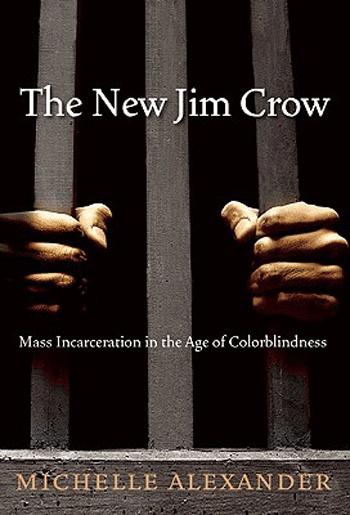
As a case in point, when Michelle Alexander talks about her motivations for writing her book The New Jim Crow: Mass Incarceration in the Age of Colorblindness, she writes in the Preface that,
I have a specific audience in mind — people who care deeply about racial justice but who, for any number of reasons, do not yet appreciate the magnitude of the crisis faced by communities of color as a result of mass incarceration. In other words, I am writing this book for people like me — the person I was ten years ago.
Many Unitarian Universalists may be in Alexander’s target audience, which helps explain why her book was chosen as this year’s Unitarian Universalist Association “Common Read” — that is, a book chosen annually for all UUs to study, discuss, and act upon.
There are at least three claims being made in the book’s title alone: (1) that our society is recapitulating the atrocities of the original Jim Crow laws, which enforced racial segregation on the false premise of “separate but equal,” (2) that we have a systemic problem of rising mass incarceration in this country, and (3) that our alleged “colorblind” age prevents many people from seeing or admitting that that there are racist implications behind our high rates of mass incarceration.
Let me start with the second and arguably least controversial of these claims: that we have a mass incarceration problem. Consider this fact: “In 1972, fewer than 350,000 people were being held in prisons and jails nationwide, compared with more than 2 million people today” (8). The short answer for how this shift happened is the War on Drugs: “The percentage of drug arrests that result in prison sentences (rather than dismissal, community service, or probation) has quadrupled, resulting in a prison-building boom the likes of which the world has never seen” (60).
At this point, colorblindness comes into play. The perception that justice is blind — and the belief that in our advanced society laws are applied evenhandedly without regard to age, sex, class or race — can block us from seeing that: “No other country in the world imprisons so many of its racial or ethnic minorities. The United States imprisons a larger percentage of its black population than South Africa did at the height of apartheid” (6) Looking to our nation’s capital, “In Washington, D.C. … it is estimated that three out of four young black men (and nearly all those in the poorest neighborhoods) can expect to serve time in prison (7).” Tragically, those lopsided incarceration rates are mirrored across our country.
One explanation for this disparity could be that African-Americans commit more crimes, especially drug-related crimes. If that were the case, then the Drug War would understandably have affected African Americans disproportionately. However, studies do not support these claims. A 2001 study by the U.S. Department of Health and Human Services found that, “6.4% of whites, 6.4 percent of blacks, and 5.3% of Hispanics were current users of illegal drugs.” A subsequent DHHS study in 2003 also found “nearly identical rates of illegal drug use among whites and blacks, only a single percentage point between them.” Again in 2007, we see “essentially the same findings.” A 2006 report from the U.S. Department of Justice found that “white youth are more likely than black youth to engage in illegal drug sales.” And a 2007 multi-decade longitudinal study showed that “African American 12th graders have consistently shown lower usage rates than White 12th graders for most drugs, both licit and illicit” (264).
So, if illegal drug sales and illegal drug use are approximately the same across racial lines, why are so many more African-American convicted of drug crimes? The answer seems to be that drug laws are enforced in a racially discriminatory manner to the extent that “In some states, black men have been admitted to prison on drug charges at rates twenty to fifty times greater than those of white men” (7). To give another example closer to home for my congregation, in studies done in Maryland, “African Americans comprised only 17% of drivers along a stretch of I-95 outside of Baltimore, yet they were 70% of those who were stopped and searched” (133). This phenomenon is known as being guilty of “driving while black.”
With this ground laid, perhaps we are ready to begin to consider Alexander’s insight that we live in an era of a New Jim Crow. The crux of her charge is regarding the high numbers of African Americans who have been disproportionately convicted of drug crimes is that,
One you’re labeled a felon, the old forms of discrimination — employment discrimination, housing discrimination, denial of the right to vote, denial o educational opportunity, denial of food stamps and other public benefits, and exclusion from jury service — are suddenly legal. As a criminal, you have scarcely more rights, and arguably less respect, than a black man living in Alabama at the height of Jim Crow.
Alexander then drives her point home that, “We have not ended racial caste in America; we have merely redesigned it” (2).
As Alexander tells her own story, she readily confesses that as recently as ten years ago, she would have been deeply skeptical about the claims she herself is making in her book. And she freely admits that she was “beyond thrilled” at the election of our first black President (2). But the more she learned about our criminal justice system the more she became convinced that the result was a de facto New Jim Crow that “permanently locks a huge percentage of the African American community out of the mainstream society and economy” (13).
The reason I mentioned Alexander’s own initial skepticism about a revitalized racial caste system in the U.S. as well as her celebration of President Obama’s election is because I don’t want any sense of overreaching — any sense that Alexander may be overstating the case for a New Jim Crow — to cause anyone to dismiss this work without wrestling with it seriously. I began by noting the sharply increased rates of mass incarceration because perhaps large segments of our society can at least agree that such high rates of incarceration are a trend that needs to be reversed — although the troubling privatization of prisons complicates any proposed reversals. As Paul Krugman has written in the New York Times, “Privatized prisons save money by employing fewer guards and other workers, and by paying them badly. And then we get horror stories about how these prisons are run. What a surprise!” To remind you of the raw numbers, “In 1972, fewer than 350,000 people were being held in prisons and jails nationwide, compared with more than 2 million people today.” So perhaps step one is simply raising aware of this marked shift and calling for ways of drastically lowering our prison population.
The next step is raising awareness about the racially biased nature of how our legal system sometimes operates. To address the so-called “colorblindness” that has blocked many parts of our society from seeing racial bias in criminal convictions, I would like to share with you one of my first experiences with Anti-Racism work. I first attended a multi-day intensive workshop on “Dismantling Racism” a little more than a decade ago. Part of what still stands out to me from that training was a claim that, “There has been no progress in working against racism in this country.” Although I found most of the workshop compelling and challenging, I was completely incredulous about that claim that “There has been no progress in working against racism in this country.” Admittedly, in the early 2000s, you still occasionally heard commentators say with a straight face that Bill Clinton was our county’s first black president. But I just couldn’t accept that someone could be aware of historical events such as the adoption of the 13th Amendment in 1865, the ruling of Brown vs. the Board of Education in 1954, and the passage of the Civil Rights Act of 1964 and the Voting Rights Act of 1965 — how could you be aware of those sea changes — and continue to claim that, “There has been no progress in working against racism in this country” (38)? But the facilitator would not back down from this claim despite my protests. I was willing to accept his counterpoint that racism had become more insidious, but I remained unconvinced that progress had not been made for racial justice.
I would still be willing today that there has been progress in this country toward dismantling racism, but I think what my workshop facilitator was missing was a book like Michelle Alexander’s The New Jim Crow, which wasn’t published until 2010. I wonder if I would have been forced to rethink my conviction that there has been clear racial progress if my facilitator had confronted me with the fact that “Today there are more African-American adults under correctional control — in prison or jail, on probation or parole — than were enslaved in 1850, a decade before the Civil War began.” Does that fact give you the same pause that it does me? Are we too quick in our assurance that there has been progress in dismantling racism when we realize that “Today there are more African-American adults under correctional control — in prison or jail, on probation or parole — than were enslaved in 1850, a decade before the Civil War began”?
A few weeks ago for Martin Luther King, Jr. Day, I posted about King’s use of the Rip Van Winkle story to caution us against sleeping through a revolution. But Dr. King had in mind a revolution toward fulfilling his dream of racial equality. Michelle Alexander is warning about an insidious “Counter-Revolution”: that the racially discriminatory way in which our laws are enforced is “the most damaging manifestation of the backlash against the Civil Rights Movement” (11). From another angle, Cornel West goes one step further in the Foreword to Alexander’s book, writing, “if young white people were incarcerated at the same rates as young black people, the issue would be a national emergency” (x).
One response to this dire situation could be despair. My own response when reading Alexander’s book oscillated somewhere between deep sadness and righteous anger. But the first step in transforming our Prison-Industrial Complex is raising awareness that there is even a problem, that the situation is much more complex than “getting tough on crime,” and that colorblindness may more a part of the problem than the solution. To again quote Cornel West from the Foreword of Alexander’s book, the lesson West takes from MLK’s dream is that we are not called to be “colorblind toward each other”; rather, we are called to be “lovestruck with each other” (x).
The First Principle of Unitarian Universalism is “The inherent worth and dignity of every person.” That includes prisoners, the poor, and the vulnerable. Our Second Principle is “Justice, equity and compassion in human relations,” and that includes a need to make our Criminal Justice System a more humane, just, and compassionate — that those who move through our Criminal Justice System emerge on the other side equipped to be responsible citizens. I could continue to correlate each of our UU Principles with the need for prison reform, but instead, I will include a note at the end of this post to the many different Unitarian Universalist Statements of Conscience that have been made over the years related to reforming our Criminal Justice System and our nation’s drug policy. We do not have to start from ground zero in the work. We can partner with those individuals and groups who have been working for many years to change the system.
And at least in my opinion, a commitment to principles such as “The inherent worth and dignity of every person” and “Justice, equity and compassion in human relations” requires working for a shift from a Criminal Justice System primarily characterized by Punitive Justice to one primarily characterized by Restorative Justice — that is, a focus less on punishment than on rehabilitation, restoring right relationship for all concerned, and on repairing the problems that contribute to crimes being committed in the first place. For example, in the U.S., we spend “more on prisons than police,” but those numbers were reversed before the rise of the Prison-Industrial Complex began in this county. And communities such as New York City have been able in recent years to decrease prison populations and crime rates through increased police work, although those statistics are complicated by use of “stop and frisk rules” that disproportionately stop and frisk people of color.
We relatedly need to do a much better job about teaching, promoting, and protecting our Fourth Amendment rights: “The right of the people to be secure in their persons, houses, papers, and effects, against unreasonable searches and seizures, shall not be violated, and no Warrants shall issue, but upon probable cause….” Disturbingly the trend in recent years has been many court rulings that seem to many to undermine the Fourth Amendment and encourage unreasonable search — including rampant racial profiling, contributing to a disproportionately high rate of incarceration for racial minorities (63-64, 69).
To name one further possibly response to The New Jim Crow, many decades ago the congregation where I am now the minister became a lifetime member of the NAACP, “The National Association for the Advancement of Colored People.” And as my fellow Patheos blogger Jonathan Wilson-Hartgrove has suggested, one way forward for mostly white congregations to become more serious about anti-racist work might be to start attending NAACP meetings to hear from people of color directly about their stories, their struggles, and their ongoing work for racial justice.
Along these lines, Mark Morrison-Reed has written a book titled, Black Pioneers in a White Denomination about the experience of African-American ministers in Unitarian Universalism. Morrison-Reed describes himself as “a black-born, Unitarian-bred minister of the liberal faith.” His studies show that, “In 1968 when black involvement in [Unitarian Universalism] was at a high point, blacks numbered 1,500 of the denomination’s 180,000 members, less than 1%….” And, “Only 23 black men and women have been received into ministerial fellowship since 1889” (xii-xiii). Looking at the few Unitarian Universalist congregation that have been more racially integrated, he notes that “the most successful were those visibly active in race relations in their communities” (144).
To learn more or to join with others in working to end the New Jim Crow, visit http://www.uua.org/multiculturalism/208702.shtml.
The Rev. Dr. Carl Gregg is a trained spiritual director, a D.Min. graduate of San Francisco Theological Seminary, and the minister of the Unitarian Universalist Congregation of Frederick, Maryland. Follow him on Facebook (facebook.com/carlgregg) and Twitter (@carlgregg).
Learn more about Unitarian Universalism:
http://www.uua.org/beliefs/principles/index.shtml
Previous Post

February 13, 2013
Giving Up Lent (for Lent?!)
Next Post
February 19, 2013 Zero Dark Thirty: Torture, Disavowal, and the Oscars
Browse Our Archives
Select a Category Advent Anti-Racism Archaeology Atheism Baptism Best of the Year List Book Reviews Buddhism Catholicism Christian Education Church and State Church Planting Climate Change Conscientious Objection to War Creation Spirituality Death Penalty Didache Disability Rights Discernment Easter Ecology Emergent Church Movement Empire-Critical Ethics Evolution Feminist Theology Film Reviews Gandhi Gospel of Mark Gun Control Hinduism Immigration Reform Interfaith Islam JFK Judaism Jungian Spirituality Lectionary Commentary Lent Letters to the Editor LGBT Marriage MLK Multiculturalism Mysticism Nonviolent Activism Occupy Paganism (Earth-centered Religions) Parables Paul Pluralism Politics Process Theology Quantum Physics Requiescat In Pace Seminary and Divinity School Sermon Series Retrospective Sermons Spiritual Direction Spiritual Practices Stewardship (Fundraising) The Book of J The Wheel of the Year (Paganism) Theoblogger Challenge Triathlon Uncategorized Unitarian Universalism Worship Resources Youth Ministry
Select a Month July 2026 May 2026 March 2026 November 2025 October 2025 August 2025 February 2025 December 2024 October 2024 March 2024 January 2024 December 2023 November 2023 March 2023 February 2023 January 2023 December 2022 November 2022 August 2022 March 2022 February 2022 January 2022 December 2021 September 2021 August 2021 July 2021 June 2021 May 2021 February 2021 January 2021 December 2020 August 2020 June 2020 May 2020 April 2020 March 2020 February 2020 January 2020 December 2019 November 2019 October 2019 September 2019 July 2019 June 2019 March 2019 February 2019 January 2019 December 2018 November 2018 October 2018 September 2018 June 2018 May 2018 April 2018 March 2018 February 2018 January 2018 December 2017 November 2017 October 2017 September 2017 August 2017 July 2017 June 2017 May 2017 April 2017 March 2017 February 2017 January 2017 December 2016 November 2016 October 2016 September 2016 August 2016 June 2016 May 2016 April 2016 March 2016 February 2016 January 2016 December 2015 November 2015 October 2015 September 2015 August 2015 July 2015 June 2015 May 2015 April 2015 March 2015 February 2015 January 2015 December 2014 November 2014 October 2014 August 2014 July 2014 June 2014 May 2014 April 2014 March 2014 February 2014 January 2014 December 2013 November 2013 October 2013 September 2013 August 2013 July 2013 June 2013 May 2013 April 2013 March 2013 February 2013 January 2013 December 2012 November 2012 October 2012 September 2012 August 2012 July 2012 June 2012 May 2012 April 2012 March 2012 February 2012 January 2012 December 2011 November 2011 October 2011 September 2011 August 2011 July 2011 June 2011 May 2011 April 2011 March 2011 February 2011 January 2011 December 2010 November 2010 October 2010 August 2009 July 2009 May 2009
Follow Us!
TAKE THE
Religious Wisdom Quiz
What is the correct sequence of the fruit of the Spirit as listed in Galatians?
Select your answer to see how you score.
Joy, love, peace, goodness, kindness, faithfulness, forbearance, gentleness, self-control Love, peace, joy, kindness, forbearance, faithfulness, goodness, self-control, gentleness Love, joy, peace, kindness, goodness, forbearance, faithfulness, self-control, gentleness Love, joy, peace, forbearance, kindness, goodness, faithfulness, gentleness, self-control
Related posts from Carl Gregg
What Ta-Nehisi Coates Taught Me About “People Who...

Reading America at 250: A Nation Wrestles With...


Andrew Holocek on the Power of Darkness
TRENDING AT PATHEOS More Voices

Reading America at 250: A Nation Wrestles With...
As part of my own reflection on the 250th anniversary of the...

Whenever I am reading a book or listening to an argument, I...

President Trump Ban Animal Torture Videos on Facebook
Call for Stricter Regulations of Animal Abuse Content on Facebook Although President...

Draft Amendments to Address Ritual Abuse in New...
The proposed changes would make it illegal for individuals in domestic partnerships...

How Bans on LGBTQ+ Student Clubs Threaten Religious...
On June 20, 2025, the State of Texas passed Senate Bill 12....

The Truth About the Gen Z Revival
This past year, there has been a lot of media buzz surrounding...
view all More Voices blogs
Ad-Free & Subscriber Log-In Subscription Support
- About Us
- 2026 Calendar
- Videos
- Podcasts
- Library of World Religions
- Faith In Media Tracker
- Advertise With Us
- Write for Us
- Privacy Policy
- Terms of Service
- Do Not Sell My Data
- Contact Us
- Radiant Digital
- Manage Newsletter Subscriptions
- Unsubscribe From Notifications
- Sitemap
Copyright 2008-2026, Patheos. All rights reserved.
Subscription Support Ad-Free & Subscriber Log-In
Follow Patheos