
BuddhistCatholicContemplativeEvangelicalGeneral ChristianHinduJewishLatter-day SaintMuslimNew VisionsProgressive Christian
Beliefs
- Buddhist
- Catholic
- Contemplative
- Evangelical
- General Christian
- Hindu
- Jewish
- Latter-day Saint
- More Voices
- Muslim
- New Visions
- Pagan
- Progressive Christian
Topics
- Religion News
- Food and Religion
- Sports and Religion
- Religious Art
- Religious Music and Entertainment
- Religious Events
- History and Religion
- Style and Religion
- Politics and Religion
- Women in Religion
- Recreation Outdoors and Religion
- Business Finance and Religion
- Careers Workplace and Religion
- Education and Religion
- Family Parenting and Religion
- Health Fitness and Religion
- Home and Religion
- Relationships and Religion
- Technology and Religion
- Travel and Religion
Columnists
- Buddhist Columnists
- Business Finance and Religion Columnists
- Careers Workplace and Religion Columnists
- Catholic Columnists
- Contemplative Columnists
- Education and Religion Columnists
- Evangelists Columnists
- Family Parenting and Religion Columnists
- General Christian Columnists
- Health Fitness and Religion Columnists
- Hindu Columnists
- History and Religion Columnists
- Home and Religion Columnists
- Jewish Columnists
- More Voices Columnists
- Latter Day Columnists
- Muslim Columnists
- New Visions Columnists
- Nonreligious Columnists
- Pagan Columnists
- Politics and Religion Columnists
- Progressive Columnists
- Recreation Outdoors and Religion Columnists
- Relationships and Religion Columnists
- Religion News Columnists
- Religious Art Columnists
- Religious Events Columnists
- Religious Music and Entertainment Columnists
- Sports and Religion Columnists
- Style and Religion Columnists
- Technology and Religion Columnists
- Travel and Religion Columnists
- Women in Religion Columnists
Resource Library
- 2026 Calendar
- Library of World Religions
- The 100 Most Holy Places on Earth
- Patheos Answers
- Podcasts
- Videos
- Faith Leaders Database
- Anglican Episcopalian
- Bahai
- Baptist
- Buddhism
- Christianity
- Confucianism
- Eastern Orthodoxy
- Hinduism
- Holiness and Pentecostal
- ISKCON
- Islam
- Judaism
- Lutheran
- Methodist
- The Church of Jesus Christ of Latter-day Saints
- New Age
- Paganism
- Presbytarian and Reformed
- Protestantism
- Religion Behind the Scenes
- Roman Catholic
- Scientology
- Shia Islam
- Sikhism
- Sufism
- Sunni Islam
- Taoism
- Zen
- See all religions
Research Tools
 Ad-Free & Subscriber Log-In Subscription Support
Ad-Free & Subscriber Log-In Subscription Support
Follow Patheos 

- Trending:
- Forgiveness
- |
- Marriage
- |
- Consciousness
- |
- Death Penalty
- |
- Election
- |
- Halloween

- Home
- More Voices
- A Whirlwind Tour of Liberal Religious History: Major Developments in Unitarian Universalism
A Whirlwind Tour of Liberal Religious History: Major Developments in Unitarian Universalism
Last updated on: January 25, 2013 at 6:11 pm by Carl Gregg
A Whirlwind Tour of Liberal Religious History: Major Developments in Unitarian Universalism 2013-01-25T18:11:51-05:00 Carl Gregg
Patheos Explore the world's faith through different perspectives on religion and spirituality! Patheos has the views of the prevalent religions and spiritualities of the world.
This post is the final entry in a five-part series on Unitarian Universalist history in preparation for a course I audited in January on “Unitarian Universalist History & Polity” with The Rev. Dr. Nicole Kirk. For those following along as I seek formal fellowship with the Unitarian Universalist Association, you may be interested to see the full Ministerial Fellowship Committee “Required Reading List” and “Encouraged Reading List and Resources.”
In 1983, a study was published on “Unitarian Universalism and the Quest for Racial Justice” titled 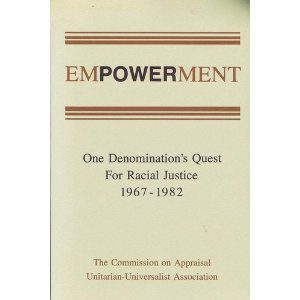 Empowerment: One Denomination’s Quest for Racial Justice, 1967-1982. As I read and reflected on this study, a debate continues to rage in our nation about gun control. There have been calls for a long overdue “National Conversation” about preventing future gun violence, but there are others who argue that we need to skip conversation and immediately move to more restrictive legislation. A parallel situation was present in 1982 when “A National Council of Churches conference concluded… ‘Rhetoric is continuously substituted for intentional activity to combat racism.'”
Even before the Black Empowerment controversy, “In a speech to the National Conference of Black Unitarian Universalists on February 23, 1968, Hayward Henry, former Student Nonviolent Coordinating Committee organizer, microbiology doctoral candidate, board member of Boston Second Church, and future chairman of the Black UU Caucus [noted the following about] the Unitarian Universalist church, which said and believed that it was an integrated institution”:
FACT — there were only two blacks in full-time pulpits.
FACT — nowhere in the religious education curriculum were black contributions to American society studied.
FACT — blacks sat only as tokens on decision-making bodies of the church
FACT — there was no expression of blackness in UU liturgical forms. (22-23)
As historical context for these facts, keep in mind that in April 4, 1968 — barely more than a month later — The Rev. Dr. Martin Luther King, Jr. was assassinated.
Two major factions of the Black Empowerment controversy were the following:
- BAWA (“Black And White Action”) utilized the ideals of the UUA and referred to the UUA Bylaws and statements on racial equality for its inspiration….
- Another organization — BAC “Black Affairs Council” — approached racism through an exclusively black caucus. (68)
One continuing perception of many BAC members was that BAWA and the UUA more generally were being “paternalistic,” and not trusting black members to be self-directive. BAWA and other parts of the UUA, in turn, viewed BAC as extreme and uncompromising (for instance, in a demand that only BAC receive funding and not BAWA). At the Boston General Assembly in July 1969, “There were two walkouts of the Black Caucus and its supporters…. [T]here was a real threat to split the denomination” (79, 107).
“BAWA claimed to be in the tradition of Dr. Martin Luther King, Jr., and…tended to perceive the leadership of BUUC[“Black UU Caucus”]/BAC as persons who sought empowerment for themselves in the name of black people and where were new, both to UUism and to the vivil rights movement. (81) However, remember that MLK condemned the “white moderate” in the “Letter from a Birmingham Jail”:
I have almost reached the regrettable conclusion that the Negro’s great stumbling block in his stride toward freedom is not the White Citizen’s Counciler or the Ku Klux Klanner, but the white moderate, who is more devoted to “order” than to justice; who prefers a negative peace which is the absence of tension to a positive peace which is the presence of justice; who constantly says: “I agree with you in the goal you seek, but I cannot agree with your methods of direct action”; who paternalistically believes he can set the timetable for another man’s freedom; who lives by a mythical concept of time and who constantly advises the Negro to wait for a “more convenient season.” Shallow understanding from people of good will is more frustrating than absolute misunderstanding from people of ill will. Lukewarm acceptance is much more bewildering than outright rejection.
Some of the following were named, in hindsight, as alternate approaches that should have been tried:
- “better prepared with facts and figures…” (127)
- “[get[ the BUUC leadership immediately involved in the power circle of the UUA” (129) [176-182]
2
Mark Morrison-Reed, in his book Black Pioneers in a White Denomination (Third Edition), describes himself as “a black-born, Unitarian-bred minister of the liberal faith.” Some highlights of his important and challenging book include the following:
- “In 1968 when black involvement in the denomination was at a high point, blacks numbered 1,500 of
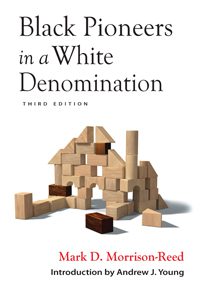 denomination’s 180,000 members, less than 1%…. Only 23 black men and women have been received into ministerial fellowship since 1889” (xii-xiii).
 - Morrison-Reed says baldly about UUs that, “we still are class and culture bound” (xvii). “The churches of the disinherited and the churches of the middle class are quite distinct…” (1).
- Paralleling the quote above from MLK about white moderates, in 1857, Frederick Douglass wrote,
If there is no struggle, there is no progress. Those who profess to favor freedom, and yet depreciate agitation, are men who want crops without plowing up the ground. They want rain without thunder and lighting. They want the ocean without the awful roar of its many waters…. Power concedes nothing without a demand. It never did and never will… Freedom is not a gift, freedom is won through relentless effort. (6)
- For congregations who want to become more integrated, Morrison-Reed notes that “the most successful were those visibly active in race relations in their communities” (144). He continues, “Despite the black church’s reputation for other-worldliness, it has met the needs of the present, Child care, food and shelter, funerary matters, the cause of civil rights, and voter registration are all concerns to which the black church has responded” (171).
- Other frequent factors seen in successful racial integration in congregation include “large urban areas,” “a large black middle class,” “intentionality,” and “time.” “To distill this still further, it requires opportunity and commitment” (203-205).
3
Earl Holt, an ordained UU minister, delivered an address at the 1988 General Assembly titled “Does Congregational Polity Sanction Any Vice? Yes.” Personally, as someone who has transitioned from a Southern Baptist Church in childhood, through liberal Baptist churches, to Unitarian Universalism, I was intrigued to see Holt’s point that the SBC and the UUs — although starkly different in many ways — are “closest kin” in their shared “radical congregational polity.” I’m reminded of a point made earlier in this series of posts that UUs finds themselves often, at most, being able to speak about a “prevailing consensus.”
As a case study about this radical congregational polity, Earl Holt in a 1991 “Ordination Sermon” notes that the UUA Bylaws “recognizes and affirms that member churches alone have the right to call and ordain their ministers.” And
In theory we know that Ordination and Ministerial Fellowship are two distinct and independent processes. One can be Ordained and not Fellowshipped, Fellowshipped but not Ordained…. [A]nd to advance professionally, both are ordinarily required. But in our tradition it is Ordination — which is the consequence of a decision made by an individual congregation — and not Fellowship, which makes someone a minister. Yet for some time now the UUA’s Fellowship Committee has done everything in its power to subordinate Ordination to Fellowship and in fact will deny standing to any Minister who is Ordained before receiving Fellowship.
As someone who is ordained in the liberal Baptist tradition, already serving as minister of a UU congregation, and in the process of seeking ministerial fellowship with the UUA, this matter is a live issue for me. Although I have found the fellowship process to be lengthy, I have found both the UUA staff and my UU colleagues to all be most helpful, gracious, and welcoming.
From a different perspective, Peter Raible in 1987, delivered a conference address on “The Meaning of Ministry Among Present Day Liberals.” In liberal Baptist circles one commonly hears the assertion that, despite ordination, “All members are ministers.” Many liberal Baptists view the status of professional clergy as unfortunately undercutting the seriousness of the baptismal call of all Christians to be full-time disciples. But UUism does not practice Baptism (or at least not commonly). And Raible rejects the idea that “Ministers are just laity, who are paid to engage in full time religious activity.” Highlighting all the training and study of UU ministers, he emphasizes the value in a professional clergy class. (Another dynamic at play in the contrast is that some strands of the Baptist tradition oppose educated clergy.) Raible also emphasizes “the tension between the institutional church and prophetic leadership” as well as the vital importance of “covenant” over contract.
4
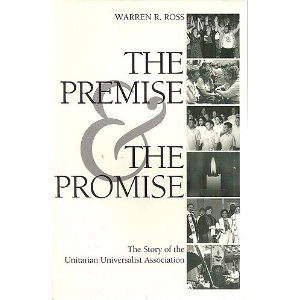 In 2001, for the 40th anniversary of the Unitarian Universalist Association, Warren Ross published The Premise & The Promise: The Story of the Unitarian Universalist Association. It’s no surprise that the liberal UU denomination was forged the hope-filled early 1960s, which included the election of John F. Kennedy as President: “It was a golden moment for both the USA and the UUA; the tarnish came later” (29).
As one of many turning points in UU history in which the results could have been otherwise, the first president of the denomination was elected 1,135 to 980, a difference of only 155 votes (30).
William (Bill) Schulz, who was later to be president of the UUA, was radicalized for social justice when he was the student minister of the small UU congregation in Kent at the time of the Kent State shootings: “In the wake of the shootings, the Kent city council banned all public meetings, but Schulz defied the ban by holding a memorial service” (35). “President Greeley shared the commitment. Twice at a time when such a move was considered by many to be nothing short of treason, he went with a team of religious leaders to Vietnam” (35).
At the same time, some “older, more conservative Unitarian Universalists” were wary of the anti-war sentiments in the denomination that centered most strongly around the Arlington Street Church. Referring especially the drop in giving that resulted from the anti-war efforts, Greeley wrote, “I think [the Arlington Street Church was never really conscious of how much the denomination suffered in its behalf” (38).
Compared to statistics given in an earlier posts about the earliest women in UU ministry, in 2000, “Two-thirds of those receiving fellowship…were women, and women now make up just about half of all active UU ministers, compared with virtually none in 1961 and a negligible two percent in the early 1970s” (129).
“85-90% of UUs today were not raised as such. [O]ur children may share our ideals in the abstract, but feel no loyalty to the institution that gives them viability…. [K]ids knew more about Buddhism than UUism” (137-139). One program to correct this trend is called “Articulating (Y)Our Faith”
Although UUs were at the forefront of the LGBT rights movement, in 1979 — a decade after Stonewall — there were no out gay ministers in UU pulpits. That changed in 1980 with the call of two openly gay men to two different UU pulpits. But “the GA vote in favor of the Office of Gay Affairs was by no means unanimous and that many voiced strong objection. ‘I recall one colleague asking the assembly if the next step would be an Office of Bestiality.’ Even after gaining his pulpit it took Strong almost 18 months to convince the editors of the UU World that AIDS was a topic worth covering. ‘There was a collective feeling that AIDS was not an appropriate topic for UUs to ponder.” (158-159).
5
We looked previously in this series at Conrad Wright’s Walking Together (1989). Some highlights for this final post include the following:
- “Our problem with our covenants is that we do not take them seriously enough. We do not remind ourselves that a covenant is an agreement made between parties, not a statement by an individual to be discarded or forgotten unilaterally” (9).
- “Joining a church should not be quite the same thing as joining the National Geographic Society” (10).
- “In maintaining the right of each particular church to admit whomsoever it will to membership, we adhere to a very basic proposition of congregational polity” (11).
- Following the direction laid out in Chapter Six of the Cambridge Platform that, “there may be the essence & being of a church without any officers,” Wright emphasizes for our time that “the distinction between ‘Church’ and ‘Fellowship’ as it has appeared in the rules of the UUA is a bureaucratic one, not an ecclesiological one. Indeed, quite apart from size, there are a good many fellowships that have come closer to the theological or ecclesiological understanding of a ‘church’ than most of those designated as such” (14-15).
- “Churches neither ‘hire’ nor ‘fire’ ministers. Minister are ‘called,’ and if need be, ‘dismissed.’”
- Following from the Cambridge Platform tenet that, “Church officers are officers to one church, even that particular, over which the Holy Ghost hath made them overseers,” Wright contends that, “So far as I am concerned, persons in ministerial fellowship who abandon the parish for a career, such as teaching — even teaching in a divinity school — are ex-ministers” (16, 20). In contrast, I would argue that something “more,” something sacramental, happens in ordination.
- To strengthen connection between UU congregations, Wright recommends that, “Each church, following its annual meeting, should send to an appropriate lay officer or committee in every other church in the district a copy of the reports of the minister and chair of the Standing Committee” (22-23).
6
Likewise, we looked previously in this series at Conrad Wright’s Congregational Polity (1997). Some highlights for this final post include the following:
- The Church of the Larger Fellowship, for UUs who are geographically isolated from a UU congregations, was founded back in 1944 (160). The Internet Age and advent of Social Media has vastly increased the possibilities for this venture in the twenty-first century.
- Expanding on the point above about fellowships versus churches, the “practical meaning was that the AUA gave subsidies to nascent churches but not to fellowships But ecclesiologicaly, from the point of view of congregational polity, both were churches…. The distinction between ‘churches’ and ‘fellowships’ soon became embedded in popular understanding, the presence or absence of a minister usually being the defining characteristic. Biblically…where two or three are gathered” (162-163).
- Also connecting to the positions above about the role of the laity vis-a-vis the professionalization of the clergy, a trend has been that “Professional standards for the minister ‘should be increased rather than diminished” (193).
Previous Posts in This Series on “A Whirlwind Tour of Liberal Religious History”
Part 1: The Radical Reformation
Part 2: The 18th and 19th Century
Part 3: U.S. Unitarians in the 19th Century
Part 4: Unitarian Expansion and Transformation
The Rev. Dr. Carl Gregg is a trained spiritual director, a D.Min. graduate of San Francisco Theological Seminary, and the minister of the Unitarian Universalist Congregation of Frederick, Maryland. Follow him on Facebook (facebook.com/carlgregg) and Twitter (@carlgregg) .
Learn more about Unitarian Universalism:
http://www.uua.org/beliefs/principles/index.shtml
Previous Post

January 7, 2013
Future Me: Not All Resolutions Are Created Equal
Next Post
January 25, 2013 A Whirlwind Tour of Liberal Religious History: Compilation
Browse Our Archives
Select a Category Advent Anti-Racism Archaeology Atheism Baptism Best of the Year List Book Reviews Buddhism Catholicism Christian Education Church and State Church Planting Climate Change Conscientious Objection to War Creation Spirituality Death Penalty Didache Disability Rights Discernment Easter Ecology Emergent Church Movement Empire-Critical Ethics Evolution Feminist Theology Film Reviews Gandhi Gospel of Mark Gun Control Hinduism Immigration Reform Interfaith Islam JFK Judaism Jungian Spirituality Lectionary Commentary Lent Letters to the Editor LGBT Marriage MLK Multiculturalism Mysticism Nonviolent Activism Occupy Paganism (Earth-centered Religions) Parables Paul Pluralism Politics Process Theology Quantum Physics Requiescat In Pace Seminary and Divinity School Sermon Series Retrospective Sermons Spiritual Direction Spiritual Practices Stewardship (Fundraising) The Book of J The Wheel of the Year (Paganism) Theoblogger Challenge Triathlon Uncategorized Unitarian Universalism Worship Resources Youth Ministry
Select a Month July 2026 May 2026 March 2026 November 2025 October 2025 August 2025 February 2025 December 2024 October 2024 March 2024 January 2024 December 2023 November 2023 March 2023 February 2023 January 2023 December 2022 November 2022 August 2022 March 2022 February 2022 January 2022 December 2021 September 2021 August 2021 July 2021 June 2021 May 2021 February 2021 January 2021 December 2020 August 2020 June 2020 May 2020 April 2020 March 2020 February 2020 January 2020 December 2019 November 2019 October 2019 September 2019 July 2019 June 2019 March 2019 February 2019 January 2019 December 2018 November 2018 October 2018 September 2018 June 2018 May 2018 April 2018 March 2018 February 2018 January 2018 December 2017 November 2017 October 2017 September 2017 August 2017 July 2017 June 2017 May 2017 April 2017 March 2017 February 2017 January 2017 December 2016 November 2016 October 2016 September 2016 August 2016 June 2016 May 2016 April 2016 March 2016 February 2016 January 2016 December 2015 November 2015 October 2015 September 2015 August 2015 July 2015 June 2015 May 2015 April 2015 March 2015 February 2015 January 2015 December 2014 November 2014 October 2014 August 2014 July 2014 June 2014 May 2014 April 2014 March 2014 February 2014 January 2014 December 2013 November 2013 October 2013 September 2013 August 2013 July 2013 June 2013 May 2013 April 2013 March 2013 February 2013 January 2013 December 2012 November 2012 October 2012 September 2012 August 2012 July 2012 June 2012 May 2012 April 2012 March 2012 February 2012 January 2012 December 2011 November 2011 October 2011 September 2011 August 2011 July 2011 June 2011 May 2011 April 2011 March 2011 February 2011 January 2011 December 2010 November 2010 October 2010 August 2009 July 2009 May 2009
Follow Us!
TAKE THE
Religious Wisdom Quiz
Who was known for interpreting dreams in Babylon?
Select your answer to see how you score.
Daniel Moses Joseph David
Related posts from Carl Gregg

Peak Spiritual Experiences, Psychedelics, & Consciousness Research

"How the Founding Fathers Became Infallible and Our...

Vampires, Witches, & NPR: The Legacy of Margot...

“Do You Really Want to Know?” From Pope...
TRENDING AT PATHEOS More Voices

Reading America at 250: A Nation Wrestles With...
As part of my own reflection on the 250th anniversary of the...

Whenever I am reading a book or listening to an argument, I...

President Trump Ban Animal Torture Videos on Facebook
Call for Stricter Regulations of Animal Abuse Content on Facebook Although President...

Draft Amendments to Address Ritual Abuse in New...
The proposed changes would make it illegal for individuals in domestic partnerships...

How Bans on LGBTQ+ Student Clubs Threaten Religious...
On June 20, 2025, the State of Texas passed Senate Bill 12....

The Truth About the Gen Z Revival
This past year, there has been a lot of media buzz surrounding...
view all More Voices blogs
Ad-Free & Subscriber Log-In Subscription Support
- About Us
- 2026 Calendar
- Videos
- Podcasts
- Library of World Religions
- Faith In Media Tracker
- Advertise With Us
- Write for Us
- Privacy Policy
- Terms of Service
- Do Not Sell My Data
- Contact Us
- Radiant Digital
- Manage Newsletter Subscriptions
- Unsubscribe From Notifications
- Sitemap
Copyright 2008-2026, Patheos. All rights reserved.
Subscription Support Ad-Free & Subscriber Log-In
Follow Patheos