
BuddhistCatholicContemplativeEvangelicalGeneral ChristianHinduJewishLatter-day SaintMuslimNew VisionsProgressive Christian
Beliefs
- Buddhist
- Catholic
- Contemplative
- Evangelical
- General Christian
- Hindu
- Jewish
- Latter-day Saint
- More Voices
- Muslim
- New Visions
- Pagan
- Progressive Christian
Topics
- Religion News
- Food and Religion
- Sports and Religion
- Religious Art
- Religious Music and Entertainment
- Religious Events
- History and Religion
- Style and Religion
- Politics and Religion
- Women in Religion
- Recreation Outdoors and Religion
- Business Finance and Religion
- Careers Workplace and Religion
- Education and Religion
- Family Parenting and Religion
- Health Fitness and Religion
- Home and Religion
- Relationships and Religion
- Technology and Religion
- Travel and Religion
Columnists
- Buddhist Columnists
- Business Finance and Religion Columnists
- Careers Workplace and Religion Columnists
- Catholic Columnists
- Contemplative Columnists
- Education and Religion Columnists
- Evangelists Columnists
- Family Parenting and Religion Columnists
- General Christian Columnists
- Health Fitness and Religion Columnists
- Hindu Columnists
- History and Religion Columnists
- Home and Religion Columnists
- Jewish Columnists
- More Voices Columnists
- Latter Day Columnists
- Muslim Columnists
- New Visions Columnists
- Nonreligious Columnists
- Pagan Columnists
- Politics and Religion Columnists
- Progressive Columnists
- Recreation Outdoors and Religion Columnists
- Relationships and Religion Columnists
- Religion News Columnists
- Religious Art Columnists
- Religious Events Columnists
- Religious Music and Entertainment Columnists
- Sports and Religion Columnists
- Style and Religion Columnists
- Technology and Religion Columnists
- Travel and Religion Columnists
- Women in Religion Columnists
Resource Library
- 2026 Calendar
- Library of World Religions
- The 100 Most Holy Places on Earth
- Patheos Answers
- Podcasts
- Videos
- Faith Leaders Database
- Anglican Episcopalian
- Bahai
- Baptist
- Buddhism
- Christianity
- Confucianism
- Eastern Orthodoxy
- Hinduism
- Holiness and Pentecostal
- ISKCON
- Islam
- Judaism
- Lutheran
- Methodist
- The Church of Jesus Christ of Latter-day Saints
- New Age
- Paganism
- Presbytarian and Reformed
- Protestantism
- Religion Behind the Scenes
- Roman Catholic
- Scientology
- Shia Islam
- Sikhism
- Sufism
- Sunni Islam
- Taoism
- Zen
- See all religions
Research Tools
 Ad-Free & Subscriber Log-In Subscription Support
Ad-Free & Subscriber Log-In Subscription Support
Follow Patheos 

- Trending:
- Forgiveness
- |
- Marriage
- |
- Consciousness
- |
- Death Penalty
- |
- Election
- |
- Halloween

- Home
- More Voices
- A Whirlwind Tour of Liberal Religious History: Unitarian Expansion and Transformation
A Whirlwind Tour of Liberal Religious History: Unitarian Expansion and Transformation
Last updated on: December 27, 2014 at 9:21 am by Carl Gregg
A Whirlwind Tour of Liberal Religious History: Unitarian Expansion and Transformation 2014-12-27T09:21:01-05:00 Carl Gregg
Patheos Explore the world's faith through different perspectives on religion and spirituality! Patheos has the views of the prevalent religions and spiritualities of the world.
This post is the fourth in a series of at least five posts on Unitarian Universalist history in preparation for a course I’m auditing in January on “Unitarian Universalist History & Polity” with The Rev. Dr. Nicole Kirk. For those following along as I seek formal fellowship with the Unitarian Universalist Association, you may be interested to see the full Ministerial Fellowship Committee “Required Reading List” and “Encouraged Reading List and Resources.”
The following are some highlights from Spencer Lavan’s 1997 book Unitarians and India: A Study in Encounter and Response, Third Edition:
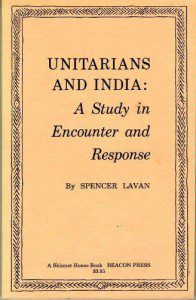 This book confesses to focusing on a “minor,” “virtually unknown” strand of history (1), but that reason helps justify this monograph: too often history books rehash angles of history that are already well-trodden.
- Although Unitarian Universalism is often not associated with the kind of “missionary impulse” (the felt need to proselytize) that is found more frequently in Christianity and Islam, “throughout the nineteenth century, the American Unitarian Association believed that, within the scope of its financial limits, it should propagate its form of Christianity among those not ordinarily able to hear it” (4). In some ways, mid-to-late twentieth-century Unitarian Universalism overcompensated to the other extreme of never promoting itself. As I sometimes tell members of my congregation, I have no desire for us to be “the best kept secret in town!” There is a middle-ground of healthy evangelism/marketing that spreads the word about liberal congregations to those who would find such religious communities to be good news.
- In our interconnected, Internet-filled, information-overloaded culture, it’s fascinating to revisit some of the early infusions of interfaith influences. In 1871, James Freeman Clarke, a Unitarian minister in Boston, published Ten Great Religions: An Essay in Comparative Theology, although this book had a strong “Christian bias” (5).
- In 1879, Samuel Johnson**,** a Unitarian minister in Salem, Massachusetts, published a two-volume book Oriental Religions (5).
- “Sir William Jones…arrived in India in 1783 and provided the earliest translation of the sacred Sanskrit Hindu texts read in America by Joseph Priestly and by increasing numbers of of British East India Company civil servants sent to India from England” (20).
- “The first Indian identifying himself as a Unitarian Christian was a low-caste Tamil Hindu, Moodelliar Vellazha, who called himself by the Christian name William Roberts. On Christmas day, 1816, he initiated an extensive correspondence with the Reverend Thomas Belsham, a minister of the Unitarian Society in London who served there as successor to and biographer of the noted Reverend Theophilus Lindsey” (24).
2
Charles H. Lyttle (1884-1980) was a history professor at Meadville-Lombard Theological School. His classic 1952 book Freedom Moves West: A History of the Western Unitarian Conference, 1852-1952 tells the story of how Unitarian practice and theology developed as the movement expanded from the establishment sectors of the east coast into the untamed western regions of the U.S. Some highlights include the following:
- In addition to the Unitarians and the Universalists, there were two other notable liberal groups in the west in the early 19th century: the “Christians” or the Christian Connection led by Barton W. Stone and Burton Eastin of Kentucky and the Society of “Liberal” or “Hicksite” Friends. (The Society of Friends is also known as the “Quakers.”) Stone’s movement was eventually merged with that of Alexander Campbell to form the groundwork of the contemporary denomination known as the Christian Church (Disciples of Christ). Personally, as someone who went to a Disciples seminary on my path to Unitarian Universalism, I was grateful for this reminder of how liberal Stone was. He questioned the Trinity and the substitutionary atonement (10). Either historically or today, one does not have to take too many steps to move to Unitarian Universalism from Quakerism, the Disciples of Christ, or the United Church Christ. Each of these traditions have much in common structurally, despite important differences.
- One crisis in the Western expansion was whether Unitarianism should remain Christ-centered or become more pluralistic, even non-theistic. Part of what prompted this movement toward pluralism was the increasing access in the mid-to-late nineteenth century to scriptures from all the worlds religions instead of merely the Bible. Maintaining that Christianity was the only or best source of truth became increasingly difficult (172). One series of questions asked in this period by Unitarian missionary Jasper Douthit — if you substitute Christians/Christianity for Unitarians/Unitarianism — sounds like many of the letters to the editor that continue to be published today. Jasper was questioning how much freedom should be allowed:
Does [Christianity] mean the Christian religion in its simplicity and purity or does it mean something else?
Are we [Christians] an organized body of Christian believers with the Holy Son of God as our Captain or are we only a nebulous, tenuous mass of humanity, believing anything and everything in general and nothing in particular?
Are [Christians] unequivocally and aggressively Christian in character or are we merely a heterogeneous multitude clamoring for Freedom, Fellowship, and Character in Religion with a complacent indifference as to whether the divine religion of Jesus is voted up or down? (168)
- Speaking of how history repeats itself if we do not learn the lessons of our past, the author of the text asks (in this case about the similar humanist controversy):
Was the denomination to be torn by another doctrinal conflict? Had Unitarians not learned, after more than a century of experience, that such conflicts were utterly and ironically incompatible with their principle of the free mind and conscience, their subordination of theological speculation to ethical and spiritual bases of faith and fellowship? (257)
3
In my second post in this series, we looked at a few highlights from the first chapter (“A Summary Overview”) in David Robinson’s 1985 book The Unitarians and the Universalists. The following are some highlights from some later chapters:
- Three of the prime movers behind the humanist movement in Unitarianism (John Dietrich, Curtis Reese, and Charles Potter) all were originally part of more conservative denominations. Reese and Potter, in particular, were both Southern Baptist ministers, who transitioned into Unitarianism — which parallels my own journey from the SBC through liberal Baptist life into UUism (144).
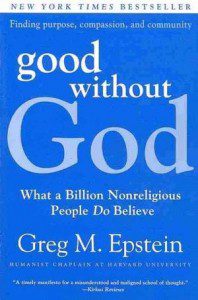 As humanism emerged, one theme was seeking to be Good without God — or “Go(o)d without God.” As Cyrus Bartol quipped in his 1872 book Radical Problems, “I spell my God with two o‘s and my devil without a d‘” (111). This ongoing project can be seen in the book title of the current humanist chaplain at Harvard: Good Without God: What a Billion Nonreligious People Do Believe by Greg Epstein: “For the Humanists the values concentrated in God, although not necessarily lost, were cut loose form any transcendent or supernatural context and grounded in human nature alone (150). However, the two World Wars in the 20th century challenged any unreflective or overly optimistic views of human nature, either with or without God (152).
- One anecdote about the difference between Universalism and Unitarianism was that at the 1870 centennial of American Universalism, a vote was taken not to change anything about the 1803 Winchester Profession of Faith (123). In contrast, we have seen the tremendous changes happening in Unitarian during those same intervening decades: “In the nineteenth century, theology was more speculative for the Unitarians but more pragmatic for the Universalists” (124).
- Regarding the Free Religious Association, “the direction of their thinking — away from supernaturalism toward science, away from theism toward Humanism and away from ecclesiasticism toward social reform — charted important directions in denominational development in the twentieth century” (108).
- “The Free Religious Association had little significance as an institution except in serving as a rallying point for the radicals” (109).
4
A few thoughts in response to William Channing Gannet’s widely-admired 1887 statement “Things Commonly Believed Among Us” for the Western Unitarian Conference, adopted by a vote of 59 to 13:
- The first line (“We believe that to love the Good and to live the Good is the supreme thing in religion“) emphasizes “Go(o)d” over “God” — or perhaps a move toward “the Good” as “God.”
- The second line (“We hold reason and conscience to be final authorities in matters of religious belief”) subverts the authority of tradition, hierarchy, or community. The (author)ity becomes what you yourself author or (author)ize.
- The next two lines are expansive: (1) moving from only honoring the Bible to honoring “all inspiring scripture, old and new” and (2) moving from only revering Jesus to revering “all holy souls that have taught men truth and righteousness and love, as prophets of religion”
- The fifth line is a move toward the full implications of evolution, but it retains notions such as a belief in an “unchanging Order.”
- The statement is short and is worth reading in full.
5
Some themes from Curtis Reese’s 1926 work Humanism:
- Epistemic humility:
The pluralism of human outlook shows the futility of seeking a universally valid cosmic point of view. Hence the humanist is at once egocentric in that he consciously looks out upon life through his own windows, and essentially modest in that he is unwilling to read the impression and ideas of individual persons into cosmic life as a whole. So he regards philosophy as a useful instrument, but as basically personal and improvable. (1)
- Embrace of science in general and evolution in particular: “To the humanist creative evolution is a fact, not a mere figure of speech. He takes evolution seriously, and so refuses to ‘sew up the Universe’ or to ‘put the end in the beginning.’ New levels of creation actually result in new things” (2).
- Authority of evidence: the preference for either external or internal authority is given less emphasis than evidence: “facts reasonably interpreted” (4).
- “Supremacy of Intelligence”:
Suppose we studied the race problem as thoroughly as an architect plans a steel structure; suppose we attacked the problem of education as comprehensively as an international banking house surveys the resources and needs of the people it serves…. [L]et us try to imagine what could be done for human justice and happiness if the goverment of the world were a science instead of a system of conflicing ambitions. (6-7)
Despite Reese’s hopeful, early-twentieth-century hopes, today, we tragically can’t even agree about the “facts,” most outrageously in the debate over climate change.
- “Humanizing Religion”: “religion requires growth in its content and change in its expression” (12). This perspective resonates with the theme of evolution generally. Reese defines pre-modern religion as “man’s response to super-human sources of fortune.” In contract, a new religion for today should emphasize “life, and its chief content is loyalty to life” (23).
6
John H. Dietrich’s 1927 sermon “Unitarianism and Humanism” was included in a collection titled Humanist Sermons. Some themes:
- He opens with an analogy that Protestant Fundamentalism : Protestant Modernism :: Unitarian Theism : Unitarian Humanism. But there is one significant caveat on the Unitarian side of the equation: “we have the highest regard for one another’s views and differ with perfect sympathy and understanding. The very basis of our fellowship is freedom of conviction and utterance, so there is no question of the right to preach either of these forms of doctrine form a Unitarian pulpit” (95). Although this sentiment is true in theory, the history of humanists and theists within Unitarian Universalism was not always so sanguine.
- In a similar comparison, a traditional view of religion in many Christian theistic circles is that religion is about “the knowledge of God and our duties toward him.” Dietrich, then, artfully gives a humanist twist:
By religion I mean the knowledge of man and our duties toward him…. In short, the task of Humanism is to unfold the personality of men and women, to fit and qualify them for the best use of their natural powers, and the fullest enjoyment of the natural world and the human society around them. It conceives of religion as spiritual enthusiasm directed toward the enrichment of the individual life and the improvement of the social order. (96)
- Humanism in Dietrich’s conception is not atheistic, “but it places faith in man, a knowledge of man, and our duties toward one another first…. And if there be not a God, it makes no difference — there is man just the same with his insatiable craving for something better than he has yet known…” (97).
- Dietrich is also a religious pragmatist: “we base our theories upon the experiments, or the experience, of life” not on alleged historical revelation (99)
- Unitarianism provided a ground in which humanism could thrive because of Unitarianism’s “insistence upon intellectual integrity rather than upon intellectual uniformity” (100).
- One risk of humanism is specieism: “human life [as] the thing of supreme worth in the universe” (105). Hence, the current first UU Principle is “The inherent worth and dignity of every person,” revising the former specieist version: “affirm, defend, and promote the supreme worth and dignity of every human personality.”
Previous Posts in This Series on “A Whirlwind Tour of Liberal Religious History”
Part 1: The Radical Reformation
Part 2: The 18th and 19th Century
Part 3: U.S. Unitarians in the 19th Century
The Rev. Dr. Carl Gregg is a trained spiritual director, a D.Min. graduate of San Francisco Theological Seminary, and the minister of the Unitarian Universalist Congregation of Frederick, Maryland. Follow him on Facebook (facebook.com/carlgregg) and Twitter (@carlgregg) .
Learn more about Unitarian Universalism:
http://www.uua.org/beliefs/principles/index.shtml
Previous Post

December 16, 2012
Politics of the Broken Hearted: Gun Rights and Gun Responsibilities
Next Post
December 18, 2012 Best Podcasts of 2012
Browse Our Archives
Select a Category Advent Anti-Racism Archaeology Atheism Baptism Best of the Year List Book Reviews Buddhism Catholicism Christian Education Church and State Church Planting Climate Change Conscientious Objection to War Creation Spirituality Death Penalty Didache Disability Rights Discernment Easter Ecology Emergent Church Movement Empire-Critical Ethics Evolution Feminist Theology Film Reviews Gandhi Gospel of Mark Gun Control Hinduism Immigration Reform Interfaith Islam JFK Judaism Jungian Spirituality Lectionary Commentary Lent Letters to the Editor LGBT Marriage MLK Multiculturalism Mysticism Nonviolent Activism Occupy Paganism (Earth-centered Religions) Parables Paul Pluralism Politics Process Theology Quantum Physics Requiescat In Pace Seminary and Divinity School Sermon Series Retrospective Sermons Spiritual Direction Spiritual Practices Stewardship (Fundraising) The Book of J The Wheel of the Year (Paganism) Theoblogger Challenge Triathlon Uncategorized Unitarian Universalism Worship Resources Youth Ministry
Select a Month July 2026 May 2026 March 2026 November 2025 October 2025 August 2025 February 2025 December 2024 October 2024 March 2024 January 2024 December 2023 November 2023 March 2023 February 2023 January 2023 December 2022 November 2022 August 2022 March 2022 February 2022 January 2022 December 2021 September 2021 August 2021 July 2021 June 2021 May 2021 February 2021 January 2021 December 2020 August 2020 June 2020 May 2020 April 2020 March 2020 February 2020 January 2020 December 2019 November 2019 October 2019 September 2019 July 2019 June 2019 March 2019 February 2019 January 2019 December 2018 November 2018 October 2018 September 2018 June 2018 May 2018 April 2018 March 2018 February 2018 January 2018 December 2017 November 2017 October 2017 September 2017 August 2017 July 2017 June 2017 May 2017 April 2017 March 2017 February 2017 January 2017 December 2016 November 2016 October 2016 September 2016 August 2016 June 2016 May 2016 April 2016 March 2016 February 2016 January 2016 December 2015 November 2015 October 2015 September 2015 August 2015 July 2015 June 2015 May 2015 April 2015 March 2015 February 2015 January 2015 December 2014 November 2014 October 2014 August 2014 July 2014 June 2014 May 2014 April 2014 March 2014 February 2014 January 2014 December 2013 November 2013 October 2013 September 2013 August 2013 July 2013 June 2013 May 2013 April 2013 March 2013 February 2013 January 2013 December 2012 November 2012 October 2012 September 2012 August 2012 July 2012 June 2012 May 2012 April 2012 March 2012 February 2012 January 2012 December 2011 November 2011 October 2011 September 2011 August 2011 July 2011 June 2011 May 2011 April 2011 March 2011 February 2011 January 2011 December 2010 November 2010 October 2010 August 2009 July 2009 May 2009
Follow Us!
TAKE THE
Religious Wisdom Quiz
Who wrote the words on the tables of stone for the 10 Commandments?
Select your answer to see how you score.
Jesus God Moses Abraham
Related posts from Carl Gregg

Peak Spiritual Experiences, Psychedelics, & Consciousness Research

"How the Founding Fathers Became Infallible and Our...

Vampires, Witches, & NPR: The Legacy of Margot...

“Do You Really Want to Know?” From Pope...
TRENDING AT PATHEOS More Voices

Reading America at 250: A Nation Wrestles With...
As part of my own reflection on the 250th anniversary of the...

Whenever I am reading a book or listening to an argument, I...

President Trump Ban Animal Torture Videos on Facebook
Call for Stricter Regulations of Animal Abuse Content on Facebook Although President...

Draft Amendments to Address Ritual Abuse in New...
The proposed changes would make it illegal for individuals in domestic partnerships...

How Bans on LGBTQ+ Student Clubs Threaten Religious...
On June 20, 2025, the State of Texas passed Senate Bill 12....

The Truth About the Gen Z Revival
This past year, there has been a lot of media buzz surrounding...
view all More Voices blogs
Ad-Free & Subscriber Log-In Subscription Support
- About Us
- 2026 Calendar
- Videos
- Podcasts
- Library of World Religions
- Faith In Media Tracker
- Advertise With Us
- Write for Us
- Privacy Policy
- Terms of Service
- Do Not Sell My Data
- Contact Us
- Radiant Digital
- Manage Newsletter Subscriptions
- Unsubscribe From Notifications
- Sitemap
Copyright 2008-2026, Patheos. All rights reserved.
Subscription Support Ad-Free & Subscriber Log-In
Follow Patheos