
BuddhistCatholicContemplativeEvangelicalGeneral ChristianHinduJewishLatter-day SaintMuslimNew VisionsProgressive Christian
Beliefs
- Buddhist
- Catholic
- Contemplative
- Evangelical
- General Christian
- Hindu
- Jewish
- Latter-day Saint
- More Voices
- Muslim
- New Visions
- Pagan
- Progressive Christian
Topics
- Religion News
- Food and Religion
- Sports and Religion
- Religious Art
- Religious Music and Entertainment
- Religious Events
- History and Religion
- Style and Religion
- Politics and Religion
- Women in Religion
- Recreation Outdoors and Religion
- Business Finance and Religion
- Careers Workplace and Religion
- Education and Religion
- Family Parenting and Religion
- Health Fitness and Religion
- Home and Religion
- Relationships and Religion
- Technology and Religion
- Travel and Religion
Columnists
- Buddhist Columnists
- Business Finance and Religion Columnists
- Careers Workplace and Religion Columnists
- Catholic Columnists
- Contemplative Columnists
- Education and Religion Columnists
- Evangelists Columnists
- Family Parenting and Religion Columnists
- General Christian Columnists
- Health Fitness and Religion Columnists
- Hindu Columnists
- History and Religion Columnists
- Home and Religion Columnists
- Jewish Columnists
- More Voices Columnists
- Latter Day Columnists
- Muslim Columnists
- New Visions Columnists
- Nonreligious Columnists
- Pagan Columnists
- Politics and Religion Columnists
- Progressive Columnists
- Recreation Outdoors and Religion Columnists
- Relationships and Religion Columnists
- Religion News Columnists
- Religious Art Columnists
- Religious Events Columnists
- Religious Music and Entertainment Columnists
- Sports and Religion Columnists
- Style and Religion Columnists
- Technology and Religion Columnists
- Travel and Religion Columnists
- Women in Religion Columnists
Resource Library
- 2026 Calendar
- Library of World Religions
- The 100 Most Holy Places on Earth
- Patheos Answers
- Podcasts
- Videos
- Faith Leaders Database
- Anglican Episcopalian
- Bahai
- Baptist
- Buddhism
- Christianity
- Confucianism
- Eastern Orthodoxy
- Hinduism
- Holiness and Pentecostal
- ISKCON
- Islam
- Judaism
- Lutheran
- Methodist
- The Church of Jesus Christ of Latter-day Saints
- New Age
- Paganism
- Presbytarian and Reformed
- Protestantism
- Religion Behind the Scenes
- Roman Catholic
- Scientology
- Shia Islam
- Sikhism
- Sufism
- Sunni Islam
- Taoism
- Zen
- See all religions
Research Tools
 Ad-Free & Subscriber Log-In Subscription Support
Ad-Free & Subscriber Log-In Subscription Support
Follow Patheos 

- Trending:
- Forgiveness
- |
- Marriage
- |
- Consciousness
- |
- Death Penalty
- |
- Election
- |
- Halloween

- Home
- More Voices
- A Whirlwind Tour of Liberal Religious History: U.S. Unitarians in the 19th Century
A Whirlwind Tour of Liberal Religious History: U.S. Unitarians in the 19th Century
Last updated on: December 27, 2014 at 9:19 am by Carl Gregg
A Whirlwind Tour of Liberal Religious History: U.S. Unitarians in the 19th Century 2014-12-27T09:19:40-05:00 Carl Gregg
Patheos Explore the world's faith through different perspectives on religion and spirituality! Patheos has the views of the prevalent religions and spiritualities of the world.
This post is the third in a series of at least five posts on Unitarian Universalist history in preparation for a course I’m auditing in January on “Unitarian Universalist History & Polity” with The Rev. Dr. Nicole Kirk. For those following along as I seek formal fellowship with the Unitarian Universalist Association, you may be interested to see the full Ministerial Fellowship Committee “Required Reading List” and “Encouraged Reading List and Resources.”
If you are looking for more than a whirlwind tour of liberal religious history, one place to really sink in your teeth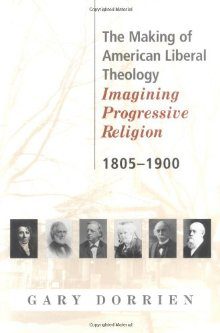 is Gary Dorrien’s magesterial (and I don’t use that word lightly here) three-volume The Making of American Liberal Theology. But for the purposes of this blog post, I’ll be focusing on the first hundred pages or so of Volume 1, Imagining Progressive Religion (1805-1900), which was published in 2001:
- On the first page of the Introduction, Dorrien emphasizes that far from a new fangled invention, “The idea of liberal theology, is nearly three centuries old,” placing its origins in the 1700s. The crucial turning point is the conviction that “modern knowledge and experience” are vital and legitimate criterions of authority for Christian theology. Accordingly, “religion should be modern and progressive,” looking to the present and future — not merely to the past (xiii).
- Although some of the earliest breakthroughs in this direction came from Germany — Friedrich Schleiermacher (1768-1834), for example, is often known as the “Father of Modern Liberal Theology” — Dorrien notes that many of the most well-known figures in 19th century Unitarianism were much more likely to be reading in English than German: “William Ellery Channing relied mostly on English Unitarians. Ralph Waldo Emerson got his Kant and Schleiermacher mostly secondhand.” More influential in the U.S. than Schleiermacher was Samuel Taylor Coleridge’s Aids to Reflection, which — despite the importance of critical reason on liberal theology — “convinced a host of American transcendentalists and Bushnellians that religion belongs to the faculty of imagination (xvii). In addition to emphasizing imagination, Emerson also increasingly came to hold that “spiritual experience comprised a better foundation for religious belief than any historically based creed” (60). (For a contemporary parallel, see the First Source of Unitarian Universalism.)
- I’ll be saying more below about Channing’s famous “Unitarian Christianity” sermon, but it is a fascinating case study of how a sermon can cause a paradigm shift: “It inspired a critical mass of pastors to stop equivocating about their liberalism” (35). At the same time, Channing did not move as far toward pantheism as did Emerson, who wrote sayings such as “God in us worships God,” and “God must be sought within, not without,” and… “Make your own Bible.” … (48).
- Unlike my previous post in this series, which described a period liberal religious history with a more exclusive, Christo-centric emphasis, with Emerson we see a turn toward pluralism. Regarding Jesus, Emerson wrote, “I do not see in him cheerfulness: I do not see in him the love of Natural Science: I see in him no kindness for Art; I see in him nothing of Socrates, of Laplace, of Shakespeare.” Thus, Emerson saw Jesus not as “The One” most exemplary human, but as one among many admirable human beings (72).
- Theodore Parker, reflecting in horror about a proposition (that was eventually defeated) to disfellowship anyone who doubted “the value and authority of miracles,” wrote, “This is the 19th century! This is Boston! This among the Unitarians! I intend, in the coming year, to let out all the force of Transcendentalism that is in me. Come what will come, I will let off the Truth fast as it comes.” If the advent of the nineteenth century caused Parker’s incredulity at the intransigence of antiquated thought, how much more so, then, is boldness needed now — in the twenty-first century?!
2
 Cynthia Grant Tucker published a fascinating book in 1990 on Prophetic Sisterhood: Liberal Women Ministers of the Frontier, 1880-1930. This history of passionate, talented, successful ministers, who happened to also be female, should shame any opponents to female ordination. However, Tucker is clear that these women were the exception rather than the rule during the post-Civil War period: “In 1870, only five women had sought a place alongside the 600 male liberal clergy. Twenty years later, the Universalists and Unitarians together had ordained only about seventy, and far fewer actually had a chance to use their credentials in full-time, paid pastorates” (3, 58).
Also, although I said that these successful minister only “happened to also be female,” there was an important sense in which their gender did often play a positive role in their success:
their practice of ministry did not repudiate woman’s sphere but allied itself with it in order to make it broader and more androgynous. Committed to a ministry that went beyond once-a-week pulpit appearances…moving the concept of “‘church home’ beyond the popular metaphor as few of their brother clergy had thought to do…. What [congregants] longed for was not academic orators but sympathetic minister with an optimistic faith to enfold them in tight, supportive communities and lighten their everyday load. (5)
Frustratingly, these women, despite their official ordination and demonstrable success in leading congregations encountered entrenched patriarchal discrimination — the “stained glass ceiling” — when they sought access to denominational positions of influence. (6-7). A parallel perversity can be seen today in the absurd rejection of women bishops in the Church of England given the large number of female priests in longstanding service (see: “Church of England votes against allowing women bishops”).
Another parallel can be found between some of these women ministers resenting younger people telling them that they were too old at age 70 to be of use (when in fact remained “Healthy and active”) and Nancy Pelosi rebuking a reporter for asking if, at age 72, she is too old to be Speaker and is “prohibiting younger members from moving forward?”
3
Our shift in focus to the nineteen century is also cause to revisit Conrad Wright’s historical survey of UU polity titled Walking Together: Polity and Participation in Unitarian Universalist Churches. Some highlights for this historical period include the following:
- A rise in religious pluralism increasingly threatened the so-called “Standing Order in New England,” which was “predicated on an essentially homogenous population sharing a common theological heritage” (34). As religious authorities were increasingly disestablished, the religious freedom of individuals and congregations increased, and new ways of fundraising had to be devised, which included selling and renting pews (36). A contemporary parallel is happening in Germany today (“No tax, no blessing: German church insists on levy”).
- In my last post, I mentioned the advantages that can come from congregationalism. But that same freedom of the local congregation can result in isolated congregations. To resist this tendency in liberalism to isolation (to which both congregations and individuals are susceptible), Henry Bellows provided pivotal leadership in helping the Unitarians form the National Conference in 1865 (43).
- The paradigmatic opponent to Bellows’ “institutionalism” was Octavius Brooks Frothingham’s “individualism” (67). The stereotype of Frothingham’s resistance to institutionalization is Emersonian “churches of two, churches of one,” and “solitary Sunday walks in grove and glen” instead of gathering together with a religious community (69). To add a third persona of “parochialism” to this typology, ministers such as Rufus Ellis were content with the current status of their congregation, and did not see the need to attend a convention of congregations.
- In my last post, I also described the promise and peril of presbyterian polity. And within Universalism, the “establishment of the General Convention in 1833” had perhaps the worst of both worlds: “presbyterian structure but not presbyterian authority” (47). This situation created bureaucracy with no power of enforcement.
- There was movement eventually in both Unitarianism and Universalism toward a middle way that rejected “‘pure’ congregationalism” (and its danger of “excessive individualism”) but allowed for “more effective common action” (65).
4
William Ellery Channing (1780-1842) preached one of the most historically famous sermons in Unitarian Universalist history: “Unitarian Christianity,” delivered at the ordination of Rev. Jared Sparks in The First Independent Church of Baltimore in 1819. Relatedly, I can’t help wondering what sort of sermon could be preached today that would eventually, like Channing’s sermon, be assigned reading for every aspiring UU minister?
- Channing’s theology in this sermon is Christocentric, but he does say not all scripture is equal: there are high points and low points in the Bible (1).
- He’s also supercessionistic — holding that Christianity has supplanted Judaism (2).
- In defense of using reason in religion, he explicitly names a primary hermeneutic for scriptural interpretation: “the Bible is a book written for men, in the language of men, and that is meaning is to be sought in the same manner as that of other books” (2). “We reason about the Bible precisely as civilians do about the constitution under which we live…. Deny us this latitude, and we must abandon this book to its enemies” (3).
- He likewise affirms scientific discoveries: “we, therefore, distrust every interpretation, which, after deliberate attention, seems repugnant to any established truth” (3). At the same time, his conservative side emphasizes that he is not rejecting revelation, but “We honor revelation too highly to make it the antagonist of reason, or to believe that it calls us to renounce our highest powers” (4). He is seeking a middle way that holds reason and revelation in tension.
- Paralleling a central point of Jonathan Haidt’s current bestseller, Channing points out that “All willingly avail themselves of reason, when it can be pressed into the service of their own party, and only complain of it, when its weapons wound themselves” (4). Haidt highlights that most moral judgements are made less like a scientist carefully weighing all the available data and more like a lawyer or a press secretary that offers argument after argument in defense of a previously determined position.
- As can be surmised from the sermon, he rejects, “the irrational and unscriptural doctrine of the Trinity,” saying further, “We are astonished, that any man can read the New Testament, and avoid the conviction, that the Father alone is God” (6).
- The sexism of Channing’s day can be seen in his formulation “his Parental character” in regard to God (12). There is an extended comparison of God to a father, but no corresponding reference to God’s maternal characteristics (12).
- He rejects the substitutionary atonement as “unscriptural and absurd” — that “Christ came to change God’s mind rather than their own; that the highest object of his mission was to avert punishment, rather than to communicate holiness” (16).
5
Almost ten years later in 1828, Channing preached another well-known sermon titled “Likeness to God,” which like the above sermon, was also delivered on the occasion of an ordination. The opening line refers to the centrality of “true religion.” This concept invokes the need to discern the “true” from the “false” religion, which liberals often say can best be done with human reason (1).
- Part of the appeal Channing had for the Transcendentalists can likely be seen in passages such as “That unbounded spiritual energy which we call God, is conceived by us only through consciousness, through the knowledge of ourselves” (4) and “The universe, I know, is full of God” (5).
- Ironically some passages could be used to support contemporary “Intelligent Design” arguments: “What man can examine the structure of a plant or an animal, and see the adaptation of its parts to each other and to common ends, and not feel, that it is the work of an intelligence akin to his own, and that he traces these marks of design by the same spiritual energy in which they had their origin?” (5-6).
- Channing’s sexism can again be seen here: “In the New Testament God is made known to us as a Father; and a brighter feature of that book cannot be named” (7).
- As the title gestures toward, there are parts that seem similar to the Eastern Orthodox concept of theosis or divinization: “It is to become what we praise” (8). Later he says, “I have said that the great work of religion is, to conform ourselves to God, or to unfold the divine likeness within us” (9). He does, however, offer caveats such as “To grow in the likeness of God, we need not cease to be men.” But he does clearly have a high anthropology: “I do and I must reverence human nature…. I thank God that my own lot is bound up with that of the human race” (11).
6
Another decade later in 1839, Ralph Waldo Emerson delivered his (in)famous “Divinity School Address“:
- Just as Channing’s controversial, famous, and almost two-hour long sermon “Unitarian Christianity” was said to be essentially inaudible to most people present (and came to be known only when copies were later printed), Emerson’s similarly controversial speech to the senior class at Harvard Divinity School was only delivered to “six students along with their families and teachers” (100).
- Emerson’s thinly-veiled target was said to be the stodgy “Unitarian pope” Andrew Norton (1786-1853). After his remarks, Emerson “was not invited back to Harvard for nearly thirty years (1866).” In Emerson’s own life, this address “marked the end of [his] preaching career and his definitive turn toward his truth vocation of lecturer” (100).
- Emerson’s optimistic view of the universe is seen in his Augustinian assertion that “Good is positive. Evil is merely privative, not absolute” (102). Personally, I’m on record as doubting this position: “What If God Is Not Fully and Unambiguously Good?”
- He criticizes the “noxious exaggeration about the person of Jesus” in much of Christian tradition that misses the point of what Jesus’ own life and teachings were about: pointing not toward himself, but toward God and ways of building the Beloved Community (107).
- Emerson pulls no punches about boring sermons: “The preachers do not see that they make his gospel not glad” (109) and “I once heard a preacher who sorely tempted me to say, I would go to church no more” (111).
- Emerson also questions the efficacy of Communion in its current desiccated form. In contrast to the historical Jesus’ practice of building relationship over full meals and conversations, the Lord’s Supper has become a “hollow, dray, creaking formality” (112).
- He stresses the significance of what you know to be true in your own experience not based on the secondhand testimony — commissioning the aspiring ministers before him, “Yourself a newborn bard of the Holy Ghost, — cast behind you all conformity, and acquaint men at first hand with Deity” (116).
I’m curious why Emerson’s “Divinity School” address is (rightly) so widely available and required reading for every aspiring UU minister, whereas Bellow’s 1859 “The Suspense of Faith: An Address to the Alumni of the Divinity School of Harvard University” — which thematically offers a pragmatic, institutional counterweight to Emersonian individualism (perhaps for the “religious, but not spiritual” set) — is not required reading. I can’t easily even find a copy with Amazon or Google. Do we not need both?!
7
Finally, in 1841 Theodore Parker (1810-1860) gave a famous sermon on “The Transient and the Permanent in Christianity” (also an ordination sermon):
- Parker gives us evidence that, not unlike today, in early nineteenth century, there was a well-known tradition of lamentation along the lines of “The Philistines be upon us, and Christianity is in danger” (1). (Of course, this lamentation goes back to Paul of Tarsus’ refutation of “other gospels” in Galatians and early “orthodox” book such as Irenaeus’ Against Heresies.)
- Parker’s goal, as we have seen in many other cases already in UU History, is to distinguish the true, authentic permanent core of Christianity from the false, temporary, transient cultural trappings of how Christianity is practiced at any particular time and place: “What is the falsehood in one province passes for truth in another. The heresy of one age is the orthodox belief and the ‘only infallible rule’ of the next… Men are burned for professing what men are burned for denying” (5-6).
- In Parker we see, as we have before in UU History, a valorization of truth in and of itself: “It is hard to see why the great truths of Christianity rest on the personal authority of Jesus, more than the axioms of geometry ret on the personal authority of Euclid, or Archimedes. The authority of Jesus, as of all teachers,one would naturally think, must rest on the truth of his words, and not their truth on his authority” (9).
- Long before the Jesus Seminar and similar to Channing’s teaching that not all parts of scripture are equal, Parker says bluntly, “The ancient belief in the infallible inspiration of each sentence of the New Testament is fast changing; very fast.… Numerous critics strike off several epistles. The Apocalypse itself it not spared, notwithstanding its concluding curse” (10). He lifts up one high point as the practice of Christianity in Jesus’ Sermon on the Mount as much more important than mere belief (16). As the UU slogan goes, “Deeds Not Creeds.”
- Surveying the history of shifting interpretation, Parker accurately notes,
Could we bring up a Christian teacher of any age, — from the sixth to the fourteenth century, for example, though a teacher of undoubted soundness of faith, whose word filled the churches of Christendom, clergymen would scarce allow him to kneel at their altar, or sit down with them at the Lord’s table. His notions of Christianity could not be expressed in our forms; nor could our notions be made intelligible to his ears. The questions of his age, those on which Christianity was thought to depend, — questions which perplexed and divided the subtle doctors, — are no questions to us. The quarrels which then drove wise men mad, now only excite a smile or a tear, as we are disposed to laugh or weep at the frailty of man. We have other straws of our own to quarrel for. Their ancient books of devotion do not speak to us; their theology is a vain word. To look back but a short period, the theological speculations of our fathers during the last two centuries; their “practical divinity;” even the sermons written by genius and piety, are, with rare exceptions, found unreadable; such a change is there in the doctrines. (13)
The call, then, is for epistemic humility, being honest about how little we know with apodictic certainty. And accordingly, Parker celebrates pluralism: “Were all men Quakers or Catholics, Unitarians or Baptists, there would be much less diversity of thought, character, and life; less of truth active in the world than now” (15).
- His closing paragraphs are a rousing call for a robust and prophetic free pulpit:
You may prevent the freedom of speech in this pulpit if you will. You may hire you servants to preach as you bid; to spare your vices and flatter your follies; to prophecy smooth things, and say, It is peace, when there is no peace. Yet is so doing you weaken and enthrall yourselves. And alas for that man who consents to think one thing in his closet, and preach another in his pulpit. God shall judge him in his mercy not man in his wrath. But over his study and over his pulpit might be writ — EMPTINESS; on his canonical robes, on his forehead and right hand — DECEIT, DECEIT.
But, on the other hand, you may encourage you brother to tell you the truth. Your affection will then be precious to him; your prayers of great price. Every evidence of your sympathy will go to baptize him anew to Holiness and Truth. You will then have his best words, his brightest thoughts, and his most hearty prayers. He may grow old in your service, blessing and blest. He will have . . . .”The sweetest, best of consolation, . . . . . .The thought, that he has given, . . . . . .To serve the cause of Heaven, . . . . The freshness of his early inspiration.”
Choose as you will choose; but weal or woe depends upon your choice. (18-19)
8
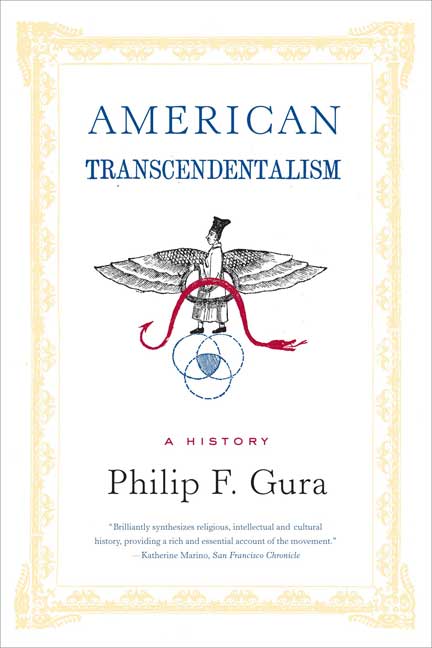 Philip K. Gura’s 2007 book American Transcendentalism: A History has been described as
a sweeping narrative history of America’s first group of public intellectuals, the men and women who defined American literature and indelibly marked American reform in the decades before and following the American Civil War…. The transcendentalists would painfully bifurcate over what could be attained and how, one half epitomized by Ralph Waldo Emerson and stressing self-reliant individualism, the other by Orestes Brownson, George Ripley, and Theodore Parker, emphasizing commitment to the larger social good.
Some highlights:
- Thoreau’s 1854 book Walden,
arguably the literary masterpiece of the Transcendentalist movement…embodies a love affair with America as the writer struggles to square his devotion to conscience with the republican ideals on which the nation was founded…. For Thoreau, God culminates in the present moment of each person’s life and transforms all aspects of that life into acts of devotion. Content to be in and of the world rather than to transcend it…. (269)
- “To Emerson, Whitman was just another aspiring author, no more or less interesting…. [A]fter 1865, [Emerson] settled more and more into his newly assumed role as the country’s de facto philosopher in chief…” (270).
- Cyrus Bartol (1813-1900) published Discourses on the Christian Spirit and Life in 1850. He had a Christian bias, continuing to see Jesus, the Bible, and Christianity as superior to other religions. And he was part of the group that, when the National Conference was formed within Unitarianism in 1865, pushed for “‘keeping the phrase ‘Lord Jesus Christ’ in its constitution’s preamble, effectively eliminating from membership more broad-minded clergy” (274-265).
- The Free Religious Association and The Radical Club formed as a response, and were “‘against any final wording’ of a person’s faith” (276).
- The FRA “held that even in its most liberal manifestations, traditional Christianity was bankrupt because it did not make room for the claims of scientific materialism” (298).
- I’m curious to learn more about Octavius Brooks Frothingham, who “reversed the method of evangelical preachers, trying to read ‘the heart through the brain — through the perceptive reasoning, and aesthetic faculties’… When he was finished, people felt that they had been ‘subjected to a certain mental tension,’ watching ‘ his free and fine intellect at play'” (296-297). In contrast to the Christian bias noted above, Frothingham “believed that all the world’s religions were on equal footing…” (298). One option for learning more that I may read is J. Wade Caruthers 1977 book Octavius Brooks Frothingham, Gentle Radical. I’m also interested to learn more about his 1891 memoir Recollections and Impressions, 1822-1890.
- Regarding the ongoing theme of correcting Calvinism, in 1911 George Santayana said, “If you told the modern American that he is totally depraved, he would think you were joking” (304).
9
The following are a few highlights from Arthur Versluis’ book American Transcendentalism and Asian Religions (Oxford University Press, 1993):
 Fascinatingly, Edward Said’s landmark book Orientalism “did not touch on American Transcendentalism at all” (4), helping justify this present study.
- “Transcendentalists — who like most Europeans based all their Orientalism on texts — interpreted Asian religious texts according to their particular bent. Emerson and Thoreau abstracted, Johnson and Frothingham universalized, and others Christianized” (4).
- “The outstanding symbolic event in the history of Transcendentalism is Emerson’s resignation from his Boston [Unitarian] pastorate in 1832 to become a scholar-at-large” (5).
- “Emerson often cared less whether a work was Islamic, Buddhist, Hindu, or Platonic than whether the quotation he used provoked insights and was appropriate (7). Compare the contemporary resurgence of the ancient monastic practice of lectio divina (“divine reading”), which encourages an idiosyncratic, “prooftexting” as a path of spiritual growth.
- Emerson wrote, “When India was explored & the wonderful riches of Indian theologic literature found, that dispelled once for all the dream about Christianity being the sole revelation.” Versluis continues, “There are myriad spiritual revelations of the universal truth: why therefore should there not be such in America? Emerson not only recognized the transcendent unity of religions, he also intended to lay the groundwork for its manifestation in America” (74).
- “In his classic study Melville’s Quarrel with God, Lawrance Thompson wrote that it would be more appropriate to call Melville a ‘descendentalist’ than a transcendentalist…. [I]n Melville we see an Orientalism radically darker and more pessimistic than that in Transcendentalism. Both Melville and Hawthorne, though perhaps not fairly described as ‘anti-Transcendentalists,’ without a doubt shared an animosity toward Transcendentalism” (119-120).
Previous Posts in This Series on “A Whirlwind Tour of Liberal Religious History”
Part 1: The Radical Reformation
Part 2: The 18th and 19th Century
The Rev. Dr. Carl Gregg is a trained spiritual director, a D.Min. graduate of San Francisco Theological Seminary, and the minister of the Unitarian Universalist Congregation of Frederick, Maryland. Follow him on Facebook (facebook.com/carlgregg) and Twitter (@carlgregg) .
Learn more about Unitarian Universalism:
http://www.uua.org/beliefs/principles/index.shtml
Next Post

December 9, 2012 Top 10 “Netflix Instant” Streamed in 2012
Browse Our Archives
Select a Category Advent Anti-Racism Archaeology Atheism Baptism Best of the Year List Book Reviews Buddhism Catholicism Christian Education Church and State Church Planting Climate Change Conscientious Objection to War Creation Spirituality Death Penalty Didache Disability Rights Discernment Easter Ecology Emergent Church Movement Empire-Critical Ethics Evolution Feminist Theology Film Reviews Gandhi Gospel of Mark Gun Control Hinduism Immigration Reform Interfaith Islam JFK Judaism Jungian Spirituality Lectionary Commentary Lent Letters to the Editor LGBT Marriage MLK Multiculturalism Mysticism Nonviolent Activism Occupy Paganism (Earth-centered Religions) Parables Paul Pluralism Politics Process Theology Quantum Physics Requiescat In Pace Seminary and Divinity School Sermon Series Retrospective Sermons Spiritual Direction Spiritual Practices Stewardship (Fundraising) The Book of J The Wheel of the Year (Paganism) Theoblogger Challenge Triathlon Uncategorized Unitarian Universalism Worship Resources Youth Ministry
Select a Month July 2026 May 2026 March 2026 November 2025 October 2025 August 2025 February 2025 December 2024 October 2024 March 2024 January 2024 December 2023 November 2023 March 2023 February 2023 January 2023 December 2022 November 2022 August 2022 March 2022 February 2022 January 2022 December 2021 September 2021 August 2021 July 2021 June 2021 May 2021 February 2021 January 2021 December 2020 August 2020 June 2020 May 2020 April 2020 March 2020 February 2020 January 2020 December 2019 November 2019 October 2019 September 2019 July 2019 June 2019 March 2019 February 2019 January 2019 December 2018 November 2018 October 2018 September 2018 June 2018 May 2018 April 2018 March 2018 February 2018 January 2018 December 2017 November 2017 October 2017 September 2017 August 2017 July 2017 June 2017 May 2017 April 2017 March 2017 February 2017 January 2017 December 2016 November 2016 October 2016 September 2016 August 2016 June 2016 May 2016 April 2016 March 2016 February 2016 January 2016 December 2015 November 2015 October 2015 September 2015 August 2015 July 2015 June 2015 May 2015 April 2015 March 2015 February 2015 January 2015 December 2014 November 2014 October 2014 August 2014 July 2014 June 2014 May 2014 April 2014 March 2014 February 2014 January 2014 December 2013 November 2013 October 2013 September 2013 August 2013 July 2013 June 2013 May 2013 April 2013 March 2013 February 2013 January 2013 December 2012 November 2012 October 2012 September 2012 August 2012 July 2012 June 2012 May 2012 April 2012 March 2012 February 2012 January 2012 December 2011 November 2011 October 2011 September 2011 August 2011 July 2011 June 2011 May 2011 April 2011 March 2011 February 2011 January 2011 December 2010 November 2010 October 2010 August 2009 July 2009 May 2009
Follow Us!
TAKE THE
Religious Wisdom Quiz
Which Psalm contains "Create in me a clean heart, O God"?
Select your answer to see how you score.
Psalm 51 Psalm 33 Psalm 110 Psalm 70
Related posts from Carl Gregg

Peak Spiritual Experiences, Psychedelics, & Consciousness Research

"How the Founding Fathers Became Infallible and Our...

Vampires, Witches, & NPR: The Legacy of Margot...

“Do You Really Want to Know?” From Pope...
TRENDING AT PATHEOS More Voices

Reading America at 250: A Nation Wrestles With...
As part of my own reflection on the 250th anniversary of the...

Whenever I am reading a book or listening to an argument, I...

President Trump Ban Animal Torture Videos on Facebook
Call for Stricter Regulations of Animal Abuse Content on Facebook Although President...

Draft Amendments to Address Ritual Abuse in New...
The proposed changes would make it illegal for individuals in domestic partnerships...

How Bans on LGBTQ+ Student Clubs Threaten Religious...
On June 20, 2025, the State of Texas passed Senate Bill 12....

The Truth About the Gen Z Revival
This past year, there has been a lot of media buzz surrounding...
view all More Voices blogs
Ad-Free & Subscriber Log-In Subscription Support
- About Us
- 2026 Calendar
- Videos
- Podcasts
- Library of World Religions
- Faith In Media Tracker
- Advertise With Us
- Write for Us
- Privacy Policy
- Terms of Service
- Do Not Sell My Data
- Contact Us
- Radiant Digital
- Manage Newsletter Subscriptions
- Unsubscribe From Notifications
- Sitemap
Copyright 2008-2026, Patheos. All rights reserved.
Subscription Support Ad-Free & Subscriber Log-In
Follow Patheos