
BuddhistCatholicContemplativeEvangelicalGeneral ChristianHinduJewishLatter-day SaintMuslimNew VisionsProgressive Christian
Beliefs
- Buddhist
- Catholic
- Contemplative
- Evangelical
- General Christian
- Hindu
- Jewish
- Latter-day Saint
- More Voices
- Muslim
- New Visions
- Pagan
- Progressive Christian
Topics
- Religion News
- Food and Religion
- Sports and Religion
- Religious Art
- Religious Music and Entertainment
- Religious Events
- History and Religion
- Style and Religion
- Politics and Religion
- Women in Religion
- Recreation Outdoors and Religion
- Business Finance and Religion
- Careers Workplace and Religion
- Education and Religion
- Family Parenting and Religion
- Health Fitness and Religion
- Home and Religion
- Relationships and Religion
- Technology and Religion
- Travel and Religion
Columnists
- Buddhist Columnists
- Business Finance and Religion Columnists
- Careers Workplace and Religion Columnists
- Catholic Columnists
- Contemplative Columnists
- Education and Religion Columnists
- Evangelists Columnists
- Family Parenting and Religion Columnists
- General Christian Columnists
- Health Fitness and Religion Columnists
- Hindu Columnists
- History and Religion Columnists
- Home and Religion Columnists
- Jewish Columnists
- More Voices Columnists
- Latter Day Columnists
- Muslim Columnists
- New Visions Columnists
- Nonreligious Columnists
- Pagan Columnists
- Politics and Religion Columnists
- Progressive Columnists
- Recreation Outdoors and Religion Columnists
- Relationships and Religion Columnists
- Religion News Columnists
- Religious Art Columnists
- Religious Events Columnists
- Religious Music and Entertainment Columnists
- Sports and Religion Columnists
- Style and Religion Columnists
- Technology and Religion Columnists
- Travel and Religion Columnists
- Women in Religion Columnists
Resource Library
- 2026 Calendar
- Library of World Religions
- The 100 Most Holy Places on Earth
- Patheos Answers
- Podcasts
- Videos
- Faith Leaders Database
- Anglican Episcopalian
- Bahai
- Baptist
- Buddhism
- Christianity
- Confucianism
- Eastern Orthodoxy
- Hinduism
- Holiness and Pentecostal
- ISKCON
- Islam
- Judaism
- Lutheran
- Methodist
- The Church of Jesus Christ of Latter-day Saints
- New Age
- Paganism
- Presbytarian and Reformed
- Protestantism
- Religion Behind the Scenes
- Roman Catholic
- Scientology
- Shia Islam
- Sikhism
- Sufism
- Sunni Islam
- Taoism
- Zen
- See all religions
Research Tools
 Ad-Free & Subscriber Log-In Subscription Support
Ad-Free & Subscriber Log-In Subscription Support
Follow Patheos 

- Trending:
- Forgiveness
- |
- Marriage
- |
- Consciousness
- |
- Death Penalty
- |
- Election
- |
- Halloween

- Home
- More Voices
- Liberal Religious History: The Radical Reformation
Liberal Religious History: The Radical Reformation
Last updated on: December 29, 2014 at 1:07 pm by Carl Gregg
Liberal Religious History: The Radical Reformation 2014-12-29T13:07:44-05:00 Carl Gregg
Patheos Explore the world's faith through different perspectives on religion and spirituality! Patheos has the views of the prevalent religions and spiritualities of the world.
This post is the first in a series of at least five posts on Unitarian Universalist history in preparation for a course I’m auditing in January on “Unitarian Universalist History & Polity Survey Course” with The Rev. Dr. Nicole Kirk. For those following along as I seek formal fellowship with the Unitarian Universalist Association, you may be interested to see the full Ministerial Fellowship Committee “Required Reading List” and “Encouraged Reading List and Resources.”
The first of the five major sections of the UU history course in which I am enrolled is on the Radical Reformation, and the first assignment is Charles A. Howe’s 1997 book For Faith and  Freedom: A Short History of Unitarianism in Europe (211 pages): “a spirited account of the trinitarian debate that started with Michael Servetus in 1531, and traveled through Poland, Transylvania, Hungary, and England to become the Unitarian movement.” Howe is transparent in the preface that his short, introductory volume is “almost entirely derivative” (xiii). But his condensed version is a welcome entry point in that he is synthesizing two extremely large tomes:
(1) Earl Morse Wilbur’s two-volume A History of Unitarianism (1945 and 1952), weighing in at 1,135 pages, is the “first comprehensive study of the Unitiarian movement” and “remain[s] the basic work in the field” (xi).
(2) George Hunston Williams’ The Radical Reformation, Third Edition (1962/1992), weighing in at 1,513 pages, details “the interconnected stories of radical groups operating at the margins of the mainline Reformation.”
Speaking of the trinitarian debates, I have written previously about what it might look like to redeem the word “Trinity” from a progressive Christian perspective. Now, from a Unitarian Universalist perspective, Howe’s book is an important reminder of how many people were persecuted, intellectually repressed, tortured, or killed in the various movements against trinitarianism or for some form of Unitarianism. A classic fault line is the fourth-century rivalry between Arius (250 or 256–336) and the trinitarian Athanasius of Alexandria (c. 296-298 – 373).
One of many reverberations of this debate is that “it was not until 1928 that the use of the Athanasian Creed was made optional in the Church of England” (145). Bart Ehrman’s important book Lost Christianities: The Battles for Scripture and the Faiths We Never Knew is one of many excellent reminders that the (temporary) victory of Athanasius and the trinitarians was not inevitable. What came to be seen as so-called “Orthodox” theology has always been merely one among many theological positions striving for dominance, power, and influence.
Fast forwarding to the Reformation, Howe demonstrates that many of the Reformers, including Melanchthon, Luther, and Calvin, did not emphasize the doctrine of the Trinity, but they were willing to persecute noncomformist proto-Unitarians to protect their own safety, power, and influence (2). That is not to say that the Reformation’s leaders were against the Trinity, but it was not central (or even necessarily biblical) in many of their views; however, they were not willing to grant the same freedom to the proto-Unitarians that the Reformers sought for themselves from Rome. As the French theologian Sebastian Castello (writing as “Martin Bellius”) wrote in the wake of Servetus’ martyrdom:
We are all heretics in the eyes of those who do not share our views… Let us be tolerant towards one another, and let no one condemn another’s belief…. Who would not think Christ a Moloch or some such god, if he wished that [humans] should be immolated to him and burned alive? (42-43)
As a Southern Baptist turned liberal Baptist, turned Unitarian Universalist reading these centuries-old struggles, I was interested to see the anti-trinitarian themes among some Anabaptists, who believed you should only pray to God, not to Jesus (16-17). The stories of those persecuted historically for their “heretical” beliefs also embolden me today to protect and celebrate the hard-won religious liberty that many (but not all) enjoy in the twenty-first century.
Starting with Michael Servetus’ 1531 On the Errors of the Trinity, there was a trend of rejecting the Trinity based on the lack of scriptural support for this doctrine (19). Overtime, participants in what became the Unitarian movement began to also question the Bible as a criterion of authority — seeing it increasingly as a book written by humans, not a product of direct divine revelation. A landmark example of this transition is Andrew Wiszowaty’s posthumously published book in 1685 Rational Religion (Religio rationalis), which asserted human reason as a vital criterion of authority. In contrast, Wiszowaty’s grandfather, Faustus Socinus (1539–1604) — the namesake of the important proto-Unitarian movement Socinianism — saw scripture as “the sole source of religious truth” (92).
In considering the overall lessons to be gleaned from Howe’s sweeping review of liberal religious history in Europe, it is important to note that all the movements that laid the groundwork for contemporary Unitarian Universalism have many “family resemblances” (in the Wittgensteinian sense), but the connections should not be overstated or overgeneralized (157). Despite this caveat, Howe highlights three overall trends that Wilbur draws from his earlier massive study of the diverse individuals and movements that contributed to the history of Unitarianism: “freedom of religious thought, the unrestricted use of reason, and tolerance of difference views and practices” (185). Indeed, the Liberal Turn in Religion can be seen precisely as the move from authority vested in hierarchy, community, and (alleged) historical precedents of unchanging divine revelation to reason and individual experience as equally valid, if not more valid, criterions of authority.
The title of this post notes that the first section of this course is on the “Radical Reformation.” The word radical, from the Latin for “root,” has various meanings in English from a return back to the beginning (the root” out of which a tree has grown) or a revolutionary shift (the radicalization of a splinter group). Modern day Unitarian Universalists, as contemporary heirs of The Radical Reformation, have sought less to turn back the wheels of time to a some mythological time of pure roots and more to discern the true essence or root of authentic religion. And their “free and responsible search for truth and meaning,” has most often led them away from external authorities and toward pluralism and critically-examined experience.
Appendix: Other Readings on the Radical Reformation
1
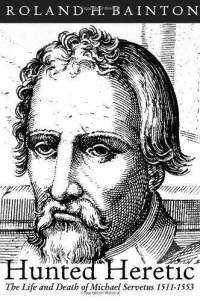
Roland Herbert Bainton has written a book-length treatment of Servetus in his Hunted Heretic: The Life and Death of Michael Servetus, 1511-1553 (1953/2005). Themes:
- Danger and threat of censorship for publishing materials religious authorities would likely find controversial: “The
 manuscript was burned leaf by leaf as the printed pages were set in type” (103).
 - A perceived need to keep Christianity clean: “purge Christianity of such filth, such deadly pestilence” (107). Servetus’ death sentence included the accusation, “you have obstinately tried to infect the world with your stinking heretical poison….” Thus, “desiring to purge the church of God of such infection and cut off the rotten member…” (141). “There was absolutely nothing about any political offense. Servetus died as a heretic” for anti-Trinitarianism and anti-paedobaptism (140). [In contrast, see Jesus’ subversion of the purity commandments. See also Kester Brewin’s chapter on “Dirt” in his Signs of Emergence: A Vision for Church That Is Always Organic/Networked/Decentralized/Bottom-Up/Communal/Flexible/Always Evolving.]
- A perceived need to protect God: “The Calvinistic God is not an abyss of being but the sovereign Lord” (117). For Calvin, “it was all so perfectly clear that the majesty of God, the salvation of souls, and the stability of Christendom were at stake” (142):
The severity of Calvin was born of zeal for truth and even concern for the victim. Death itself seemed to him not too harsh a penalty for perversion of the truth of God. Today any of us would be the first cast a stone against Calvin’s intolerance; and seldom do we reflect that we who are aghast at the burning of one man to ashes for religion do not hesitate for the preservation of our culture to reduce whole cities to cinders. (146)
Note: The author of the Servetus biography was a pacifist, likely influencing his interest in this subject: “Roland Bainton knew what it meant to hold an unpopular belief. In 1917 he was a pacifist while almost all around him, including his fellow students and the faculty at the Yale Divinity School, were caught up in the war frenxy. The Dean delcared that those students who did not enlist were “morally deficient” (155).
2
I’ve already mentioned Earl Morse Wilbur’s two-volume A History of Unitarianism (1945 and 1952), which weighs in at 1,135 pages, is the first comprehensive study of the Unitiarian movement. One of the reasons this work and remains the basic work in the field is that Wilbur was willing to do the hard work linguistic work not only “in Latin and in the more familiar languages of western Europe,” but also in the essential — for this history — work “buried in Polish and Hungarian.” The following are some specifics from Volume II: “A History of Unitarianism: Socinianism and its Antecedents.”
- Anabaptists were part of the Radical Reformation and helped set the groundwork for later heterodoxy because “Inasmuch as the Anabapists rejected all external authority in religion save scripture, which each explained according to his own inner conviction, the way was open for wide differences of opinion.”
- Servetus does have a certain brashness and arrogance. At the same time, there is a genuinely ernest concern that so many have been unnecessarily killed or persecuted for anti-Trinitarian beliefs:
In place of a doctrine whose very terms — Trinity, hypostasis, person, substance, essence — were not taken from the Bible but invented by philosophers, and whose Christ was little more than philosophical abstraction, he wished to get men to put their faith in a living God, in a divine Christ who had been a historical reality, and in a Holy Spirit forever working in the hearts of men.
Sounds similar to the later emphasis in Emerson and elsewhere on not secondhand, but firsthand religion!
[Note: there are no page references for the quotes because the free version of Wilbur’s (long!) book frustratingly doesn’t have page numbers! Also Wilbur annoyingly leaves many passages untranslated, neglecting to appreciate those of us who unfortunately don’t speak as many languages as he did.
3
Also remarkable is the precedent set by history’s only Unitarian King, John Sigismund of Transylvania (1540-1571), with his
1568 “Act of Religious Tolerance and Freedom of Conscience” at the Diet of Torda (99) — also known as the “Edict of Torda.” (Diet is from the Latin for “parliamentary assembly.”) This document would be revolutionary in many parts of the world in the twenty-first century, much less in its original context of the sixteenth century for protections including the following:
- Freedom of the Pulpit: “Preachers everywhere are to preach the gospel according to their understanding of it…. Let no superintendent or anyone else act violently or abusively to a preacher. No one may threaten another, on account of his teaching, with imprisonment or deprivation of office.”
- Freedom of the Pew: “if the parish willingly receives it good: but if not, let there be no compulsion on it to do so.”
- Freedom of the Local Congregation: “let each parish keep a minister whose teaching is acceptable to it.”
4
Robert Browne’s “The Life and Manner of All True Christians” (1582) is another important document in the history of the Radical Reformation. He is credited as being the first person in English to help widely spread the Anabaptist notion that the church and state should operate in separate spheres. A contemporary parallel is the seventh part of the Alliance of Baptists’ covenant: “The principle of a free church in a free state and the opposition to any effort either by church or state to use the other for its own purposes.”
-
Browne emphasizes the importance of entering into a “willing covenant” to become the “people of God” (18).
-
He also notes that some people have “the grace and office of teaching and guiding” either with or without a call to be a preacher (21). The contemporary introduction argues that a historical parallel can be seen here for the UUA’s position of “Minister of Religious Education” as separate from a “Parish Minister.” In Browne’s conception:
- Pastor – “gift of exhorting, and applying especially.”
- Teacher – “gift of teaching especially, and less the gift of exhorting and applying.”
- Elders – “overseeing and counseling”
- Deacons – “cherishing and rescuing the afflicted and poor”
- Widows – prayer of the church, with attendance to the sick and afflicted thereof. (22).
5
“The Cambridge Platform,” also important in the history of polity, was written a little  less than a century later in 1648. The “Congregational Church” (governed by a congregation) is explicitly mentioned (130), presumably as opposed to a presbyterian (governed by elders), episcopal (governed by a bishop), or other form of church structure:
A Congregational Church is by the Institution of Christ a part of the Militant Visible Church, consisting of a company of Saints by calling, united into one Body by an holy Covenant, for the Public Worship of God, and mutual Edification one of another, in the Fellowship of the Lord Jesus.
This church is also specifically described as “free,” which is significant in tracing the history of the Free Church tradition (134).
An interesting distinction is made between an Immediate Call to Office (“by Christ himself, such as the Call of the Apostles and Prophets, this manner of calling ended with them) or a Mediate Call to Office (“by the Church”) (134).
The modern day introduction notes, “The radical polity of the Platform did not extend to individual freedom of belief for congregants within a parish.” Instead, “when such a People do [freely] choose any to be over them…then do they become subject, and most willingly submit to their Ministry in the Lord, whom they have so chosen.” At the same time:
if the Church have Power to choose their Officers and Minister, then in case of manifest Unworthiness and Delinquency, they have power also to depose them. For, to open and shut, to choose and refuse, to constitute in Office, and remove from Office, are acts belonging to the same Power. (134)
6
Finally, some highlights from Conrad Wright’s 1989 book Walking Together: Polity and Participation in Unitarian Universalist Churches.
From Chapter 5, “Autonomy and Fellowship”:
- Tension at the 1963 UU General Assembly in Chicago between the values of (1) congregational polity and (2) social justice. The specific acrimony was over whether it was a violation of congregational polity to force a racial nondiscrimination policy on congregations. But was a failure to do so a violation of social justice values (64)? In 1965, a vote recognized a “prevailing consensus among us that our churches should admit to membership without discrimination people of all races and origins, and that diversity of opinion among us is welcomed rather than feared” (65). The option of a hierarchal use of force on a local congregation would be more normative in a presbyterian or episcopal polity (69). “Rebuke” vs. “Coerced” (68)
- “the UUA is something more than an agency to serve us; in some respects it is actually ourselves” (68).
From Chapter 9, “The Mirror of History”
- (121) Emerson promoted firsthand religious experience, as opposed to abdicating one’s religious autonomy to the alleged secondhand testimony of authorities or ancestors: “Our age is retrospective…. It builds the sepulchers of the fathers. It writes biographies, histories, an criticism. The foregoing generations beheld God and nature face to face; we though their eyes” (121).
- Generations later, Emerson is now (ironically!) beloved, quoted, and read for his testimony about the importance of firsthand experience. However, Wright makes a strong case for how we are arguably at least equally influenced today by Henry W. Bellows. Although many don’t remember his name, he help set the precedents for networking, holding National Conference to annually assemble Unitarian congregations, and soliciting funds for these ventures: “Emerson once asserted that every institution is the lengthened shadow of a man. We still stand in the shadow of Bellows much more than we realize” (126).
The Rev. Dr. Carl Gregg is a trained spiritual director, a D.Min. graduate of San Francisco Theological Seminary, and the minister of the Unitarian Universalist Congregation of Frederick, Maryland. Follow him on Facebook (facebook.com/carlgregg) and Twitter (@carlgregg).
Learn more about Unitarian Universalism:
http://www.uua.org/beliefs/principles/index.shtml
Previous Post

November 12, 2012
In the Wake of an Election
Next Post
November 18, 2012 Savoring the Small Stuff: Ordinary Gratitude as Spiritual Practice
Browse Our Archives
Select a Category Advent Anti-Racism Archaeology Atheism Baptism Best of the Year List Book Reviews Buddhism Catholicism Christian Education Church and State Church Planting Climate Change Conscientious Objection to War Creation Spirituality Death Penalty Didache Disability Rights Discernment Easter Ecology Emergent Church Movement Empire-Critical Ethics Evolution Feminist Theology Film Reviews Gandhi Gospel of Mark Gun Control Hinduism Immigration Reform Interfaith Islam JFK Judaism Jungian Spirituality Lectionary Commentary Lent Letters to the Editor LGBT Marriage MLK Multiculturalism Mysticism Nonviolent Activism Occupy Paganism (Earth-centered Religions) Parables Paul Pluralism Politics Process Theology Quantum Physics Requiescat In Pace Seminary and Divinity School Sermon Series Retrospective Sermons Spiritual Direction Spiritual Practices Stewardship (Fundraising) The Book of J The Wheel of the Year (Paganism) Theoblogger Challenge Triathlon Uncategorized Unitarian Universalism Worship Resources Youth Ministry
Select a Month July 2026 May 2026 March 2026 November 2025 October 2025 August 2025 February 2025 December 2024 October 2024 March 2024 January 2024 December 2023 November 2023 March 2023 February 2023 January 2023 December 2022 November 2022 August 2022 March 2022 February 2022 January 2022 December 2021 September 2021 August 2021 July 2021 June 2021 May 2021 February 2021 January 2021 December 2020 August 2020 June 2020 May 2020 April 2020 March 2020 February 2020 January 2020 December 2019 November 2019 October 2019 September 2019 July 2019 June 2019 March 2019 February 2019 January 2019 December 2018 November 2018 October 2018 September 2018 June 2018 May 2018 April 2018 March 2018 February 2018 January 2018 December 2017 November 2017 October 2017 September 2017 August 2017 July 2017 June 2017 May 2017 April 2017 March 2017 February 2017 January 2017 December 2016 November 2016 October 2016 September 2016 August 2016 June 2016 May 2016 April 2016 March 2016 February 2016 January 2016 December 2015 November 2015 October 2015 September 2015 August 2015 July 2015 June 2015 May 2015 April 2015 March 2015 February 2015 January 2015 December 2014 November 2014 October 2014 August 2014 July 2014 June 2014 May 2014 April 2014 March 2014 February 2014 January 2014 December 2013 November 2013 October 2013 September 2013 August 2013 July 2013 June 2013 May 2013 April 2013 March 2013 February 2013 January 2013 December 2012 November 2012 October 2012 September 2012 August 2012 July 2012 June 2012 May 2012 April 2012 March 2012 February 2012 January 2012 December 2011 November 2011 October 2011 September 2011 August 2011 July 2011 June 2011 May 2011 April 2011 March 2011 February 2011 January 2011 December 2010 November 2010 October 2010 August 2009 July 2009 May 2009
Follow Us!
TAKE THE
Religious Wisdom Quiz
What British monarch is also Supreme Governor of the Church of England?
Select your answer to see how you score.
Prime Minister The King/Queen of England Archbishop of Canterbury Pope
Related posts from Carl Gregg

Reading America at 250: A Nation Wrestles With...


Andrew Holocek on the Power of Darkness

The Stories That Shape Us: Myths, Archetypes, &...
TRENDING AT PATHEOS More Voices

Reading America at 250: A Nation Wrestles With...
As part of my own reflection on the 250th anniversary of the...

Whenever I am reading a book or listening to an argument, I...

President Trump Ban Animal Torture Videos on Facebook
Call for Stricter Regulations of Animal Abuse Content on Facebook Although President...

Draft Amendments to Address Ritual Abuse in New...
The proposed changes would make it illegal for individuals in domestic partnerships...

How Bans on LGBTQ+ Student Clubs Threaten Religious...
On June 20, 2025, the State of Texas passed Senate Bill 12....

The Truth About the Gen Z Revival
This past year, there has been a lot of media buzz surrounding...
view all More Voices blogs
Ad-Free & Subscriber Log-In Subscription Support
- About Us
- 2026 Calendar
- Videos
- Podcasts
- Library of World Religions
- Faith In Media Tracker
- Advertise With Us
- Write for Us
- Privacy Policy
- Terms of Service
- Do Not Sell My Data
- Contact Us
- Radiant Digital
- Manage Newsletter Subscriptions
- Unsubscribe From Notifications
- Sitemap
Copyright 2008-2026, Patheos. All rights reserved.
Subscription Support Ad-Free & Subscriber Log-In
Follow Patheos