
BuddhistCatholicContemplativeEvangelicalGeneral ChristianHinduJewishLatter-day SaintMuslimNew VisionsProgressive Christian
Beliefs
- Buddhist
- Catholic
- Contemplative
- Evangelical
- General Christian
- Hindu
- Jewish
- Latter-day Saint
- More Voices
- Muslim
- New Visions
- Pagan
- Progressive Christian
Topics
- Religion News
- Food and Religion
- Sports and Religion
- Religious Art
- Religious Music and Entertainment
- Religious Events
- History and Religion
- Style and Religion
- Politics and Religion
- Women in Religion
- Recreation Outdoors and Religion
- Business Finance and Religion
- Careers Workplace and Religion
- Education and Religion
- Family Parenting and Religion
- Health Fitness and Religion
- Home and Religion
- Relationships and Religion
- Technology and Religion
- Travel and Religion
Columnists
- Buddhist Columnists
- Business Finance and Religion Columnists
- Careers Workplace and Religion Columnists
- Catholic Columnists
- Contemplative Columnists
- Education and Religion Columnists
- Evangelists Columnists
- Family Parenting and Religion Columnists
- General Christian Columnists
- Health Fitness and Religion Columnists
- Hindu Columnists
- History and Religion Columnists
- Home and Religion Columnists
- Jewish Columnists
- More Voices Columnists
- Latter Day Columnists
- Muslim Columnists
- New Visions Columnists
- Nonreligious Columnists
- Pagan Columnists
- Politics and Religion Columnists
- Progressive Columnists
- Recreation Outdoors and Religion Columnists
- Relationships and Religion Columnists
- Religion News Columnists
- Religious Art Columnists
- Religious Events Columnists
- Religious Music and Entertainment Columnists
- Sports and Religion Columnists
- Style and Religion Columnists
- Technology and Religion Columnists
- Travel and Religion Columnists
- Women in Religion Columnists
Resource Library
- 2026 Calendar
- Library of World Religions
- The 100 Most Holy Places on Earth
- Patheos Answers
- Podcasts
- Videos
- Faith Leaders Database
- Anglican Episcopalian
- Bahai
- Baptist
- Buddhism
- Christianity
- Confucianism
- Eastern Orthodoxy
- Hinduism
- Holiness and Pentecostal
- ISKCON
- Islam
- Judaism
- Lutheran
- Methodist
- The Church of Jesus Christ of Latter-day Saints
- New Age
- Paganism
- Presbytarian and Reformed
- Protestantism
- Religion Behind the Scenes
- Roman Catholic
- Scientology
- Shia Islam
- Sikhism
- Sufism
- Sunni Islam
- Taoism
- Zen
- See all religions
Research Tools
 Ad-Free & Subscriber Log-In Subscription Support
Ad-Free & Subscriber Log-In Subscription Support
Follow Patheos 

- Trending:
- Forgiveness
- |
- Marriage
- |
- Consciousness
- |
- Death Penalty
- |
- Election
- |
- Halloween

- Home
- More Voices
- Water Communion: “A River Runs through It”
Water Communion: “A River Runs through It”
Last updated on: September 10, 2012 at 3:10 pm by Carl Gregg
Water Communion: “A River Runs through It” 2012-09-10T15:10:12-04:00 Carl Gregg
Patheos Explore the world's faith through different perspectives on religion and spirituality! Patheos has the views of the prevalent religions and spiritualities of the world.
Like many fly fishermen in western Montana where the summer days are almost Arctic in length, I often do not start fishing until the cool of the evening. Then in the Arctic half-light of the canyon, all existence fades to a being with my soul and memories and the sounds of the Big Blackfoot River and a four-count rhythm and the hope that a fish will rise. Eventually, all things merge into one, and a river runs through it. The river was cut by the world’s great flood and runs over rocks from the basement of time. On some of those rocks are timeless raindrops. Under the rocks are the words, and some of the words are theirs. I am haunted by waters.
—Norman Maclean, A River Runs Through It (1976)
These closing lines from Norman Maclean’s 1976 novella A River Runs through It are also the closing lines of Robert Redford’s 1992 film with the same title. Although the film is now twenty years old, if you’ve ever seen the movie or read the book, I suspect those lines 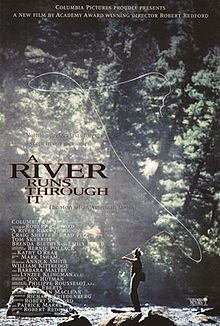 may have sounded familiar to you — even if you haven’t thought of them since you first encountered them. Truly excellent writing is like that: it’s meaningful, memorable, and it sticks with you.
These words are poetic and mystical, gesturing in the same direction as the First Source of our Unitarian Universalist tradition: “Direct experience of that transcending mystery and wonder, affirmed in all cultures, which moves us to a renewal of the spirit and an openness to the forces which create and uphold life.” In this case, the sublime sense of awe and interconnectedness comes from fly fishing. And although I not an accomplished fisherman, much less an accomplished fly fisher, I can relate to a sense of self-transcendent interconnectedness when in nature, especially near water — as, I suspect, can many of you and as have a long line of prominent Unitarian Universalists from Emerson and Thoreau to today.
In those closing lines, the sentence that stands out to me most is the final one: “I am haunted by waters.” For the narrator, a palpable presence of his father and brother lingers around waters, especially around certain rivers where they fished often. But I do not think that that he is primarily haunted by waters in a negative sense. I think that he means he is “haunted by waters” in the sense of being preoccupied with waters, particularly those deeply resonant waters of his childhood.
Reflecting on this final line of A River Runs thought It reminds me of the opening line of Pat Conroy’s 1986 novel The Prince of Tides: “My wound is geography. It is also my anchorage, my port of call.” Conroy is one of my favorite novelists not because he is our most brilliant prose stylist, but because he is a natural storyteller — and because most of his stories revolve around the low-country flavor that characterizes some of the best part of my home state of South Carolina. Just as waters can haunt us, geography can wound us, leaving its mark on us: on our accents, our proclivities, and our perspectives. But Conroy is also right that geography can ground us, give us roots, and a place to which we can return. Geography can be our anchor, our port of call.
In this sense, I have heard it said that the difference between being a tourist and a pilgrim is that, “A tourist passes through a place, but a pilgrim allows a place to pass through them.” Those places that have both wounded and anchored us are those places that we have allowed to pass through us.
Bodies of water, in particular, are like anchors for me. The still waters of a lake compel me to sit and rest a while. The crashing of ocean invites me to walk slowly along the shore. Even the simple, artificial noise of a fountain contemplatively calls me into the present moment. But the same water that invites us to rest before it if present in too much abundance causes a flood or tsunami — or in its absence causes a crop-destroying drought. Waters can be, in turn, haunting and comforting, anchoring and wounding.
In a few moments, you will be invited to come forward and pour a small amount of water — an ounce or two — from a body of water that is special to you into the bowl at the front of the sanctuary. You may also briefly share this water’s significance, but please do be brief out of respect for everyone gathered here, so that as many people as possible who want to share have a chance to share.
The tradition in many Unitarian Universalist congregations, including our own, is for each person to collect an ounce or two of water at some time during each year from a body of water that is particularly meaningful to you for any number of reasons. The combined water represents our shared faith from many different sources. However, if you forgot to bring water or if you, like me, were unfamiliar with the practice of Water Communion until recently (or until just now), don’t worry. You are welcome to pour water from the pitcher and explain what body of water it symbolizes for you.
For me the water I will pour out symbolizes the water than washes up on the western shore of the Chesapeake Bay near the pier in North Beach, Maryland. In truth, I have always preferred the mountains to the beach, which is one of the many reasons I am grateful to live in Frederick; however, for the past two years when Magin and I lived a mile from the bay, those waters were comforting and compelling. I am haunted by those waters, but in a good way. After running, biking, and walking beside the bay so many times, those waters have passed through me. They continue to be part of me. They are now part of my anchorage, my port of call.
I invite you to come forward as you feel led, and share briefly about a source of water that has been meaningful to you in the past year.
The Rev. Dr. Carl Gregg is a trained spiritual director, a D.Min. graduate of San Francisco Theological Seminary, and the minister of the Unitarian Universalist Congregation of Frederick, Maryland. Follow him on Facebook (facebook.com/carlgregg) and Twitter (@carlgregg).
Learn more about Unitarian Universalism:
http://www.uua.org/beliefs/principles/index.shtml
Previous Post

September 4, 2012
Is The Book of James Proto-Marxist?
Next Post
September 27, 2012 Native American Spiritualities: Appropriation and Reciprocity
Browse Our Archives
Select a Category Advent Anti-Racism Archaeology Atheism Baptism Best of the Year List Book Reviews Buddhism Catholicism Christian Education Church and State Church Planting Climate Change Conscientious Objection to War Creation Spirituality Death Penalty Didache Disability Rights Discernment Easter Ecology Emergent Church Movement Empire-Critical Ethics Evolution Feminist Theology Film Reviews Gandhi Gospel of Mark Gun Control Hinduism Immigration Reform Interfaith Islam JFK Judaism Jungian Spirituality Lectionary Commentary Lent Letters to the Editor LGBT Marriage MLK Multiculturalism Mysticism Nonviolent Activism Occupy Paganism (Earth-centered Religions) Parables Paul Pluralism Politics Process Theology Quantum Physics Requiescat In Pace Seminary and Divinity School Sermon Series Retrospective Sermons Spiritual Direction Spiritual Practices Stewardship (Fundraising) The Book of J The Wheel of the Year (Paganism) Theoblogger Challenge Triathlon Uncategorized Unitarian Universalism Worship Resources Youth Ministry
Select a Month July 2026 May 2026 March 2026 November 2025 October 2025 August 2025 February 2025 December 2024 October 2024 March 2024 January 2024 December 2023 November 2023 March 2023 February 2023 January 2023 December 2022 November 2022 August 2022 March 2022 February 2022 January 2022 December 2021 September 2021 August 2021 July 2021 June 2021 May 2021 February 2021 January 2021 December 2020 August 2020 June 2020 May 2020 April 2020 March 2020 February 2020 January 2020 December 2019 November 2019 October 2019 September 2019 July 2019 June 2019 March 2019 February 2019 January 2019 December 2018 November 2018 October 2018 September 2018 June 2018 May 2018 April 2018 March 2018 February 2018 January 2018 December 2017 November 2017 October 2017 September 2017 August 2017 July 2017 June 2017 May 2017 April 2017 March 2017 February 2017 January 2017 December 2016 November 2016 October 2016 September 2016 August 2016 June 2016 May 2016 April 2016 March 2016 February 2016 January 2016 December 2015 November 2015 October 2015 September 2015 August 2015 July 2015 June 2015 May 2015 April 2015 March 2015 February 2015 January 2015 December 2014 November 2014 October 2014 August 2014 July 2014 June 2014 May 2014 April 2014 March 2014 February 2014 January 2014 December 2013 November 2013 October 2013 September 2013 August 2013 July 2013 June 2013 May 2013 April 2013 March 2013 February 2013 January 2013 December 2012 November 2012 October 2012 September 2012 August 2012 July 2012 June 2012 May 2012 April 2012 March 2012 February 2012 January 2012 December 2011 November 2011 October 2011 September 2011 August 2011 July 2011 June 2011 May 2011 April 2011 March 2011 February 2011 January 2011 December 2010 November 2010 October 2010 August 2009 July 2009 May 2009
Follow Us!
TAKE THE
Religious Wisdom Quiz
What does the Bible say about pride?
Select your answer to see how you score.
It is a virtue It goes before a fall It always wins It is harmless
Related posts from Carl Gregg

Peak Spiritual Experiences, Psychedelics, & Consciousness Research

"How the Founding Fathers Became Infallible and Our...

Vampires, Witches, & NPR: The Legacy of Margot...

“Do You Really Want to Know?” From Pope...
TRENDING AT PATHEOS More Voices

Reading America at 250: A Nation Wrestles With...
As part of my own reflection on the 250th anniversary of the...

Whenever I am reading a book or listening to an argument, I...

President Trump Ban Animal Torture Videos on Facebook
Call for Stricter Regulations of Animal Abuse Content on Facebook Although President...

Draft Amendments to Address Ritual Abuse in New...
The proposed changes would make it illegal for individuals in domestic partnerships...

How Bans on LGBTQ+ Student Clubs Threaten Religious...
On June 20, 2025, the State of Texas passed Senate Bill 12....

The Truth About the Gen Z Revival
This past year, there has been a lot of media buzz surrounding...
view all More Voices blogs
Ad-Free & Subscriber Log-In Subscription Support
- About Us
- 2026 Calendar
- Videos
- Podcasts
- Library of World Religions
- Faith In Media Tracker
- Advertise With Us
- Write for Us
- Privacy Policy
- Terms of Service
- Do Not Sell My Data
- Contact Us
- Radiant Digital
- Manage Newsletter Subscriptions
- Unsubscribe From Notifications
- Sitemap
Copyright 2008-2026, Patheos. All rights reserved.
Subscription Support Ad-Free & Subscriber Log-In
Follow Patheos