
BuddhistCatholicContemplativeEvangelicalGeneral ChristianHinduJewishLatter-day SaintMuslimNew VisionsProgressive Christian
Beliefs
- Buddhist
- Catholic
- Contemplative
- Evangelical
- General Christian
- Hindu
- Jewish
- Latter-day Saint
- More Voices
- Muslim
- New Visions
- Pagan
- Progressive Christian
Topics
- Religion News
- Food and Religion
- Sports and Religion
- Religious Art
- Religious Music and Entertainment
- Religious Events
- History and Religion
- Style and Religion
- Politics and Religion
- Women in Religion
- Recreation Outdoors and Religion
- Business Finance and Religion
- Careers Workplace and Religion
- Education and Religion
- Family Parenting and Religion
- Health Fitness and Religion
- Home and Religion
- Relationships and Religion
- Technology and Religion
- Travel and Religion
Columnists
- Buddhist Columnists
- Business Finance and Religion Columnists
- Careers Workplace and Religion Columnists
- Catholic Columnists
- Contemplative Columnists
- Education and Religion Columnists
- Evangelists Columnists
- Family Parenting and Religion Columnists
- General Christian Columnists
- Health Fitness and Religion Columnists
- Hindu Columnists
- History and Religion Columnists
- Home and Religion Columnists
- Jewish Columnists
- More Voices Columnists
- Latter Day Columnists
- Muslim Columnists
- New Visions Columnists
- Nonreligious Columnists
- Pagan Columnists
- Politics and Religion Columnists
- Progressive Columnists
- Recreation Outdoors and Religion Columnists
- Relationships and Religion Columnists
- Religion News Columnists
- Religious Art Columnists
- Religious Events Columnists
- Religious Music and Entertainment Columnists
- Sports and Religion Columnists
- Style and Religion Columnists
- Technology and Religion Columnists
- Travel and Religion Columnists
- Women in Religion Columnists
Resource Library
- 2026 Calendar
- Library of World Religions
- The 100 Most Holy Places on Earth
- Patheos Answers
- Podcasts
- Videos
- Faith Leaders Database
- Anglican Episcopalian
- Bahai
- Baptist
- Buddhism
- Christianity
- Confucianism
- Eastern Orthodoxy
- Hinduism
- Holiness and Pentecostal
- ISKCON
- Islam
- Judaism
- Lutheran
- Methodist
- The Church of Jesus Christ of Latter-day Saints
- New Age
- Paganism
- Presbytarian and Reformed
- Protestantism
- Religion Behind the Scenes
- Roman Catholic
- Scientology
- Shia Islam
- Sikhism
- Sufism
- Sunni Islam
- Taoism
- Zen
- See all religions
Research Tools
 Ad-Free & Subscriber Log-In Subscription Support
Ad-Free & Subscriber Log-In Subscription Support
Follow Patheos 

- Trending:
- Forgiveness
- |
- Marriage
- |
- Consciousness
- |
- Death Penalty
- |
- Election
- |
- Halloween

- Home
- More Voices
- Simplify! Living More Abundantly with Less Stuff in Less Space
Simplify! Living More Abundantly with Less Stuff in Less Space
Last updated on: July 16, 2012 at 9:07 am by Carl Gregg
Simplify! Living More Abundantly with Less Stuff in Less Space 2012-07-16T09:07:31-04:00 Carl Gregg
Patheos Explore the world's faith through different perspectives on religion and spirituality! Patheos has the views of the prevalent religions and spiritualities of the world.
(Will Davis, Jr., Enough: Finding More by Living with Less, 2012, 232 pages.)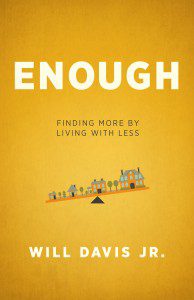
This book review is a sponsored post that is part of the Patheos Book Club.
When I was first asked to review this book, my first thought was, “Great. I’ve already read it!” However, I was mistakenly thinking of another good book titled “Enough” by an author whose first name is also “Will”: Enough: Contentment in an Age of Excess by Will Samson (from back in 2009). Reflecting on this duplicate title reminded me of another book I reviewed for Patheos a few months ago with the title “Enough,” also published in 2012 in a revised form: Adam Hamilton’s Enough: Discovering Joy through Simplicity and Generosity . A quick Amazon search revealed even more recently-published books with “Enough” as their title. Enough already with “Enough!”
More seriously, my suspicion — especially given how long the book publication process takes — is that these titles are less likely copying one another and more likely responding to a similar dilemma in Western culture: materialism. And in different ways the three titles named above all recommend a basic Gandhian cure: “Live simply so that others may simply live.” Or as Thoreau said,
Our life is frittered away by detail. Simplify, simplify, simplify! I say, let your affairs be as two or three, and not a hundred or a thousand; instead of a million count half a dozen, and keep your accounts on your thumb-nail.
Having spent the better part of this past week moving from a 3,100 ft² parsonage to an 1,100 ft² apartment, I was particularly primed for Davis’ argument. More importantly, I can honestly report that my wife and I feel that two-thirds less living space feels like a preferable amount: much easier to clean and much more environmentally responsible. Our main qualm is that there’s no great place to store our bikes other than the entry hall, but we can always put them temporarily on the porch when necessary. (But don’t get me wrong; we aren’t looking to sign-up for one of the mini-apartments featured in this past week’s New York Times that are “no bigger than 300 square feet.”)
Although Davis comes from a more conservative position theologically than I do, he has collected some strong stories and practices about how and why one could and should come to realize, as the old adages says, that “Enough is as good as a feast.” For example, the following is a top ten list from Davis of reasons to consider simplifying your life:
- You’ll have more time.
- You’ll have more peace.
- You’ll help your relationships.
- You’ll be more content.
- You’ll have less or no debt.
- You’ll be prepared for touch financial times.
- You’ll be better equipped to respond to need.
- Your life will be simpler
- You’ll have better intimacy with God.
- You’ll have more joy. (26-30)
In the book, Davis elaborates about his rationale for each of these claims as well as many related ideas.
He also cites convicting statistics such as that,
If you have an annual income of $20,000 in the United States, you are in the top 11% of the richest people in the world. If you have an annual income of the $50,000, you are in the top 0.9% of richest people in the world. (57-58)
Thus, while I continue to support the Occupy Movement and its vital critique of the U.S. wealth gap, Davis simultaneously provides an even larger global perspective for consideration. Davis also discusses the negative impact of having “more than enough” (60-63) and the equally important consequences of having “less than enough” (120-121).
Relatedly, I recommend the Sojourners‘ recent blog post, “Will the Real Ms. Middle Class Please Stand Up?” An excerpt:
The Real Middle Class is one layoff, one unexpected hospital visit, one pregnancy away from inching closer to the poverty line—$23,050 for a family of four. Median household family income in the U.S. is $49,445. For a non-family household, it’s $29,730.
Visit Patheos’ Book Club website for more free resources related to Davis’ book.
The Rev. Dr. Carl Gregg is a trained spiritual director, a D.Min. graduate of San Francisco Theological Seminary, and the minister of the Unitarian Universalist Congregation of Frederick, Maryland. Follow him on Facebook (facebook.com/carlgregg) and Twitter (@carlgregg).
Learn more about Unitarian Universalism:
http://www.uua.org/beliefs/principles/index.shtml
Previous Post

July 14, 2012
25 of My Favorite Quotations...in no particular order
Next Post
July 23, 2012 Decentering Jesus: My Journey to Unitarian Universalism
Browse Our Archives
Select a Category Advent Anti-Racism Archaeology Atheism Baptism Best of the Year List Book Reviews Buddhism Catholicism Christian Education Church and State Church Planting Climate Change Conscientious Objection to War Creation Spirituality Death Penalty Didache Disability Rights Discernment Easter Ecology Emergent Church Movement Empire-Critical Ethics Evolution Feminist Theology Film Reviews Gandhi Gospel of Mark Gun Control Hinduism Immigration Reform Interfaith Islam JFK Judaism Jungian Spirituality Lectionary Commentary Lent Letters to the Editor LGBT Marriage MLK Multiculturalism Mysticism Nonviolent Activism Occupy Paganism (Earth-centered Religions) Parables Paul Pluralism Politics Process Theology Quantum Physics Requiescat In Pace Seminary and Divinity School Sermon Series Retrospective Sermons Spiritual Direction Spiritual Practices Stewardship (Fundraising) The Book of J The Wheel of the Year (Paganism) Theoblogger Challenge Triathlon Uncategorized Unitarian Universalism Worship Resources Youth Ministry
Select a Month July 2026 May 2026 March 2026 November 2025 October 2025 August 2025 February 2025 December 2024 October 2024 March 2024 January 2024 December 2023 November 2023 March 2023 February 2023 January 2023 December 2022 November 2022 August 2022 March 2022 February 2022 January 2022 December 2021 September 2021 August 2021 July 2021 June 2021 May 2021 February 2021 January 2021 December 2020 August 2020 June 2020 May 2020 April 2020 March 2020 February 2020 January 2020 December 2019 November 2019 October 2019 September 2019 July 2019 June 2019 March 2019 February 2019 January 2019 December 2018 November 2018 October 2018 September 2018 June 2018 May 2018 April 2018 March 2018 February 2018 January 2018 December 2017 November 2017 October 2017 September 2017 August 2017 July 2017 June 2017 May 2017 April 2017 March 2017 February 2017 January 2017 December 2016 November 2016 October 2016 September 2016 August 2016 June 2016 May 2016 April 2016 March 2016 February 2016 January 2016 December 2015 November 2015 October 2015 September 2015 August 2015 July 2015 June 2015 May 2015 April 2015 March 2015 February 2015 January 2015 December 2014 November 2014 October 2014 August 2014 July 2014 June 2014 May 2014 April 2014 March 2014 February 2014 January 2014 December 2013 November 2013 October 2013 September 2013 August 2013 July 2013 June 2013 May 2013 April 2013 March 2013 February 2013 January 2013 December 2012 November 2012 October 2012 September 2012 August 2012 July 2012 June 2012 May 2012 April 2012 March 2012 February 2012 January 2012 December 2011 November 2011 October 2011 September 2011 August 2011 July 2011 June 2011 May 2011 April 2011 March 2011 February 2011 January 2011 December 2010 November 2010 October 2010 August 2009 July 2009 May 2009
Follow Us!
TAKE THE
Religious Wisdom Quiz
True or False: The Israelites wandered in the wilderness for forty years.
Select your answer to see how you score.
TRUE FALSE
Related posts from Carl Gregg
Why Peter Singer Hates on Guide Dogs &...
“Unsanctifying Human Life”: Wrestling with Peter Singer’s Ethics

Letting Go of Fear & Celebrating Differences: Insights...

TRENDING AT PATHEOS More Voices

Reading America at 250: A Nation Wrestles With...
As part of my own reflection on the 250th anniversary of the...

Whenever I am reading a book or listening to an argument, I...

President Trump Ban Animal Torture Videos on Facebook
Call for Stricter Regulations of Animal Abuse Content on Facebook Although President...

Draft Amendments to Address Ritual Abuse in New...
The proposed changes would make it illegal for individuals in domestic partnerships...

How Bans on LGBTQ+ Student Clubs Threaten Religious...
On June 20, 2025, the State of Texas passed Senate Bill 12....

The Truth About the Gen Z Revival
This past year, there has been a lot of media buzz surrounding...
view all More Voices blogs
Ad-Free & Subscriber Log-In Subscription Support
- About Us
- 2026 Calendar
- Videos
- Podcasts
- Library of World Religions
- Faith In Media Tracker
- Advertise With Us
- Write for Us
- Privacy Policy
- Terms of Service
- Do Not Sell My Data
- Contact Us
- Radiant Digital
- Manage Newsletter Subscriptions
- Unsubscribe From Notifications
- Sitemap
Copyright 2008-2026, Patheos. All rights reserved.
Subscription Support Ad-Free & Subscriber Log-In
Follow Patheos