
BuddhistCatholicContemplativeEvangelicalGeneral ChristianHinduJewishLatter-day SaintMuslimNew VisionsProgressive Christian
Beliefs
- Buddhist
- Catholic
- Contemplative
- Evangelical
- General Christian
- Hindu
- Jewish
- Latter-day Saint
- More Voices
- Muslim
- New Visions
- Pagan
- Progressive Christian
Topics
- Religion News
- Food and Religion
- Sports and Religion
- Religious Art
- Religious Music and Entertainment
- Religious Events
- History and Religion
- Style and Religion
- Politics and Religion
- Women in Religion
- Recreation Outdoors and Religion
- Business Finance and Religion
- Careers Workplace and Religion
- Education and Religion
- Family Parenting and Religion
- Health Fitness and Religion
- Home and Religion
- Relationships and Religion
- Technology and Religion
- Travel and Religion
Columnists
- Buddhist Columnists
- Business Finance and Religion Columnists
- Careers Workplace and Religion Columnists
- Catholic Columnists
- Contemplative Columnists
- Education and Religion Columnists
- Evangelists Columnists
- Family Parenting and Religion Columnists
- General Christian Columnists
- Health Fitness and Religion Columnists
- Hindu Columnists
- History and Religion Columnists
- Home and Religion Columnists
- Jewish Columnists
- More Voices Columnists
- Latter Day Columnists
- Muslim Columnists
- New Visions Columnists
- Nonreligious Columnists
- Pagan Columnists
- Politics and Religion Columnists
- Progressive Columnists
- Recreation Outdoors and Religion Columnists
- Relationships and Religion Columnists
- Religion News Columnists
- Religious Art Columnists
- Religious Events Columnists
- Religious Music and Entertainment Columnists
- Sports and Religion Columnists
- Style and Religion Columnists
- Technology and Religion Columnists
- Travel and Religion Columnists
- Women in Religion Columnists
Resource Library
- 2026 Calendar
- Library of World Religions
- The 100 Most Holy Places on Earth
- Patheos Answers
- Podcasts
- Videos
- Faith Leaders Database
- Anglican Episcopalian
- Bahai
- Baptist
- Buddhism
- Christianity
- Confucianism
- Eastern Orthodoxy
- Hinduism
- Holiness and Pentecostal
- ISKCON
- Islam
- Judaism
- Lutheran
- Methodist
- The Church of Jesus Christ of Latter-day Saints
- New Age
- Paganism
- Presbytarian and Reformed
- Protestantism
- Religion Behind the Scenes
- Roman Catholic
- Scientology
- Shia Islam
- Sikhism
- Sufism
- Sunni Islam
- Taoism
- Zen
- See all religions
Research Tools
 Ad-Free & Subscriber Log-In Subscription Support
Ad-Free & Subscriber Log-In Subscription Support
Follow Patheos 

- Trending:
- Forgiveness
- |
- Marriage
- |
- Consciousness
- |
- Death Penalty
- |
- Election
- |
- Halloween

- Home
- More Voices
- Ellen Davis: An Eco-friendly Bible Scholar You Should Know
Ellen Davis: An Eco-friendly Bible Scholar You Should Know
Last updated on: December 29, 2014 at 1:17 pm by Carl Gregg
Ellen Davis: An Eco-friendly Bible Scholar You Should Know 2014-12-29T13:17:51-05:00 Carl Gregg
Patheos Explore the world's faith through different perspectives on religion and spirituality! Patheos has the views of the prevalent religions and spiritualities of the world.
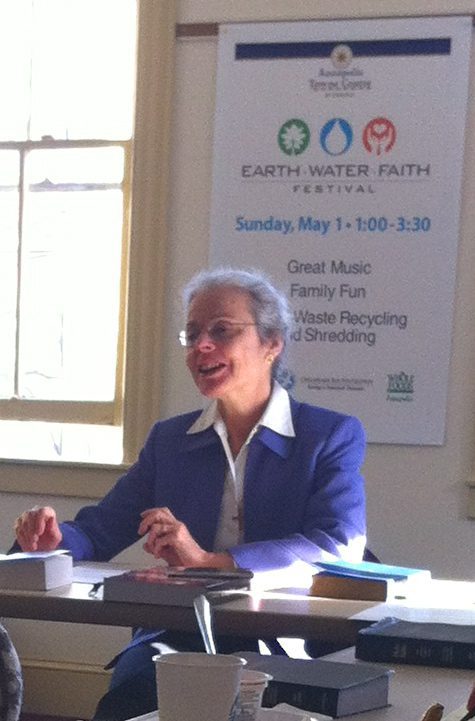
I recently had the opportunity to attend a morning workshop with Ellen Davis on “Honest Grief and Realistic Hope: Teaching and Preaching about Creation in 2012.” Ellen is the Amos Ragan Kearns Distinguished Professor of Bible and Practical Theology at Duke Divinity School.
She is perhaps best know for her excellent book Scripture, Culture, and Agriculture: An Agrarian Reading of the Bible (Cambridge University Press, 2009):
Photo Credit: Carl Gregg
This book examines the theology and ethics of land use, especially the practices of modern industrialized agriculture, in light of critical biblical exegesis. Nine interrelated essays explore the biblical writers’ pervasive concern for the care of arable land against the background of the geography, social structures, and religious thought of ancient Israel. This approach consistently brings out neglected aspects of texts, both poetry and prose, that are central to Jewish and Christian traditions. Rather than seeking solutions from the past, Davis creates a conversation between ancient texts and contemporary agrarian writers; thus she provides a fresh perspective from which to view the destructive practices and assumptions that now dominate the global food economy. The biblical exegesis is wide-ranging and sophisticated; the language is literate and accessible to a broad audience.
I find her close readings of the Hebrew Bible to be fascinating, historically-grounded, and ecologically-minded.
We opened the morning’s workshop with “A Prayer for Monday Morning” from John Philip Newell’s Praying with the Earth: A Prayerbook for Peace.
Her remarks were framed by her current writing project, “Biblical Prophecy and Contemporary Ministry,” which reminded me of James Luther Adams’ powerful essay, “The Prophethood of All Believers.” The following are my notes from the session. (Her commentary on the scripture readings is often in brackets.):
A core prophetic concern in the Bible is integrity of created order. Five principles or themes that may govern the prophetic understanding of God, humanity, and the earth. Five key ideas for understanding of God-Creation-Humanity relationship:
1. There exists a triangular relationship among God, humanity, and creation.
Amos 8:8, “Shall not the land tremble on this account?”
Hosea 2:18-19, 20-23 [perhaps speaking to Earth…to adamah, the fertile soil. Singular, 2nd person]:
18 I will make for you a covenant on that day with the wild animals, the birds of the air, and the creeping things of the ground; and I will abolish the bow, the sword, and war from the land; and I will make you lie down in safety. 19 And I will take you for my wife forever; I will take you for my wife in righteousness and in justice, in steadfast love, and in mercy.
The main problem is that there is no knowledge of God. Jezreel is richest agricultural valley; it means, “God sows.”
20 I will take you for my wife in faithfulness; and you shall know the Lord. 21 On that day I will answer, says the Lord, I will answer the heavens and they shall answer the earth; 22 and the earth shall answer the grain, the wine, and the oil, and they shall answer Jezreel; 23 and I will sow him for myself in the land. And I will have pity on Lo-ruhamah, and I will say to Lo-ammi, “You are my people”; and he shall say, “You are my God.”
Language of response is unexpected. It would be more expected in the inter-responsiveness of pre-Israelite Caanaanite poetry.
Earth has an interiority, is a character. Earth is capable of moral agency. Reminds me of “Rocks will cry out”…if humans neglect their responsive capacity (Luke 19:40).
Similar to Buber’s I & Thou: trees, for example, better thought of as “Thou,” than “it” to be thoughtlessly manipulated.
2. Humans and non-humans together are “the poor and vulnerable,” in need of salvation and redemption
Psalm 36, referring to humans and beasts being saved*:* “you save humans and animals alike, O Lord.” As Sallie McFague says in her book The Body of God: An Ecological Theology. “Nature is the new poor and vulnerable…include it.”
Joel 1:10-12 is under-appreciated:
The field is laid waste. The fertile soil mourns/drys up [4 out of 10 years in Israel are drought years] for the land is laid waste. The vintage is withered. The oil crop has failed. Farmers wither [same word as for what happened to vintage]. Vitners howl over the wheat and over the barley. For the harvest of the field is gone. The vine is withered. the fig has pfailed. Pomegranate, date plam, …all the trees withered…human job withered.
Notice that the same language is used for what happens to humans and to creation.
3. God feels pain and anger (Heschel’s “pathos“) when the earth suffers.
Jer 12:7-12,
7 I have forsaken my house, I have abandoned my heritage [inheritance]; I have given the beloved of my heart into the hands of her enemies. 8 My heritage has become to me like a lion in the forest; she has lifted up her voice against me— therefore I hate her. 9 Is the hyena greedy for my heritage at my command? Are the birds of prey all around her? [My inheritances acts to me like a hyena or bird of prey — God is in the Lear, roadkill position.] Go, assemble all the wild animals; bring them to devour her. 10 Many shepherds have destroyed my vineyard, they have trampled down my portion, they have made my pleasant [delightful] portion a desolate [devastated] wilderness. 11 They have made it a desolation; desolate, it mourns to me. The whole land is made desolate, but no one lays [takes] it to heart [or pays attention to it]. 12 Upon all the bare heights in the desert spoilers have come; for the sword of the Lord devours from one end of the land to the other; no one shall be safe.
God is vulnerable to human sin/greed.
After Darwin, do humans really know where we are in the economy of salvation?
4. The suffering of the earth itself may be the chief index of the brokennesness in our relationship with God.
Jer 14,
1 The word of the Lord that came to Jeremiah concerning the drought: 2 Judah mourns and her gates languish; they lie in gloom on the ground, and the cry of Jerusalem goes up. 3 Her nobles send their servants for water; they come to the cisterns, they find no water, they return with their vessels empty. They are ashamed and dismayed [humiliated] and cover their heads, 4 because the ground is cracked. Because there has been no rain on the land the farmers are dismayed [ashamed]; they cover their heads. 5 Even the doe in the field forsakes her newborn fawn [gives birth adn abandons] because there is no grass.
Why “humiliated” and not desperate/disappointed? They are complicit. The language is similar to Gen 3:17, “Cursed be the soil because of you. And now because of the soil, there is dismay [humiliation]” — when humans act outside of their covenant relationship. [Not the same as Jer 14.]
5. God already intends a new/restored creation.
Creation is the necessary reality from which Creation emerges (Fretheim).
Joel 2:21-3:2,
21 Do not fear, O soil [fertile soil]; be glad and rejoice, for the Lord has done great things [somethign really bid]! 22 Do not fear, you animals of the field [beasts], for the pastures of the wilderness are green [putting forth grass]; the tree bears its fruit, the fig tree and vine [grape] give their full yield [strength/might]. 23 O children [inhabitants] of Zion, be glad and rejoice [parallel as command to soil] in the Lord your God; for he has given the early rain for your vindication [in his kindness], he has poured down for you abundant rain, the early and the later rain, as before [as it used to be].
Soil is first to rejoin, then beasts, and only later humans. All those named are sentient. All are capable of rejoicing in God’s action. [Joel begins w/ locust plague…like army.]
24 The threshing floors shall be full of grain, the vats shall overflow with wine and oil. 25 I will repay you for the years that the swarming locust has eaten, the hopper, the destroyer, and the cutter, my great army, which I sent against you. 26 You shall eat in plenty and be satisfied, and praise the name of the Lord your God, who has dealt wondrously with you. And my people shall never again be put to shame. 27 You shall know that I am in the midst of Israel, and that I, the Lord, am your God and there is no other. And my people shall never again be put to shame. 28 Then afterward [after that…there is an order] [THEN that Pentecost verse quoted in Acts 2] I will pour out my spirit on all flesh [Noahic covenant is with ALL FLESH..all living things on face on adamah]; your sons and your daughters shall prophesy [Is that just humans? in light of all that has gone before], your old men shall dream dreams, and your young men shall see visions. 29 Even on the male and female slaves, in those days, I will pour out my spirit.30 I will show portents in the heavens and on the earth, blood and fire and columns of smoke. 31The sun shall be turned to darkness, and the moon to blood, before the great and terrible [awesome] day of the Lord comes. 32 Then everyone who calls on the name of the Lord shall be saved; for in Mount Zion and in Jerusalem there shall be those who escape, as the Lord has said, and among the survivors shall be those whom the Lord calls.
Translate tsedagah as “sustainability” instead of righteousness. (Note: Marcus Borg has made similar points about alternative translations to the English word “righteousness.”)
The closing reading was Anne Porter’s poem, “A Short Testament“:
Whatever harm I may have done
In all my life in all your wide creation creation
If I cannot repair it
I beg you to repair it,
And then there are all the wounded
The poor the deaf the lonely and the old
Whom I have roughly dismissed
As if I were not one of them.
Where I have wronged them by it
And cannot make amends
I ask you
To comfort them to overflowing,
And where there are lives I may have withered around me,
Or lives of strangers far or near
That I’ve destroyed in blind complicity,
And if I cannot find them
Or have no way to serve them,
Remember them. I beg you to remember them
When winter is over
And all your unimaginable promises
Burst into song on death’s bare branches.
Ellen Davis’ Book recommendations
- Hilary Marlow, Biblical Prophets and Contemporary Environmental Ethics
- Terence Fretheim, God and World in the Old Testament: A Relational Theology of Creation
- Margaret Barker, Creation: A Biblical Vision for the Environment
The Rev. Dr. Carl Gregg is a trained spiritual director, a D.Min. graduate of San Francisco Theological Seminary, and the pastor of Broadview Church in Chesapeake Beach, Maryland. On July 9, 2012, he will start as the Minister of the Unitarian Universalist Congregation of Frederick, Maryland. Follow him on Facebook (facebook.com/carlgregg) and Twitter (@carlgregg).
Previous Post

July 4, 2012
How To Lead a Congregational Discernment Process
Next Post
July 7, 2012 Highlights from Jesus Seminar on the Road in D.C.
Browse Our Archives
Select a Category Advent Anti-Racism Archaeology Atheism Baptism Best of the Year List Book Reviews Buddhism Catholicism Christian Education Church and State Church Planting Climate Change Conscientious Objection to War Creation Spirituality Death Penalty Didache Disability Rights Discernment Easter Ecology Emergent Church Movement Empire-Critical Ethics Evolution Feminist Theology Film Reviews Gandhi Gospel of Mark Gun Control Hinduism Immigration Reform Interfaith Islam JFK Judaism Jungian Spirituality Lectionary Commentary Lent Letters to the Editor LGBT Marriage MLK Multiculturalism Mysticism Nonviolent Activism Occupy Paganism (Earth-centered Religions) Parables Paul Pluralism Politics Process Theology Quantum Physics Requiescat In Pace Seminary and Divinity School Sermon Series Retrospective Sermons Spiritual Direction Spiritual Practices Stewardship (Fundraising) The Book of J The Wheel of the Year (Paganism) Theoblogger Challenge Triathlon Uncategorized Unitarian Universalism Worship Resources Youth Ministry
Select a Month July 2026 May 2026 March 2026 November 2025 October 2025 August 2025 February 2025 December 2024 October 2024 March 2024 January 2024 December 2023 November 2023 March 2023 February 2023 January 2023 December 2022 November 2022 August 2022 March 2022 February 2022 January 2022 December 2021 September 2021 August 2021 July 2021 June 2021 May 2021 February 2021 January 2021 December 2020 August 2020 June 2020 May 2020 April 2020 March 2020 February 2020 January 2020 December 2019 November 2019 October 2019 September 2019 July 2019 June 2019 March 2019 February 2019 January 2019 December 2018 November 2018 October 2018 September 2018 June 2018 May 2018 April 2018 March 2018 February 2018 January 2018 December 2017 November 2017 October 2017 September 2017 August 2017 July 2017 June 2017 May 2017 April 2017 March 2017 February 2017 January 2017 December 2016 November 2016 October 2016 September 2016 August 2016 June 2016 May 2016 April 2016 March 2016 February 2016 January 2016 December 2015 November 2015 October 2015 September 2015 August 2015 July 2015 June 2015 May 2015 April 2015 March 2015 February 2015 January 2015 December 2014 November 2014 October 2014 August 2014 July 2014 June 2014 May 2014 April 2014 March 2014 February 2014 January 2014 December 2013 November 2013 October 2013 September 2013 August 2013 July 2013 June 2013 May 2013 April 2013 March 2013 February 2013 January 2013 December 2012 November 2012 October 2012 September 2012 August 2012 July 2012 June 2012 May 2012 April 2012 March 2012 February 2012 January 2012 December 2011 November 2011 October 2011 September 2011 August 2011 July 2011 June 2011 May 2011 April 2011 March 2011 February 2011 January 2011 December 2010 November 2010 October 2010 August 2009 July 2009 May 2009
Follow Us!
TAKE THE
Religious Wisdom Quiz
Where did David spare Saul's life when he found him in a cave?
Select your answer to see how you score.
Gilgal Hebron En Gedi Bethlehem
Related posts from Carl Gregg

Why Peter Singer Hates on Guide Dogs &...

Vampires, Witches, & NPR: The Legacy of Margot...

“Do You Really Want to Know?” From Pope...
“Unsanctifying Human Life”: Wrestling with Peter Singer’s Ethics
TRENDING AT PATHEOS More Voices

Reading America at 250: A Nation Wrestles With...
As part of my own reflection on the 250th anniversary of the...

Whenever I am reading a book or listening to an argument, I...

President Trump Ban Animal Torture Videos on Facebook
Call for Stricter Regulations of Animal Abuse Content on Facebook Although President...

Draft Amendments to Address Ritual Abuse in New...
The proposed changes would make it illegal for individuals in domestic partnerships...

How Bans on LGBTQ+ Student Clubs Threaten Religious...
On June 20, 2025, the State of Texas passed Senate Bill 12....

The Truth About the Gen Z Revival
This past year, there has been a lot of media buzz surrounding...
view all More Voices blogs
Ad-Free & Subscriber Log-In Subscription Support
- About Us
- 2026 Calendar
- Videos
- Podcasts
- Library of World Religions
- Faith In Media Tracker
- Advertise With Us
- Write for Us
- Privacy Policy
- Terms of Service
- Do Not Sell My Data
- Contact Us
- Radiant Digital
- Manage Newsletter Subscriptions
- Unsubscribe From Notifications
- Sitemap
Copyright 2008-2026, Patheos. All rights reserved.
Subscription Support Ad-Free & Subscriber Log-In
Follow Patheos