
BuddhistCatholicContemplativeEvangelicalGeneral ChristianHinduJewishLatter-day SaintMuslimNew VisionsProgressive Christian
Beliefs
- Buddhist
- Catholic
- Contemplative
- Evangelical
- General Christian
- Hindu
- Jewish
- Latter-day Saint
- More Voices
- Muslim
- New Visions
- Pagan
- Progressive Christian
Topics
- Religion News
- Food and Religion
- Sports and Religion
- Religious Art
- Religious Music and Entertainment
- Religious Events
- History and Religion
- Style and Religion
- Politics and Religion
- Women in Religion
- Recreation Outdoors and Religion
- Business Finance and Religion
- Careers Workplace and Religion
- Education and Religion
- Family Parenting and Religion
- Health Fitness and Religion
- Home and Religion
- Relationships and Religion
- Technology and Religion
- Travel and Religion
Columnists
- Buddhist Columnists
- Business Finance and Religion Columnists
- Careers Workplace and Religion Columnists
- Catholic Columnists
- Contemplative Columnists
- Education and Religion Columnists
- Evangelists Columnists
- Family Parenting and Religion Columnists
- General Christian Columnists
- Health Fitness and Religion Columnists
- Hindu Columnists
- History and Religion Columnists
- Home and Religion Columnists
- Jewish Columnists
- More Voices Columnists
- Latter Day Columnists
- Muslim Columnists
- New Visions Columnists
- Nonreligious Columnists
- Pagan Columnists
- Politics and Religion Columnists
- Progressive Columnists
- Recreation Outdoors and Religion Columnists
- Relationships and Religion Columnists
- Religion News Columnists
- Religious Art Columnists
- Religious Events Columnists
- Religious Music and Entertainment Columnists
- Sports and Religion Columnists
- Style and Religion Columnists
- Technology and Religion Columnists
- Travel and Religion Columnists
- Women in Religion Columnists
Resource Library
- 2026 Calendar
- Library of World Religions
- The 100 Most Holy Places on Earth
- Patheos Answers
- Podcasts
- Videos
- Faith Leaders Database
- Anglican Episcopalian
- Bahai
- Baptist
- Buddhism
- Christianity
- Confucianism
- Eastern Orthodoxy
- Hinduism
- Holiness and Pentecostal
- ISKCON
- Islam
- Judaism
- Lutheran
- Methodist
- The Church of Jesus Christ of Latter-day Saints
- New Age
- Paganism
- Presbytarian and Reformed
- Protestantism
- Religion Behind the Scenes
- Roman Catholic
- Scientology
- Shia Islam
- Sikhism
- Sufism
- Sunni Islam
- Taoism
- Zen
- See all religions
Research Tools
 Ad-Free & Subscriber Log-In Subscription Support
Ad-Free & Subscriber Log-In Subscription Support
Follow Patheos 

- Trending:
- Forgiveness
- |
- Marriage
- |
- Consciousness
- |
- Death Penalty
- |
- Election
- |
- Halloween

- Home
- More Voices
- Preaching “The Book of J”: Are There Hidden Books in the Bible?
Preaching “The Book of J”: Are There Hidden Books in the Bible?
Last updated on: December 29, 2014 at 9:29 pm by Carl Gregg
Preaching “The Book of J”: Are There Hidden Books in the Bible? 2014-12-29T21:29:34-05:00 Carl Gregg
Patheos Explore the world's faith through different perspectives on religion and spirituality! Patheos has the views of the prevalent religions and spiritualities of the world.
 In the day that the Lord God made the earth and the heavens, 5 when no plant of the field was yet in the earth and no herb of the field had yet sprung up — for the Lord God had not caused it to rain upon the earth, and there was no one to till the ground; 6 but a stream would rise from the earth, and water the whole face of the ground — 7 then the Lord God formed man from the dust of the ground, and breathed into his nostrils the breath of life; and the man became a living being. 8 And the Lord God planted a garden in Eden, in the east; and there he put the man whom he had formed…. 18 Then the Lord God said, “It is not good that the man should be alone; I will make him a helper as his partner.” 19 So out of the ground the Lord God formed every animal of the field and every bird of the air, and brought them to the man to see what he would call them; and whatever the man called every living creature, that was its name. 20 The man gave names to all cattle, and to the birds of the air, and to every animal of the field; but for the man there was not found a helper as his partner. 21 So the Lord God caused a deep sleep to fall upon the man, and he slept; then he took one of his ribs and closed up its place with flesh. 22 And the rib that the Lord God had taken from the man he made into a woman and brought her to the man. 23 Then the man said, “This at last is bone of my bones and flesh of my flesh; this one shall be called Woman, for out of Man this one was taken.”
Genesis 2:4b-23
How many books are in the Bible? If you don’t know the answer to this piece of trivia, the answer is easy to
find from the table of contents in your favorite Bible. The results will vary based on if the Bible at hand includes various parts of the Apocrypha used by different branches of the Eastern Orthodox or Roman Catholic churches. But if you check a standard Protestant Bible, you should find 27 books in the New Testament and 39 books in the Hebrew Scriptures, for a total of 66 books in the Bible. However, as we saw in our studies of Matthew and Mark, many scholars think that there are “hidden” books in the Bible. These books are not hidden in The Da Vinci Code sense. They won’t lead you to a buried pirate treasure chest, and there is not a secret decoder ring hidden in a bank vault that will help you find the hiding place.
The ‘hidden’ books in question are the books used as source material to compile the final version of the biblical books with which we are familiar. As scholars have studied the Bible over many centuries, they began to notice clues of how the original authors and editors of the Bible stitched together the material at their disposal. As we saw with the Gospels, most scholars are now convinced that the best current explanation for how Matthew, Mark, and Luke were composed is that Matthew and Luke, writing independently, had a copy on their respective desks of both the Gospel of Mark and another written source that scholars call “Q.” The letter Q is a shorthand for the German word Quelle, which means “source.” And scholars hypothesize this source as an explanation for how to explain two facts: on one hand, Matthew and Luke share more than 200 verses almost verbatim in common that are not in Mark; but on the other hand, Matthew and Luke do not seem to be aware of one another’s books. The hypothetical existence of Q is the best current theory of Matthew and Luke’s common source, part of which is now “hidden,” so to speak, in those respective Gospels.
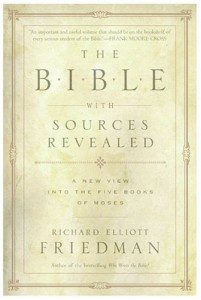
As we prepare to spend some time in the Hebrew Scriptures, a similar dynamic is also at play in the first books of the Bible. Scholars hypothesize that the first few books of the Bible (perhaps through as far as 2 Kings) were originally four independently circulating documents that were then edited together into their final form. Our guide for into the hidden books of the Bible will be Richard Elliott Friedman, who has a helpful book called The Bible with Sources Revealed that shows the first five books of the Bible in different colors, fonts, and highlights, which illustrates both the original sources themselves and the ways they were edited together.
The four main original independent sources are called J, E, D, and P. Similar to the “Q Source” used to compose Matthew and Luke, J-E-D-P are each shorthand for the full title scholars have given to these sources. Over the next few months we will be concentrating primarily on the oldest of these four sources, The Book of J, which stands for the “Jahwist.” Normally, we English-speakers would begin spelling YaHWeH with a “Y,” but the landmark scholars who developed this “Documentary Hypothesis” were Germans.
The J source almost exclusively refers to God as “Yahweh,” whereas the second source uses the basic Hebrew word for God, Elohim. And, hence, is known as a the “E Source.” Then we have the “P Source,” which was written by the Priestly class as a response to the version of history in J and E. The fourth and final source is the “D,” which is primarily in Deuteronomy. J, P, and D also continue into Joshua, Judges, Samuel, and Kings.
It is worth mentioning that the theory that more than one person wrote the first few books of the Bible is quite ancient. The first thousand years of Christian history included both people who questioned that Moses wrote the Torah as well as others who made elaborate, contorted arguments to explain the inconsistencies in the text.
In the Middle Ages we have records of scholars who read the Bible closely and noticed details such as Genesis 36, which includes a chronology of kings who lived long after Moses’ death, which prompted the question, “How could Moses write a list of the kings who reigned long after Moses was alive to see the line of succession?”
Another medieval scholar noted, “passages that referred to Moses in the third person, used terms that Moses would not have know, described places where Moses had never been, and used language that reflected another time and locale from those of Moses.”
Still others pointed out that it would have been impossible for Moses to write the account of his own death, and that phrases in the Torah such as “‘To this day’ is not the phase of someone describing a contemporary situation. It is rather the phrase of a later writer who is describing something that has endured.”
The 19th-century scholar Julius Wellhausen (1844-1918) helped synthesize all the previous research and made a strong case for the “Documentary Hypothesis”: the theory that the first books of the Bible was originally edited together from four independent sources: J, E, D, and P — the Jahwist, Elohist, Deuteronomist, and Priestly Sources.
Two pieces of evidence particularly contributed to this Documentary Hypothesis: doublets and the names of God. As we will see as we move through this first book of the Bible, we will see that the Book of Genesis is replete with doublets: two versions of the same story in close proximity. As scholars reflected on the different characteristics in the various pairs of stories, they began to theorize that these two versions might consistently have come from two specific sources. And when Genesis was written, instead of keeping one version and throwing out the other, the popularity of both versions perhaps mandate that both versions be kept. Similarly, the early church did not keep just one Gospel and throw the rest out (although they unfortunately threw out more Gospels than was perhaps advisable!). The official canon includes four Gospels: Matthew, Mark, Luke, and John — not merely one Gospel.
As I mentioned before, two pieces of evidence particularly contributed to this Documentary Hypothesis: doublets and the names of God. As scholars compared the doublets in Hebrew Bible, they also noticed that usually one of each pair used the name Elohim for God and the other used the name Yahweh for God. Moreover, the E stories showed a bias toward the northern kingdom of Israel, and the J stories showed a bias toward the southern kingdom of Judah.
In 722 B.C.E., after the Assyrians destroyed the northern kingdom of Israel, J and E were likely woven together. We cannot know for sure, but Friedman wagers an educated guess that weaving these two rival documents together was a symbolic way of “reuniting” the rival kingdoms in the wake of one kingdom being tragically conquered and destroyed.
~~~~~~~~
At the beginning of this sermon, I asked, “How many books are in the Bible.” And we saw that the answer depends both on what Bible you are using as well as whether you count the “hidden” books in the Bible such as Q or J-E-D-P that were the source books that were incorporated into the final version of the text.
I now want to ask a related question, “How does the Bible begin?” One traditional answer, according the King James Version, is “In the beginning God created the heaven and the earth.” But remember that we are studying The Book of J. The opening chapter of Genesis is from the P (or Priestly) Source, and consistently uses the Hebrew word Elohim for God. That’s why our scripture reading began with Genesis 2:4b. According to the Book of J, the Bible begins with the line, “In the day that the Lord God made the earth and the heavens….”
Genesis 1 and 2 are the first of the many doublets we were see. They tell the Creation Story two times, in two significantly different versions. In Genesis 2, God is consistently called Yahweh because it is from the J Source. Importantly, for the E Source, God’s name, Yahweh, is not revealed until Exodus on Mount Sinai. But as we will see throughout Genesis, in the J Source strand, that God is called Yahweh regularly long before Moses’ encounter with the burning bush.
You may have also noticed that Genesis 2 has the peculiar formulation “Lord God.” This combination of Yahweh Elohim appears to be one of those times you can clearly see the editorial hand at work. This forced combination of the way the J Source refers to God and the way the P Source refers to God is likely an attempt by the editor to make the shift from the first Creation account to the second account less stark.
But turning again to a comparison of Genesis 1 and 2, remember that the P source was a response to the way Israel’s history was depicted in J and E. And doesn’t it make sense that the priestly class would be uncomfortable with the Creation account in Genesis 2? In Genesis 2, God is not afraid to get God’s hands dirty. God, like a potter sinking her hands into wet clay, “formed Adam from the dust of the ground.”
And as we continue through Genesis 2, God continues to get God’s hands dirty in the business of Creation. God, like an Emergency Medical Technician delivering CPR, “breathed into Adam’s nostrils the breath of life, and Adam became a living being.” And God, like a gardener, “planted a garden in Eden.”
And in The Book of J, as we will see repeatedly, God is often capricious, makes mistakes, and changes God’s mind. In this case, God made a human and all manner of animals, but then realizes something is missing: “It is not good that the human should be alone.” One traditional rendering continues, “I will make him a helper as his partner.” But I prefer Friedman’s translation: “I’ll make for him a strength corresponding to him.”
Then God, like an anesthesiologist, “caused a deep sleepto fall upon the man.” And, like a surgeon, “took one of his ribs and closed up its place with flesh.” Then, like a stone mason, God took the rib and built “a woman and brought her to the man.” On one hand, perhaps we can learn something here that woman is built out of the sturdy material of bone, whereas man is made out of dirt! But notice also the line, “this one shall be called Woman, for out of Man this one was taken.” Here we see the first man claim to have given birth, so to speak, to the first woman; thus laying prior claim to the birth process, one of the acts only women can do. This line is a reminder that the Bible was primarily written and edited by men in a patriarchal world, and must be read and interpreted with this bias in mind.
Now remember that the P Source was written in response to J and E. And can’t you just imagine the rush of the priestly class to insist that Creation was not anything like what The Book of J described: God doesn’t get God’s hands dirty! God isn’t like a potter, an EMT, an anesthesiologist, surgeon, or stone mason! God is like the priest, who stands at the front of the sanctuary in clean robes, with clean hands, and speaks the liturgy in formal, measured tones. Hence, in P’s version, God is a disembodied voice who speaks the world into being, doesn’t make mistakes, and declares everything good.
We will continue in future weeks to trace similar comparisons left by the hidden books in the Bible. But on this Earth Day, as this sermon on both the Creation of the world and the Creation of the Bible draws to a close, and we prepare to enter into a time of contemplative silence, I invite you to listen to a quote from the poet Rainer Maria Rilke about creation and creating:
Everything is in gestation and then birthing. To let each impression and each embryo of a feeling come to completion, entirely in itself, in the dark, in the unsayable, in the unconscious, beyond the reach of one’s own understanding, and with deep humility and patience to wait for the hour when the new clarity is born: this alone is what it means to live…in understanding as in creating.
The Bible, as with any book, was not always as it is now. It is an anthology that was composed and edited over time. I invite you to consider this morning what is gestating within you? What is waiting to be compiled and woven together from the raw materials within your heart, mind, soul, and body? In the silence, I invite you to be still and listen for what is waiting to be emerge.
For Further Reading on “The Book of J”
- Richard Elliott Friedman, The Bible with Sources Revealed.
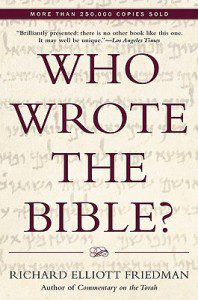
- ________, Who Wrote the Bible?
Notes
1 The Q Source — Scholars have gone to great lengths to reconstruct Q. For more, see James Robinson, Paul Hoffmann, and John S. Kloppenborg, The Critical Edition of Q: A Synopsis Including the Gospels of Matthew and Luke, Mark and Thomas With English, German and French Translations of Q…and Historical Commentary on the Bible). For a much more accessible introduction to Q, see John S. Kloppenborg, Q, the Earliest Gospel: An Introduction to the Original Stories and Sayings of Jesus.
2 J, P, and D also continue into Joshua, Judges, Samuel, and Kings — for more, see Richard Elliott Friedman, The Hidden Book in the Bible.
3 In the Middle Ages — for attributions of the quotes and more information, see Friedman, Who Wrote the Bible?, 19-20ff.
4 For a more detailed summary of what Friedman calls “Six Hundred Years of Investigation” leading to the discovery of the “Documentary Hypothesis,” see his Who Wrote the Bible?, 18-32.
5 For a list of evidence about the biases of J and E toward Judah and Israel respectively, see Friedman, Who Wrote the Bible?, 62-63ff.
6 “Yahweh Elohim” in Genesis 2 — for more, see Friedman, The Bible with Sources Revealed, 35.
7 “formed Adam from the dust of the ground.” — There’s a pun here in the Hebrew. The word for ground is adamah. So God formed the human (adam) from the ground (adamah). Thus, we get Adam from the adamah. Some have suggested the English equivalent might be God forming “humans from the hummus.”
8 Rilke, Letters to a Young Poet (1929), 23.
The Rev. Carl Gregg is a trained spiritual director, a D.Min. candidate at San Francisco Theological Seminary, and the pastor of Broadview Church in Chesapeake Beach, Maryland. Follow him on Facebook (facebook.com/carlgregg) and Twitter (@carlgregg).
Previous Post

April 2, 2012
Individuation, The Beatles, and the Journey to Wholeness
Next Post
April 23, 2012 Letters to a Future Church: Take Risks, Be Honest, Stop Equivocating
Browse Our Archives
Select a Category Advent Anti-Racism Archaeology Atheism Baptism Best of the Year List Book Reviews Buddhism Catholicism Christian Education Church and State Church Planting Climate Change Conscientious Objection to War Creation Spirituality Death Penalty Didache Disability Rights Discernment Easter Ecology Emergent Church Movement Empire-Critical Ethics Evolution Feminist Theology Film Reviews Gandhi Gospel of Mark Gun Control Hinduism Immigration Reform Interfaith Islam JFK Judaism Jungian Spirituality Lectionary Commentary Lent Letters to the Editor LGBT Marriage MLK Multiculturalism Mysticism Nonviolent Activism Occupy Paganism (Earth-centered Religions) Parables Paul Pluralism Politics Process Theology Quantum Physics Requiescat In Pace Seminary and Divinity School Sermon Series Retrospective Sermons Spiritual Direction Spiritual Practices Stewardship (Fundraising) The Book of J The Wheel of the Year (Paganism) Theoblogger Challenge Triathlon Uncategorized Unitarian Universalism Worship Resources Youth Ministry
Select a Month July 2026 May 2026 March 2026 November 2025 October 2025 August 2025 February 2025 December 2024 October 2024 March 2024 January 2024 December 2023 November 2023 March 2023 February 2023 January 2023 December 2022 November 2022 August 2022 March 2022 February 2022 January 2022 December 2021 September 2021 August 2021 July 2021 June 2021 May 2021 February 2021 January 2021 December 2020 August 2020 June 2020 May 2020 April 2020 March 2020 February 2020 January 2020 December 2019 November 2019 October 2019 September 2019 July 2019 June 2019 March 2019 February 2019 January 2019 December 2018 November 2018 October 2018 September 2018 June 2018 May 2018 April 2018 March 2018 February 2018 January 2018 December 2017 November 2017 October 2017 September 2017 August 2017 July 2017 June 2017 May 2017 April 2017 March 2017 February 2017 January 2017 December 2016 November 2016 October 2016 September 2016 August 2016 June 2016 May 2016 April 2016 March 2016 February 2016 January 2016 December 2015 November 2015 October 2015 September 2015 August 2015 July 2015 June 2015 May 2015 April 2015 March 2015 February 2015 January 2015 December 2014 November 2014 October 2014 August 2014 July 2014 June 2014 May 2014 April 2014 March 2014 February 2014 January 2014 December 2013 November 2013 October 2013 September 2013 August 2013 July 2013 June 2013 May 2013 April 2013 March 2013 February 2013 January 2013 December 2012 November 2012 October 2012 September 2012 August 2012 July 2012 June 2012 May 2012 April 2012 March 2012 February 2012 January 2012 December 2011 November 2011 October 2011 September 2011 August 2011 July 2011 June 2011 May 2011 April 2011 March 2011 February 2011 January 2011 December 2010 November 2010 October 2010 August 2009 July 2009 May 2009
Follow Us!
TAKE THE
Religious Wisdom Quiz
Which Psalm contains "Create in me a clean heart, O God"?
Select your answer to see how you score.
Psalm 51 Psalm 33 Psalm 110 Psalm 70
Related posts from Carl Gregg

What Do We Mean We When Say, “Building...
Margaret Fuller: The Stories We Tell Matter
"Feminist Masculinity and Father’s Day" #EachEveryWoman #AllMenCan
Aronofsky’s Noah: from “Hope in Heaven” to “Hope...
TRENDING AT PATHEOS More Voices

Reading America at 250: A Nation Wrestles With...
As part of my own reflection on the 250th anniversary of the...

Whenever I am reading a book or listening to an argument, I...

President Trump Ban Animal Torture Videos on Facebook
Call for Stricter Regulations of Animal Abuse Content on Facebook Although President...

Draft Amendments to Address Ritual Abuse in New...
The proposed changes would make it illegal for individuals in domestic partnerships...

How Bans on LGBTQ+ Student Clubs Threaten Religious...
On June 20, 2025, the State of Texas passed Senate Bill 12....

The Truth About the Gen Z Revival
This past year, there has been a lot of media buzz surrounding...
view all More Voices blogs
Ad-Free & Subscriber Log-In Subscription Support
- About Us
- 2026 Calendar
- Videos
- Podcasts
- Library of World Religions
- Faith In Media Tracker
- Advertise With Us
- Write for Us
- Privacy Policy
- Terms of Service
- Do Not Sell My Data
- Contact Us
- Radiant Digital
- Manage Newsletter Subscriptions
- Unsubscribe From Notifications
- Sitemap
Copyright 2008-2026, Patheos. All rights reserved.
Subscription Support Ad-Free & Subscriber Log-In
Follow Patheos