
BuddhistCatholicContemplativeEvangelicalGeneral ChristianHinduJewishLatter-day SaintMuslimNew VisionsProgressive Christian
Beliefs
- Buddhist
- Catholic
- Contemplative
- Evangelical
- General Christian
- Hindu
- Jewish
- Latter-day Saint
- More Voices
- Muslim
- New Visions
- Pagan
- Progressive Christian
Topics
- Religion News
- Food and Religion
- Sports and Religion
- Religious Art
- Religious Music and Entertainment
- Religious Events
- History and Religion
- Style and Religion
- Politics and Religion
- Women in Religion
- Recreation Outdoors and Religion
- Business Finance and Religion
- Careers Workplace and Religion
- Education and Religion
- Family Parenting and Religion
- Health Fitness and Religion
- Home and Religion
- Relationships and Religion
- Technology and Religion
- Travel and Religion
Columnists
- Buddhist Columnists
- Business Finance and Religion Columnists
- Careers Workplace and Religion Columnists
- Catholic Columnists
- Contemplative Columnists
- Education and Religion Columnists
- Evangelists Columnists
- Family Parenting and Religion Columnists
- General Christian Columnists
- Health Fitness and Religion Columnists
- Hindu Columnists
- History and Religion Columnists
- Home and Religion Columnists
- Jewish Columnists
- More Voices Columnists
- Latter Day Columnists
- Muslim Columnists
- New Visions Columnists
- Nonreligious Columnists
- Pagan Columnists
- Politics and Religion Columnists
- Progressive Columnists
- Recreation Outdoors and Religion Columnists
- Relationships and Religion Columnists
- Religion News Columnists
- Religious Art Columnists
- Religious Events Columnists
- Religious Music and Entertainment Columnists
- Sports and Religion Columnists
- Style and Religion Columnists
- Technology and Religion Columnists
- Travel and Religion Columnists
- Women in Religion Columnists
Resource Library
- 2026 Calendar
- Library of World Religions
- The 100 Most Holy Places on Earth
- Patheos Answers
- Podcasts
- Videos
- Faith Leaders Database
- Anglican Episcopalian
- Bahai
- Baptist
- Buddhism
- Christianity
- Confucianism
- Eastern Orthodoxy
- Hinduism
- Holiness and Pentecostal
- ISKCON
- Islam
- Judaism
- Lutheran
- Methodist
- The Church of Jesus Christ of Latter-day Saints
- New Age
- Paganism
- Presbytarian and Reformed
- Protestantism
- Religion Behind the Scenes
- Roman Catholic
- Scientology
- Shia Islam
- Sikhism
- Sufism
- Sunni Islam
- Taoism
- Zen
- See all religions
Research Tools
 Ad-Free & Subscriber Log-In Subscription Support
Ad-Free & Subscriber Log-In Subscription Support
Follow Patheos 

- Trending:
- Forgiveness
- |
- Marriage
- |
- Consciousness
- |
- Death Penalty
- |
- Election
- |
- Halloween

- Home
- More Voices
- “Sorry I’ve Been Busy!” How to Bring Your Life Back Into Focus
“Sorry I’ve Been Busy!” How to Bring Your Life Back Into Focus
Last updated on: March 14, 2012 at 12:58 pm by Carl Gregg
“Sorry I’ve Been Busy!” How to Bring Your Life Back Into Focus 2012-03-14T12:58:31-04:00 Carl Gregg
Patheos Explore the world's faith through different perspectives on religion and spirituality! Patheos has the views of the prevalent religions and spiritualities of the world.
(Arthur Boers, Living Into Focus: Choosing What Matters in an Age of Distractions, Brazos Press, 2012, 226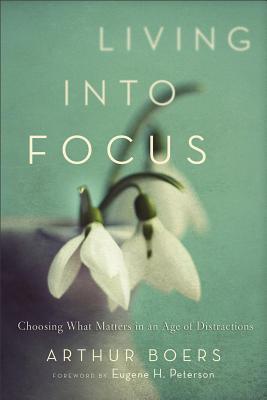 pages)
“I’m sorry it’s taken us so long to get in touch. I’ve just been so busy recently.” I hear myself and my friends make apologies along these lines far too frequently. But “busyness” is rarely an idle excuse. Most of us are overwhelmed with responsibilities much of the time. And it can be easy to slip into the trap of wearing our busyness as a badge of honor or of trying to prove that we are the busiest in a perverse game of one-upmanship. (Remember that, “Whoever wins the rat race is still a rat!”) In contrast, we desperately need to name busyness for what it often is: a cry for help.
Boers’ book Living into Focus both helps us diagnose the problem (“The first step is admitting you have a problem!”) and offers many stories and concrete examples of how we can live into a more meaningful and sustainable way of life. Scattered throughout are delightful illustrations from the Dutch cartoonist Margreet de Heer that hilariously underscore the text. The book also impressively begins with a foreword from Eugene Peterson, who, like Boers, is an pastor-turned-professor-and-author.
The book’s driving metaphor of “focus” and finding the “focal point” in an age of technological distractions reminds me of my iPhone with its ironically lower-cased “i.” I used to never take pictures, but now I take multiple pictures most days since my iPhone is also a fairly impressive camera. However, I have found that if I point-and-click too quickly, the picture is often blurry. But if I linger, and take a few pictures, the second or third photo is usually superior to the first attempt. It takes time to focus.
Boers is right that technology is a two-edged sword. My iPhone frequently makes me feel like the “future is now.” Some of its astonishing functionality makes me feel like I could easily be living inside an episode of Star Trek. But there is also the accompanying temptation to constantly check Facebook, tweet every passing insight, and respond immediately to every email. Indeed, I dropped my cell phone down a stairwell during my final semester in seminary, and enjoyed a few weeks of uninterrupted studying outside in nature that spring before getting around to replacing my phone.
Similarly, allow me to give you a taste of the related practices that are included throughout Boer’s book. This one is called “Slow Down Email”:
The more emails I respond to the more I get, and those also need a response, making life busier. So I usually do not answer email correspondence the same day. By putting off replies, I stem the incoming tide. If I write quickly I often realize later in the day that there was a better way to respond or that I needed to include additional information or that I did not want to say what I wrote in the first email. Then I have to send yet another. (118)
Also, taking the ubiquitous call to “Silence your cell phones!” to another level, Boers invites worship leaders to remove their wristwatches before entering the sanctuary to be fully present to the worship event: God’s kairos time supersedes clock preoccupations” (152).
To offer one final example among many others, he recommends the following Sabbath Manifesto, which importantly has far more suggestions of life-giving practices than prohibitions (154):
- Avoid technology.
- Connect with loved ones.
- Nurture your health.
- Get outside.
- Avoid commerce.
- Light candles.
- Drink wine.
- Eat bread.
- Find silence.
- Give back.
As a teaser, if you buy this book, be sure to read the conclusion, which includes a fascinating survival guide for “Living into Focus” even in the midst of all that can go awry at the airport.
This book review is a sponsored post that is part of the Roundtable at the Patheos Book Club. Visit the Book Club website for more free resources related to this book.
The Rev. Carl Gregg is a trained spiritual director, a D.Min. candidate at San Francisco Theological Seminary, and the pastor of Broadview Church in Chesapeake Beach, Maryland. Follow him on Facebook (facebook.com/carlgregg) and Twitter (@carlgregg).
Previous Post

March 14, 2012
Sermon Series Retrospective: “The Gospel According to Mark”
Next Post
March 15, 2012 Have You Heard the One about the Pope Who Quit? (Seriously!)
Browse Our Archives
Select a Category Advent Anti-Racism Archaeology Atheism Baptism Best of the Year List Book Reviews Buddhism Catholicism Christian Education Church and State Church Planting Climate Change Conscientious Objection to War Creation Spirituality Death Penalty Didache Disability Rights Discernment Easter Ecology Emergent Church Movement Empire-Critical Ethics Evolution Feminist Theology Film Reviews Gandhi Gospel of Mark Gun Control Hinduism Immigration Reform Interfaith Islam JFK Judaism Jungian Spirituality Lectionary Commentary Lent Letters to the Editor LGBT Marriage MLK Multiculturalism Mysticism Nonviolent Activism Occupy Paganism (Earth-centered Religions) Parables Paul Pluralism Politics Process Theology Quantum Physics Requiescat In Pace Seminary and Divinity School Sermon Series Retrospective Sermons Spiritual Direction Spiritual Practices Stewardship (Fundraising) The Book of J The Wheel of the Year (Paganism) Theoblogger Challenge Triathlon Uncategorized Unitarian Universalism Worship Resources Youth Ministry
Select a Month July 2026 May 2026 March 2026 November 2025 October 2025 August 2025 February 2025 December 2024 October 2024 March 2024 January 2024 December 2023 November 2023 March 2023 February 2023 January 2023 December 2022 November 2022 August 2022 March 2022 February 2022 January 2022 December 2021 September 2021 August 2021 July 2021 June 2021 May 2021 February 2021 January 2021 December 2020 August 2020 June 2020 May 2020 April 2020 March 2020 February 2020 January 2020 December 2019 November 2019 October 2019 September 2019 July 2019 June 2019 March 2019 February 2019 January 2019 December 2018 November 2018 October 2018 September 2018 June 2018 May 2018 April 2018 March 2018 February 2018 January 2018 December 2017 November 2017 October 2017 September 2017 August 2017 July 2017 June 2017 May 2017 April 2017 March 2017 February 2017 January 2017 December 2016 November 2016 October 2016 September 2016 August 2016 June 2016 May 2016 April 2016 March 2016 February 2016 January 2016 December 2015 November 2015 October 2015 September 2015 August 2015 July 2015 June 2015 May 2015 April 2015 March 2015 February 2015 January 2015 December 2014 November 2014 October 2014 August 2014 July 2014 June 2014 May 2014 April 2014 March 2014 February 2014 January 2014 December 2013 November 2013 October 2013 September 2013 August 2013 July 2013 June 2013 May 2013 April 2013 March 2013 February 2013 January 2013 December 2012 November 2012 October 2012 September 2012 August 2012 July 2012 June 2012 May 2012 April 2012 March 2012 February 2012 January 2012 December 2011 November 2011 October 2011 September 2011 August 2011 July 2011 June 2011 May 2011 April 2011 March 2011 February 2011 January 2011 December 2010 November 2010 October 2010 August 2009 July 2009 May 2009
Follow Us!
TAKE THE
Religious Wisdom Quiz
True or False: The parable of the Prodigal Son appears only in Luke's Gospel.
Select your answer to see how you score.
FALSE TRUE
Related posts from Carl Gregg

Why You Should Give Yourself Permission for Self-Care:...

"Are You Living the Life You Chose?": How...
Why a 40-Hour Work Week? (It's Decreased Before....
TRENDING AT PATHEOS More Voices

Reading America at 250: A Nation Wrestles With...
As part of my own reflection on the 250th anniversary of the...

Whenever I am reading a book or listening to an argument, I...

President Trump Ban Animal Torture Videos on Facebook
Call for Stricter Regulations of Animal Abuse Content on Facebook Although President...

Draft Amendments to Address Ritual Abuse in New...
The proposed changes would make it illegal for individuals in domestic partnerships...

How Bans on LGBTQ+ Student Clubs Threaten Religious...
On June 20, 2025, the State of Texas passed Senate Bill 12....

The Truth About the Gen Z Revival
This past year, there has been a lot of media buzz surrounding...
view all More Voices blogs
Ad-Free & Subscriber Log-In Subscription Support
- About Us
- 2026 Calendar
- Videos
- Podcasts
- Library of World Religions
- Faith In Media Tracker
- Advertise With Us
- Write for Us
- Privacy Policy
- Terms of Service
- Do Not Sell My Data
- Contact Us
- Radiant Digital
- Manage Newsletter Subscriptions
- Unsubscribe From Notifications
- Sitemap
Copyright 2008-2026, Patheos. All rights reserved.
Subscription Support Ad-Free & Subscriber Log-In
Follow Patheos