
BuddhistCatholicContemplativeEvangelicalGeneral ChristianHinduJewishLatter-day SaintMuslimNew VisionsProgressive Christian
Beliefs
- Buddhist
- Catholic
- Contemplative
- Evangelical
- General Christian
- Hindu
- Jewish
- Latter-day Saint
- More Voices
- Muslim
- New Visions
- Pagan
- Progressive Christian
Topics
- Religion News
- Food and Religion
- Sports and Religion
- Religious Art
- Religious Music and Entertainment
- Religious Events
- History and Religion
- Style and Religion
- Politics and Religion
- Women in Religion
- Recreation Outdoors and Religion
- Business Finance and Religion
- Careers Workplace and Religion
- Education and Religion
- Family Parenting and Religion
- Health Fitness and Religion
- Home and Religion
- Relationships and Religion
- Technology and Religion
- Travel and Religion
Columnists
- Buddhist Columnists
- Business Finance and Religion Columnists
- Careers Workplace and Religion Columnists
- Catholic Columnists
- Contemplative Columnists
- Education and Religion Columnists
- Evangelists Columnists
- Family Parenting and Religion Columnists
- General Christian Columnists
- Health Fitness and Religion Columnists
- Hindu Columnists
- History and Religion Columnists
- Home and Religion Columnists
- Jewish Columnists
- More Voices Columnists
- Latter Day Columnists
- Muslim Columnists
- New Visions Columnists
- Nonreligious Columnists
- Pagan Columnists
- Politics and Religion Columnists
- Progressive Columnists
- Recreation Outdoors and Religion Columnists
- Relationships and Religion Columnists
- Religion News Columnists
- Religious Art Columnists
- Religious Events Columnists
- Religious Music and Entertainment Columnists
- Sports and Religion Columnists
- Style and Religion Columnists
- Technology and Religion Columnists
- Travel and Religion Columnists
- Women in Religion Columnists
Resource Library
- 2026 Calendar
- Library of World Religions
- The 100 Most Holy Places on Earth
- Patheos Answers
- Podcasts
- Videos
- Faith Leaders Database
- Anglican Episcopalian
- Bahai
- Baptist
- Buddhism
- Christianity
- Confucianism
- Eastern Orthodoxy
- Hinduism
- Holiness and Pentecostal
- ISKCON
- Islam
- Judaism
- Lutheran
- Methodist
- The Church of Jesus Christ of Latter-day Saints
- New Age
- Paganism
- Presbytarian and Reformed
- Protestantism
- Religion Behind the Scenes
- Roman Catholic
- Scientology
- Shia Islam
- Sikhism
- Sufism
- Sunni Islam
- Taoism
- Zen
- See all religions
Research Tools
 Ad-Free & Subscriber Log-In Subscription Support
Ad-Free & Subscriber Log-In Subscription Support
Follow Patheos 

- Trending:
- Forgiveness
- |
- Marriage
- |
- Consciousness
- |
- Death Penalty
- |
- Election
- |
- Halloween

- Home
- More Voices
- Preaching the Didache: What Is Your Canon and Why?
Preaching the Didache: What Is Your Canon and Why?
Last updated on: January 16, 2012 at 10:47 am by Carl Gregg
Preaching the Didache: What Is Your Canon and Why? 2012-01-16T10:47:03-05:00 Carl Gregg
Patheos Explore the world's faith through different perspectives on religion and spirituality! Patheos has the views of the prevalent religions and spiritualities of the world.
The Didache (usually pronounced Did-ah-Kay) is an ancient Christian document written around 50-70 CE and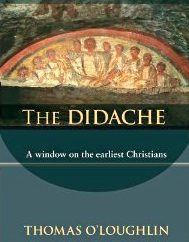 rediscovered in 1873. It is addressed not to radical itinerant peasants like Jesus and his original followers, but to householders as a manual for how “to adapt the way of Jesus to the exigencies of family, of occupation, of home — the very things that Jesus and his wandering apostles had left behind.” This post is the first entry in a new series I will be adding to throughout the season of Epiphany. To explain some of the reasons I am focusing on this relatively (though arguably undeservedly) obscure book, let me begin with a story.
When I was in second grade, all the members of our Sunday School class were presented with a Bible signed by the pastor. But this book was not just any Bible. It was, as some of you may be able to guess, a King James Bible. The best part of this Bible in retrospect are the troubling and unintentionally hilarious full-color picture inserts that depict famous Bible scene featuring figures that are much more Caucasian looking than Semitic. Projecting back to my second grade self, the picture were probably what drew my attention most at that point as well. Although parts of the King James Bible contain gloriously beautiful poetry and prose, it is not set at the most appropriate reading level for a seven year old.
I tell you this story because I want us to reflect together about our various implicit and inherited understandings of canon as a way about becoming more explicit and intentional about our approach to scriptural canons. Not a cannon with two “n’s” that goes “Boom!” and shoots cannonballs, but a canon with one “n” that means a measuring rod or standard. In the context of the Bible, a canon with one “n” refers to the authoritative list of books that are included in the Bible. As you’ve heard me say before, the word Bible comes from the Greek root word for “books,” and the Bible is in on one basic level an anthology or collection of books. Overtime various lists were developed to determine which books were canonical (and thus included in the Bible) and which books were non-canonical (and excluded from the Bible).
Many people, including my second grade self, somewhat unreflectively assume that the Bible includes everything that was written at the time on the subject at hand, but that straightforward picture couldn’t be farther from the truth, which was a complicated and convoluted process in which some books were championed, other books were denounced, and still others were included or excluded on fairly arbitrary or contingent grounds.
Returning to the question that underlies my story: why give a second grader a copy of the King James Bible, which is written in a style that is difficult to comprehend even for many adults? One answer is that this choice betrays the implicit canon of some of the leadership of my childhood church, which includes a particular ordering of the books of the Bible and a particular translation of the words. I don’t think it would be too strong to say that certain groups within my childhood church — as well as many others — had or have an unhealthy obsession with the King James Version. This obsession, from my perspective, fails to account for a number of crucial points. First, as beautiful as parts of the King James Bible are, it is was not published until the year 1611. There are many other important and earlier biblical manuscripts, including landmark English translations. Second, an overemphasis on the King James Version shows a disrespect for the 400 years of biblical scholarship that have followed the KJV and which have given us better, more accurate, and more accessible translations of the Bible. Both of these points also do not even begin to raise the problematic background of colonialism, imperialism, and Manifest Destiny that gave birth to the idea that an English translation of the Bible is the best translation ever made. Here, we are also invited to consider why congregations, who emphasize the Bible as centrally important, do not make their members learn the original Hebrew and Greek languages in which the Bible was written. At minimum, why do Christians not learn Greek the way that Jews learn Hebrew and eventually preside at a religious coming of age ceremony? An adaption of this process for Christian communities could be an excellent and empowering way of practicing the priesthood of all believers.
To return to my main point, the Bible with which we are most familiar can, if we are not careful, become our unexamined canon or standard in a way that masks the diversity of books and translations that are the reality of the past few millennia of biblical history. The shape of the Bible that we are mostly accustomed to as twenty-first century Western Protestants was neither inevitable historically, nor is it unanimous today. Today, Jews, Roman Catholics, and various branches of Eastern Orthodox Christianity all have more or less books of the Bible than Protestants or the books in different order. A more foundational matter related to the overemphasis on the Bible in some quarters is that Jesus never wrote a word of the books that were eventually collected as the New Testament, nor did he commission his disciples to be scribes. Jesus was interested in our behavior, in changing our way of thinking and our way of being in the world. Thus, it makes sense that the earliest Christian writings that survived the vagaries of history are the letters of the apostle Paul from the 50s, a full generation after the life of the historical Jesus. There is a real sense in which both the institution of the church and the New Testament are both “Plan B.”
“Plan A,” depending on whom you talk to, was either for the Kingdom of God (the “Beloved Community”) to become fully manifest as people followed the way Jesus showed them or for Jesus to return. When neither of these Plan A’s happened, folks like Paul started writing to groups of followers of the Way about how to live in the wake of Jesus’ absence. And toward the final third of the first century — more than two or three generations removed from the historical Jesus — various written lists of Jesus’ saying and the oral traditions about Jesus began to be compiled into the documents we now know as the Gospels.
But there were many other books being written by and for Christians at the same time such as the Gospel of Thomas, the letters of Clement, the Shepherd of Hermas, the Didache to name a few. And various Christian groups have used different combinations of these books until today. Indeed, the first list of the 27 books of our New Testament (no more, no less) was made Athanasius, bishop of Alexandria, in an Easter Letter in 367 CE, more than three hundred years after Jesus’ death. And Athanasius was only speaking to the churches in Egypt under his jurisdiction. He had no authority to proclaim a definitive canon for all Christians. He merely helped contribute to the precedent that eventually became the most common standard.
Speaking of Easter letters, Martin Luther King, Jr.’s “Letter from the Birmingham Jail,” written on Easter Weekend 1963 was, during the Civil Rights Movement, seriously proposed in some quarters as worthy of inclusion in the Bible. As bizarre as that proposal may sound, the more I’ve thought about how much work myself and others put into making the ancient writings in the Bible relevant for today I think that sometimes we would be better off spending at least equal amounts of time reading contemporary prophets such as Martin Luther King, Jr., Dorothy Day, and Wendell Berry as we do read the words of ancient scriptural writers because the modern writers speak the word of God more directly to our own situation.
My first peak behind the curtain that the Great and Powerful Oz of the King James Bible might not be so Great and Powerful was ironically one day in when I arrived early for youth group and was wandering around the church library. (Yes, I was a God Nerd even back then.) I was scanning the varieties of Bibles on the shelf and for some reason the volume labeled “Catholic Bible” caught my eye. And when I pulled it off the shelf and scanned the table of contents, my mind began to swirl. I had long ago memorized the books of the Bible in the only order in which I thought everyone listed them, but here I was seeing “extra” books: Tobit, Judith, Bel and the Dragon, 1-2 Maccabees, and others. I thought to myself, “What?! You can add books to the Bible?” It would be many years before I began to read the many scholars who help detail the messy, complex, controversial, and sometimes violent history of how some books became included or excluded from various Christian canons.
Another revelation came when I was assigned to buy the The New Oxford Annotated Bible with the Apocrypha as required reading in my freshmen-year undergraduate Humanities sequence. Unlike the more predictable and brief commentary in the NIV Study Bible I had used in high school, this new Bible with its bright red cover included annotations that introduced me to the wide-ranging debates of mainline biblical scholarship. I also began to realize that annotated Bibles aren’t that different in a sense from the idea of canonizing MLK’s “Letter from a Birmingham Jail.” The print may be slightly smaller for the annotations, but study Bibles essentially are weaving scholarly commentary into the canon, although not in a way that is as pervasive as the core content of the books themselves.
To summarize the point I’ve been building to, studying the Didache seems important to me because it could easily have been as part of our New Testament if a few historical contingencies have turned differently and because God is speaking to us through all of Creation if we take time to listen, including both through nature itself and certainly through non-canonical books. (Of course sometimes God could be speaking to us to say, “This book is nonsense,” but I will leave it to you to judge the Didache for yourself.) I hope as well that it is clear by now from our studies of Mark and Matthew that I have a love of the traditional biblical canon that I suspect will continue for the rest of my life, and after Easter I would like for us to begin a study of Genesis. So, we will return to the canon soon enough, but I hope that many of you will enjoy our study of the Didache.
Let us now briefly turn our focus again to the text of the Didache itself. Literally the title Didache means “The Teaching.” It is from the same Greek root as our English word didactic, which means, “designed or intended to teach.” And the Didache is in many ways a pragmatic manual for how to follow the Way of Jesus, implicitly as a “Plan B,” as we have already seen.
Remember that Jesus and his earliest disciples were all itinerant peasants, who had all left home, had no home, or who lost their home and are now seeking to follow Jesus’ Way. Remember the words Jesus spoke to commission the seventy followers of his Way in Luke 10:1-11,
After this the Lord appointed seventy others and sent them on ahead of him in pairs to every town and place where he himself intended to go…. Go on your way. See, I am sending you out like lambs into the midst of wolves. Carry no purse, no bag, no sandals; and greet no one on the road. Whatever house you enter, first say, ‘Peace to this house!’ And if anyone is there who shares in peace, your peace will rest on that person; but if not, it will return to you. Remain in the same house, eating and drinking whatever they provide, for the laborer deserves to be paid. Do not move about from house to house. Whenever you enter a town and its people welcome you, eat what is set before you; cure the sick who are there, and say to them, ‘The kingdom of God has come near to you.’ But whenever you enter a town and they do not welcome you, go out into its streets and say, ‘Even the dust of your town that clings to our feet, we wipe off in protest against you. Yet know this: the kingdom of God has come near.’”
The Didache reflects both the other side of the coin and the fruit of this commission. Jesus sent these itinerant peasant out to proclaim the good news of God’s grace to whom? To householders, to those who would open the doors of their homes to Jesus’ followers and either offer them hospitality or not. Jesus’ commission to the seventy is Plan A. With the Didache we are seeing Plan B and the results of Plan A. The Didache is addressed not to radical itinerant peasant like Jesus and his original followers, but, as one Didache scholar says, to the householders as a manual for how “to adapt the way of Jesus to the exigencies of family, of occupation, of home — the very things that Jesus and his wandering apostles had left behind.”
So we will see in future weeks recommendations about how to baptize, how to practice Communion, and how householders are to determine if wandering prophets that knock on their door seeking hospitality and claiming to practice the Way of Jesus are authentic or charlatans.
The Didache is, further, written about the same time that Paul is writing his letters or a little bit afterward: the 50s, about twenty years after Jesus — but without any seeming knowledge of Paul’s work or of the Gospels, the first of which are a decade or more in the future. We live in the Information Age, when we can Google almost anything in an instant with our handheld smart phones. But in the first century knowledge was decidedly more local. For example, scholars tell us that the Gospel of Luke can claim with presumed honesty to have “gathered [all available] primary sources as background research for writing his Gospel, but “these sources apparently did not include even a single copy of any of Paul’s letters, which, at the time of his writing, had been in circulation for over twenty years.” Thus, “even after being circulated and used regionally, the Didache failed to have enough clout to gain inclusion in the fourth-century universal canons of books,” which became the New Testament. But I hope you will come to see that the Didache still represents a fascinating window into an attempt by early followers to wrestle with what it means to follow the Way of Jesus. It’s also only one-third as long as the Gospel According to Mark, so we will be able to move through it much more quickly than some of our other book-long sermon series.
To briefly cover some of the fascinating history of the Didache, although it was referred to by numerous early church fathers such as Origen (185-254 CE) and Athanasius (293-373 CE), modern scholars presumed it was lost to the vagaries of history. Then, in 1873 a long-overlooked complete copy of the Didache was discovered as a small part of a larger anthology in the library of the Church of the Holy Sepulchre in Istanbul. This rediscovery is good news, not only because it sheds greater light on the many important aspects of early Christianity not included in the official canon, but also because it highlights a way of being Christian that is pragmatic and about behavior, not beliefs or creeds.
You can see this emphasis on practice from the first chapter that we heard read earlier: “There are two ways, one of life and one of death! And there is a great difference between the two ways.” This opening section speak about not two ways of believing, but two ways of acting, two different ways of being in the world.
Chapter one continues that, “The way of life is this: First, you shall love God who made you. And second, love your neighbor as yourself, and do not do to another what you would not want done to you.” As I have said before, I couldn’t agree more that we should interpret all of scripture in such as way that our interpretation encourages a greater love of God and a greater love of neighbor. Conversely, if our interpretation leads to a hatred of God or neighbor, the fault is more we our interpretation than with the scripture at hand.
The Didachist, the anonymous writer of the Didache, continues with some of the most radical teachings of Jesus:
Bless those who curse you, and pray for your enemies, and fast for those who persecute you. For what reward is there for loving those who love you? …you should love those who hate you, and then you shall have no enemies….. If someone strikes your right cheek, turn the other also…. If someone forces you to go one mile, go two. If someone takes your cloak, give also your coat. If someone takes from you what is yours, don’t ask for it back. You really cannot. Give to every one who asks you, and don’t ask for it back.
Here in chapter one we also see the Didache community wrestling with freeloaders, those who try to game the system, and those who try to manipulate cheap grace for their own selfish gain: “if one receives who has need, he is guiltless, but if one receives not having need, he shall stand trial, answering why he received and for what use.” We will confront these dynamics more fully in future weeks. For now, I hope you find yourself at least beginning to share my excitement and gratitude for this peek into early Christianity, a celebration of a document that once was lost, but now is found.
For Further Study on Canonization
- Bart D. Ehrman’s Lost Christianities: The Battles for Scripture and the Faiths We Never Knew is a narrative commentary, and his Lost Scriptures: Books that Did Not Make It into the New Testament contains the texts themselves.
- Bruce Metzger’s The Canon of the New Testament: Its Origin, Development, and Significance is a more traditional, academic version—as opposed to Ehrman’s more accessible, popularized approach.
- Lee Martin McDonald and James A. Sanders’ The Canon Debate (2002) is a more recent collection that helps summarize recent scholarship on canonization.
- Elaine Pagels, Beyond Belief: The Secret Gospel of Thomas.
- Cynthia Bourgeault, The Meaning of Mary Magdalene: Discovering the Woman at the Heart of Christianity.
- Robert J. Miller, The Complete Gospels, 4th Edition.
For Further Study on the Didache
- Aaron Milavec’s The Didache: Text, Translation, Analysis, and Commentary is an accessible, condensed version of his massive tome The Didache: Faith, Hope, and Life of the Earliest Christian Communities, 50-70 C.E.
- Tony Jones’ The Teaching of the Twelve: Believing & Practicing the Primitive Christianity of the Ancient Didache Community is another accessible entry point. And there is a supplemental DVD.
- Thomas O’Loughlin, The Didache: A Window on the Earliest Christians.
- Read the text of the Didache for yourself free online at http://www.paracletepress.com/didache.html.
Notes
1 I owe the term “Plan B” to a free podcast with John Caputo that is available at http://homebrewedchristianity.com/2012/01/05/john-caputo-says-god-perhaps-ep-131/.
2 On the controversy over Jesus’ Plan A, see The Apocalyptic Jesus: A Debate by Dale Allison, et al.
3 In Athanasius’ Festal Letter, he said, “In these alone the teachings of godliness is proclaimed. Let no one add to these; let nothing be taken away from them.”
4 Regard the term “God Nerd,” I commend to you my friend and fellow Patheos blogger Christian Piatt’s post “The Nerd Gospel”: https://www.sojo.net/blogs/2012/01/06/nerd-gospel.
5 On the violence that sometimes erupted over canonization and related debates, see Philip Jenkins’ Jesus Wars: How Four Patriarchs, Three Queens, and Two Emperors Decided What Christians Would Believe for the Next 1,500 years.
6 In my estimation, the The New Interpreter’s Study Bible: New Revised Standard Version With the Apocrypha has surpassed the New Oxford Annotated Bible as the best one-volume study Bible on the market, although I have not had time to check out the NOAB’s new fourth edition.
7 The Didache was a manual for how “to adapt the way of Jesus to the exigencies of family, of occupation, of home — the very things that Jesus and his wandering apostles had left behind.” — Aaron Milavec, The Didache: Text, Translation, Analysis, and Commentary, x:
8 “the Didache does not depend on Matthew or any other Gospel.” — Milavec, The Didache: Faith, Hope, and Life of the Earliest Christian Communities, 50-70 C.E., 789:
9 “even after being circulated and used regionally, the Didache failed to have enough clout to gain inclusion in the fourth-century universal canons of books.” — Milavec, The Didache: Text, Translation, Analysis, and Commentary xi.
10 On the 1873 discovery of the Didache, see Tony Jones, The Teaching of the Twelve: Believing & Practicing the Primitive Christianity of the Ancient Didache Community, 4-5.
11 On the Didache’s emphasis on practice more than belief of the cross, see Milavec, The Didache: Faith, Hope, and Life of the Earliest Christian Communities, 50-70 C.E., 846.
12 “if our interpretation leads to a hatred of God or neighbor, the fault is more we our interpretation than with the scripture at hand.” — see my post on “Why Not Choose Love? Picking and Choosing Scripture as a Twenty-first Century Christian.”
The Rev. Carl Gregg is a trained spiritual director, a D.Min. candidate at San Francisco Theological Seminary, and the pastor of Broadview Church in Chesapeake Beach, Maryland. Follow him on Facebook (facebook.com/carlgregg) and Twitter (@carlgregg).
Next Post

January 10, 2012 Contemplative Listening: A Simple, How-to Guide
Browse Our Archives
Select a Category Advent Anti-Racism Archaeology Atheism Baptism Best of the Year List Book Reviews Buddhism Catholicism Christian Education Church and State Church Planting Climate Change Conscientious Objection to War Creation Spirituality Death Penalty Didache Disability Rights Discernment Easter Ecology Emergent Church Movement Empire-Critical Ethics Evolution Feminist Theology Film Reviews Gandhi Gospel of Mark Gun Control Hinduism Immigration Reform Interfaith Islam JFK Judaism Jungian Spirituality Lectionary Commentary Lent Letters to the Editor LGBT Marriage MLK Multiculturalism Mysticism Nonviolent Activism Occupy Paganism (Earth-centered Religions) Parables Paul Pluralism Politics Process Theology Quantum Physics Requiescat In Pace Seminary and Divinity School Sermon Series Retrospective Sermons Spiritual Direction Spiritual Practices Stewardship (Fundraising) The Book of J The Wheel of the Year (Paganism) Theoblogger Challenge Triathlon Uncategorized Unitarian Universalism Worship Resources Youth Ministry
Select a Month July 2026 May 2026 March 2026 November 2025 October 2025 August 2025 February 2025 December 2024 October 2024 March 2024 January 2024 December 2023 November 2023 March 2023 February 2023 January 2023 December 2022 November 2022 August 2022 March 2022 February 2022 January 2022 December 2021 September 2021 August 2021 July 2021 June 2021 May 2021 February 2021 January 2021 December 2020 August 2020 June 2020 May 2020 April 2020 March 2020 February 2020 January 2020 December 2019 November 2019 October 2019 September 2019 July 2019 June 2019 March 2019 February 2019 January 2019 December 2018 November 2018 October 2018 September 2018 June 2018 May 2018 April 2018 March 2018 February 2018 January 2018 December 2017 November 2017 October 2017 September 2017 August 2017 July 2017 June 2017 May 2017 April 2017 March 2017 February 2017 January 2017 December 2016 November 2016 October 2016 September 2016 August 2016 June 2016 May 2016 April 2016 March 2016 February 2016 January 2016 December 2015 November 2015 October 2015 September 2015 August 2015 July 2015 June 2015 May 2015 April 2015 March 2015 February 2015 January 2015 December 2014 November 2014 October 2014 August 2014 July 2014 June 2014 May 2014 April 2014 March 2014 February 2014 January 2014 December 2013 November 2013 October 2013 September 2013 August 2013 July 2013 June 2013 May 2013 April 2013 March 2013 February 2013 January 2013 December 2012 November 2012 October 2012 September 2012 August 2012 July 2012 June 2012 May 2012 April 2012 March 2012 February 2012 January 2012 December 2011 November 2011 October 2011 September 2011 August 2011 July 2011 June 2011 May 2011 April 2011 March 2011 February 2011 January 2011 December 2010 November 2010 October 2010 August 2009 July 2009 May 2009
Follow Us!
TAKE THE
Religious Wisdom Quiz
How many disciples did Jesus have?
Select your answer to see how you score.
One hundred Twelve Seven Thirty
Related posts from Carl Gregg

What Do We Mean We When Say, “Building...

Margaret Fuller: The Stories We Tell Matter
"Feminist Masculinity and Father’s Day" #EachEveryWoman #AllMenCan
Religious Mystic & Rational Humanist: The Mystical Humanism...
TRENDING AT PATHEOS More Voices

Reading America at 250: A Nation Wrestles With...
As part of my own reflection on the 250th anniversary of the...

Whenever I am reading a book or listening to an argument, I...

President Trump Ban Animal Torture Videos on Facebook
Call for Stricter Regulations of Animal Abuse Content on Facebook Although President...

Draft Amendments to Address Ritual Abuse in New...
The proposed changes would make it illegal for individuals in domestic partnerships...

How Bans on LGBTQ+ Student Clubs Threaten Religious...
On June 20, 2025, the State of Texas passed Senate Bill 12....

The Truth About the Gen Z Revival
This past year, there has been a lot of media buzz surrounding...
view all More Voices blogs
Ad-Free & Subscriber Log-In Subscription Support
- About Us
- 2026 Calendar
- Videos
- Podcasts
- Library of World Religions
- Faith In Media Tracker
- Advertise With Us
- Write for Us
- Privacy Policy
- Terms of Service
- Do Not Sell My Data
- Contact Us
- Radiant Digital
- Manage Newsletter Subscriptions
- Unsubscribe From Notifications
- Sitemap
Copyright 2008-2026, Patheos. All rights reserved.
Subscription Support Ad-Free & Subscriber Log-In
Follow Patheos