
BuddhistCatholicContemplativeEvangelicalGeneral ChristianHinduJewishLatter-day SaintMuslimNew VisionsProgressive Christian
Beliefs
- Buddhist
- Catholic
- Contemplative
- Evangelical
- General Christian
- Hindu
- Jewish
- Latter-day Saint
- More Voices
- Muslim
- New Visions
- Pagan
- Progressive Christian
Topics
- Religion News
- Food and Religion
- Sports and Religion
- Religious Art
- Religious Music and Entertainment
- Religious Events
- History and Religion
- Style and Religion
- Politics and Religion
- Women in Religion
- Recreation Outdoors and Religion
- Business Finance and Religion
- Careers Workplace and Religion
- Education and Religion
- Family Parenting and Religion
- Health Fitness and Religion
- Home and Religion
- Relationships and Religion
- Technology and Religion
- Travel and Religion
Columnists
- Buddhist Columnists
- Business Finance and Religion Columnists
- Careers Workplace and Religion Columnists
- Catholic Columnists
- Contemplative Columnists
- Education and Religion Columnists
- Evangelists Columnists
- Family Parenting and Religion Columnists
- General Christian Columnists
- Health Fitness and Religion Columnists
- Hindu Columnists
- History and Religion Columnists
- Home and Religion Columnists
- Jewish Columnists
- More Voices Columnists
- Latter Day Columnists
- Muslim Columnists
- New Visions Columnists
- Nonreligious Columnists
- Pagan Columnists
- Politics and Religion Columnists
- Progressive Columnists
- Recreation Outdoors and Religion Columnists
- Relationships and Religion Columnists
- Religion News Columnists
- Religious Art Columnists
- Religious Events Columnists
- Religious Music and Entertainment Columnists
- Sports and Religion Columnists
- Style and Religion Columnists
- Technology and Religion Columnists
- Travel and Religion Columnists
- Women in Religion Columnists
Resource Library
- 2026 Calendar
- Library of World Religions
- The 100 Most Holy Places on Earth
- Patheos Answers
- Podcasts
- Videos
- Faith Leaders Database
- Anglican Episcopalian
- Bahai
- Baptist
- Buddhism
- Christianity
- Confucianism
- Eastern Orthodoxy
- Hinduism
- Holiness and Pentecostal
- ISKCON
- Islam
- Judaism
- Lutheran
- Methodist
- The Church of Jesus Christ of Latter-day Saints
- New Age
- Paganism
- Presbytarian and Reformed
- Protestantism
- Religion Behind the Scenes
- Roman Catholic
- Scientology
- Shia Islam
- Sikhism
- Sufism
- Sunni Islam
- Taoism
- Zen
- See all religions
Research Tools
 Ad-Free & Subscriber Log-In Subscription Support
Ad-Free & Subscriber Log-In Subscription Support
Follow Patheos 

- Trending:
- Forgiveness
- |
- Marriage
- |
- Consciousness
- |
- Death Penalty
- |
- Election
- |
- Halloween

- Home
- More Voices
- Top 10 Best Books Read in 2011
Top 10 Best Books Read in 2011
Last updated on: December 7, 2011 at 7:40 am by Carl Gregg
Top 10 Best Books Read in 2011 2011-12-07T07:40:17-05:00 Carl Gregg
Patheos Explore the world's faith through different perspectives on religion and spirituality! Patheos has the views of the prevalent religions and spiritualities of the world.
The following are the top ten best books I’ve read so far this year in alphabetical order by the author’s last name (because agonizing over a precise order would take all the fun out of making this list):
- Cynthia Bourgeault, The Wisdom Way of Knowing: Reclaiming An Ancient Tradition to Awaken the Heart:
 I have been a fan for many years of Bourgeault’s work, including her most recent book The Meaning of Mary Magdalene: Discovering the Woman at the Heart of Christianity and especially her landmark book Centering Prayer and Inner Awakening. But The Wisdom Way of Knowing was easily the best book by her I read this past year even though it was published in 2003 (so I’m late to the game). In this small, short volume, Bourgeault outlines practical methods for recovering wisdom in our culture than is dominated by an overflow of data and so-called knowledge. To name a similarly excellent book that was published this year, I recommend Martin Laird’s small gem of a book, A Sunlit Absence: Silence, Awareness, and Contemplation.
- Bart Ehrman, Forged: Writing in the Name of God–Why the Bible’s Authors Are Not Who We Think They Are:
It is often said, even by critical scholars who should know better, that “writing in the name of another” was widely
accepted in antiquity. But Ehrman dares to call it what it was: literary forgery, a practice that was as scandalous then as it is today. In Forged, Ehrman’s fresh and original research takes readers back to the ancient world, where forgeries were used as weapons by unknown authors to fend off attacks to their faith and establish their church. So, if many of the books in the Bible were not in fact written by Jesus’s inner circle — but by writers living decades later, with differing agendas in rival communities — what does that do to the authority of Scripture? Ehrman investigates ancient sources to reveal which New Testament books were outright forgeries, explain how widely forgery was practiced by early Christian writers — and how strongly it was condemned in the ancient world as fraudulent and illicit — and expose the deception in the history of the Christian religion.
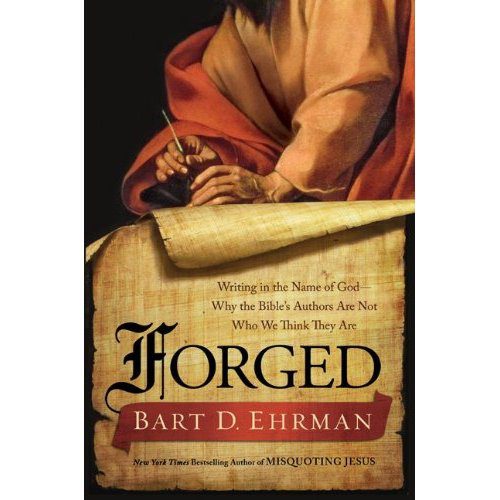
Ehrman is always controversial, challenging, and accessible (at least in the books he publishes with HarperOne). Another great Ehrman read from this past year was The Reliability of the New Testament: Bart Ehrman and Daniel Wallace in Dialogue. This book is also accessible because it is the transcript of a live interaction in front of an audience.
- Richard Elliott Friedman, Who Wrote the Bible?
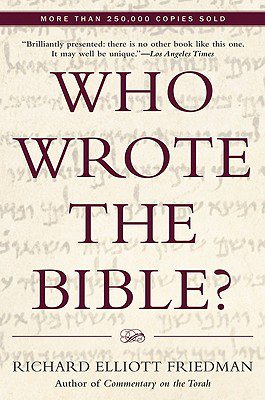 A riveting tour through the history of the writing, editing, and compilation of that anthology of ancient texts we call the Bible. It’s been described as “an investigation and analysis that reads as compellingly as a good detective story.” I have spent much more time familiarizing myself with historical Jesus scholarship, the Q Gospel, and the history of the New Testament. So, Friedman’s book was a helpful refresher course on the documentary hypothesis regarding the Hebrew Bible. As a supplement, see his color-coded The Bible with Sources Revealed.
- John Taylor Gatto, Weapons of Mass Instruction: A Schoolteacher’s Journey Through the Dark World of Compulsory Schooling:
Gotto’s book focuses on the mechanisms of traditional education that cripple imagination, discourage critical
thinking, and create a false view of learning as a byproduct of rote-memorization drills. Gatto’s earlier book, Dumbing Us Down: The Hidden Curriculum of Compulsory Schooling, introduced the now-famous expression of the title into the common vernacular. The real function of pedagogy, he argues, is to render the common population manageable. To that end, young people must be conditioned to rely upon experts, to remain divided from natural alliances, and to accept disconnections from their own lived experiences. They must at all costs be discouraged from developing self-reliance and independence. He taught for thirty years in public schools before resigning on the op-ed pages of The Wall Street Journal during the year he was named New York’s official “Teacher of the Year.”
I am a strong advocate for a robust public school education that is universally available to all members of our society, and I am deeply grateful to the many amazing teachers I have had over the years. But Gatto’s book reminded me also of the incredible amount of wasted time I experienced in various classrooms. If my wife and I choose to have children, his book is yet another factor that prompts me to consider homeschooling (which is increasingly viable in our Internet Age), perhaps using the Great Books curriculum. But if we actually have kids I may change my mind. Only time will tell.
Commands to kill, to commit ethnic cleansing, to institutionalize segregation, to hate and fear other races and religions — all are in the Bible, and all occur with a far greater frequency than in the Qur’an. But fanaticism is no more hard-wired in Christianity than it is in Islam.
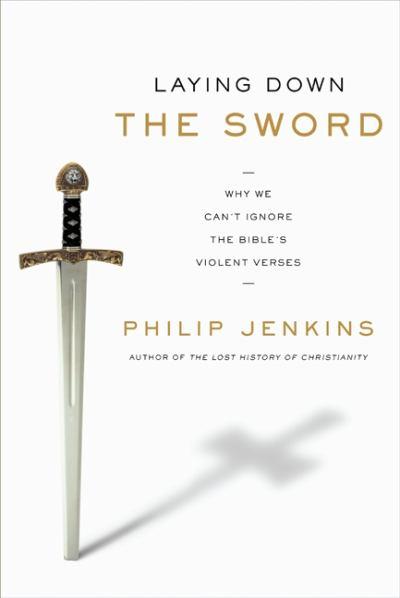
Although I have appreciate Jenkins’ books for many year, his latest is both better and more important that I expected from the title alone. The devil is in the details, and he has amassed a stunning number of examples of how the Bible has been misused throughout history to horrifying results. His point: the problem isn’t the text itself of any sacred scripture; it’s how we learn and choose to read these texts that makes all the difference. It’s a crucial read for anyone who is quick to highlight the problematic passages in the Qur’an, while being simultaneously blind to the larger number of problematic passages in the Bible. Jenkins’ work helps further support my earlier post on “Why Not Choose Love? Picking and Choosing Scripture as a Twenty-first Century Christian.”

Rohr is one of our greatest living wisdom teachers and elders. Everything he has written is worth reading, and I highly recommend (even in a world of over-flowing inboxes) his free daily e-mail meditations. I usually read two of his meditations each morning, and I may start over from the beginning next year. It is that good.
- Peter Rollins, Insurrection: To Believe is Human, To Doubt is Divine:
In this incendiary new work, the controversial author and speaker Peter Rollins proclaims that the Christian faith is not primarily concerned with questions regarding life after death but with the possibility of life before death.In order to unearth this truth, Rollins prescribes a radical and wholesale critique of contemporary Christianity that he calls pyro-theology. It is only as we submit our spiritual practices, religious rituals, and dogmatic affirmations to the flames of fearless interrogation that we come into contact with the reality that Christianity is in the business of transforming our world rather than offering a way of interpreting or escaping it. Belief in the Resurrection means but one thing: Participation in an Insurrection.
Rollins is another of those authors, like many on this list, whose books I pre-order without question because everything they publish tends to be provocative, original, and worth reading.
Lately the American Left has withdrawn into the ivied halls of academe to rue the nation’s shameful past and
present. In this set of lectures, one of America’s foremost philosophers challenges this lost generation of the Left to understand the role it might play in the great tradition of democratic intellectual labor that started with writers like Walt Whitman and John Dewey. In the turn to theory, Rorty sees a retreat from the secularism and pragmatism championed by Dewey and Whitman, and he decries the tendency of the heirs of the New Left to theorize about the United States from a distance instead of participating in the civic work of shaping our national future.
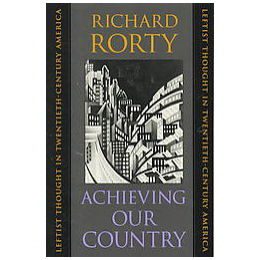
I was assigned a lot of writings by the late Richard Rorty as an undergraduate philosophy major. If I could go back, perhaps I would preferred to have been assigned more Caputo. However, I have deeply benefited from Rorty’s emphasis on the theme of pragmatism in the American philosophical tradition. He is a fascinating interpreter of other philosophers, and perhaps, bar none, the writer of the most lucid and literary philosophical prose I have ever encountered. In a field bedeviled by dense jargon, Rorty is a welcome change. Fascinatingly, his maternal grandfather was Walter Rauschenbusch, a central figure in the Social Gospel movement of the early twentieth century.
- Irving Sandler, Abstract Expressionism and the American Experience: A Reevaluation:
When Irving Sandler published The Triumph of American Painting in 1970, this groundbreaking study quickly became the canonical account of Abstract Expressionism. Now, nearly 40 years later, Sandler, the preeminent chronicler of postwar American art, returns to the subject with this new study. Sandler focuses on two new aims: first, to present the fresh conclusions about Abstract Expressionism that he has arrived at since 1970, and, second, to counter what he sees at the distorted interpretations of the movement offered by some younger art historians. This new study focuses on the decade (1942-1952) when the Abstract Expressionists matured as artists and created their most important works, and also identifies the distinctly American character of Abstract Expressionism, in particular the painters Sandler sees as the movement’s most important figures: Jackson Pollock and Clyfford Still.
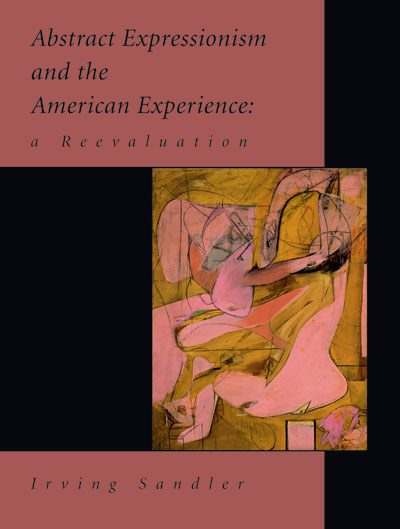
I have a longtime obsession with the Abstract Expressionist movement, and Sandler’s book was my companion on a bustrip earlier this year to the Museum of Modern Art’s recent retrospective. It was worth the trip because so much of this art is on such a large scale that a its aesthetic power cannot be fully captured in a book-sized representation.
- Merold Westphal, Suspicion and Faith: The Religious Uses of Modern Atheism:
Westphal brilliantly shows how much Christians can learn from atheists such as Feuerbach, Marx, Nietzsche, and Freud. Our greatest critics can sometimes be our greatest teachers because they baldly point out the weaknesses that our friends are unable or unwilling to speak aloud. Peter Rollins rightly suggests that Christians should study books such as this one during the Lenten season. He calls his bold proposal, “Atheism for Lent.”
Bonus: Most Anticipated Books that Will Be Published in 2012:
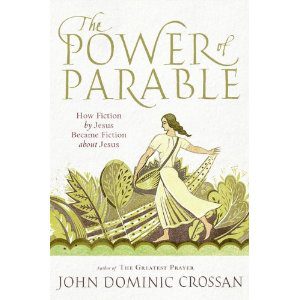
 John Dominic Crossan, The Power of Parable: How Fiction by Jesus Became Fiction about Jesus.
- Matthew Bowman, The Mormon People: The Making of an American Faith:
An eminent
scholar of American evangelicalism explores the history and reflects on the future of this native-born American faith and its connection to the life of the nation.” I am grateful to my friend Darren for pointing me toward what looks to be an important book for intelligently framing the conversation around Mormonism and the 2012 election.
Fiction: Although I clearly spend most of my available reading time on religion and philosophy, I do usually make some space to read fiction over the holidays. During Thanksgiving, I really enjoyed Jeffery Eugenides’ novel The Marriage Plot, which has some great religious motifs. Between Christmas and New Year’s, I’m looking forward to reading Stephen King’s well-reviewed 11/22/63, Tom Perrotta’s The Leftovers (an anti-Left Behind novel set post-Rapture), Best American Short Stories 2011, and The Best Spiritual Writing 2012.
Previous Lists
What have I left out? What are your favorite books from this past year?
The Rev. Carl Gregg is a trained spiritual director, a D.Min. candidate at San Francisco Theological Seminary, and the pastor of Broadview Church in Chesapeake Beach, Maryland. Follow him on Facebook (facebook.com/carlgregg) and Twitter (@carlgregg).
Previous Post

December 6, 2011
How is God coming into the world this Advent? A Theoblogger Challenge
Next Post
December 7, 2011 Best Response to, "I think I don't believe in Santa anymore."
Browse Our Archives
Select a Category Advent Anti-Racism Archaeology Atheism Baptism Best of the Year List Book Reviews Buddhism Catholicism Christian Education Church and State Church Planting Climate Change Conscientious Objection to War Creation Spirituality Death Penalty Didache Disability Rights Discernment Easter Ecology Emergent Church Movement Empire-Critical Ethics Evolution Feminist Theology Film Reviews Gandhi Gospel of Mark Gun Control Hinduism Immigration Reform Interfaith Islam JFK Judaism Jungian Spirituality Lectionary Commentary Lent Letters to the Editor LGBT Marriage MLK Multiculturalism Mysticism Nonviolent Activism Occupy Paganism (Earth-centered Religions) Parables Paul Pluralism Politics Process Theology Quantum Physics Requiescat In Pace Seminary and Divinity School Sermon Series Retrospective Sermons Spiritual Direction Spiritual Practices Stewardship (Fundraising) The Book of J The Wheel of the Year (Paganism) Theoblogger Challenge Triathlon Uncategorized Unitarian Universalism Worship Resources Youth Ministry
Select a Month July 2026 May 2026 March 2026 November 2025 October 2025 August 2025 February 2025 December 2024 October 2024 March 2024 January 2024 December 2023 November 2023 March 2023 February 2023 January 2023 December 2022 November 2022 August 2022 March 2022 February 2022 January 2022 December 2021 September 2021 August 2021 July 2021 June 2021 May 2021 February 2021 January 2021 December 2020 August 2020 June 2020 May 2020 April 2020 March 2020 February 2020 January 2020 December 2019 November 2019 October 2019 September 2019 July 2019 June 2019 March 2019 February 2019 January 2019 December 2018 November 2018 October 2018 September 2018 June 2018 May 2018 April 2018 March 2018 February 2018 January 2018 December 2017 November 2017 October 2017 September 2017 August 2017 July 2017 June 2017 May 2017 April 2017 March 2017 February 2017 January 2017 December 2016 November 2016 October 2016 September 2016 August 2016 June 2016 May 2016 April 2016 March 2016 February 2016 January 2016 December 2015 November 2015 October 2015 September 2015 August 2015 July 2015 June 2015 May 2015 April 2015 March 2015 February 2015 January 2015 December 2014 November 2014 October 2014 August 2014 July 2014 June 2014 May 2014 April 2014 March 2014 February 2014 January 2014 December 2013 November 2013 October 2013 September 2013 August 2013 July 2013 June 2013 May 2013 April 2013 March 2013 February 2013 January 2013 December 2012 November 2012 October 2012 September 2012 August 2012 July 2012 June 2012 May 2012 April 2012 March 2012 February 2012 January 2012 December 2011 November 2011 October 2011 September 2011 August 2011 July 2011 June 2011 May 2011 April 2011 March 2011 February 2011 January 2011 December 2010 November 2010 October 2010 August 2009 July 2009 May 2009
Follow Us!
TAKE THE
Religious Wisdom Quiz
Who was the mother of Jesus?
Select your answer to see how you score.
Ruth Mary Elizabeth Sarah
Related posts from Carl Gregg

Best of 2015: Books, Music, TV, & Podcasts

Top 10 Best Albums Listened to in 2015
Top 10 Best Books Read in 2015
TRENDING AT PATHEOS More Voices

Reading America at 250: A Nation Wrestles With...
As part of my own reflection on the 250th anniversary of the...

Whenever I am reading a book or listening to an argument, I...

President Trump Ban Animal Torture Videos on Facebook
Call for Stricter Regulations of Animal Abuse Content on Facebook Although President...

Draft Amendments to Address Ritual Abuse in New...
The proposed changes would make it illegal for individuals in domestic partnerships...

How Bans on LGBTQ+ Student Clubs Threaten Religious...
On June 20, 2025, the State of Texas passed Senate Bill 12....

The Truth About the Gen Z Revival
This past year, there has been a lot of media buzz surrounding...
view all More Voices blogs
Ad-Free & Subscriber Log-In Subscription Support
- About Us
- 2026 Calendar
- Videos
- Podcasts
- Library of World Religions
- Faith In Media Tracker
- Advertise With Us
- Write for Us
- Privacy Policy
- Terms of Service
- Do Not Sell My Data
- Contact Us
- Radiant Digital
- Manage Newsletter Subscriptions
- Unsubscribe From Notifications
- Sitemap
Copyright 2008-2026, Patheos. All rights reserved.
Subscription Support Ad-Free & Subscriber Log-In
Follow Patheos