
BuddhistCatholicContemplativeEvangelicalGeneral ChristianHinduJewishLatter-day SaintMuslimNew VisionsProgressive Christian
Beliefs
- Buddhist
- Catholic
- Contemplative
- Evangelical
- General Christian
- Hindu
- Jewish
- Latter-day Saint
- More Voices
- Muslim
- New Visions
- Pagan
- Progressive Christian
Topics
- Religion News
- Food and Religion
- Sports and Religion
- Religious Art
- Religious Music and Entertainment
- Religious Events
- History and Religion
- Style and Religion
- Politics and Religion
- Women in Religion
- Recreation Outdoors and Religion
- Business Finance and Religion
- Careers Workplace and Religion
- Education and Religion
- Family Parenting and Religion
- Health Fitness and Religion
- Home and Religion
- Relationships and Religion
- Technology and Religion
- Travel and Religion
Columnists
- Buddhist Columnists
- Business Finance and Religion Columnists
- Careers Workplace and Religion Columnists
- Catholic Columnists
- Contemplative Columnists
- Education and Religion Columnists
- Evangelists Columnists
- Family Parenting and Religion Columnists
- General Christian Columnists
- Health Fitness and Religion Columnists
- Hindu Columnists
- History and Religion Columnists
- Home and Religion Columnists
- Jewish Columnists
- More Voices Columnists
- Latter Day Columnists
- Muslim Columnists
- New Visions Columnists
- Nonreligious Columnists
- Pagan Columnists
- Politics and Religion Columnists
- Progressive Columnists
- Recreation Outdoors and Religion Columnists
- Relationships and Religion Columnists
- Religion News Columnists
- Religious Art Columnists
- Religious Events Columnists
- Religious Music and Entertainment Columnists
- Sports and Religion Columnists
- Style and Religion Columnists
- Technology and Religion Columnists
- Travel and Religion Columnists
- Women in Religion Columnists
Resource Library
- 2026 Calendar
- Library of World Religions
- The 100 Most Holy Places on Earth
- Patheos Answers
- Podcasts
- Videos
- Faith Leaders Database
- Anglican Episcopalian
- Bahai
- Baptist
- Buddhism
- Christianity
- Confucianism
- Eastern Orthodoxy
- Hinduism
- Holiness and Pentecostal
- ISKCON
- Islam
- Judaism
- Lutheran
- Methodist
- The Church of Jesus Christ of Latter-day Saints
- New Age
- Paganism
- Presbytarian and Reformed
- Protestantism
- Religion Behind the Scenes
- Roman Catholic
- Scientology
- Shia Islam
- Sikhism
- Sufism
- Sunni Islam
- Taoism
- Zen
- See all religions
Research Tools
 Ad-Free & Subscriber Log-In Subscription Support
Ad-Free & Subscriber Log-In Subscription Support
Follow Patheos 

- Trending:
- Forgiveness
- |
- Marriage
- |
- Consciousness
- |
- Death Penalty
- |
- Election
- |
- Halloween

- Home
- More Voices
- “Out Beyond Ideas” for Advent: Original Blessing, Creation Spirituality, and Social Justice
“Out Beyond Ideas” for Advent: Original Blessing, Creation Spirituality, and Social Justice
Last updated on: December 29, 2014 at 9:46 pm by Carl Gregg
“Out Beyond Ideas” for Advent: Original Blessing, Creation Spirituality, and Social Justice 2014-12-29T21:46:01-05:00 Carl Gregg
Patheos Explore the world's faith through different perspectives on religion and spirituality! Patheos has the views of the prevalent religions and spiritualities of the world.
Jesus clearly says the kingdom of heaven is among us (Luke 17:21) or “at hand” (Matthew 3:2, 4:17). One wonders why we made it into a reward system for later, or as Brian McLaren calls it, “an evacuation plan for the next world.” Maybe it was easier to obey laws and practice rituals for later than to actually be transformed now.
The price for real transformation is high. It means that we have to change our loyalties from power, success, money, and control (read: “our kingdoms”) to the Lordship of Jesus and the kingdom of God. Henceforth, there is only one thing that is Absolute and in relationship to that, everything else is relative — everything — even the church, even our nation, even national security, even our wealth and our possessions, even our identity and our reputation.
This sermon is the final signpost of our Advent pilgrimage toward Christmas. Throughout this liturgical 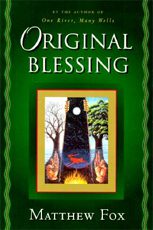 season, we have been walking the four paths of Matthew Fox’s book Original Blessing: A Primer in Creation Spirituality as a way of exploring what Christianity would look like if the focus was Original Blessing, not Original Sin; Creation Spirituality, not the Fall/Redemption story; and social justice, not individual perfectionism. As we have considered, in turn, the four paths of Fox’s theological vision, one question that has continually been set before us is, “Which of these four paths am I on in this season of my life?” Is God calling you at this time more toward the Via Positiva of befriending Creation and spending time in Nature or the Via Negativa of letting go and saying “No”? Is God calling you toward last week’s focus of getting in touch with your creativity or more toward this week’s focus on the Via Transformativa: the “Transformative Way’”of Befriending New Creation, Compassion, Celebration, and Justice?
Fox writes that, “We have seen how the spiritual journey of the Via Positiva and Via Negativa, when entered into fully, culminates in the Via Creativa. But we are also aware that not all creativity is for the beautiful. Creativity itself needs criticism and direction” (247). The starkest example I can think of is the atomic bomb. From one angle, the harnessing of atomic energy — the power of the atom! — is a stunning leap of human ingenuity. From another angle, immense death and destruction has been wrought from this discovery, and a nuclear fallout could still transform our advanced civilization into an apocalyptic dystopia.
My use of the word “transform” in that last sentence was intentional: “a nuclear fallout could still transform our advanced civilization into an apocalyptic dystopia.” Such a heinous transformation moves in the opposite direction of where Fox is inviting us to travel when we walk the Via Transformativa. Many of you will recall the line we considered last week from the musical Rent that, “The opposite of war isn’t peace, it’s creation.”
The claim that, “The opposite of war is creation” is about not only the Via Creativa’s artistic “creativity,” but also the Via Transformativa’s “New Creation.” Thus, the atomic bomb is a product of creativity, but not New Creation. The atomic bomb is a product that emerges more out of Original Sin than Original Blessing, more out of the dualist Fall/Redemption story than Creation Spirituality, and more from the quixotic quest of individual perfectionism than the solidarity of social justice.
Regarding the possibility of “New Creation,” the apostle Paul writes, “From now on, therefore, we regard no one from a human point of view; even though we once knew Christ from a human point of view, we know him no longer in that way. So if anyone is in Christ, there is a new creation: everything old has passed away; see, everything has become new!” (2 Corinthians 5:17-17). Paul elsewhere speaks of Christians having “the mind of Christ.” (1 Corinthians 2:16). And I invite all of us to consider, as people of faith who find ourselves living at the beginning of Christianity’s third millennium, that when we seek to understand “New Creation” and the “mind of Christ,” we must account for the 13.7 billion year old Universe Story and our planet’s place as an almost infinitesimal part of a Universe that includes more than 100 billion galaxies.
Accordingly I invite you to consider that one important way of understanding’s Paul’s vision of “New Creation” and putting on the “mind of Christ” is reflected in that shift in consciousness that we explored on the first Sunday of Advent, which was triggered for many people in imagines such as “Earthrise” (the first picture ever seen of Earth as a whole planet) and The Hubble Ultra-Deep Field pictures (which, through the workings of the speed of light, allow us to look back in time toward the origins of our universe). This movement, then, toward “New Creation” and putting on the “mind of Christ” perhaps looks something like that four-part shift from egocentrism (in which we selfishly only care about our needs) to ethnocentrism (or tribalism, in which we only care about the needs of those similar to ourselves), to globo-centrism (in which we embrace both the common humanity of all humans and the place of humanity as merely one among many important parts of Planet Earth), and finally to cosmo-centrism (in which we truly begin to embrace an integrated perspective that takes into account our place as an interdependent part in the ongoing 13.7 billion year old — and counting! — unfolding of Creation that is the Universe Story). A shorthand description of this process is the move from “me” to “we,” to “all of us,” to “ALL.”
As twenty-first century Christians we are invited to see Paul’s call for us to put on the “mind of Christ” as about learning to view life from a cosmo-centric perspective. And “New Creation” is about that transformed way of being human that comes from experiencing the world from the perspective of Original Blessing, Creation Spirituality, and social justice. Consider again Paul’s words: “From now on, therefore, we regard no one from a human point of view [that is, merely from an egocentric or tribalistic perspective]; even though we once knew Christ from a human point of view, we know him no longer in that way [instead we seek to understand what it could mean to speak of a “Cosmic Christ.”] So if anyone is in Christ, there is a new creation: everything old has passed away; see, everything has become new!”
Along these lines, we saw a particularly important example of the Via Transformativa in last year’s Advent series on the Annunciation when Mary, upon learning that she was pregnant with Jesus, spoke boldly of the vision God had given her of the New Creation that is possible for those who would choose to follow the way Jesus would show them was possible. We now know Mary’s vision of New Creation as the Magnificat. As an unmarried, pregnant teenager in a backwater village occupied by a hostile Roman Empire, Mary was bold to sing with confidence to God:
You have shown strength with your arm;
You have scattered the proud in the thoughts of their hearts.
You have brought down the powerful from their thrones, and lifted up the lowly;
You have filled the hungry with good things, and sent the rich away empty.
The lyrics of Mary’s song would readily lend themselves as appropriate for the Occupy Wall Street protests. But the cosmo-centric perspective of the “mind of Christ” reminds us that the pleading of the 99% is only the penultimate rallying cry of “New Creation.” In the final sense, God is for the 100%, for everyone, for a revitalized sense of the commonweal, and for a recommitment to the common good. There is indeed much in the Bible, such as the lyrics of the Magnificat, that supports the 99%’s prophetic call to “let justice roll down like water, like an ever-flowing stream” (Amos 5:24). But Jesus’ parables also remind us that God will not rest until the 100% are part of the kingdom of God, the Beloved Community:
“Which one of you, having a hundred sheep and losing one of them, does not leave the ninety-nine in the wilderness and go after the one that is lost until he finds it? When he has found it, he lays it on his shoulders and rejoices. And when he comes home, he calls together his friends and neighbors, saying to them, “Rejoice with me, for I have found my sheep that was lost.’ Just so, I tell you, there will be more joy in heaven over one sinner who repents than over ninety-nine righteous persons who need no repentance. (Luke 15).
Similarly, in recent memory, one of the most powerful expositors of the Via Transformativa — the “Transformative Way” of Befriending New Creation, Compassion, Celebration, and Justice — is the Rev. Dr. Martin Luther King, Jr., whose words could profitably be read at the beginning of any Occupy protest:
I’ve seen too much hate to want to hate, myself, and every time I see it, I say to myself, hate is too great a burden to bear. Somehow we must be able to stand up against our most bitter opponents and say: “We shall match your capacity to inflict suffering by our capacity to endure suffering. We will meet your physical force with soul force. Do to us what you will and we will still love you. We cannot in all good conscience obey your unjust laws and abide by the unjust system, because non-cooperation with evil is as much a moral obligation as is cooperation with good, so throw us in jail and we will still love you. Bomb our homes and threaten our children, and, as difficult as it is, we will still love you. Send your hooded perpetrators of violence into our communities at the midnight hour and drag us out on some wayside road and leave us half-dead as you beat us, and we will still love you. Send your propaganda agents around the country and make it appear that we are not fit, culturally and otherwise, for integration, but we’ll still love you. But be assured that we’ll wear you down by our capacity to suffer, and one day we will win our freedom. We will not only win freedom for ourselves; we will appeal to your heart and conscience that we will win you in the process, and our victory will be a double victory.
King’s “soul force” is “New Creation.” His desire to win a “double victory” for himself and his enemies derives from having put on the globo-centric and cosmo-centric “mind of Christ” that calls us to expand our sense our solidarity beyond merely ourselves and those most like us.
But such courageous words and acts are easier said than done, although people such as Gandhi, Martin Luther King, Jr., Dorothy Day and others show us that this transformative way of being in the world is possible. But Advent, in the end, is more about waiting than acting, more about contemplation than action. To be sure, the action will come. But for now, in this season of pregnant hope, we remain in waiting room, anticipating the birth that is to come. The challenge of Advent is learning to wait with patient hope that we might discern how we are being called in the new year to partner with what God is already in the process of birthing in the world.
As we learn to wait and as we learn to put on the cosmo-centric mind of Christ, I invite you to listen to a poem from Rumi that speaks about that place we must allow ourselves to go to if we seek to have eyes to see, ears to hear, and legs to walk the transformative way of the New Creation promised at Christmas:
Out beyond ideas
of wrongdoing and rightdoing
there is a field. I’ll meet you there.
When the soul lies down in that grass,
The world is too full to talk about.
Ideas, language, even the phrase
each other, doesn’t make any sense.
For Further Study
- Matthew Fox, “A Courageous Spirituality”: In this free Insights at the Edge podcast, interviewer Tami Simon speaks with Matthew about how we can apply the four spiritual paths in every part of life, the value of grief rituals, the reinvention of Christianity, and what spirituality might look like in the future (60 minutes). Available at http://www.soundstrue.com/podcast/matthew-fox-a-courageous-spirituality/. This audio is an opportunity to hear Fox speak about the themes we have been studying almost thirty years after the initial publication of our focal text Original Blessing.
- There’s an Advent sermon just waiting to be preached on ‘slowing down’ and ‘waiting’ in this 2007 Washington Post article: “Pearls Before Breakfast: Can one of the nation’s great musicians cut through the fog of a D.C. rush hour? Let’s find out.” Available at http://www.washingtonpost.com/wp-dyn/content/article/2007/04/04/AR2007040401721.html.
- Susan Brooks Thistlethwaite, “Peace on Earth? The End of the Iraq War.” The Washington Post. Available at http://www.washingtonpost.com/blogs/guest-voices/post/peace-on-earth-the-end-of-the-iraq-war/2011/12/15/gIQA1jE3vO_blog.html. An excerpt:
“Peace on earth!” (Luke 2:14) heralded the angels, announcing the birth of Jesus. Scripture reminds us that war itself is the real “War on Christmas.” I am glad to see the returning troops. But we are far from peace on earth in this Christmas season. We are still at war in Afghanistan, and those who are tempted by the spectacle of war are again saber rattling to bomb Iran and start another war. In this Christmas season we are still far, much too far, from peace on earth. But in ending the Iraq war, we may have taken a step away from endless war. And God willing, let us repudiate the idea of ‘preemptive’ war. Dona nobis pacem. Give us peace.
- Jon Kabat-Zinn’s audio book Mindfulness for Beginners. If you prefer to read instead of listen, this same text is being released in written form as Mindfulness for Beginners: Reclaiming the Present Moment–and Your Life.
- Ian Ayres and Aaron Edlin, “Don’t Tax the Rich. Tax Inequality Itself.” Available at http://www.nytimes.com/2011/12/19/opinion/dont-tax-the-rich-tax-inequality-itself.html. An excerpt:
Louis Brandeis once said, “We may have democracy, or we may have wealth concentrated in the hands of a few, but we cannot have both.” We propose an automatic extra tax on the income of the top 1% of earners to limit the after-tax incomes of this club to 36 times the median household income. Billionaires could double their current income without the tax kicking in, as long as the median income also doubles. The sky is the limit for the rich as long as the “rising tide lifts all boats.” Indeed, the tax gives job creators an extra reason to make sure that corporate wealth does in fact trickle down.”
Previous Sermons in this Advent Series
- Via Positiva: “Theology in a 13.7 Billion-Year-Old Universe: Matthew Fox, Original Blessing, and Creation Spirituality” (Advent 1). Available at http://www.patheos.com/blogs/carlgregg/2011/11/embracing-christianity-and-evolution-matthew-fox-original-blessing-and-creation-spirituality/.
- Via Negativa: “#OccupyAdvent: Befriending Darkness, Letting Go, and Letting Be” (Advent 2). Available at http://www.patheos.com/blogs/carlgregg/2011/12/occupyadvent-befriending-darkness-letting-go-and-letting-be/.
- Via Creativa: “The Artist’s Way for Advent: Befriending Creativity and Befriending our Divinity” (Advent 3). Available at http://www.patheos.com/blogs/carlgregg/2011/12/the-artist%E2%80%99s-way-for-advent-matthew-fox%E2%80%99s-via-creativa/.
Notes
1 Fox’s four paths parallel the Christological typology of Incarnation (Via Positiva), Crucifixion (Via Negativa), Resurrection (Via Creativa), and Pentecost (Via Transformativa) (249).
2 To hear the edgy clip of the song “La Vie Boheme” from which the Rent quote is taken, see http://www.youtube.com/watch?v=czJHTEeEJmU. The musical is available as a feature film and Original Broadway Cast Recording.
3 On the stages of human development, including globo-centrism and cosmo-centrism, see Ken Wilber, Integral Spirituality: A Startling New Role for Religion in the Modern and Postmodern World. On the real hope of a shift from “me” to “we” to “ALL” on a generational scale, see the video “Generation WE: The Movement Begins” at http://vimeo.com/2032854. An excerpt: “Millennials are the largest generation in American history. Born between 1978 and 2000, WE are 95 million strong, compared to the 78 million Baby Boomers. WE are politically, socially, and philosophically independent, and are spearheading a period of sweeping change in America and around the world. The new book, Generation We, explains the emerging power of our Millennial Generation, and shows how WE (and older people who think the way WE do) are poised to change our nation and our world for the better.”
4 For more on the “Cosmic Christ,” see Fox’s subsequent book The Coming of the Cosmic Christ.
5 For more on Mary’s song, see my post on “Magnificat! Learning to Sing Mary’s Song (A Progressive Christian Lectionary Commentary on Luke 1:46-55).” Available at http://www.patheos.com/blogs/carlgregg/2011/12/magnificat-learning-to-sing-mary%E2%80%99s-song-a-progressive-christian-lectionary-commentary-on-luke-146-55/.
6 More similar poetry from Rumi and others can be found in Daniel Ladinsky’s excellent and luminous book Love Poems from God: Twelve Sacred Voices from the East and West. The singer-songwriter David Wilcox has set a number of these poems to some extraordinary music, including “Out Beyond Idea” on his album Out Beyond Ideas.
The Rev. Carl Gregg is a trained spiritual director, a D.Min. candidate at San Francisco Theological Seminary, and the pastor of Broadview Church in Chesapeake Beach, Maryland. Follow him on Facebook (facebook.com/carlgregg) and Twitter (@carlgregg).
Next Post

December 20, 2011 Top 10 Best Podcasts of 2011
Browse Our Archives
Select a Category Advent Anti-Racism Archaeology Atheism Baptism Best of the Year List Book Reviews Buddhism Catholicism Christian Education Church and State Church Planting Climate Change Conscientious Objection to War Creation Spirituality Death Penalty Didache Disability Rights Discernment Easter Ecology Emergent Church Movement Empire-Critical Ethics Evolution Feminist Theology Film Reviews Gandhi Gospel of Mark Gun Control Hinduism Immigration Reform Interfaith Islam JFK Judaism Jungian Spirituality Lectionary Commentary Lent Letters to the Editor LGBT Marriage MLK Multiculturalism Mysticism Nonviolent Activism Occupy Paganism (Earth-centered Religions) Parables Paul Pluralism Politics Process Theology Quantum Physics Requiescat In Pace Seminary and Divinity School Sermon Series Retrospective Sermons Spiritual Direction Spiritual Practices Stewardship (Fundraising) The Book of J The Wheel of the Year (Paganism) Theoblogger Challenge Triathlon Uncategorized Unitarian Universalism Worship Resources Youth Ministry
Select a Month July 2026 May 2026 March 2026 November 2025 October 2025 August 2025 February 2025 December 2024 October 2024 March 2024 January 2024 December 2023 November 2023 March 2023 February 2023 January 2023 December 2022 November 2022 August 2022 March 2022 February 2022 January 2022 December 2021 September 2021 August 2021 July 2021 June 2021 May 2021 February 2021 January 2021 December 2020 August 2020 June 2020 May 2020 April 2020 March 2020 February 2020 January 2020 December 2019 November 2019 October 2019 September 2019 July 2019 June 2019 March 2019 February 2019 January 2019 December 2018 November 2018 October 2018 September 2018 June 2018 May 2018 April 2018 March 2018 February 2018 January 2018 December 2017 November 2017 October 2017 September 2017 August 2017 July 2017 June 2017 May 2017 April 2017 March 2017 February 2017 January 2017 December 2016 November 2016 October 2016 September 2016 August 2016 June 2016 May 2016 April 2016 March 2016 February 2016 January 2016 December 2015 November 2015 October 2015 September 2015 August 2015 July 2015 June 2015 May 2015 April 2015 March 2015 February 2015 January 2015 December 2014 November 2014 October 2014 August 2014 July 2014 June 2014 May 2014 April 2014 March 2014 February 2014 January 2014 December 2013 November 2013 October 2013 September 2013 August 2013 July 2013 June 2013 May 2013 April 2013 March 2013 February 2013 January 2013 December 2012 November 2012 October 2012 September 2012 August 2012 July 2012 June 2012 May 2012 April 2012 March 2012 February 2012 January 2012 December 2011 November 2011 October 2011 September 2011 August 2011 July 2011 June 2011 May 2011 April 2011 March 2011 February 2011 January 2011 December 2010 November 2010 October 2010 August 2009 July 2009 May 2009
Follow Us!
TAKE THE
Religious Wisdom Quiz
What tax collector wrote a Gospel and was called by Jesus?
Select your answer to see how you score.
Matthew Luke Mark Barnabas
Related posts from Carl Gregg
”Did God Have a Wife?”: Asherah, Heavenly Mother,...

What Do We Mean We When Say, “Building...

Winter Solstice Spirituality: “Learning to Walk in the...
TRENDING AT PATHEOS More Voices

Reading America at 250: A Nation Wrestles With...
As part of my own reflection on the 250th anniversary of the...

Whenever I am reading a book or listening to an argument, I...

President Trump Ban Animal Torture Videos on Facebook
Call for Stricter Regulations of Animal Abuse Content on Facebook Although President...

Draft Amendments to Address Ritual Abuse in New...
The proposed changes would make it illegal for individuals in domestic partnerships...

How Bans on LGBTQ+ Student Clubs Threaten Religious...
On June 20, 2025, the State of Texas passed Senate Bill 12....

The Truth About the Gen Z Revival
This past year, there has been a lot of media buzz surrounding...
view all More Voices blogs
Ad-Free & Subscriber Log-In Subscription Support
- About Us
- 2026 Calendar
- Videos
- Podcasts
- Library of World Religions
- Faith In Media Tracker
- Advertise With Us
- Write for Us
- Privacy Policy
- Terms of Service
- Do Not Sell My Data
- Contact Us
- Radiant Digital
- Manage Newsletter Subscriptions
- Unsubscribe From Notifications
- Sitemap
Copyright 2008-2026, Patheos. All rights reserved.
Subscription Support Ad-Free & Subscriber Log-In
Follow Patheos