
BuddhistCatholicContemplativeEvangelicalGeneral ChristianHinduJewishLatter-day SaintMuslimNew VisionsProgressive Christian
Beliefs
- Buddhist
- Catholic
- Contemplative
- Evangelical
- General Christian
- Hindu
- Jewish
- Latter-day Saint
- More Voices
- Muslim
- New Visions
- Pagan
- Progressive Christian
Topics
- Religion News
- Food and Religion
- Sports and Religion
- Religious Art
- Religious Music and Entertainment
- Religious Events
- History and Religion
- Style and Religion
- Politics and Religion
- Women in Religion
- Recreation Outdoors and Religion
- Business Finance and Religion
- Careers Workplace and Religion
- Education and Religion
- Family Parenting and Religion
- Health Fitness and Religion
- Home and Religion
- Relationships and Religion
- Technology and Religion
- Travel and Religion
Columnists
- Buddhist Columnists
- Business Finance and Religion Columnists
- Careers Workplace and Religion Columnists
- Catholic Columnists
- Contemplative Columnists
- Education and Religion Columnists
- Evangelists Columnists
- Family Parenting and Religion Columnists
- General Christian Columnists
- Health Fitness and Religion Columnists
- Hindu Columnists
- History and Religion Columnists
- Home and Religion Columnists
- Jewish Columnists
- More Voices Columnists
- Latter Day Columnists
- Muslim Columnists
- New Visions Columnists
- Nonreligious Columnists
- Pagan Columnists
- Politics and Religion Columnists
- Progressive Columnists
- Recreation Outdoors and Religion Columnists
- Relationships and Religion Columnists
- Religion News Columnists
- Religious Art Columnists
- Religious Events Columnists
- Religious Music and Entertainment Columnists
- Sports and Religion Columnists
- Style and Religion Columnists
- Technology and Religion Columnists
- Travel and Religion Columnists
- Women in Religion Columnists
Resource Library
- 2026 Calendar
- Library of World Religions
- The 100 Most Holy Places on Earth
- Patheos Answers
- Podcasts
- Videos
- Faith Leaders Database
- Anglican Episcopalian
- Bahai
- Baptist
- Buddhism
- Christianity
- Confucianism
- Eastern Orthodoxy
- Hinduism
- Holiness and Pentecostal
- ISKCON
- Islam
- Judaism
- Lutheran
- Methodist
- The Church of Jesus Christ of Latter-day Saints
- New Age
- Paganism
- Presbytarian and Reformed
- Protestantism
- Religion Behind the Scenes
- Roman Catholic
- Scientology
- Shia Islam
- Sikhism
- Sufism
- Sunni Islam
- Taoism
- Zen
- See all religions
Research Tools
 Ad-Free & Subscriber Log-In Subscription Support
Ad-Free & Subscriber Log-In Subscription Support
Follow Patheos 

- Trending:
- Forgiveness
- |
- Marriage
- |
- Consciousness
- |
- Death Penalty
- |
- Election
- |
- Halloween

- Home
- More Voices
- Highlights from Marcus Borg and Diana Butler Bass Lectures (Part 3 of 7)
Highlights from Marcus Borg and Diana Butler Bass Lectures (Part 3 of 7)
Last updated on: December 29, 2014 at 10:09 pm by Carl Gregg
Highlights from Marcus Borg and Diana Butler Bass Lectures (Part 3 of 7) 2014-12-29T22:09:02-05:00 Carl Gregg
Patheos Explore the world's faith through different perspectives on religion and spirituality! Patheos has the views of the prevalent religions and spiritualities of the world.
The introductory post to this blog series is available here.
The highlights from Diana Butler Bass’ first lecture are available here.
My musings on the lectures are in brackets.
Marcus Borg’s first lecture (of three total lectures) was on “Reclaiming Christian Language.” He began by reminding us that his work is done in the hope of inspiring “adult theological re-education.”
- The American Lutheran theologian George Lindbeck (1923-) wrote a landmark book in 1984 on The Nature of Doctrine: Religion and Theology in a Postliberal Age. Therein, he spoke of religions as “cultural-linguistic traditions.” More simply, we can say that the word Christian is shorthand for “speaking Christian” (hence the title of Borg’s latest book). Religions are like languages.
- Anyone born in 1964 or later grew up in a time when “church” was no longer the dominant norm. U.S. citizens have been increasingly unchurched in recent decades, especially in the Pacific Northwest, where Borg taught as a religion professor for many years. The unchurched have little familiarity with Christian language.
- For example, Borg used to give the following assignment on first day of class: “Free associate on the topic of ‘Me and Christianity.’ What do you think of first?” He would often get responses such as, “I think there’s a story in there about a guy and a fish,” presumably an allusion to Jonah being swallowed by a whale or “big fish.” Or a student once said, “Christians are really against trespassing,” perhaps either a reference to the Lord’s Prayer or, perhaps even more likely, to all the church properties with “No Tresspassing” signs. [So much for the Christian practices of hospitality or welcoming the stranger!]
- The upshot of this trend toward the unchurched is that Christian language is becoming a foreign language and misunderstood language. For example, two-thirds of Christians don’t know the Beatitudes are only in the Gospel of Matthew. Many people mistakenly think that the line, “God helps those who help themselves” is in the Bible.
- There has also been a problematic Literalization of Christian Language. This perspective assumes that, “everything the Bible says is the literal, factual, and absolute revelation of God. If the Bible says something happened, then it happened. If the Bible says something is wrong, then it’s wrong.” Doctrines of innerancy and infallibility are linked to this view. Example: Genesis creation account vs. evolution
- However, both biblical inerrancy and literalism are modern views; they are neither ancient, nor traditional. But if your provinciality has never been challenged, you mistakenly think you “know” a lot of stuff — again, the need for adult theological re-education. [James Kugel makes this point extremely well in his book How to Read the Bible: A Guide to Scripture, Then and Now.]
(Perhaps this photo is unfair, but there was a clear liberal bent in the lectures and crowd.)
- Toward an Understanding of Christianity’s Core Message. A memory exercise: At the end of childhood (approximately age 12), imagine you had been asked to state the heart of the Christian message (“the Gospel,” the “Good News”) in a sentence. [Something Tweetable.] Why does Christianity matter? What should you or anybody be a Christian? Take 3-4 minutes of silence to imagine yourself at this age, then journal your response.
- Borg’s one-sentence, childhood answer: Jesus died for our sins so that we could be forgiven and go to heaven if we believe in him. (Emphasis: afterlife, our sinfulness, Jesus’ death, believing. This view is “Heaven and Hell Christianity” or “Belief-centered Christiainity.” [Remember Bass’ point from her first lecture that, “There was a ‘divorce’ (so to speak) in first half of twentieth century in U.S. Christianity. In the divorce settlement (as it were), fundamentalists took experience and liberals took intellectualism. In this religious split-up, liberals got custody of the head, whereas evangelicals and pentecostals got custody of the heart. The problem is that all Christians need BOTH.”]
- Words usually do not have precise meaning in isolation. They derive their meanings within contexts, within frameworks. For example, the word “elephant” means something different in the context of a zoo, a poem, and a political cartoon respectively.
- Within the framework of Heaven-and-Hell Christianity the following underlined words have the noted connotations. BUT the full biblical account of these words is often different:
- Salvation = “eternal life”
- Saved implies “from our sins.” BUT in the Bible these words seldom have those meanings. Rather, salvation is about deliverance and transformation.
- Sacrifice = Jesus’ death on the cross as payment for our sins. BUT in the bible, sacrifice is never about substitutionary payment for sins.
[Although I strongly support a move away from substitutionary atonement theology such as in Rebecca Ann Parker and Rita Nakashima Brock’s important books, I’m dubious about Borg’s “never” in that statement. See, for example, The Death and Resurrection of the Beloved Son: The Transformation of Child Sacrifice in Judaism and Christianity by Jon Douglas Levenson. I would say, instead, that we should acknowledge (and disavow) all the problematic passages in the Bible such as Philip Jenkins describes in his important recent book Laying Down the Sword: Why We Can’t Ignore the Bible’s Violent Verses. I do, however, appreciate and support, as far as I can, Borg’s work to highlight the many exemplary passages in scripture as well as to brilliantly reinterpret many of the problematic passages.
- When I asked Borg to clarify his claim that “sacrifice is never about substitutionary payment for sins,” he addressed three examples:
- Regarding the ‘scapegoat’ passages, such as in Leviticus 16, it would have been sacrilege to offer a sin-laden sacrifice to God. [Borg makes a good point here, but I would still argue that the goat is being ‘sacrificed’ for sin, even if not directly sacrificed to God. Casting out a domesticated goat into the wilderness was almost certainly a death sentence. The goat would in all likelihood have been eaten quickly by predators.]
- On Mark 10:45, which says, “The Son of Man came not to be served but to serve, and to give his life a ransom for many,” Borg offered the empire-critical reading that the ‘ransom’ in question was the ‘price to be paid to free from slavery’ — that is, to expose the corruption of the Roman Empire’s unjust killing of Jesus. [Again, I’m impressed, but not fully convinced of this interpretation.]
- The book of Hebrews, as a whole, is ultimately about subverting the sacrificial system (saying, “You don’t need that anymore.) It is not about how sacrifice is required, but about a paradigm shift. [I again understand what Borg is trying to do, although I’m not ultimately convinced if he actually redeems Hebrews for me. But moves such as this one need to be taken trepidatiously because they can unintentionally be heard as anti-Jewish and supercessionist. I trust that Borg did not intended to be anti-Jewish, but Borg’s collaborator John Dominic Crossan is clearer on this point: Jesus was “not against the Temple as such, and not against the high priesthood as such. It was a protest from the legal and prophetic heart of Judaism against Jewish religious cooperation with Roman imperial control.” In these days of Occupy Wall Street protests, it is significant that Crossan continues to say that Jesus’ way is “against any capital city’s collusion between…religion and imperial violence at any time and in any place” (God and Empire: Jesus Against Rome, Then and Now, 132). Serendipitously, on the same evening as Borg’s lecture, I saw a tweet of a related quote from Crossan speaking across the country at the annual American Academy of Religion / Society of Biblical Literature conference: “unity of x-n Bible needs to be rethought. What theology holds it together? #sblaar.” Borg is right on need for adult (progressive) theological re-education, but on this particular evening he was playing a bit too fast and loose with “What Bible ‘Really’ Says” from my perspective.]
- Redeem/redeemer/redemption = Jesus redeems us from our sins. BUT the Bible, refers to liberation from slavery/bondage.
- Repentance = contrition about sins BUT in the Bible is return/re-connection and going beyond the mind that you have.
- Reighteousness and righteousness = rigorous individual moral vitue. BUT in the bible, “just and justice” are central to God’s character and dream for the world.
- Peace = individual and internal. BUT the Bible speaks of peace as the end of war.
- Faith, believing = all literally true. BUT the Bible should be taken seriously, but not literally.
The upshot is that we need to redeem and reclaim Christian language in order to learn to “speak Christian” again.
[Overall, Borg seemed to be, at least in this lecture (as well as in the Question and Response section in which myself and at least one other person asked for clarity on this issue), setting up too firm a binary between the mistaken “Hell-and-Hell Christianity” definition and “What the Bible Really Says,” risking, in my opinion an unnecessary biblical foundationalism. My understanding is that the reality is messier and more complex. I would be more willing to say that the Bible is a sprawling anthology which is simply wrong in some places. On this point, I’m a huge fan of Pedagogy of the Bible: An Analysis and Proposal by Dale B. Martin. Again, I appreciate Borg’s attempts to reinterpret scripture in positive directions. And obviously he is well-published, erudite scholar. But he seemed insistent on playing fast-and-loose with some of the negative parts of scripture in this particular lecture. However, given the tendency of many liberal Christians to abandon the Bible (“throwing the baby out with the proverbial bathwater”), perhaps Borg’s hardline is understandable for the pedagogical purposes of reclaiming scripture for progressive Christianity.]
For more details about each of these bullet-points (and to judge for yourself in regard to these arguments), see Borg’s latest book Why Christian Words Have Lost their Meaning and Power and How They Can Be Restored (2011):
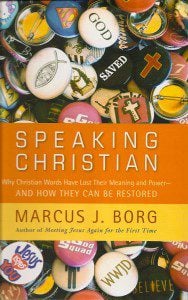
Stay tuned for the next installment on the highlights of Bass’ second lecture in the series.
The Rev. Carl Gregg is a trained spiritual director, a D.Min. candidate, and the pastor of Broadview Church in Chesapeake Beach, Maryland. Follow him on Facebook (facebook.com/carlgregg) and Twitter (@carlgregg).
Previous Post

November 22, 2011
Progressive Christian Reflections on Advent
Next Post
November 26, 2011 Highlights from Marcus Borg and Diana Butler Bass Lectures (Part 4 of 7)
Browse Our Archives
Select a Category Advent Anti-Racism Archaeology Atheism Baptism Best of the Year List Book Reviews Buddhism Catholicism Christian Education Church and State Church Planting Climate Change Conscientious Objection to War Creation Spirituality Death Penalty Didache Disability Rights Discernment Easter Ecology Emergent Church Movement Empire-Critical Ethics Evolution Feminist Theology Film Reviews Gandhi Gospel of Mark Gun Control Hinduism Immigration Reform Interfaith Islam JFK Judaism Jungian Spirituality Lectionary Commentary Lent Letters to the Editor LGBT Marriage MLK Multiculturalism Mysticism Nonviolent Activism Occupy Paganism (Earth-centered Religions) Parables Paul Pluralism Politics Process Theology Quantum Physics Requiescat In Pace Seminary and Divinity School Sermon Series Retrospective Sermons Spiritual Direction Spiritual Practices Stewardship (Fundraising) The Book of J The Wheel of the Year (Paganism) Theoblogger Challenge Triathlon Uncategorized Unitarian Universalism Worship Resources Youth Ministry
Select a Month July 2026 May 2026 March 2026 November 2025 October 2025 August 2025 February 2025 December 2024 October 2024 March 2024 January 2024 December 2023 November 2023 March 2023 February 2023 January 2023 December 2022 November 2022 August 2022 March 2022 February 2022 January 2022 December 2021 September 2021 August 2021 July 2021 June 2021 May 2021 February 2021 January 2021 December 2020 August 2020 June 2020 May 2020 April 2020 March 2020 February 2020 January 2020 December 2019 November 2019 October 2019 September 2019 July 2019 June 2019 March 2019 February 2019 January 2019 December 2018 November 2018 October 2018 September 2018 June 2018 May 2018 April 2018 March 2018 February 2018 January 2018 December 2017 November 2017 October 2017 September 2017 August 2017 July 2017 June 2017 May 2017 April 2017 March 2017 February 2017 January 2017 December 2016 November 2016 October 2016 September 2016 August 2016 June 2016 May 2016 April 2016 March 2016 February 2016 January 2016 December 2015 November 2015 October 2015 September 2015 August 2015 July 2015 June 2015 May 2015 April 2015 March 2015 February 2015 January 2015 December 2014 November 2014 October 2014 August 2014 July 2014 June 2014 May 2014 April 2014 March 2014 February 2014 January 2014 December 2013 November 2013 October 2013 September 2013 August 2013 July 2013 June 2013 May 2013 April 2013 March 2013 February 2013 January 2013 December 2012 November 2012 October 2012 September 2012 August 2012 July 2012 June 2012 May 2012 April 2012 March 2012 February 2012 January 2012 December 2011 November 2011 October 2011 September 2011 August 2011 July 2011 June 2011 May 2011 April 2011 March 2011 February 2011 January 2011 December 2010 November 2010 October 2010 August 2009 July 2009 May 2009
Follow Us!
TAKE THE
Religious Wisdom Quiz
Who is the apostle to deny Jesus?
Select your answer to see how you score.
Phillip Judas Peter Andrew
Related posts from Carl Gregg

Highlights from "Children, Youth & a New Kind...
A Guide to Firsthand Experience with God

Sermon Series Retrospective: Matthew Fox's "Original Blessing: A...
Preaching the Didache (50-70 C.E.): A Sermon Series...
TRENDING AT PATHEOS More Voices

Reading America at 250: A Nation Wrestles With...
As part of my own reflection on the 250th anniversary of the...

Whenever I am reading a book or listening to an argument, I...

President Trump Ban Animal Torture Videos on Facebook
Call for Stricter Regulations of Animal Abuse Content on Facebook Although President...

Draft Amendments to Address Ritual Abuse in New...
The proposed changes would make it illegal for individuals in domestic partnerships...

How Bans on LGBTQ+ Student Clubs Threaten Religious...
On June 20, 2025, the State of Texas passed Senate Bill 12....

The Truth About the Gen Z Revival
This past year, there has been a lot of media buzz surrounding...
view all More Voices blogs
Ad-Free & Subscriber Log-In Subscription Support
- About Us
- 2026 Calendar
- Videos
- Podcasts
- Library of World Religions
- Faith In Media Tracker
- Advertise With Us
- Write for Us
- Privacy Policy
- Terms of Service
- Do Not Sell My Data
- Contact Us
- Radiant Digital
- Manage Newsletter Subscriptions
- Unsubscribe From Notifications
- Sitemap
Copyright 2008-2026, Patheos. All rights reserved.
Subscription Support Ad-Free & Subscriber Log-In
Follow Patheos