
BuddhistCatholicContemplativeEvangelicalGeneral ChristianHinduJewishLatter-day SaintMuslimNew VisionsProgressive Christian
Beliefs
- Buddhist
- Catholic
- Contemplative
- Evangelical
- General Christian
- Hindu
- Jewish
- Latter-day Saint
- More Voices
- Muslim
- New Visions
- Pagan
- Progressive Christian
Topics
- Religion News
- Food and Religion
- Sports and Religion
- Religious Art
- Religious Music and Entertainment
- Religious Events
- History and Religion
- Style and Religion
- Politics and Religion
- Women in Religion
- Recreation Outdoors and Religion
- Business Finance and Religion
- Careers Workplace and Religion
- Education and Religion
- Family Parenting and Religion
- Health Fitness and Religion
- Home and Religion
- Relationships and Religion
- Technology and Religion
- Travel and Religion
Columnists
- Buddhist Columnists
- Business Finance and Religion Columnists
- Careers Workplace and Religion Columnists
- Catholic Columnists
- Contemplative Columnists
- Education and Religion Columnists
- Evangelists Columnists
- Family Parenting and Religion Columnists
- General Christian Columnists
- Health Fitness and Religion Columnists
- Hindu Columnists
- History and Religion Columnists
- Home and Religion Columnists
- Jewish Columnists
- More Voices Columnists
- Latter Day Columnists
- Muslim Columnists
- New Visions Columnists
- Nonreligious Columnists
- Pagan Columnists
- Politics and Religion Columnists
- Progressive Columnists
- Recreation Outdoors and Religion Columnists
- Relationships and Religion Columnists
- Religion News Columnists
- Religious Art Columnists
- Religious Events Columnists
- Religious Music and Entertainment Columnists
- Sports and Religion Columnists
- Style and Religion Columnists
- Technology and Religion Columnists
- Travel and Religion Columnists
- Women in Religion Columnists
Resource Library
- 2026 Calendar
- Library of World Religions
- The 100 Most Holy Places on Earth
- Patheos Answers
- Podcasts
- Videos
- Faith Leaders Database
- Anglican Episcopalian
- Bahai
- Baptist
- Buddhism
- Christianity
- Confucianism
- Eastern Orthodoxy
- Hinduism
- Holiness and Pentecostal
- ISKCON
- Islam
- Judaism
- Lutheran
- Methodist
- The Church of Jesus Christ of Latter-day Saints
- New Age
- Paganism
- Presbytarian and Reformed
- Protestantism
- Religion Behind the Scenes
- Roman Catholic
- Scientology
- Shia Islam
- Sikhism
- Sufism
- Sunni Islam
- Taoism
- Zen
- See all religions
Research Tools
 Ad-Free & Subscriber Log-In Subscription Support
Ad-Free & Subscriber Log-In Subscription Support
Follow Patheos 

- Trending:
- Forgiveness
- |
- Marriage
- |
- Consciousness
- |
- Death Penalty
- |
- Election
- |
- Halloween

- Home
- More Voices
- 25 Books Every Christian Should Read
25 Books Every Christian Should Read
Last updated on: November 28, 2011 at 9:45 pm by Carl Gregg
25 Books Every Christian Should Read 2011-11-28T21:45:13-05:00 Carl Gregg
Patheos Explore the world's faith through different perspectives on religion and spirituality! Patheos has the views of the prevalent religions and spiritualities of the world.
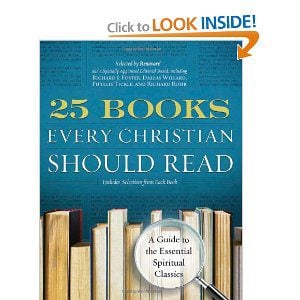
 (Renovaré, 25 Books Every Christian Should Read, 2011, 390 pages.)
Renovaré is from the Latin word for “renew” or “restore.” It is also a non-profit organization focused on spiritual formation. Their latest project is a list of the top 25 books every Christians should read.
On one hand, I have deep respect for many of those who selected this list (Richard Foster, Frederica Mathewes-Green, Richard Rohr, Phyllis Tickle, and Dallas Willard). On the other hand, if I were empowered with the opportunity to assign 25 books that every Christian should read, I would construct a significantly different list.
The book’s editorial board qualifies that,
This book is not the list of the best Christian books ever written or a list of the top twenty-five devotional books; it isn’t even the list of the top twenty-five classics, although we believe all of the books on the list are or will be considered classics of their respective genres. The books we have chosen to include are, instead, the books that the board judges served as the best guides for living life with God. Cumulatively, these books embody a rich treasure of wisdom and counsel for how to live the Christian life. (x)
I would recommend this book as valuable because, for each of their selections, the editors have included a historical context, summary of why this book is “essential,” recommendations for “how to read” this particular classic, excerpts, and a study guide.
I also understand why the board has “excluded all books from living authors” (xi). However, if I were asked to recommend “25 books every Christian should read,” (at least for our current time and place), I would recommend, for the most part, precisely living authors:
 (Before reading my alternative list below, it may be helpful to read the Renovaré list, which is available here.)
- Choosing Athanasius’ Incarnation (c. 318) — as important as the Incarnation is to Franciscan and Creation Spirituality — is, nevertheless, in many ways, a capitulation to the Constantinian Turn in which the church sold its soul to the Roman Empire. Instead, I would recommend John Dominic Crossan’s book God and Empire: Jesus Against Rome, Then and Now.
- I have given a best-faith effort at engaging Augustine’s Confessions on multiple occasions, but I continue to find it overrated (albeit historically significant) for the twenty-first century. We’re already narcissistic enough; instead, we need to move from ‘me’ (personal confession) to ‘we’ (systemic problems). Accordingly, Sallie McFague has written the immensely important book A New Climate for Theology: God, the World, and Global Warming.
- Without belaboring the sexism and patriarchy of the Renovaré list, there are some easy substitutes that could have been made. In place of the The Desert Fathers, we now have access to The Forgotten Desert Mothers: Sayings, Lives, and Stories of Early Christian Women.
- From the hospitality I have experienced at Benedictine monasteries, I am fully convinced that Benedict of Nursia’s sixth-century Rule is a classic, but more challenging for today is School(s) for Conversion: 12 Marks of a New Monasticism.
- We need less Dante’s fourteenth-century meditation on the afterlife, and more a theology that grapples with twenty-first-century pluralism such as Paul Knitter’s Without Buddha, I Could Not Be a Christian.
- The anonymous author of the fourteenth-century Cloud of Unknowing is undoubtably a spiritual genius, but Cynthia Bourgeault’s Centering Prayer and Inner Awakening does not require the same level of translation and takes the Cloud’s teaching to the next level.
- Surely Dame Julian is presciently and profoundly right that, “All shall be well, and all shall be well, and every manner of thing shall be well.” But Marcella Althaus-Reid charts an even more vital and challenging course for today in her Indecent Theology.
- There is not space in this post to detail the problems with Thomas a Kempis’ unhealthy asceticism. We should much more readily look to Shane Claiborne’s The Irresistible Revolution: Living as an Ordinary Radical.
- The Philokalia (literally, “love of the beautiful”) is one of three places in which I find myself in direct agreement with the Renovaré editors. However, for those not already immersed in Eastern Orthodox theology, I would recommend beginning with the Skylight Illuminations edition.
- Long before I would point a student toward Calvin’s Institutes, I would recommend Rita Nakashima Brock’s and Rebecca Parker’s book Proverbs of Ashes: Violence, Redemptive Suffering, and the Search for What Saves Us (2002), or (if you’re up for it!) the more recent, more historical, and much longer Saving Paradise: How Christianity Traded Love of This World for Crucifixion and Empire.
- Teresa of Avila’s sixteenth-century Interior Castle is an important guide for the interior journey, but Ken Wilber’s Integral Spirituality has the benefit of more than four centuries of insight to which Teresa did not have access. However, because I am reticent to substitute a male for a female in a list that is so heavily weighted against female authors, Caroline Myss has written the important updating of Teresa’s classic titled, Entering the Castle: Finding the Inner Path to God and Your Soul’s Purpose.
- Gerald May has similarly updated St. John of the Cross in his The Dark Night of the Soul: A Psychiatrist Explores the Connection Between Darkness and Spiritual Growth.
- Pascal’s Pensees is also a classic, but as a guide to our contemporary situation, I look first to Marcus Borg’s The Heart of Christianity: Rediscovering a Life of Faith.
- Similarly, long before Pilgrim’s Progress, twenty-first-century Christians could benefit from Brian McLaren’s A New Kind of Christianity: Ten Questions That Are Transforming the Faith.
- The Practice of Presence of God is the second of the three books in which I wholeheartedly agree with the Renovaré editors.
- Law’s Serious Call is important, but the work of Eugene Peterson, such as Working the Angles: The Shape of Pastoral Integrity, is much more comprehensible today.
- The Way of a Pilgrim is the third and final of the three books in which I find myself in complete agreement with the Renovaré editors.
- I wrote my undergraduate thesis on Dostoevsky’s Brother’s Karamazov, but instead of this classic fictional take on the “problem of evil,” Christians today could benefit much more from wrestling with Philip Jenikins’ Laying Down the Sword: Why We Can’t Ignore the Bible’s Violent Verses.
- Apologetics such as Chesterton’s Orthodoxy are not what Christians need to be reading. We could find ourselves more appropriately chastened from Bart Ehrman’s Lost Christianities: The Battles for Scripture and the Faiths We Never Knew.
- I will confess that I am a fan of Gerald Manley Hopkins’ poetry, but in a list in which less than ten percent of the writers are female, Mary Oliver’s poems would be more appropriate.
- Dietrich Bonhoffer’s Discipleship (also known as “Cost of Discipleship”) was pivotal in my own rejection of “cheap grace,” but for forming disciples in the United States in the twenty-first century, I look first to A Testament of Hope: The Essential Writings and Speeches of Martin Luther King, Jr..
- Thomas Kelly’s A Testament of Devotion remains immensely moving, but I look first to perhaps Western Christianity’s greatest living wisdom teacher Richard Rohr’s Everything Belongs: The Gift of Contemplative Prayer, or, more recently, The Naked Now: Learning to See as the Mystics See.
- I have benefited immensely from Thomas Merton’s writings, but instead of Seven Storey Mountain, see one of the primary texts of the East-West dialogue toward which Merton was moving at the end of his tragically short life: Tao de Ching.
- C.S. Lewis is perhaps the most out of place author included on the Renovaré list. Lewis’ Mere Christianity is overrated much more than Augustine’s Confessions. If I were an evangelical, I would look much more readily to John Stott’s Basic Christianity. However, given the state of the religion-science debate at the beginning of the third millenium, I would recommend, instead, John Haught’s Making Sense of Evolution: Darwin, God, and the Drama of Life.
- Finally, although everything Henri Nouwen wrote is worth reading, in my top 25 list, I would consider first dreamwork, one of the major modalities (along with paying attention to synchronicities), that Jungians focus on for an adult spirituality: Jeremy Taylor, The Wisdom of Your Dreams: Using Dreams to Tap into Your Unconscious and Transform Your Life.
Christians should, by all means, read the classics, but I recommend starting with the best of what is available right now.
Bonus: Top Five Books Most Essential to My Spiritual Formation
1. Tony Campolo, 20 Hot Potatoes Christians Are Afraid To Touch (1993). The summer before my senior year in high school, Campolo’s book gave me permission to ask some hard questions about the Southern Baptist Christianity of my childhood. Chapter titles include, “Can a Christian Own a BMW?” and “Can Christians Kill?”
2. John Shelby Spong, Why Christianity Must Change or Die (1998). As a sophomore religion major, I stumbled across Spong’s latest release on the bestseller rack of a large bookstore. I felt liberated to find an Episcopal bishop exploring many of the same questions I was asking.
3. William James, The Varieties of Religious Experience (1902). This classic book helped me notice the difference between first-hand religious experience (“truth I had experienced directly for myself”) and second-hand religious experience (“what others claimed was true about religion, God, or reality”).
4. Richard Rorty, Contingency, Irony, and Solidarity (1989). I also majored in philosophy as an undergraduate, and Rorty’s postmodern perspective shook the foundations of my religious assumptions more than any other philosopher. However, if I could go back, I would read less Rorty and more Caputo.
5. Wendell Berry, What Are People For? (1990). Berry’s essays, poems, and novels invited me to see that neither “progress” nor “technology” are unalloyed goods; further, he refocused my attention on the importance of living simply, locally, and sustainably. More recent collections of his essays are Citizenship Papers (2003) and The Way of Ignorance (2006). I also cannot recommend highly enough his poem “Manifesto: The Mad Farmer Liberation Front.” Consider reading this poem through the lens of the Occupy protests.
This book review is a part of the Roundtable at the Patheos Book Club.
Visit the Book Club for more free resources related to this book.
The Rev. Carl Gregg is a trained spiritual director, a D.Min. candidate, and the pastor of Broadview Church in Chesapeake Beach, Maryland. Follow him on Facebook (facebook.com/carlgregg) and Twitter (@carlgregg).
Previous Post

November 16, 2011
Mutants and Mystics
Next Post
November 18, 2011 #WhyPray?
Browse Our Archives
Select a Category Advent Anti-Racism Archaeology Atheism Baptism Best of the Year List Book Reviews Buddhism Catholicism Christian Education Church and State Church Planting Climate Change Conscientious Objection to War Creation Spirituality Death Penalty Didache Disability Rights Discernment Easter Ecology Emergent Church Movement Empire-Critical Ethics Evolution Feminist Theology Film Reviews Gandhi Gospel of Mark Gun Control Hinduism Immigration Reform Interfaith Islam JFK Judaism Jungian Spirituality Lectionary Commentary Lent Letters to the Editor LGBT Marriage MLK Multiculturalism Mysticism Nonviolent Activism Occupy Paganism (Earth-centered Religions) Parables Paul Pluralism Politics Process Theology Quantum Physics Requiescat In Pace Seminary and Divinity School Sermon Series Retrospective Sermons Spiritual Direction Spiritual Practices Stewardship (Fundraising) The Book of J The Wheel of the Year (Paganism) Theoblogger Challenge Triathlon Uncategorized Unitarian Universalism Worship Resources Youth Ministry
Select a Month July 2026 May 2026 March 2026 November 2025 October 2025 August 2025 February 2025 December 2024 October 2024 March 2024 January 2024 December 2023 November 2023 March 2023 February 2023 January 2023 December 2022 November 2022 August 2022 March 2022 February 2022 January 2022 December 2021 September 2021 August 2021 July 2021 June 2021 May 2021 February 2021 January 2021 December 2020 August 2020 June 2020 May 2020 April 2020 March 2020 February 2020 January 2020 December 2019 November 2019 October 2019 September 2019 July 2019 June 2019 March 2019 February 2019 January 2019 December 2018 November 2018 October 2018 September 2018 June 2018 May 2018 April 2018 March 2018 February 2018 January 2018 December 2017 November 2017 October 2017 September 2017 August 2017 July 2017 June 2017 May 2017 April 2017 March 2017 February 2017 January 2017 December 2016 November 2016 October 2016 September 2016 August 2016 June 2016 May 2016 April 2016 March 2016 February 2016 January 2016 December 2015 November 2015 October 2015 September 2015 August 2015 July 2015 June 2015 May 2015 April 2015 March 2015 February 2015 January 2015 December 2014 November 2014 October 2014 August 2014 July 2014 June 2014 May 2014 April 2014 March 2014 February 2014 January 2014 December 2013 November 2013 October 2013 September 2013 August 2013 July 2013 June 2013 May 2013 April 2013 March 2013 February 2013 January 2013 December 2012 November 2012 October 2012 September 2012 August 2012 July 2012 June 2012 May 2012 April 2012 March 2012 February 2012 January 2012 December 2011 November 2011 October 2011 September 2011 August 2011 July 2011 June 2011 May 2011 April 2011 March 2011 February 2011 January 2011 December 2010 November 2010 October 2010 August 2009 July 2009 May 2009
Follow Us!
TAKE THE
Religious Wisdom Quiz
What sea did Moses and the Israelites cross?
Select your answer to see how you score.
Dead Sea Sea of Galilee Red Sea Black Sea
Related posts from Carl Gregg

Top 10 Best Books Read in 2014
"Fast Future: How the Millennial Generation Is Shaping...
TRENDING AT PATHEOS More Voices

Reading America at 250: A Nation Wrestles With...
As part of my own reflection on the 250th anniversary of the...

Whenever I am reading a book or listening to an argument, I...

President Trump Ban Animal Torture Videos on Facebook
Call for Stricter Regulations of Animal Abuse Content on Facebook Although President...

Draft Amendments to Address Ritual Abuse in New...
The proposed changes would make it illegal for individuals in domestic partnerships...

How Bans on LGBTQ+ Student Clubs Threaten Religious...
On June 20, 2025, the State of Texas passed Senate Bill 12....

The Truth About the Gen Z Revival
This past year, there has been a lot of media buzz surrounding...
view all More Voices blogs
Ad-Free & Subscriber Log-In Subscription Support
- About Us
- 2026 Calendar
- Videos
- Podcasts
- Library of World Religions
- Faith In Media Tracker
- Advertise With Us
- Write for Us
- Privacy Policy
- Terms of Service
- Do Not Sell My Data
- Contact Us
- Radiant Digital
- Manage Newsletter Subscriptions
- Unsubscribe From Notifications
- Sitemap
Copyright 2008-2026, Patheos. All rights reserved.
Subscription Support Ad-Free & Subscriber Log-In
Follow Patheos