
BuddhistCatholicContemplativeEvangelicalGeneral ChristianHinduJewishLatter-day SaintMuslimNew VisionsProgressive Christian
Beliefs
- Buddhist
- Catholic
- Contemplative
- Evangelical
- General Christian
- Hindu
- Jewish
- Latter-day Saint
- More Voices
- Muslim
- New Visions
- Pagan
- Progressive Christian
Topics
- Religion News
- Food and Religion
- Sports and Religion
- Religious Art
- Religious Music and Entertainment
- Religious Events
- History and Religion
- Style and Religion
- Politics and Religion
- Women in Religion
- Recreation Outdoors and Religion
- Business Finance and Religion
- Careers Workplace and Religion
- Education and Religion
- Family Parenting and Religion
- Health Fitness and Religion
- Home and Religion
- Relationships and Religion
- Technology and Religion
- Travel and Religion
Columnists
- Buddhist Columnists
- Business Finance and Religion Columnists
- Careers Workplace and Religion Columnists
- Catholic Columnists
- Contemplative Columnists
- Education and Religion Columnists
- Evangelists Columnists
- Family Parenting and Religion Columnists
- General Christian Columnists
- Health Fitness and Religion Columnists
- Hindu Columnists
- History and Religion Columnists
- Home and Religion Columnists
- Jewish Columnists
- More Voices Columnists
- Latter Day Columnists
- Muslim Columnists
- New Visions Columnists
- Nonreligious Columnists
- Pagan Columnists
- Politics and Religion Columnists
- Progressive Columnists
- Recreation Outdoors and Religion Columnists
- Relationships and Religion Columnists
- Religion News Columnists
- Religious Art Columnists
- Religious Events Columnists
- Religious Music and Entertainment Columnists
- Sports and Religion Columnists
- Style and Religion Columnists
- Technology and Religion Columnists
- Travel and Religion Columnists
- Women in Religion Columnists
Resource Library
- 2026 Calendar
- Library of World Religions
- The 100 Most Holy Places on Earth
- Patheos Answers
- Podcasts
- Videos
- Faith Leaders Database
- Anglican Episcopalian
- Bahai
- Baptist
- Buddhism
- Christianity
- Confucianism
- Eastern Orthodoxy
- Hinduism
- Holiness and Pentecostal
- ISKCON
- Islam
- Judaism
- Lutheran
- Methodist
- The Church of Jesus Christ of Latter-day Saints
- New Age
- Paganism
- Presbytarian and Reformed
- Protestantism
- Religion Behind the Scenes
- Roman Catholic
- Scientology
- Shia Islam
- Sikhism
- Sufism
- Sunni Islam
- Taoism
- Zen
- See all religions
Research Tools
 Ad-Free & Subscriber Log-In Subscription Support
Ad-Free & Subscriber Log-In Subscription Support
Follow Patheos 

- Trending:
- Forgiveness
- |
- Marriage
- |
- Consciousness
- |
- Death Penalty
- |
- Election
- |
- Halloween

- Home
- More Voices
- Celebrating Evolution Sunday
Celebrating Evolution Sunday
Last updated on: April 12, 2012 at 3:35 pm by Carl Gregg
Celebrating Evolution Sunday 2012-04-12T15:35:00-04:00 Carl Gregg
Patheos Explore the world's faith through different perspectives on religion and spirituality! Patheos has the views of the prevalent religions and spiritualities of the world.
Happy Evolution Sunday! Or “Happy Evolution Weekend,” as the event is coming to be known. For the past five years, an increasing number of individuals, churches, and faith communities have recognized the Sunday closest to Charles Darwin’s birthday (February 12) as an annual opportunity to reflect on what religion has to learn from science, in particular how Christianity can embrace the insights of evolution.
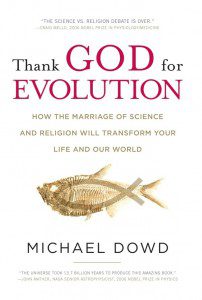
In recent months, perhaps the most exciting dialogue between Christianity and evolution has been a series of free online teleseminars on The Advent of Evolutionary Christianity: Conversations at the Leading Edge of Faith that have featured some of the most well-known luminaries of the religion-science dialogue, ranging from scientists to theologians to pastors. The series was hosted by Michael Dowd, author of the bestselling book Thank God for Evolution.
The need for open-minded conversations at the intersection of faith and science is highlighted regularly in the news, which too often features closed-minded atheists yelling at (or being yelled at by) closed-minded Christians. For the purposes of this blog, I will limit myself only to the two most recent examples that come to mind.
First, comedian Stephen Colbert brilliantly satirized political commentator Bill O’Reilly’s claim that the regularity of the ocean’s tides proves the existence of God. When many listeners pointed out that the moon’s gravity causes tidal ebb and flow, O’Reilly dug himself in deeper by saying, “Okay, how did the moon get there?” Of course, scientists have long been able to explain the existence of the moon without recourse to divine intervention. Accordingly, Colbert likened O’Reilly to St. Thomas Aquinas since “Like St. Thomas Aquinas, Bill O’Reilly’s understanding of the world is also from the 13th century.” As people of faith in the 21st century, we can do better, and Evolution Sunday is an explicit invitation to remind both ourselves and our congregations that we shouldn’t have to check our brain at the door of the church.
As a second example, during an recent appearance on “Real Time with Bill Maher,” Representative Jack Kingston (Republican from Georgia) said, “I believe I came from God, not from a monkey…. I don’t believe that a creature crawled out of the sea and became a human being one day.” That position is the sort of anti-intellectual pandering long-ago ridiculed in films such as Inherit the Wind. We deserve better from our elected representatives, and Evolution Sunday is an annual opportunity to demonstrate that religion and science are not mutually exclusive.
O’Reilly’s worldview is borderline pre-Copernican — that is, refusing to accept that the earth is not the center of the universe. But as Carl Sagan helped make known in his books and in his television series Cosmos, we know today that there are more than 100 billion galaxies in the universe, and each of those 100 billion galaxies is comprised of billions of stars. Earth is only a small planet, orbiting one medium-sized star toward the edge of one spiral galaxy that, again, is only one among more than 100 billion other galaxies in the universe.
Representative Kingston’s worldview similarly fails to come to terms with post-Darwinian science. English naturalist Charles Darwin’s 1859 book On the Origin of the Species by Means of Natural Selection recorded his meticulous observations of the natural world and helped demonstrate that humans beings did not originate from a special, one-time act of divine intervention. Instead, humans evolved through the process of natural selection just like every other species. Darwin’s book was monumental, but the challenge for Christians in the 21st-century is not to be in dialogue with Darwin, but to be open to the insights of what science has learned in the 150 years since Darwin’s landmark work. Evolution Sunday is an opportunity to show how much religion and science have to learn from one another.
Moreover, Christians and other people of faith must come to terms with a post-Einsteinian world and its “theory of relativity” as well as of quantum mechanics as popularized by figures like Brian Greene. We do not do ourselves or our congregations any favors by pretending that God spoke the world into existence in Hebrew only 6,000 years ago. Or as Rabbi Harold Kushner has written, “I don’t take the story of the Garden of Eden as a newspaper report … describing the human race as beginning with two full-grown, Hebrew-speaking adults and a talking snake.” Evolution Sunday is a time to stand in open-mouthed awe and wonder at the 13.7 billion year sweep of creation. Roman Catholic theologian John F. Haught has written compellingly about how we can come to have a greater sense of this “deep time”:
Imagine that you have thirty large volumes on your bookshelf. Each tome is 450 pages long, and every page stands for one million years. Let this set of books represent the scientific story of our 13.7-billion-year-old universe. The narrative begins with the Big Bang on page 1 of volume 1, but the first twenty-one books show no obvious signs of life at all. The earth story begins only in volume 21, 4.5 billion years ago, but life doesn’t appear until volume 22, about 3.8 billion years ago. Even then, living organisms do not become particularly interesting, at least in human terms, until almost the end of volume 29. There the famous Cambrian explosion occurs, and the patterns of life suddenly burst out into an unprecedented array of complexity and diversity. Dinosaurs come in around the middle of volume 30 but are wiped out on page 385. Only during the last sixty-five pages of volume 30 does mammalian life begin to flourish. Our hominid ancestors show up several pages from the end of volume 30, but modern humans do not appear until the bottom of the final page. The entire history of human intelligence, ethics, religious aspiration, and scientific discovery takes up only the last few lines on the last page of the last volume.
On Evolution Sunday, such a breathtaking view can remind us to be less arrogant about what we know about God or the tides or the moon — and, instead, following the words of the prophet Micah learn to “walk humbly with God.”
Link to Further Resources: Evolution Weekend 2011
Previous Post

February 2, 2011
Welcome Imbolc
Next Post
February 14, 2011 REVIEW: Jesus and the Jewish Roots of the Eucharist
Browse Our Archives
Select a Category Advent Anti-Racism Archaeology Atheism Baptism Best of the Year List Book Reviews Buddhism Catholicism Christian Education Church and State Church Planting Climate Change Conscientious Objection to War Creation Spirituality Death Penalty Didache Disability Rights Discernment Easter Ecology Emergent Church Movement Empire-Critical Ethics Evolution Feminist Theology Film Reviews Gandhi Gospel of Mark Gun Control Hinduism Immigration Reform Interfaith Islam JFK Judaism Jungian Spirituality Lectionary Commentary Lent Letters to the Editor LGBT Marriage MLK Multiculturalism Mysticism Nonviolent Activism Occupy Paganism (Earth-centered Religions) Parables Paul Pluralism Politics Process Theology Quantum Physics Requiescat In Pace Seminary and Divinity School Sermon Series Retrospective Sermons Spiritual Direction Spiritual Practices Stewardship (Fundraising) The Book of J The Wheel of the Year (Paganism) Theoblogger Challenge Triathlon Uncategorized Unitarian Universalism Worship Resources Youth Ministry
Select a Month July 2026 May 2026 March 2026 November 2025 October 2025 August 2025 February 2025 December 2024 October 2024 March 2024 January 2024 December 2023 November 2023 March 2023 February 2023 January 2023 December 2022 November 2022 August 2022 March 2022 February 2022 January 2022 December 2021 September 2021 August 2021 July 2021 June 2021 May 2021 February 2021 January 2021 December 2020 August 2020 June 2020 May 2020 April 2020 March 2020 February 2020 January 2020 December 2019 November 2019 October 2019 September 2019 July 2019 June 2019 March 2019 February 2019 January 2019 December 2018 November 2018 October 2018 September 2018 June 2018 May 2018 April 2018 March 2018 February 2018 January 2018 December 2017 November 2017 October 2017 September 2017 August 2017 July 2017 June 2017 May 2017 April 2017 March 2017 February 2017 January 2017 December 2016 November 2016 October 2016 September 2016 August 2016 June 2016 May 2016 April 2016 March 2016 February 2016 January 2016 December 2015 November 2015 October 2015 September 2015 August 2015 July 2015 June 2015 May 2015 April 2015 March 2015 February 2015 January 2015 December 2014 November 2014 October 2014 August 2014 July 2014 June 2014 May 2014 April 2014 March 2014 February 2014 January 2014 December 2013 November 2013 October 2013 September 2013 August 2013 July 2013 June 2013 May 2013 April 2013 March 2013 February 2013 January 2013 December 2012 November 2012 October 2012 September 2012 August 2012 July 2012 June 2012 May 2012 April 2012 March 2012 February 2012 January 2012 December 2011 November 2011 October 2011 September 2011 August 2011 July 2011 June 2011 May 2011 April 2011 March 2011 February 2011 January 2011 December 2010 November 2010 October 2010 August 2009 July 2009 May 2009
Follow Us!
TAKE THE
Religious Wisdom Quiz
What does "Bethany" mean in Hebrew?
Select your answer to see how you score.
House of affliction House of mercy House of bread House of stone
Related posts from Carl Gregg

Why Peter Singer Hates on Guide Dogs &...
Sermon Series Retrospective: Matthew Fox's "Original Blessing: A...

The Gospel According to Process-Relational Theology
TRENDING AT PATHEOS More Voices

Reading America at 250: A Nation Wrestles With...
As part of my own reflection on the 250th anniversary of the...

Whenever I am reading a book or listening to an argument, I...

President Trump Ban Animal Torture Videos on Facebook
Call for Stricter Regulations of Animal Abuse Content on Facebook Although President...

Draft Amendments to Address Ritual Abuse in New...
The proposed changes would make it illegal for individuals in domestic partnerships...

How Bans on LGBTQ+ Student Clubs Threaten Religious...
On June 20, 2025, the State of Texas passed Senate Bill 12....

The Truth About the Gen Z Revival
This past year, there has been a lot of media buzz surrounding...
view all More Voices blogs
Ad-Free & Subscriber Log-In Subscription Support
- About Us
- 2026 Calendar
- Videos
- Podcasts
- Library of World Religions
- Faith In Media Tracker
- Advertise With Us
- Write for Us
- Privacy Policy
- Terms of Service
- Do Not Sell My Data
- Contact Us
- Radiant Digital
- Manage Newsletter Subscriptions
- Unsubscribe From Notifications
- Sitemap
Copyright 2008-2026, Patheos. All rights reserved.
Subscription Support Ad-Free & Subscriber Log-In
Follow Patheos