
BuddhistCatholicContemplativeEvangelicalGeneral ChristianHinduJewishLatter-day SaintMuslimNew VisionsProgressive Christian
Beliefs
- Buddhist
- Catholic
- Contemplative
- Evangelical
- General Christian
- Hindu
- Jewish
- Latter-day Saint
- More Voices
- Muslim
- New Visions
- Pagan
- Progressive Christian
Topics
- Religion News
- Food and Religion
- Sports and Religion
- Religious Art
- Religious Music and Entertainment
- Religious Events
- History and Religion
- Style and Religion
- Politics and Religion
- Women in Religion
- Recreation Outdoors and Religion
- Business Finance and Religion
- Careers Workplace and Religion
- Education and Religion
- Family Parenting and Religion
- Health Fitness and Religion
- Home and Religion
- Relationships and Religion
- Technology and Religion
- Travel and Religion
Columnists
- Buddhist Columnists
- Business Finance and Religion Columnists
- Careers Workplace and Religion Columnists
- Catholic Columnists
- Contemplative Columnists
- Education and Religion Columnists
- Evangelists Columnists
- Family Parenting and Religion Columnists
- General Christian Columnists
- Health Fitness and Religion Columnists
- Hindu Columnists
- History and Religion Columnists
- Home and Religion Columnists
- Jewish Columnists
- More Voices Columnists
- Latter Day Columnists
- Muslim Columnists
- New Visions Columnists
- Nonreligious Columnists
- Pagan Columnists
- Politics and Religion Columnists
- Progressive Columnists
- Recreation Outdoors and Religion Columnists
- Relationships and Religion Columnists
- Religion News Columnists
- Religious Art Columnists
- Religious Events Columnists
- Religious Music and Entertainment Columnists
- Sports and Religion Columnists
- Style and Religion Columnists
- Technology and Religion Columnists
- Travel and Religion Columnists
- Women in Religion Columnists
Resource Library
- 2026 Calendar
- Library of World Religions
- The 100 Most Holy Places on Earth
- Patheos Answers
- Podcasts
- Videos
- Faith Leaders Database
- Anglican Episcopalian
- Bahai
- Baptist
- Buddhism
- Christianity
- Confucianism
- Eastern Orthodoxy
- Hinduism
- Holiness and Pentecostal
- ISKCON
- Islam
- Judaism
- Lutheran
- Methodist
- The Church of Jesus Christ of Latter-day Saints
- New Age
- Paganism
- Presbytarian and Reformed
- Protestantism
- Religion Behind the Scenes
- Roman Catholic
- Scientology
- Shia Islam
- Sikhism
- Sufism
- Sunni Islam
- Taoism
- Zen
- See all religions
Research Tools
 Ad-Free & Subscriber Log-In Subscription Support
Ad-Free & Subscriber Log-In Subscription Support
Follow Patheos 

- Trending:
- Forgiveness
- |
- Marriage
- |
- Consciousness
- |
- Death Penalty
- |
- Election
- |
- Halloween

- Home
- Pagan
- History and Religion
- Traditional Witchcraft and Betrayal…
Traditional Witchcraft and Betrayal…
Last updated on: March 12, 2025 at 2:37 pm by Ian Chambers
Traditional Witchcraft and Betrayal… 2025-03-12T14:37:53+00:00 Ian Chambers
Patheos Explore the world's faith through different perspectives on religion and spirituality! Patheos has the views of the prevalent religions and spiritualities of the world.
Within the milieu of modern occult arts, the folklore and historicity of witchcraft has developed in tandem with the Craft’s popularity in recent decades, presenting an alternative to traditional initiatory Wicca of yesteryear and notions of a surviving Murrayite pagan cult. With a greater number of people growing within the fold of witchery, combined with the availability of information through unprecedented literary output and social media outlets, a more broad perspective has been brought to the subject. Therefore, modern witchcraft adherents are more inclined to discover the historic and folkloric elements for themselves, develop personal relations with spirits and be guided by the numen of the current of witchcraft and sigaldry (ME. sorcery).
Amongst the many strands that constitute a modern idea of witchcraft, Traditional Witchcraft is a label that serves to loosely denote certain streams that have a coherent ethos and recognisable identity and, typically, involve an initiatory aspect — that is, they purport to uphold the values of an apparent tradition or body and require one to be initiated into that stream in order to draw from the wellhead.
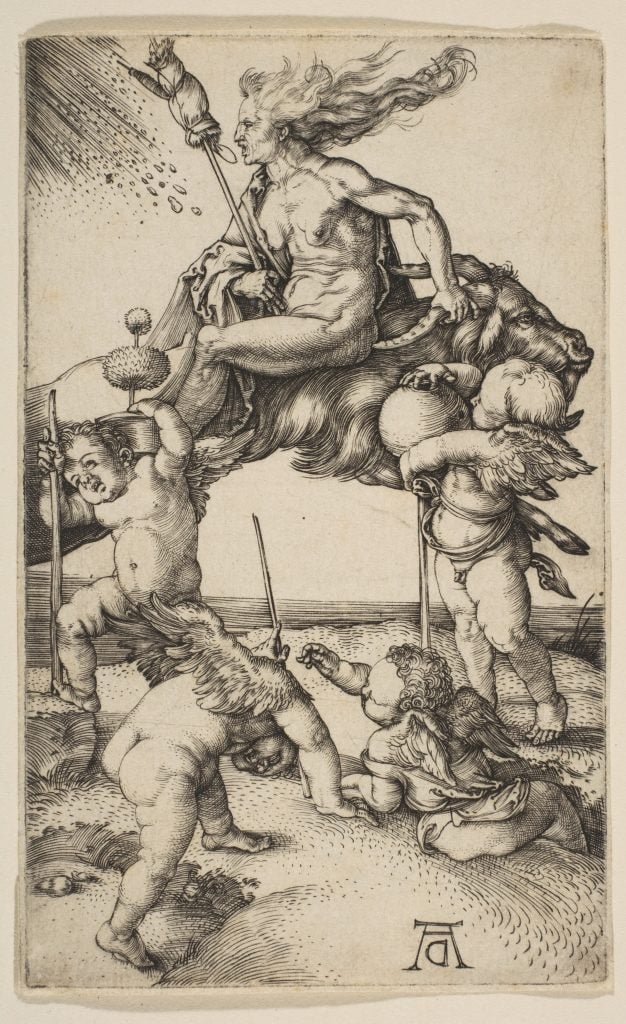
Witch Riding on a Goat, Albrecht Dürer, circa 1500.
Paradoxically, the heritage of witchcraft itself is one that purposefully transgresses what would be deemed ‘tradition’ in the common vernacular, harvesting power precisely from the betrayal of conservative conventions and recognisably ‘traditional’ values in pockets of culture, communal ethical codes and individual moralism. In broader society, this social conditioning has manifest through the stricture and morality of religious inclination that has powerfully informed the cultural body of the so-called civilised world for millennia — and still does to some extent, especially in less secular societies that are not as tolerant of freedom of thought and expression.
This leaves us wondering, then, what it is that Traditional Witchcraft actually signifies and how it perceives itself. Progressively, it would appear in many instances to arise as a self-identity, suggesting a kind of preserving of and adherence to an ethos that propounds certain underlying belief and praxes — a witch is one who does witchcraft; witchcraft is what a witch does. Where this becomes interesting are those areas of witchery that recognise the inherent power and fundamental basis of the cult through opposition — indicated through deliberate perversion, inversion and reversion.
Importantly, witchcraft is not the wanton transgression of tradition and morality for its own sake, although that may yield some potential in moderation. Rather, it is the purposeful recognition of the undulating road that cuts a narrow path between obedience and disobedience, the good and the right, body and soul, life and death. We ever stand upon a knife’s edge, perilously treading a way that can ultimately become our demise. The bond of the immortal soul, tethered to the worldly flesh, is ever pulling against the converse weight of the mortal body. The manifest solidity of the body adheres mankind to the profane world and a collective consciousness ordered through cumulative, often tacit, ethical codes and behaviours — a need and desire to clothe ourselves and hide our nakedness. The frictious antinomy betwixt flesh and soul is resolved in the body of the witch, historically epitomised by the orgiastic and phantasmal Sabbat that is envisaged as simultaneously carnal and spectral — oxymoronically of flesh and mind.
“The duality we try to capture through the concept of ‘soul’ derives from the human capacity to choose between obedience and disobedience. The soul is part of the body — the part that disobeys… the body is the true Establishment, seeking to maintain the status quo. Much to the contrary, the soul is that part of the viscera whose precise purpose is to betray these interests.” (Bonder 2001, 6-7)
Within the flesh, the impulse to copulate and continue suggests the alchemical base metal, representing the sensuous world of unregenerate man that the soul may work into spiritual gold. “The word of sin is Restriction,” saith Brother Crowley (Liber AL vel Legis), revealing the prohibitive bind that traditional mores and convention can fashion about us as chains to constrict Will, preventing the breaking free from missionary stagnation through a dynamic, ecstatic art.
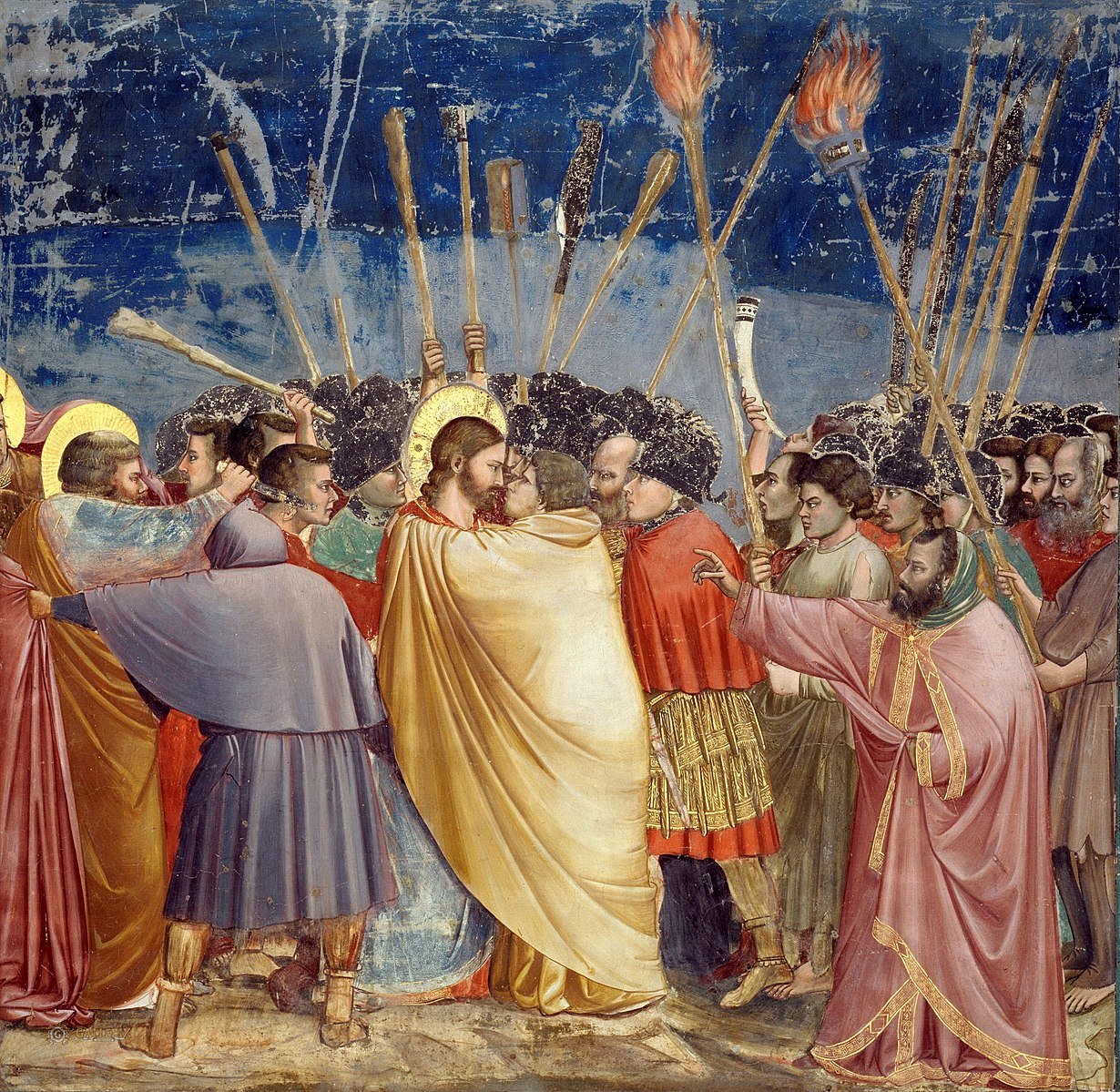
Where Crowley cites Love as the force that unites the divided, the great motivator of mankind is assuredly Death and our innate foreboding sense that all roads lead, ultimately, to the cessation of life. The mortality of the common flesh prompts us to cleave to the mundane world, while mysticism often directs the aspirant toward the Certainty* through teaching one “to die before you die”. Thus saith Jesus to his Betrayer: “you will sacrifice the man that clothes me.” (Gospel of Judas) In this simple statement is the essence of the Betrayal enunciated, and the transgression of the soul against the common flesh revealed in a kiss.
The tradition of witchcraft itself, evinced in the historic and folkloric record, displays an inherently contravening nature. Through the violation of moral and natural law, witches in all cultures and times have demonstrated disobedience as expression of power. Indeed, the turning backward of religious and societal codes contains within it great potency in the act itself, wielding the capacity for inversion and reversion. The tension between tradition and transgression is critical in this instance to realise that potentiality.
“Tradition and treason are two inseparable concepts… Tradition (from the Latin traditio, “handing over”) encompasses the tasks of instinct taken up by human consciousness… the beliefs designed to provide the task of preservation with its theoretical and ideological underpinnings…” (Bonder 2001, 8)
The progress of mankind has been built upon the transgressions of those who would challenge the status quo to advance a new way. Whilst we can depend upon the sanctuary of tradition, it is also the cage that can restrict growth when it grips too tightly. Interestingly, the Latin root word that gives modern English both the words ‘treason’ and ‘tradition’ is tradere, which denotes the essential meaning of “to hand over”.
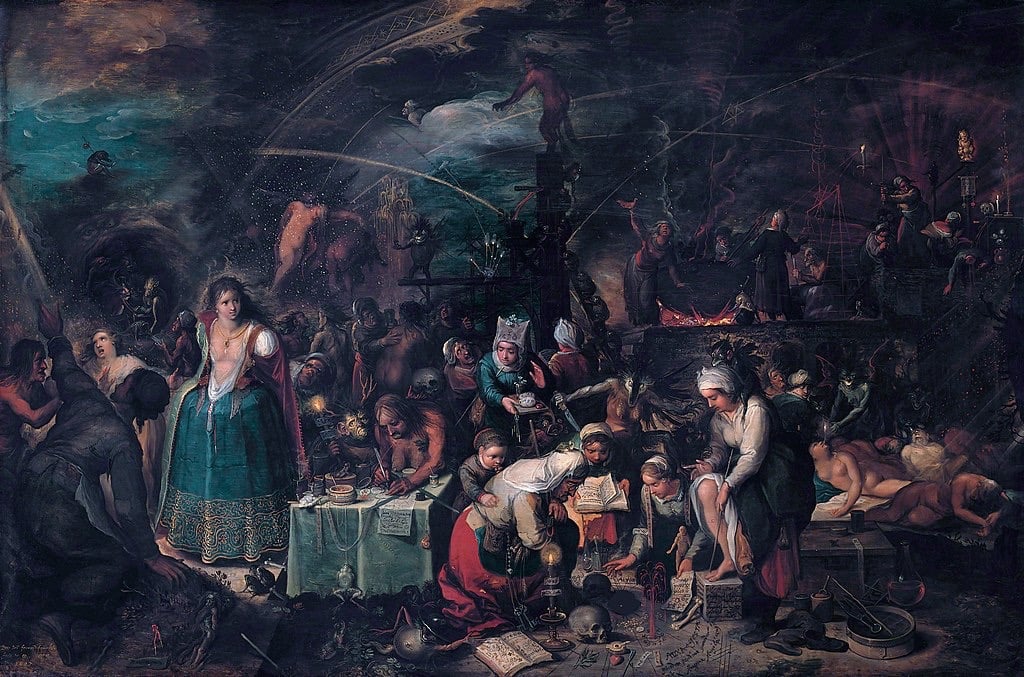
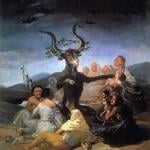
The Witches Sabbath, Frans Francken the Younger, 1607,
“Treason or betrayal, by contrast, involves transcendence… The Bible itself is filled with strange transgressions transpiring in the midst of countless reminders about the law…” (Bonder 2001, 8).
The power of witchcraft’s transgression serves to generate power for the individual, and the wandering coterie that serve the exiled and occulted. It is a lonely and turning road that positions one outside of the accepted and consensus mores. The traditions of witchcraft, then, may not necessarily be the preservation of an aged ideal, a medieval fantasy world of a pagan past preserved in cult form, nor the Victorian cunning man’s rustic charm. Continuation for its own sake neglects the very essence and spirit of the tradition that has been passed on. This is especially relevant when that tradition appears as, for example, Catholic folk charms used by the Pendle Witches and uttered in the garbled Papist tongue of Latin during the rigours of Reformation England. What was once believed in for its magical power, with more than the tinge of danger and risk at copping a snook to the stringent purist temperament, is now potentially used for its simple curiosity devoid, then, of the very potency that gave it transgressive power.
“The traitor is a transgressor who advocates another law and another reality.” (Bonder 2001, 9)
My new book, is due for publication through Ninth Circle Press in spring 2025. It is a deep exploration of the mystery of betrayal through the history, myth and lore of Judas Iscariot, the arch-traitor of christendom for nearly two millennia. Launch to be announced soon. To keep up-to-date and order when available, please subscribe to Ninth Circle Press newsletters.
*A euphemistic term for death from Islam.
References: Rabbi Nilton Bonder, Our Immoral Soul: A Manifesto of Spiritual Disobedience. Shambhala, 2001.
History and Religion
About Ian Chambers
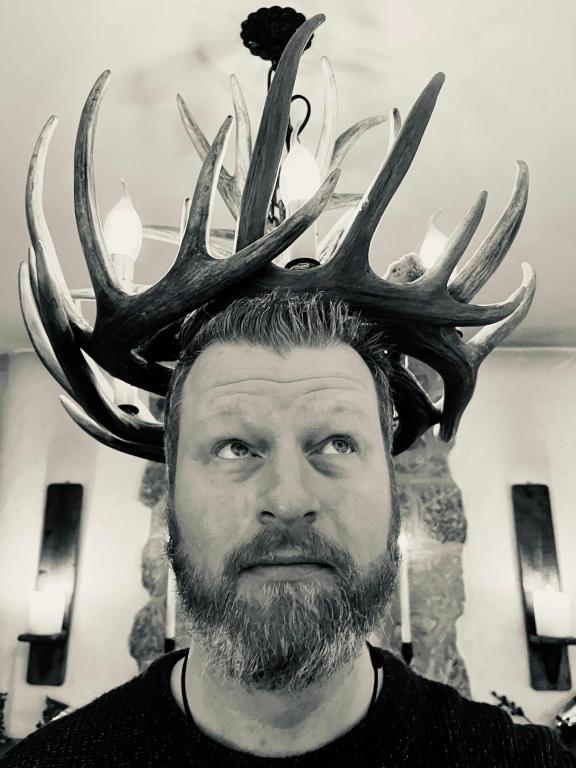
Ian Chambers is a long-time practitioner of traditional forms of witchcraft and folk sorcery through the fields of magic, mysticism, philosophy and history. Ian has studied both solitary and with a few craft groups, taking a broad purview of the subject as a practitioner scholar. A selection of Ian's writings has appeared in various magazines, including The Cauldron, White Dragon, and The Hedgewytch, as well as more recent essays in The Enquiring Eye, and Coire Ansic. Ian's first book, The Witch Compass: Working with the Winds in Traditional Witchcraft was published by Llewellyn in 2022. His forthcoming book Haqel D'ma is published by Ninth Circle Press in Spring 2025. You can read more about the author here.
Previous Post
February 17, 2025
Witchcraft in Reality: A Rebuttal
Next Post

March 27, 2025 Maundy Thursday: Night of the Witches
Recent Comments
"I didn't read Janega's article on Witchcraft but I do know there are archives in ..."
Witchcraft in Reality: A Rebuttal
"I'm curious about your thoughts on the statement "you cannot in fact sell your soul ..."
Witchcraft in Reality: A Rebuttal
"This was why royalty had someone taste the food before they ate it. That way, ..."
The Devil and the Sun King: ..."
"I agree. I have found the running community to be one of the most supportive ..."
Browse Our Archives
Select a Category 1734 Ancestors Apophatic Sorcery Atramentous Press Beltane Betrayal big dipper Book Book Review Brigit Candlemas Ced Ced Tarot child of promise Christmas Climate Community Compass Conferences Conjuration culture Cultus Sabbati Dance Death Devil Dionysus Double Easter Environment Esotericism Events Experience Fairy Fate Folklore Greek Gods Greek Magical Papyri Green Man Grimoire history Initiation Interviews Jewish Mysticism Judas Kabbalah Legend Lilith Mandrake Books Llewellyn Lore Lucifer Magic Magic in History Series May Day Meditation Merkabah Monkey King Myth Necromancy New Books NEws north star road Oberon Obituary Occult Offerings Opposer Pagan Pax Deorum Pax Diaboli PGM Philosophy Poetry Politics Praxis Punk Witchcraft Ralph Harvey Reviews Richard Gordon Rita Morgan Ronald “Chalky” White Sabbatic Witchcraft Sabbats Sun Wukong Taoist the Regency The Witch Compass Three Hands Press Tradition Traditional Witchcraft Trickster God Tricksters Uncategorized via Negativa White Dragon Winds Witch lore Witchcraft Witchcraft Lore Witches' Sabbath wyrd Yule
Select a Month May 2025 March 2025 February 2025 January 2025 December 2024 July 2024 June 2024 April 2024 March 2024 February 2024 January 2024 December 2023 November 2023 October 2023 September 2023 August 2023 July 2023 December 2022 October 2022 September 2022 August 2022 May 2022 April 2022 March 2022 February 2022 December 2021 July 2021 May 2021 April 2021 February 2021 January 2021 December 2020 November 2020 September 2020 August 2020 July 2020 June 2020 May 2020 April 2020 March 2020 February 2020 January 2020 December 2019 November 2019 October 2019 September 2019 July 2019 June 2019 May 2019 April 2019 March 2019 December 2018 September 2018 August 2018 July 2018 June 2018 May 2018 April 2018 March 2018 February 2018 June 2017 October 2016 September 2016 July 2016 June 2016 April 2016
Follow Us!
TAKE THE
Religious Wisdom Quiz
Who was the last judge of Israel?
Select your answer to see how you score.
Samuel Samson Gideon Eli
Related posts from By The Pale Moonlight

Shattered Illusions: Stories of Pre-Internet Days

Maundy Thursday: Night of the Witches

Witchcraft in Reality: A Rebuttal
The Devil and the Sun King: The Affair...
TRENDING AT PATHEOS Pagan

I was recently chatting with someone on Instagram. She asked me what...

While there are many people who share their results, the end of...

On July 23, I saw Christopher Nolan's The Odyssey which is Homer’s...

As I write this two big events have just finished up. One...

Restoring the Watershed of Divine Love
Perhaps cooperation is not something we manufacture through legislation, ideology, or moral...

Many UUs don’t pray because of bad experiences in a previous religion,...
view all Pagan blogs
What Are Your Thoughts?leave a comment
Ad-Free & Subscriber Log-In Subscription Support
- About Us
- 2026 Calendar
- Videos
- Podcasts
- Library of World Religions
- Faith In Media Tracker
- Advertise With Us
- Write for Us
- Privacy Policy
- Terms of Service
- Do Not Sell My Data
- Contact Us
- Radiant Digital
- Manage Newsletter Subscriptions
- Unsubscribe From Notifications
- Sitemap
Copyright 2008-2026, Patheos. All rights reserved.
Subscription Support Ad-Free & Subscriber Log-In
Follow Patheos