
BuddhistCatholicContemplativeEvangelicalGeneral ChristianHinduJewishLatter-day SaintMuslimNew VisionsProgressive Christian
Beliefs
- Buddhist
- Catholic
- Contemplative
- Evangelical
- General Christian
- Hindu
- Jewish
- Latter-day Saint
- More Voices
- Muslim
- New Visions
- Pagan
- Progressive Christian
Topics
- Religion News
- Food and Religion
- Sports and Religion
- Religious Art
- Religious Music and Entertainment
- Religious Events
- History and Religion
- Style and Religion
- Politics and Religion
- Women in Religion
- Recreation Outdoors and Religion
- Business Finance and Religion
- Careers Workplace and Religion
- Education and Religion
- Family Parenting and Religion
- Health Fitness and Religion
- Home and Religion
- Relationships and Religion
- Technology and Religion
- Travel and Religion
Columnists
- Buddhist Columnists
- Business Finance and Religion Columnists
- Careers Workplace and Religion Columnists
- Catholic Columnists
- Contemplative Columnists
- Education and Religion Columnists
- Evangelists Columnists
- Family Parenting and Religion Columnists
- General Christian Columnists
- Health Fitness and Religion Columnists
- Hindu Columnists
- History and Religion Columnists
- Home and Religion Columnists
- Jewish Columnists
- More Voices Columnists
- Latter Day Columnists
- Muslim Columnists
- New Visions Columnists
- Nonreligious Columnists
- Pagan Columnists
- Politics and Religion Columnists
- Progressive Columnists
- Recreation Outdoors and Religion Columnists
- Relationships and Religion Columnists
- Religion News Columnists
- Religious Art Columnists
- Religious Events Columnists
- Religious Music and Entertainment Columnists
- Sports and Religion Columnists
- Style and Religion Columnists
- Technology and Religion Columnists
- Travel and Religion Columnists
- Women in Religion Columnists
Resource Library
- 2026 Calendar
- Library of World Religions
- The 100 Most Holy Places on Earth
- Patheos Answers
- Podcasts
- Videos
- Faith Leaders Database
- Anglican Episcopalian
- Bahai
- Baptist
- Buddhism
- Christianity
- Confucianism
- Eastern Orthodoxy
- Hinduism
- Holiness and Pentecostal
- ISKCON
- Islam
- Judaism
- Lutheran
- Methodist
- The Church of Jesus Christ of Latter-day Saints
- New Age
- Paganism
- Presbytarian and Reformed
- Protestantism
- Religion Behind the Scenes
- Roman Catholic
- Scientology
- Shia Islam
- Sikhism
- Sufism
- Sunni Islam
- Taoism
- Zen
- See all religions
Research Tools
 Ad-Free & Subscriber Log-In Subscription Support
Ad-Free & Subscriber Log-In Subscription Support
Follow Patheos 

- Trending:
- Forgiveness
- |
- Marriage
- |
- Consciousness
- |
- Death Penalty
- |
- Election
- |
- Halloween

- Home
- Pagan
- To Always Hele, Ever Conceal, and Never Reveal…
To Always Hele, Ever Conceal, and Never Reveal…
Last updated on: December 9, 2024 at 7:45 pm by Ian Chambers
To Always Hele, Ever Conceal, and Never Reveal… 2024-12-09T19:45:40+00:00 Ian Chambers
Patheos Explore the world's faith through different perspectives on religion and spirituality! Patheos has the views of the prevalent religions and spiritualities of the world.
I swear that I will always conceal and never reveal these secrets… (Society of Esoteric Endeavour 2009, 89) [1]
This solemn oath is delivered by the initiate into the secretive Society of the Horseman’s Word, taken from The Ancient Ritual of the Buchan Ploughmen, Incorporated with the Ancient Horsemen. A parallel society to the Freemasons, such initiatory oaths contain similar phraseology, and these binding words have, therefore, a magical context. Indeed, throughout the magical milieu, such oaths of secrecy serve to protect and maintain the efficacy and power of not only the individuals and spirits involved, but also the current itself. From Masonry, such has also entered the service of Ceremonial Magic, found in the esoteric Freemasonic orders, The Hermetic Order of the Golden Dawn, and the Ordo Templi Orientis. Indeed, the ritual elements of the solemn vows, such as the Horseman’s Oath, are sealed within certain prayers laced with the threat of what might befall those who go against their oath:
O Help me God to perform all my vows as a horseman and if I shall break any of them I wish no less a punishment to fall upon me than to be torn between two wild horses and my body quartered and thrown to the four winds of heaven and hell to be taken and buried into the sands of the sea where the tide ebbs and flows twice a day to show that I have been a deceiver of the faith. (Society of Esoteric Endeavour 2009, p. 91) [2]
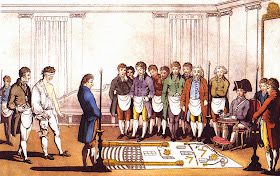
Masonic initiation, Paris 1745. Public Domain
Comparable penalties are articulated within the rite of Freemasonry, describing the bounds placed upon the Entered Apprentice. Indeed, the oath of secrecy to protect the Mason’s Craft is found in one of its earliest documents, the Cooke Manuscript dated to around the mid-fifteenth century. In this context, an obsolete word is used: hele signifying to hide:
He shall hele the counsel or his fellows in lodge and in chamber, and wherever masons meet. [3]
From the Old English verb helan, meaning to conceal, or cover, hele derives from Middle English and is a now no longer used term cognate with the Scots heal, all of which indicate to mask, hide, or otherwise guard.
The Cooke Manuscripte continues:
He shall be no traitor to the art and and do it no harm nor conform to any enactments against the art not against the members thereof… [4]
These rather punitive sounding measures originate, of course, from a time when the skill of the Craft, be it that of the stonemason, or the guarded techniques of horsemanship, required careful guarding lest they be abused by greedy owners. Indeed, this early form of unionisation was forbidden and, therefore, rendered the act of secrecy all the more important and dangerous. One is minded of the Tolpuddle Martyrs who were six agricultural labourers convicted in 1834 of swearing unlawful oaths during a labour dispute. Whilst they were transported to the penal colonies of Australia, protests delivered them pardons and they were returned to England between 1837-39. This forms an early part of the history of unions and worker’s rights, but nevertheless underscores the requirement to maintain secrets from authorities for any skilled labourer.
Magically, these oaths take on a different meaning and purpose than simply protecting the members and their trade knowledge and skill. As etymological roots reveal, words in English for the act of solemn declaration works in accord with the powers that are invoked. Specifically, of oaths “sworn” and “to swear” all originate and are bound by the appeal to a numinous agent, be it deity, spirit, collective or other sacred power. Importantly, the utterer of oaths must hold a relationship to the power being evoked to bind the covenant, and the sealing of such forms a bond between those who take the oath and the spirits as witness and sealer of the oath. As a solemn declaration, swearing of oaths has long called upon supernatural or spiritual powers to oversee and enforce the sacred, earnest contract.
Today, the custom remains in which a sacred text is still used to witness and retain the pact of truth between the speaker and their sacred gods and lore-keepers; a tradition maintained in common courts of law, and even Freemasonry today where initiates can be sworn in using the Bible, Torah, Koran, and other holy books held sacred by the individual. Therefore, there is a tacit agreement that the individual making the oath is sincere and holds the sacred witness in high regard, with faith in the penalties that are uttered or implied. The basis of the oath rests, therefore, upon the character of the oath-taker — both their personal honour and how they comport themselves, and the inner relationship between them and their spirits and gods. In between, of course, are all those for whom the oath foreswears to protect and guard — to hele, conceal and never reveal. If one evokes a magical or spiritual authority in a pact, one assumes that they respect that authority and intend to fulfil the vow. Furthermore, breaking the oath ensures that faith between the guardian spirit and the individual is irrevocably sundered! In cases of witchcraft, this manifest palpably during the early modern period when suspected witches reported the requirement to renounce their baptism upon initiation, thus reneging on their oath to God and becoming a de facto oath-breaker, or warlock.

Anderson’s Constitution of 1723. Public Domain
Within Wicca, oaths comparable to the Masonic standard are undertaken at initiation to the first degree:
…in the presence of the Mighty Ones, do of my own will and accord, most solemnly swear that I will ever keep secret and never reveal the secrets of the Art, except it be to a proper person, properly prepared, within a circle such as I am now in. All this I swear by my hopes of a future life, mindful that my measure has been taken, and may my weapons turn against me if I break this my solemn oath… [5]
The twentieth-century mystic, actress and founder of the Welsh Plant Brân family tradition, Ruth Wynn Owen held certain obligations for those attending under the banner of her house. One of these importantly did not require the taking of sacred and dreadful oaths, instead asking the subtle question: “Are you not trustworthy?” This simple statement turns the individual’s worthiness upon itself, requiring each to look into their own heart and, in so enquiring, become their own judge and arbiter. In this, the person’s integrity is recognised as a personal responsibility and that we must all answer to ourselves in regard to our measure of faithfulness.
The Old Irish gets or geis is a magical taboo, providing potential for blessing and curse, which sets its parameters via a spiritual boundary that confines the recipient. Should the bearer of the geis break with their duty, the penalty is automatic and swift, bringing death and dishonour. Such was the culture that maintained geasa as a formal, spiritual taboo, that the recipient was bound to observe certain obligations unless they were to suffer the terrible fate of dishonour, to be ridiculed in song and reputation. Death, of course, would be the ultimate penalty for the breaking of such an oath, but the suggestion remains that the dishonour would be carried on to all worlds and that the gods themselves would know of the crime. A geis could also signify the binding by fate, prophesying what must come, prohibiting certain other behaviours, and rewarding of blessing by the observation of these bonds.
Often, people swear to maintain or demonstrate a level of sincerity — perceiving such to be indicative of the highest level of honesty one may possess. Colloquially, people swear on the graves of loved ones, or else on their own life, suggesting some divine retribution in the after life as currency against their truthfulness. Of course, in the mundane, the weight of the promise is only measurable against the belief and nature of the individual. In the magical world, of course, we operate in the assumption that those around us hold similar ideas about the world and its operations. This can vary widely, but overall a belief in the spiritual in some capacity is a fundamental basis for most magical systems. It seems reasonable, then, to suppose that brethren in a magical compact would be sufficiently aware of such, and might respect the bonds of an oath between people, spirits and gods. Therefore, the magical oath has a power that might exceed that of the mundane world — higher even than the courts of law or religious institution — given that the magi and witch seeks to deal with spiritual forces in myriad ways and means.
- Society of Esoteric Endeavour. 2009. The Society of the Horseman’s Grip and Word, p. 89.
- Ibid, 91.
- “The Cooke Manuscript One of the Oldest Known Masonic Documents Written about 1450.” n.d. Accessed October 15, 2024. https://freemasonrymatters.co.uk/wp-content/uploads/2016/04/Cooke-Manuscript-1450.pdf.
- Ibid.
- https://sacred-texts.com/pag/gbos/gbos03.htm

About Ian Chambers
Ian Chambers is a long-time practitioner of traditional forms of witchcraft and folk sorcery through the fields of magic, mysticism, philosophy and history. Ian has studied both solitary and with a few craft groups, taking a broad purview of the subject as a practitioner scholar. A selection of Ian's writings has appeared in various magazines, including The Cauldron, White Dragon, and The Hedgewytch, as well as more recent essays in The Enquiring Eye, and Coire Ansic. Ian's first book, The Witch Compass: Working with the Winds in Traditional Witchcraft was published by Llewellyn in 2022. You can read more about the author here.
Previous Post
July 28, 2024
Feast of the Gods: Outrage and Parody...
Next Post

January 22, 2025 The Devil and the Sun King: The Affair of the Poisons
Recent Comments
"I didn't read Janega's article on Witchcraft but I do know there are archives in ..."
Witchcraft in Reality: A Rebuttal
"I'm curious about your thoughts on the statement "you cannot in fact sell your soul ..."
Witchcraft in Reality: A Rebuttal
"This was why royalty had someone taste the food before they ate it. That way, ..."
The Devil and the Sun King: ..."
"I agree. I have found the running community to be one of the most supportive ..."
Browse Our Archives
Select a Category 1734 Ancestors Apophatic Sorcery Atramentous Press Beltane Betrayal big dipper Book Book Review Brigit Candlemas Ced Ced Tarot child of promise Christmas Climate Community Compass Conferences Conjuration culture Cultus Sabbati Dance Death Devil Dionysus Double Easter Environment Esotericism Events Experience Fairy Fate Folklore Greek Gods Greek Magical Papyri Green Man Grimoire history Initiation Interviews Jewish Mysticism Judas Kabbalah Legend Lilith Mandrake Books Llewellyn Lore Lucifer Magic Magic in History Series May Day Meditation Merkabah Monkey King Myth Necromancy New Books NEws north star road Oberon Obituary Occult Offerings Opposer Pagan Pax Deorum Pax Diaboli PGM Philosophy Poetry Politics Praxis Punk Witchcraft Ralph Harvey Reviews Richard Gordon Rita Morgan Ronald “Chalky” White Sabbatic Witchcraft Sabbats Sun Wukong Taoist the Regency The Witch Compass Three Hands Press Tradition Traditional Witchcraft Trickster God Tricksters Uncategorized via Negativa White Dragon Winds Witch lore Witchcraft Witchcraft Lore Witches' Sabbath wyrd Yule
Select a Month May 2025 March 2025 February 2025 January 2025 December 2024 July 2024 June 2024 April 2024 March 2024 February 2024 January 2024 December 2023 November 2023 October 2023 September 2023 August 2023 July 2023 December 2022 October 2022 September 2022 August 2022 May 2022 April 2022 March 2022 February 2022 December 2021 July 2021 May 2021 April 2021 February 2021 January 2021 December 2020 November 2020 September 2020 August 2020 July 2020 June 2020 May 2020 April 2020 March 2020 February 2020 January 2020 December 2019 November 2019 October 2019 September 2019 July 2019 June 2019 May 2019 April 2019 March 2019 December 2018 September 2018 August 2018 July 2018 June 2018 May 2018 April 2018 March 2018 February 2018 June 2017 October 2016 September 2016 July 2016 June 2016 April 2016
Follow Us!
TAKE THE
Religious Wisdom Quiz
What Jewish festival celebrates deliverance from Egypt?
Select your answer to see how you score.
Passover Purim Tabernacles Pentecost
Related posts from By The Pale Moonlight

Shattered Illusions: Stories of Pre-Internet Days

Maundy Thursday: Night of the Witches
Traditional Witchcraft and Betrayal...

Witchcraft in Reality: A Rebuttal
TRENDING AT PATHEOS Pagan

I was recently chatting with someone on Instagram. She asked me what...

While there are many people who share their results, the end of...

On July 23, I saw Christopher Nolan's The Odyssey which is Homer’s...

As I write this two big events have just finished up. One...

Restoring the Watershed of Divine Love
Perhaps cooperation is not something we manufacture through legislation, ideology, or moral...

Many UUs don’t pray because of bad experiences in a previous religion,...
view all Pagan blogs
What Are Your Thoughts?leave a comment
Ad-Free & Subscriber Log-In Subscription Support
- About Us
- 2026 Calendar
- Videos
- Podcasts
- Library of World Religions
- Faith In Media Tracker
- Advertise With Us
- Write for Us
- Privacy Policy
- Terms of Service
- Do Not Sell My Data
- Contact Us
- Radiant Digital
- Manage Newsletter Subscriptions
- Unsubscribe From Notifications
- Sitemap
Copyright 2008-2026, Patheos. All rights reserved.
Subscription Support Ad-Free & Subscriber Log-In
Follow Patheos