
BuddhistCatholicContemplativeEvangelicalGeneral ChristianHinduJewishLatter-day SaintMuslimNew VisionsProgressive Christian
Beliefs
- Buddhist
- Catholic
- Contemplative
- Evangelical
- General Christian
- Hindu
- Jewish
- Latter-day Saint
- More Voices
- Muslim
- New Visions
- Pagan
- Progressive Christian
Topics
- Religion News
- Food and Religion
- Sports and Religion
- Religious Art
- Religious Music and Entertainment
- Religious Events
- History and Religion
- Style and Religion
- Politics and Religion
- Women in Religion
- Recreation Outdoors and Religion
- Business Finance and Religion
- Careers Workplace and Religion
- Education and Religion
- Family Parenting and Religion
- Health Fitness and Religion
- Home and Religion
- Relationships and Religion
- Technology and Religion
- Travel and Religion
Columnists
- Buddhist Columnists
- Business Finance and Religion Columnists
- Careers Workplace and Religion Columnists
- Catholic Columnists
- Contemplative Columnists
- Education and Religion Columnists
- Evangelists Columnists
- Family Parenting and Religion Columnists
- General Christian Columnists
- Health Fitness and Religion Columnists
- Hindu Columnists
- History and Religion Columnists
- Home and Religion Columnists
- Jewish Columnists
- More Voices Columnists
- Latter Day Columnists
- Muslim Columnists
- New Visions Columnists
- Nonreligious Columnists
- Pagan Columnists
- Politics and Religion Columnists
- Progressive Columnists
- Recreation Outdoors and Religion Columnists
- Relationships and Religion Columnists
- Religion News Columnists
- Religious Art Columnists
- Religious Events Columnists
- Religious Music and Entertainment Columnists
- Sports and Religion Columnists
- Style and Religion Columnists
- Technology and Religion Columnists
- Travel and Religion Columnists
- Women in Religion Columnists
Resource Library
- 2026 Calendar
- Library of World Religions
- The 100 Most Holy Places on Earth
- Patheos Answers
- Podcasts
- Videos
- Faith Leaders Database
- Anglican Episcopalian
- Bahai
- Baptist
- Buddhism
- Christianity
- Confucianism
- Eastern Orthodoxy
- Hinduism
- Holiness and Pentecostal
- ISKCON
- Islam
- Judaism
- Lutheran
- Methodist
- The Church of Jesus Christ of Latter-day Saints
- New Age
- Paganism
- Presbytarian and Reformed
- Protestantism
- Religion Behind the Scenes
- Roman Catholic
- Scientology
- Shia Islam
- Sikhism
- Sufism
- Sunni Islam
- Taoism
- Zen
- See all religions
Research Tools
 Ad-Free & Subscriber Log-In Subscription Support
Ad-Free & Subscriber Log-In Subscription Support
Follow Patheos 

- Trending:
- Forgiveness
- |
- Marriage
- |
- Consciousness
- |
- Death Penalty
- |
- Election
- |
- Halloween

- Home
- Pagan
- Here Oberon presents himself thy friend…
Here Oberon presents himself thy friend…
Last updated on: May 28, 2022 at 12:20 pm by Ian Chambers
Here Oberon presents himself thy friend… 2022-05-28T12:20:23+00:00 Ian Chambers
Patheos Explore the world's faith through different perspectives on religion and spirituality! Patheos has the views of the prevalent religions and spiritualities of the world.
And from that fatal moment, till this time
The fairy king has never deign’d to show
His native form, but wandering to and fro
Now dwells upon the mountain peak sublime,
Now hid beneath the forest’s gloomy shade…
– Oberon, A Poem, from the German of Wieland, by William Sotheby, 1798. [1]
Over the past few years, since the publication of The Book of Oberon, a sixteenth century manuscript grimoire, I have had a curious fascination with the folk magic custom surrounding the spirit of Ober[i]on. Following study of this beautiful book, carefully edited by the hands of Daniel Harms and Joseph Peterson – masters of the grimoire tradition – and illustrated under their guidance by James R. Clark, I was instilled with a certain sense of the spirit of Oberon that I couldn’t shift.

At the time of first purchasing The Book of Oberon, I was engrossed in study of John Dee’s angelic magic (sometimes known as Enochian*), and was becoming interested in the cross over between the work of Cunning Folk, scholarly and clerical magicians, and the common magics of the working class. In practicing a traditional witchcraft that has occasion to work with those magics of the past, linking directly through the literature now more widely available than ever before, I often seek to understand and operate sigaldry [2] that incorporates traditional spirit work.
Whilst contemplating this, my habit is to take lengthy walks wherein thoughts are hashed out. During one such walk, I was specifically visiting the nearby site of an old Romano-British temple dedicated to the Gallic Jupiter type god Sucellus and the arboreous Roman god Silvanus. The site is of peculiar interest to me and I have grown rather attached to the location, understanding the temple, now consumed by ancient woodland and heath, to have been established by the Romans to appropriate the area’s already established worship. Indeed, archeology would suggest that the older ceremonial or ritual ground was not directly where the temple remains and temenos now lie, but are a short distance away.
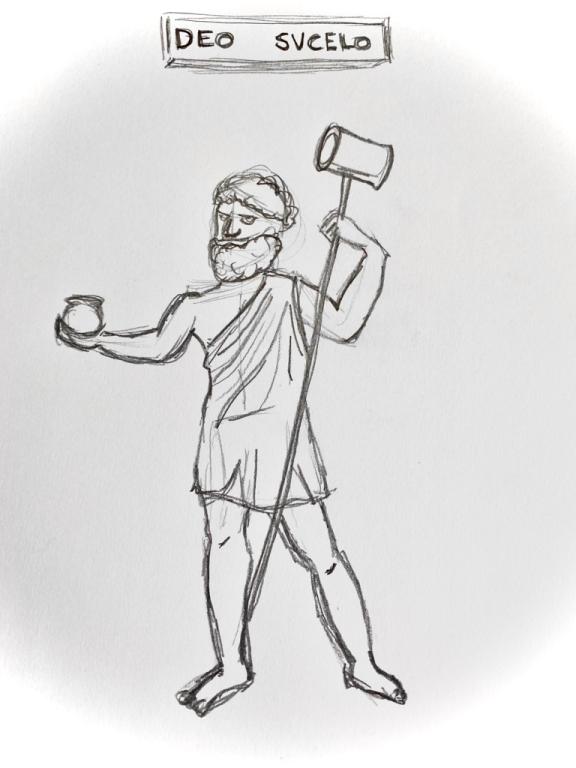
Anyone for croquet? © Ian Chambers 2020
Regardless, I was enjoying a leisurely walk when I happened into an area of distinct stillness, not a single breath of wind moving leaf nor branch in the dense woodland, which opened out before me into a small valley. It transpired that the area I had unwittingly wandered into is known historically and locally as ‘Oberon’s Glade’. This remarkable revelation inspired new connections and I sought direct ways to apply what I had been studying in approaching the spirit traditionally known as the King of the Fairies…
The English medieval and renaissance name Oberon comes from the Old French Romance name Auberon, itself originating in the Germanic Alberich. Alberich is a character from Norse and High Middle German mythology, found especially in the medieval story Nibelungenlied, telling of the adventures of the epic hero Siegfried. In its Middle High German, Alberich becomes more easily recognised to signify the King (-rich) of the elves (Alb-), and signifies the authority of the spirit.
Oberon features in the medieval period as a dwarf or elf, signifying his otherworldly character, and frequently is recognised as a forest dwelling spirit. In the 13th Century French romance Les Prouesses et faitz du noble Huon de Bordeaux, for example, Oberon presides over a forest, while in the Mid High German poem Ortnit, Alberich appears only to the wearer of a magic ring. This is reminiscent of the Ring Cycle of Wagner, based in part upon Nibelungenlied. Within the high medieval tradition, Oberon/Alberich appears as a dwarf, or else with the appearance of a small child. This feature is relevant to the later appearance of the spirit Oberion in the Grimoires of the late middle ages and early modern period in which certain spirits are often conjured to appear as a young boy, of beautiful appearance.
Curiously, the dwarf of old mythology appears to be synonymous with a type of elf, rather than a distinct race – which chimes with the identification of Oberon as King of Fairies. Indeed, the historic dwarf is sometimes thought of as synonymous with the Norse svartalfar, and myrkalfar – dark elves. This seems to signify chthonic elves who dwell mainly in the earth, underground, mound dwelling and who are involved in works of smithing, metallurgy and, therefore, treasure guardianship. Once more, this relates quite pleasingly with the role of Alberich as the guardian of the treasure of the Nibelung’s in Nibelungenlied.
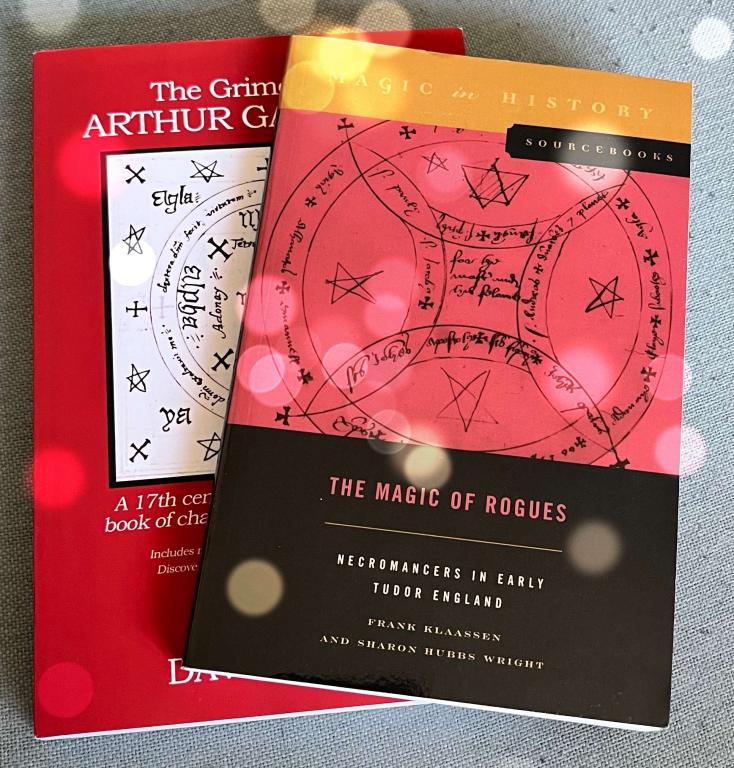
During the period in and around the Elizabethan era, around the time that William Shakespeare would have been collating his stories for A Midsummer Night’s Dream, the magicians of the age were summoning the spirit of Oberion for a particular purpose, which corresponds perfectly with the preceding myth and folklore surrounding Oberon/Alberich – that is, treasure hunting. Indeed, in the fantastic sourcebook The Magic of Rogues: Necromancers in Early Tudor England, this is precisely the use to which Oberion is being applied (I am indebted to Dr Alexander Cummins who recommended this superb study during a podcast interview).
In preparing to conjure Oberion, I made use of all the available material from the late modern sources. This proved to be more manuscript references than I expected, and include The Grimoire of Arthur Gauntlet (Sloane MS3851) , A Collection of Magical Secrets (Wellcome MS4669) and, of course, The Book of Oberon (Folger MS V.b.26). Into this mix, The Magic of Rogues provides the most complete rendition of the operation for conjuring Oberion (Sloane 3318, fols. 62r-65r). Each of these provides good cross reference material and agreement in some areas, and departure in others – although there is more in agreement than departure. The combination of these provides a complete conjuration possible.
Since undertaking the rather ambitious operation to conjure Oberion, I can commend the effort to those so willing to undertake similar works. My experiences with the spirit have been nothing but positive thus far, and I recommend him to my colleagues who work with such spirits. And in doing so, fulfil a part of a bargain struck…
* The term Enochian sometimes can be understood to refer to the modern and post Golden Dawn practice that developed around John Dee’s angelic magic. My personal preference is for a more pure approach, studying Dee’s manuscripts at the British Library.
- https://hdl.handle.net/2027/mdp.39015027522880?urlappend=%3Bseq=269%3Bownerid=1036349-257
- Middle English; sorcery.
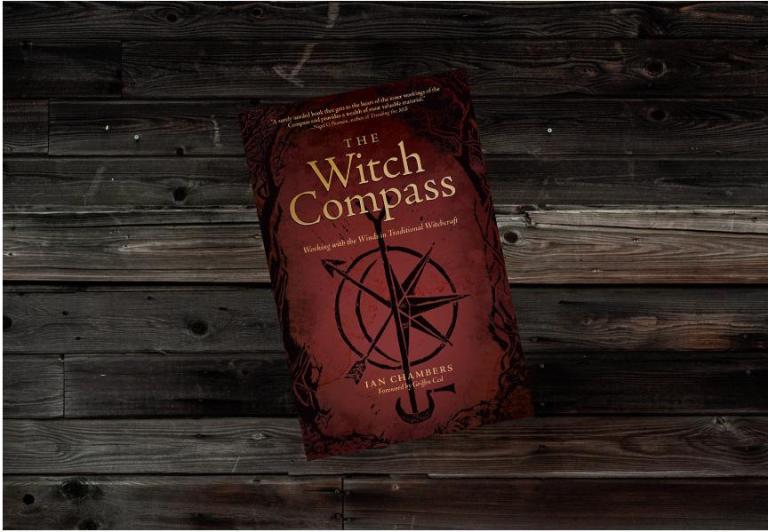
The Witch Compass: Working with the Winds in Traditional Witchcraft, is published by Llewellyn and due for release summer 2022. It is available to preorder from Amazon (Amazon.co.uk), all good book sellers and your independent bookstore (please support these important resources in our community
About Ian Chambers
Ian Chambers is a necromancer, sorcerer and traditional witch. He is the author of The Witch Compass, published by Llewellyn Worldwide on 8th August, 2022. You can read more about the author here.
Previous Post

April 21, 2022
Cosmogony of the Compass - Yetzirah Mysticism
Next Post

August 14, 2022 The Witch Compass - Working with the Winds in Traditional Witchcraft
Browse Our Archives
Select a Category 1734 Ancestors Apophatic Sorcery Atramentous Press Beltane Betrayal big dipper Book Book Review Brigit Candlemas Ced Ced Tarot child of promise Christmas Climate Community Compass Conferences Conjuration culture Cultus Sabbati Dance Death Devil Dionysus Double Easter Environment Esotericism Events Experience Fairy Fate Folklore Greek Gods Greek Magical Papyri Green Man Grimoire history Initiation Interviews Jewish Mysticism Judas Kabbalah Legend Lilith Mandrake Books Llewellyn Lore Lucifer Magic Magic in History Series May Day Meditation Merkabah Monkey King Myth Necromancy New Books NEws north star road Oberon Obituary Occult Offerings Opposer Pagan Pax Deorum Pax Diaboli PGM Philosophy Poetry Politics Praxis Punk Witchcraft Ralph Harvey Reviews Richard Gordon Rita Morgan Ronald “Chalky” White Sabbatic Witchcraft Sabbats Sun Wukong Taoist the Regency The Witch Compass Three Hands Press Tradition Traditional Witchcraft Trickster God Tricksters Uncategorized via Negativa White Dragon Winds Witch lore Witchcraft Witchcraft Lore Witches' Sabbath wyrd Yule
Select a Month May 2025 March 2025 February 2025 January 2025 December 2024 July 2024 June 2024 April 2024 March 2024 February 2024 January 2024 December 2023 November 2023 October 2023 September 2023 August 2023 July 2023 December 2022 October 2022 September 2022 August 2022 May 2022 April 2022 March 2022 February 2022 December 2021 July 2021 May 2021 April 2021 February 2021 January 2021 December 2020 November 2020 September 2020 August 2020 July 2020 June 2020 May 2020 April 2020 March 2020 February 2020 January 2020 December 2019 November 2019 October 2019 September 2019 July 2019 June 2019 May 2019 April 2019 March 2019 December 2018 September 2018 August 2018 July 2018 June 2018 May 2018 April 2018 March 2018 February 2018 June 2017 October 2016 September 2016 July 2016 June 2016 April 2016
Follow Us!
TAKE THE
Religious Wisdom Quiz
According to 2 Peter, by what will the present heavens and earth be destroyed?
Select your answer to see how you score.
Fire Water Earthquake and hail God's word
Related posts from By The Pale Moonlight

Maundy Thursday: Night of the Witches
Traditional Witchcraft and Betrayal...

Witchcraft in Reality: A Rebuttal
The Devil and the Sun King: The Affair...
TRENDING AT PATHEOS Pagan

I was recently chatting with someone on Instagram. She asked me what...

While there are many people who share their results, the end of...

On July 23, I saw Christopher Nolan's The Odyssey which is Homer’s...

As I write this two big events have just finished up. One...

Restoring the Watershed of Divine Love
Perhaps cooperation is not something we manufacture through legislation, ideology, or moral...

Many UUs don’t pray because of bad experiences in a previous religion,...
view all Pagan blogs
Ad-Free & Subscriber Log-In Subscription Support
- About Us
- 2026 Calendar
- Videos
- Podcasts
- Library of World Religions
- Faith In Media Tracker
- Advertise With Us
- Write for Us
- Privacy Policy
- Terms of Service
- Do Not Sell My Data
- Contact Us
- Radiant Digital
- Manage Newsletter Subscriptions
- Unsubscribe From Notifications
- Sitemap
Copyright 2008-2026, Patheos. All rights reserved.
Subscription Support Ad-Free & Subscriber Log-In
Follow Patheos