
BuddhistCatholicContemplativeEvangelicalGeneral ChristianHinduJewishLatter-day SaintMuslimNew VisionsProgressive Christian
Beliefs
- Buddhist
- Catholic
- Contemplative
- Evangelical
- General Christian
- Hindu
- Jewish
- Latter-day Saint
- More Voices
- Muslim
- New Visions
- Pagan
- Progressive Christian
Topics
- Religion News
- Food and Religion
- Sports and Religion
- Religious Art
- Religious Music and Entertainment
- Religious Events
- History and Religion
- Style and Religion
- Politics and Religion
- Women in Religion
- Recreation Outdoors and Religion
- Business Finance and Religion
- Careers Workplace and Religion
- Education and Religion
- Family Parenting and Religion
- Health Fitness and Religion
- Home and Religion
- Relationships and Religion
- Technology and Religion
- Travel and Religion
Columnists
- Buddhist Columnists
- Business Finance and Religion Columnists
- Careers Workplace and Religion Columnists
- Catholic Columnists
- Contemplative Columnists
- Education and Religion Columnists
- Evangelists Columnists
- Family Parenting and Religion Columnists
- General Christian Columnists
- Health Fitness and Religion Columnists
- Hindu Columnists
- History and Religion Columnists
- Home and Religion Columnists
- Jewish Columnists
- More Voices Columnists
- Latter Day Columnists
- Muslim Columnists
- New Visions Columnists
- Nonreligious Columnists
- Pagan Columnists
- Politics and Religion Columnists
- Progressive Columnists
- Recreation Outdoors and Religion Columnists
- Relationships and Religion Columnists
- Religion News Columnists
- Religious Art Columnists
- Religious Events Columnists
- Religious Music and Entertainment Columnists
- Sports and Religion Columnists
- Style and Religion Columnists
- Technology and Religion Columnists
- Travel and Religion Columnists
- Women in Religion Columnists
Resource Library
- 2026 Calendar
- Library of World Religions
- The 100 Most Holy Places on Earth
- Patheos Answers
- Podcasts
- Videos
- Faith Leaders Database
- Anglican Episcopalian
- Bahai
- Baptist
- Buddhism
- Christianity
- Confucianism
- Eastern Orthodoxy
- Hinduism
- Holiness and Pentecostal
- ISKCON
- Islam
- Judaism
- Lutheran
- Methodist
- The Church of Jesus Christ of Latter-day Saints
- New Age
- Paganism
- Presbytarian and Reformed
- Protestantism
- Religion Behind the Scenes
- Roman Catholic
- Scientology
- Shia Islam
- Sikhism
- Sufism
- Sunni Islam
- Taoism
- Zen
- See all religions
Research Tools
 Ad-Free & Subscriber Log-In Subscription Support
Ad-Free & Subscriber Log-In Subscription Support
Follow Patheos 

- Trending:
- Forgiveness
- |
- Marriage
- |
- Consciousness
- |
- Death Penalty
- |
- Election
- |
- Halloween

- Home
- Pagan
- Antisemitism and Witchcraft in the Middle Ages
Antisemitism and Witchcraft in the Middle Ages
Last updated on: July 5, 2021 at 9:09 pm by Ian Chambers
Antisemitism and Witchcraft in the Middle Ages 2021-07-05T21:09:16+00:00 Ian Chambers
Patheos Explore the world's faith through different perspectives on religion and spirituality! Patheos has the views of the prevalent religions and spiritualities of the world.
From Half A Century, 1848-1898. The Netherlands Under The Direction Of King Willem The Third And The Regency Of Queen Emma Described By The Dutch Under The Direction Of Dr. P.H. Ritter (1898). Original from the British Library. Digitally enhanced by rawpixel.
Many of the oldest, most iconic depictions of the witch feature the pronounced characteristics that have become instantly recognisable; a caricature that resides in all good fairy tales. Even today, many of us were made aware of what the stereotypical witch looks like, and where to find her on the edge of the dark forest. It is surprising, therefore, to learn that the large, hooked nose, protruding chin, hairy mole or wart, and stooped appearance, are in fact a rather ugly representation emerging from derogatory depictions of a Jewish woman. Conspiracy theories aren’t a modern phenomena, and the European Jewish population of the Middle Ages were widely regarded as being behind every terrible, imaginary plot. Indeed, the charges popularly laid at the doors of the Jewish Europeans include cannibalism, eating babies, worshipping Satan and attending the Sabbath (confusingly), while using magic to assail their enemies and cause misfortune to neighbours. This all sounds rather familiar to students of witchcraft, and with good reason.
The association between the witch and Jewish people in medieval Europe … revolves around superstition, allegations of diabolism and folk sorcery.
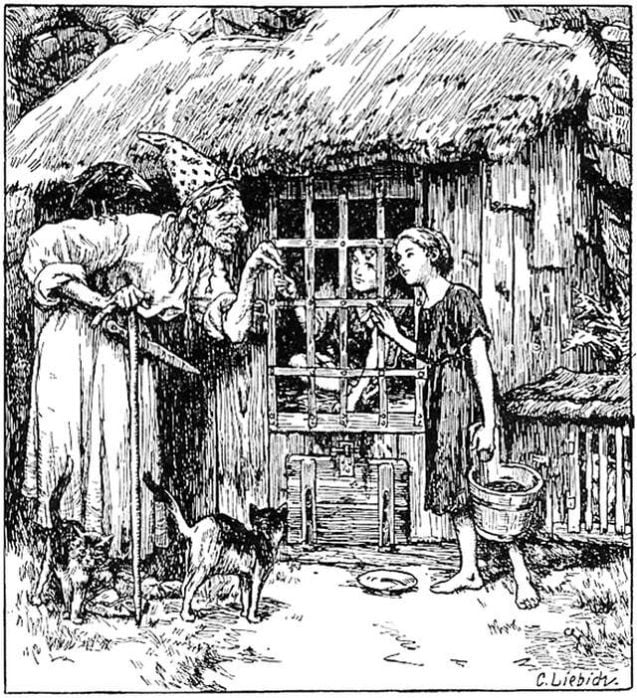
Curt Liebich (1869-1937) Hansel & Gretel 1925.
The association between the witch and Jewish people in medieval Europe in general, and England in particular, revolves around superstition, allegations of diabolism and folk sorcery. In September 1189 CE, at the coronation of Richard I (1157 – 1199) in London, some Jewish attendants bearing gifts for the new king were massacred after public sentiment branded them enchanters working against the monarch. Moreover, it is noteworthy that suspicions against Jewish communities in England were not restricted to sorcerous individuals, but the whole race was deemed wicked, and were accused of preying upon the blood of children for unleavened Passover matzah.
Of course the accusation of child murder is an offence also levelled at those charged with witchcraft during a time period when the crime of being different could rapidly inflame a fury of anger and hate. Public furore frequently resulted in several bloody incidents, including the massacre of over an hundred Jewish people in York in the year 1190 as antisemitism spread like wildfire, with awful results.
… the connection between actual Jewish sorcery and folk magics associated with the medieval witch is not without some basis in reality.
The Jewish stereotype became incorporated into the popular imagination and characteristics in depictions exaggerated, and conflated with witchcraft through sharing in diabolism and blood libel, and the appearance of the witch as a figure of evil was born from discrimination. This iconic depiction exists to this day, as seen in the Wizard of Oz, Snow White, Hansel and Gretel, and other fairy tale representations, and owes its origins to the antisemitic wave that consumed Europe through much of the Middle Ages.
Of course, the connection between actual Jewish sorcery and folk magics associated with the medieval witch is not without some basis in reality. However, this is an irrelevancy to the uncompromising and prejudiced portrayal conceived of medieval populations, inspired by the hatred that was projected upon the perceived enemy who bears the burden of any and all misfortune. That there was a cross-pollination between Jewish folk magic and the cunning craft and magical traditions, evinced by the adoption of Hebrew charms, as well as the philosophy deemed Kabbala, seems reasonable. Indeed, there is the suggestion, in particular through the use of bedtime prayers and charms found in Hebrew, perhaps inherited from Babylonian originals, which have corollary in Christian folk magics, such as the Black Paternoster.
In medieval England, the anti-Jewish fervour reached fever pitch by the time of Edward I (1239 – 1307), who issued an edict expelling the Jews from England – a banishment which would last over 350 years. As Christian law forbade usury at the time, there was no money lending for profit available to European monarchs except via wealthy Jewish families. Of course, this meant that there was a reason for kings to despise the Jewish population, many of whom had the unenviable position of holding debt over European sovereigns. King Edward, known as ‘longshanks’, funded numerous campaigns and seemingly constant warfare, against the Scots, Welsh, Irish and the French. Edward was massively in debt and resorted to heavy taxation of the country’s population to attempt to stem the bleeding coffers. In 1275, he issued the ‘Statute of the Jewry’, forbidding the lending of money with interest, thereby removing profiteering. This Statute would become the basis for his final ruling in 1290 when he issued an edict ejecting the Jewish population of England. This Edict was gleefully met by the public, perhaps assuaging their anguish at hard taxes, and who had already been condition against the Jewish people after an hundred years of brutal treatment of the relatively small Jewish population of England, estimated around two-thousand souls.
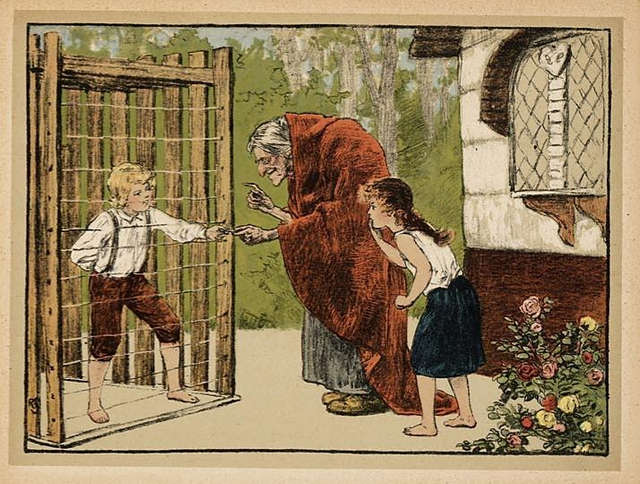
Illustration from Hansel and Gretel by Richard Scholtz
With the medieval Jewish people regarded as inherently sorcerous, and in league with the devil, the natural companion was the figure of the witch. Whilst this is definitely superstitious speculation, there remains a connection, nevertheless, between Jewish sorcery and medieval magic. A mingling of accumulated philosophies and ideas almost certainly transpired and, through the Solomonic traditions, medieval grimoires, the use of Hebrew names in ritualised ceremonial magic, and charming traditions, European magic is all the richer for it.
The image of the witch is, then, fundamentally intertwined with the derogatory stereotype of the medieval Jewish peoples of Europe. It’s no coincidence that many of the superstitions surrounding the witch that have survived the medieval period are, in fact, a composite of the same prejudiced notions of the Jewish race.
While modern witchcraft has not had reason to consider some of its more difficult origins, it is perhaps worth noting, for posterity, that this unpleasantry underwrites the concept of the European witch in popular culture. It is an unavoidable fact that the image we have all been used to regarding as the hackneyed witch derives its negative inception and features from a hateful moment in history. While we cannot change the past, it is incumbent upon us to evolve and, as witchcraft continues to make huge gains in popularity, be mindful of the kind of conspiratorial and adverse thinking that triggered the persecution of the Jewish people in medieval Europe. There is a trend in communities of new witches to consider the details of the witch craze, when the early modern communities were gripped with fear which spilled out in violence. However, scant attention is paid to the source of this dreadful mania, which has roots in the hysteria that massacred and expelled Jewish people of the Middle Ages.
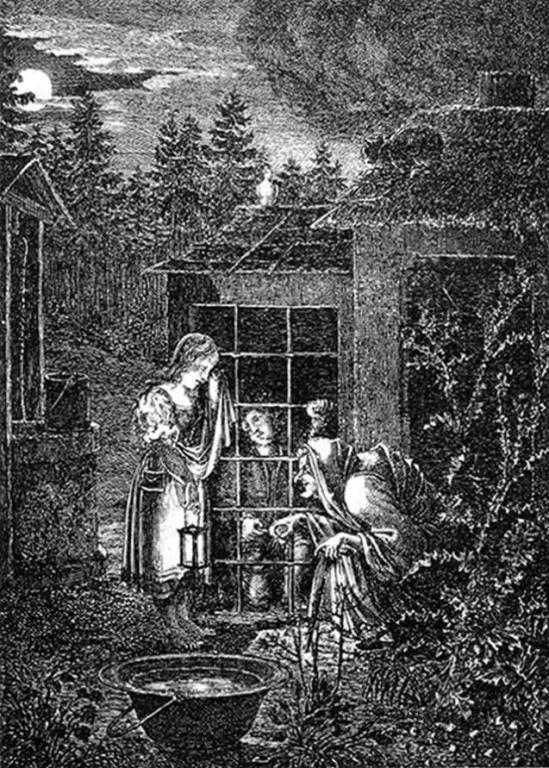
Ludwig Emil Grimm, younger brother of the Grimms who illustrated this Hansel and Gretel page, published in 1825 (1790-1863).

About Ian Chambers
Ian Chambers is engaged in the pursuit of conscious awareness, the highest ideals and the attainment of unity with all of life, including an environment that remains essential to our continuance on this blue planet. You can read more about the author here.
Previous Post

May 19, 2021
Respect the Ancestors Now!
Next Post

July 29, 2021 The House is Still on Fire - Witchcraft Against Climate Crisis
Browse Our Archives
Select a Category 1734 Ancestors Apophatic Sorcery Atramentous Press Beltane Betrayal big dipper Book Book Review Brigit Candlemas Ced Ced Tarot child of promise Christmas Climate Community Compass Conferences Conjuration culture Cultus Sabbati Dance Death Devil Dionysus Double Easter Environment Esotericism Events Experience Fairy Fate Folklore Greek Gods Greek Magical Papyri Green Man Grimoire history Initiation Interviews Jewish Mysticism Judas Kabbalah Legend Lilith Mandrake Books Llewellyn Lore Lucifer Magic Magic in History Series May Day Meditation Merkabah Monkey King Myth Necromancy New Books NEws north star road Oberon Obituary Occult Offerings Opposer Pagan Pax Deorum Pax Diaboli PGM Philosophy Poetry Politics Praxis Punk Witchcraft Ralph Harvey Reviews Richard Gordon Rita Morgan Ronald “Chalky” White Sabbatic Witchcraft Sabbats Sun Wukong Taoist the Regency The Witch Compass Three Hands Press Tradition Traditional Witchcraft Trickster God Tricksters Uncategorized via Negativa White Dragon Winds Witch lore Witchcraft Witchcraft Lore Witches' Sabbath wyrd Yule
Select a Month May 2025 March 2025 February 2025 January 2025 December 2024 July 2024 June 2024 April 2024 March 2024 February 2024 January 2024 December 2023 November 2023 October 2023 September 2023 August 2023 July 2023 December 2022 October 2022 September 2022 August 2022 May 2022 April 2022 March 2022 February 2022 December 2021 July 2021 May 2021 April 2021 February 2021 January 2021 December 2020 November 2020 September 2020 August 2020 July 2020 June 2020 May 2020 April 2020 March 2020 February 2020 January 2020 December 2019 November 2019 October 2019 September 2019 July 2019 June 2019 May 2019 April 2019 March 2019 December 2018 September 2018 August 2018 July 2018 June 2018 May 2018 April 2018 March 2018 February 2018 June 2017 October 2016 September 2016 July 2016 June 2016 April 2016
Follow Us!
TAKE THE
Religious Wisdom Quiz
Who built an ark to survive the great flood?
Select your answer to see how you score.
Abram Shem Noah Enoch
Related posts from By The Pale Moonlight

Shattered Illusions: Stories of Pre-Internet Days

Maundy Thursday: Night of the Witches
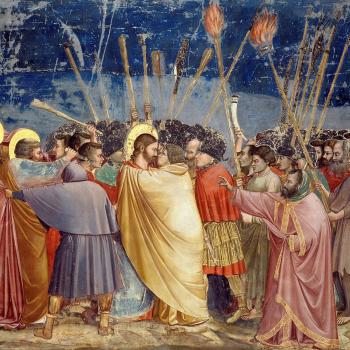
Traditional Witchcraft and Betrayal...

Witchcraft in Reality: A Rebuttal
TRENDING AT PATHEOS Pagan

I was recently chatting with someone on Instagram. She asked me what...

While there are many people who share their results, the end of...

On July 23, I saw Christopher Nolan's The Odyssey which is Homer’s...

As I write this two big events have just finished up. One...

Restoring the Watershed of Divine Love
Perhaps cooperation is not something we manufacture through legislation, ideology, or moral...

Many UUs don’t pray because of bad experiences in a previous religion,...
view all Pagan blogs
Ad-Free & Subscriber Log-In Subscription Support
- About Us
- 2026 Calendar
- Videos
- Podcasts
- Library of World Religions
- Faith In Media Tracker
- Advertise With Us
- Write for Us
- Privacy Policy
- Terms of Service
- Do Not Sell My Data
- Contact Us
- Radiant Digital
- Manage Newsletter Subscriptions
- Unsubscribe From Notifications
- Sitemap
Copyright 2008-2026, Patheos. All rights reserved.
Subscription Support Ad-Free & Subscriber Log-In
Follow Patheos