
BuddhistCatholicContemplativeEvangelicalGeneral ChristianHinduJewishLatter-day SaintMuslimNew VisionsProgressive Christian
Beliefs
- Buddhist
- Catholic
- Contemplative
- Evangelical
- General Christian
- Hindu
- Jewish
- Latter-day Saint
- More Voices
- Muslim
- New Visions
- Pagan
- Progressive Christian
Topics
- Religion News
- Food and Religion
- Sports and Religion
- Religious Art
- Religious Music and Entertainment
- Religious Events
- History and Religion
- Style and Religion
- Politics and Religion
- Women in Religion
- Recreation Outdoors and Religion
- Business Finance and Religion
- Careers Workplace and Religion
- Education and Religion
- Family Parenting and Religion
- Health Fitness and Religion
- Home and Religion
- Relationships and Religion
- Technology and Religion
- Travel and Religion
Columnists
- Buddhist Columnists
- Business Finance and Religion Columnists
- Careers Workplace and Religion Columnists
- Catholic Columnists
- Contemplative Columnists
- Education and Religion Columnists
- Evangelists Columnists
- Family Parenting and Religion Columnists
- General Christian Columnists
- Health Fitness and Religion Columnists
- Hindu Columnists
- History and Religion Columnists
- Home and Religion Columnists
- Jewish Columnists
- More Voices Columnists
- Latter Day Columnists
- Muslim Columnists
- New Visions Columnists
- Nonreligious Columnists
- Pagan Columnists
- Politics and Religion Columnists
- Progressive Columnists
- Recreation Outdoors and Religion Columnists
- Relationships and Religion Columnists
- Religion News Columnists
- Religious Art Columnists
- Religious Events Columnists
- Religious Music and Entertainment Columnists
- Sports and Religion Columnists
- Style and Religion Columnists
- Technology and Religion Columnists
- Travel and Religion Columnists
- Women in Religion Columnists
Resource Library
- 2026 Calendar
- Library of World Religions
- The 100 Most Holy Places on Earth
- Patheos Answers
- Podcasts
- Videos
- Faith Leaders Database
- Anglican Episcopalian
- Bahai
- Baptist
- Buddhism
- Christianity
- Confucianism
- Eastern Orthodoxy
- Hinduism
- Holiness and Pentecostal
- ISKCON
- Islam
- Judaism
- Lutheran
- Methodist
- The Church of Jesus Christ of Latter-day Saints
- New Age
- Paganism
- Presbytarian and Reformed
- Protestantism
- Religion Behind the Scenes
- Roman Catholic
- Scientology
- Shia Islam
- Sikhism
- Sufism
- Sunni Islam
- Taoism
- Zen
- See all religions
Research Tools
 Ad-Free & Subscriber Log-In Subscription Support
Ad-Free & Subscriber Log-In Subscription Support
Follow Patheos 

- Trending:
- Forgiveness
- |
- Marriage
- |
- Consciousness
- |
- Death Penalty
- |
- Election
- |
- Halloween

- Home
- Pagan
- Punk Witchcraft !
Punk Witchcraft !
Last updated on: February 21, 2021 at 10:30 pm by Ian Chambers
Punk Witchcraft ! 2021-02-21T22:30:55+00:00 Ian Chambers
Patheos Explore the world's faith through different perspectives on religion and spirituality! Patheos has the views of the prevalent religions and spiritualities of the world.
The core of the anarchist tradition, as I understand it, is that power is always illegitimate, unless it proves itself to be legitimate. So the burden of proof is always on those who claim that some authoritarian hierarchic relation is legitimate. If they can’t prove it, then it should be dismantled.
Noam Chomsky, ‘Chomsky On Anarchism’
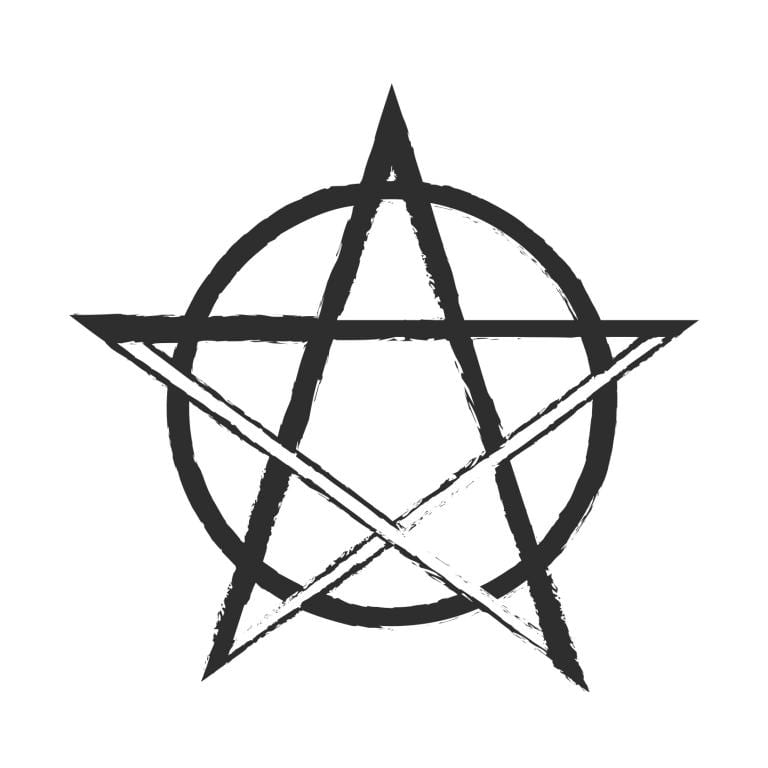
The Punk Pentagram – with thanks to Josh T. Romero
Towards the end of last year, I penned some thoughts on what I described as Punk Witchcraft, principally oriented around the idea that the fundamental core of witchcraft, in an historical context, leans toward radical anarchism. To my absolute delight, this piece resonated with one person, and this is the reward of all my writing. Writing is an art form that demands to be read and, like all good art, if it speaks or moves just one other, it has been effective.
In that piece, I argued that that Punk ethos indicated that witchcraft should be removed from hierarchical structures, orders and degrees of elitism, trappings of ego which ultimately seek to dominate and control. Working from the basis that the historic image of the witch, factual or imagined, is founded essentially upon the deep rooted fear of those engaged in the power brokering of the monolithic Church, we are entering a period when we may liberate witchcraft from the shackles of esoteric orders.
When the inquisitors penned the treatise on witchcraft, malleus maleficarum, we can observe, with the luxury of distance through time, the piteous vulnerability its authors were projecting; the frustration at being locked into the cold structure of the Church and at the mercy of superiors, and a stark misogyny that is frankly shocking even today. Like all men bound by a hierarchical power struggle, the authors reacted to the abuses of that power from above them by visiting further violence upon those they could. Violence begets violence and, in the case of the Heinrich Kramer (1430 – 1505), the principal author of the malleus, the production of a manual designed to persecute any under the suggestion of witchery was prompted after his expulsion from Innsbrook by a Bishop describing him as “senile and crazy”. Indeed, this summation may have been accurate, but the petty and vindictive nature of Kramer penned a cruel and vicious work attacking women as justification.
A conclusion I drew in my previous piece was that, if there were those who believed that they possessed the powers ascribed to them, and there were [1], they were responding to the crippling society which cornered them in every aspect of their daily lives. Indeed, the medieval peasant, navigating a terrifying mortality rate, was the recipient of abuses from both secular and religious authorities who were all too ready to brandish the tools of power. If there was one small mercy in the feudal society of our forebears it would be the ability to mete out some restitution, or otherwise obtain relief from the traumas of the everyday. I find it difficult to accept that those accused of bewitching did not hold anarchist sentiments in their hearts and would readily take the devil’s deal when he might utter: “wouldst thou like to live deliciously?”
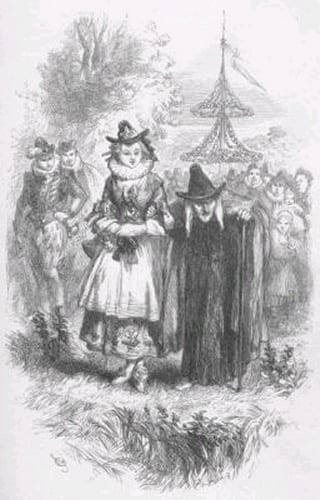
Two of the accused witches: Anne Whittle (Chattox) and her daughter Anne Redferne. Illustration by John Gilbert from the 1854 edition of William Harrison Ainsworth’s The Lancashire Witches.
Anarchism is defined as a political philosophy, and it is apparent that the usage of the term emerged from the 19th century in Europe, through the International Workingmen’s Association and Marx and Bakunin. Deriving from the Greek anarchia, denoting ‘government of no one’, or ‘without a ruler’, anarchism remains a byword for chaos and disorder. Partly, the negative connotations, and lack of knowledge or understanding which accompany it, arise from the ardent opposition anarchism continues to face from the structures of authority and state. Whilst there exist many complexities, and difficulty in discerning factions and philosophies, there remains in Anarchism a fundamental principle of decentralisation of governance, rejection of hierarchies, and opposition to unjustified wielding of power. Of course, with these tenets, Anarchism in various guises became associated with Socialism. With many diverse attitudes within the genre of Anarchism, several areas of concern have gained anarchist supporters, including most obviously politics and state, the rights of the working class, education, and art.
During the last century, the infant body of modern witchcraft lore danced around the ideas of Margaret Alice Murray (1863 – 1963) and her theories of a surviving and organised underground witch-cult. Of course, such notions are roundly debunked today, much to the chagrin of many romantics, but they continue to persist. Interesting to note that the broad acceptance of this theory among the progenitors of modern neo paganismand witchcraft is bound to their organising of bodies, or sodalities, mostly based upon the lodge systems that produced them. Ironically, many outside of regular Freemasonry don’t realise that the master of a lodge changes annually, elected from the membership, in theory allowing each to eventually have their time on the chair, thus ensuring an egalitarian governance of no singular authority at lodge level. The model of the Masonic lodge as a basis for organising was met with later developments by the mid-Century which afforded additional facets to accommodate the evolving current. Nevertheless, there emerged a sense that often hierarchical group bodies maintained an authority and power politics frequently raged, as did so called ‘witch wars’. This inevitable result of infighting, wrestling for control of groups, heritage and, ownership of ideas, continue to plague the modern witchcraft and pagan movement. Significantly, the writing of legacy, sometimes using imaginative retroactive continuity, seeks to legitimise and fix histories, while providing present or future authority and legitimacies.
Unfortunately, this all seems a necessary evil of any system which derives its power from any singular authority, maintained by structure wherein there is a person or persons who, ultimately, possess the controlling and overruling actions, knowledge, and rights that supersede the sovereignty of the individual. Whenever such tribal modes form around a leader, power ultimately becomes currency with one or two individuals gaining some influence or favour, and taking immediate advantage of their proximity to authority. Like a troop of chimpanzees, the pattern is no more sophisticated because the interest of the group are elevated by philosophy and metaphysics. Functionaries of authority will always nurture whatever favour they have garnered to their advantage, wielding this over those at the lower rungs of the pecking order, and collectively turning against even the slightest transgression within the troop. This all seems unlikely to the historic witch, who believably operated as a part of a loose gathering at best.
As the social, economic, technological and environment pressures of our modern world bear down heavily upon our group psyche, we must each take account and calculate how we engage the world. There are many instances in the occult community where Orders and lodge-type groups are becoming retired and gatekeeping is often counterproductive, sowing the seeds of elitism which corrupt into an authoritarian approach. Indeed, many moribund structures of the old school might have had their day in the twentieth Century, while the personal sovereignty of the individual is influencing the zeitgeist. If you are not empowered by your practice, nourished by your spirituality, then one must question whether it serves your best interest.
The Covid-19 pandemic, instigating several international lockdowns, has brought many aspects of our modern world starkly into the focus of our collective attention. The myriad challenges the pandemic has introduced run deep, and we must tip many sacred cows before we are ready to accept a new post-Covid world. As far as magical work goes, it has meant we have all become quite reliant upon our own efforts in the pursuit of these endeavours. Restriction on gatherings has meant a lot of creativity and adaptation in how we approach our practice, and the decentralisation, the removal of a leader in any guise as the active authority over your actual practical magics, has meant many have had enjoyed experiences they otherwise wouldn’t have had available to them if the architecture of the group were in proximity control.
As a continuation, part 2 if you will, of the previous Punk Witchcraft proposal, the principal aim here is to suggest that there is a path available to magical practitioners that does not depend upon the authority of a lineage holder, leader, High Priest(ess), guru or chief – one that is at least as legitimate, if not more authentic when measured against historic witchcraft and sorcery. In terms of witchery, I firmly believe that the origins and persistent ethos of the witch is one that embraces the Punk attitude.
I waffle incessantly, I know. If you do not read any of the above, the main point of this piece is a foundational statement of the ethos. Being true to the tenets of Punk Witchcraft, this statement and the accompanying symbol, combining the circle-A of Anarchism with the pentagram of witchcraft, do not belong to anyone. I encourage you to take this ethos forward, to develop new ways to use your magical authority to evolve. Only by facing challenges are we at liberty to adapt and grow.
Incorporating inversion, reversion and subversion, Punk Witchcraft is the sorcerous folk [2] expression of rebellion and liberty against established social and spiritual authority, coupled with the need to apply inventive and imaginative use of magical techniques in line with the tenets of the subculture of Punk, namely individual liberty, anti-establishment, direct action and a creative, Do-It-Yourself ethic.
[1] Illegitimate beggar, Alizon Demdike appears to have been utterly convinced that she had harmed pedlar John Law when he refused to give her some pins on the road to Trawden Forest in 1612, triggering the Pendle Witch trials. [2] ‘Folk’ denotes the culture arising out of, and intended for, common people and custom.
About Ian Chambers
Ian Chambers is a Punk Witch, and anarchistic sorcerous worker. You can read more about the author here.
Previous Post

January 30, 2021
Discussing the Late Witch Ralph Harvey with Richard Gordon
Next Post

April 19, 2021 Whistling the Winds of Beltane
Browse Our Archives
Select a Category 1734 Ancestors Apophatic Sorcery Atramentous Press Beltane Betrayal big dipper Book Book Review Brigit Candlemas Ced Ced Tarot child of promise Christmas Climate Community Compass Conferences Conjuration culture Cultus Sabbati Dance Death Devil Dionysus Double Easter Environment Esotericism Events Experience Fairy Fate Folklore Greek Gods Greek Magical Papyri Green Man Grimoire history Initiation Interviews Jewish Mysticism Judas Kabbalah Legend Lilith Mandrake Books Llewellyn Lore Lucifer Magic Magic in History Series May Day Meditation Merkabah Monkey King Myth Necromancy New Books NEws north star road Oberon Obituary Occult Offerings Opposer Pagan Pax Deorum Pax Diaboli PGM Philosophy Poetry Politics Praxis Punk Witchcraft Ralph Harvey Reviews Richard Gordon Rita Morgan Ronald “Chalky” White Sabbatic Witchcraft Sabbats Sun Wukong Taoist the Regency The Witch Compass Three Hands Press Tradition Traditional Witchcraft Trickster God Tricksters Uncategorized via Negativa White Dragon Winds Witch lore Witchcraft Witchcraft Lore Witches' Sabbath wyrd Yule
Select a Month May 2025 March 2025 February 2025 January 2025 December 2024 July 2024 June 2024 April 2024 March 2024 February 2024 January 2024 December 2023 November 2023 October 2023 September 2023 August 2023 July 2023 December 2022 October 2022 September 2022 August 2022 May 2022 April 2022 March 2022 February 2022 December 2021 July 2021 May 2021 April 2021 February 2021 January 2021 December 2020 November 2020 September 2020 August 2020 July 2020 June 2020 May 2020 April 2020 March 2020 February 2020 January 2020 December 2019 November 2019 October 2019 September 2019 July 2019 June 2019 May 2019 April 2019 March 2019 December 2018 September 2018 August 2018 July 2018 June 2018 May 2018 April 2018 March 2018 February 2018 June 2017 October 2016 September 2016 July 2016 June 2016 April 2016
Follow Us!
TAKE THE
Religious Wisdom Quiz
I was called three times in the night before I realized it was the Lord speaking to me. Who am I?
Select your answer to see how you score.
Saul Samuel David Eli
Related posts from By The Pale Moonlight

Shattered Illusions: Stories of Pre-Internet Days

Maundy Thursday: Night of the Witches
Traditional Witchcraft and Betrayal...

Witchcraft in Reality: A Rebuttal
TRENDING AT PATHEOS Pagan

I was recently chatting with someone on Instagram. She asked me what...

While there are many people who share their results, the end of...

On July 23, I saw Christopher Nolan's The Odyssey which is Homer’s...

As I write this two big events have just finished up. One...

Restoring the Watershed of Divine Love
Perhaps cooperation is not something we manufacture through legislation, ideology, or moral...

Many UUs don’t pray because of bad experiences in a previous religion,...
view all Pagan blogs
Ad-Free & Subscriber Log-In Subscription Support
- About Us
- 2026 Calendar
- Videos
- Podcasts
- Library of World Religions
- Faith In Media Tracker
- Advertise With Us
- Write for Us
- Privacy Policy
- Terms of Service
- Do Not Sell My Data
- Contact Us
- Radiant Digital
- Manage Newsletter Subscriptions
- Unsubscribe From Notifications
- Sitemap
Copyright 2008-2026, Patheos. All rights reserved.
Subscription Support Ad-Free & Subscriber Log-In
Follow Patheos