
BuddhistCatholicContemplativeEvangelicalGeneral ChristianHinduJewishLatter-day SaintMuslimNew VisionsProgressive Christian
Beliefs
- Buddhist
- Catholic
- Contemplative
- Evangelical
- General Christian
- Hindu
- Jewish
- Latter-day Saint
- More Voices
- Muslim
- New Visions
- Pagan
- Progressive Christian
Topics
- Religion News
- Food and Religion
- Sports and Religion
- Religious Art
- Religious Music and Entertainment
- Religious Events
- History and Religion
- Style and Religion
- Politics and Religion
- Women in Religion
- Recreation Outdoors and Religion
- Business Finance and Religion
- Careers Workplace and Religion
- Education and Religion
- Family Parenting and Religion
- Health Fitness and Religion
- Home and Religion
- Relationships and Religion
- Technology and Religion
- Travel and Religion
Columnists
- Buddhist Columnists
- Business Finance and Religion Columnists
- Careers Workplace and Religion Columnists
- Catholic Columnists
- Contemplative Columnists
- Education and Religion Columnists
- Evangelists Columnists
- Family Parenting and Religion Columnists
- General Christian Columnists
- Health Fitness and Religion Columnists
- Hindu Columnists
- History and Religion Columnists
- Home and Religion Columnists
- Jewish Columnists
- More Voices Columnists
- Latter Day Columnists
- Muslim Columnists
- New Visions Columnists
- Nonreligious Columnists
- Pagan Columnists
- Politics and Religion Columnists
- Progressive Columnists
- Recreation Outdoors and Religion Columnists
- Relationships and Religion Columnists
- Religion News Columnists
- Religious Art Columnists
- Religious Events Columnists
- Religious Music and Entertainment Columnists
- Sports and Religion Columnists
- Style and Religion Columnists
- Technology and Religion Columnists
- Travel and Religion Columnists
- Women in Religion Columnists
Resource Library
- 2026 Calendar
- Library of World Religions
- The 100 Most Holy Places on Earth
- Patheos Answers
- Podcasts
- Videos
- Faith Leaders Database
- Anglican Episcopalian
- Bahai
- Baptist
- Buddhism
- Christianity
- Confucianism
- Eastern Orthodoxy
- Hinduism
- Holiness and Pentecostal
- ISKCON
- Islam
- Judaism
- Lutheran
- Methodist
- The Church of Jesus Christ of Latter-day Saints
- New Age
- Paganism
- Presbytarian and Reformed
- Protestantism
- Religion Behind the Scenes
- Roman Catholic
- Scientology
- Shia Islam
- Sikhism
- Sufism
- Sunni Islam
- Taoism
- Zen
- See all religions
Research Tools
 Ad-Free & Subscriber Log-In Subscription Support
Ad-Free & Subscriber Log-In Subscription Support
Follow Patheos 

- Trending:
- Forgiveness
- |
- Marriage
- |
- Consciousness
- |
- Death Penalty
- |
- Election
- |
- Halloween

- Home
- Pagan
- Pax Deorum – The Formula of Do ut Des & Making of Offerings
Pax Deorum – The Formula of Do ut Des & Making of Offerings
Last updated on: November 27, 2020 at 7:15 pm by Ian Chambers
Pax Deorum – The Formula of Do ut Des & Making of Offerings 2020-11-27T19:15:25+00:00 Ian Chambers
Patheos Explore the world's faith through different perspectives on religion and spirituality! Patheos has the views of the prevalent religions and spiritualities of the world.
Pax Deorum
Being the First Book of the Wanderer
(previously unpublished © Ian Chambers 2018)

Ubud, Bali © Ian Chambers 2019
The following is taken from the privately published work Pax Deorum, and introduces the philosophy behind the working relationship between deity or spirit and operator in the Classical Roman period which informed early medieval Europe. The formula is further expanded upon throughout the book and leads elegantly into the subsequent (and as yet unpublished) companion and follow up, Pax Diaboli.
All that is gold does not glitter,
Not all those who wander are lost;
The old that is strong does not wither,
Deep roots are not reached by the frost.-J. R. R. Tolkien, The Fellowship of the Ring
To the mind of the ancestral peoples, the harmony that existed between the living, familial, collective peoples and the nebulous order of the unseen, other world, which so evidently informs and partakes of the cosmos around them, was a careful balance. At the very heart of the most fundamental relationships between a peoples and any sense of a spiritual impulse is reciprocity.
Reciprocity and fairness are so essential to the makeup of human nature, from the earliest Homo Sapiens, that our approach to relationships is founded upon a moral understanding that our interactions are of a necessary give and take. Indeed, so innate is this idea of fairness in our species that we may develop an inequity aversion within our emerging ideas of morality as early as the age of 3 years old (Li et al., 2016). So frequent is the childhood plea of “it’s not fair”, and our psyche continues to develop around the notion of what we can accept as any exchange that maintains an equilibrium.
Furthermore, the survival and, perhaps, success of our species of modern human being is arguably dependent upon primitive notions of co-operation. In his seminal book Sapiens: A Brief History of Humankind, Yuval Noah Harari (Hebrew University of Jerusalem) persuasively discusses the cognitive revolution which gave mankind the impetus to project itself forward as a collective, working co-operatively and favouring cohesiveness over competition in order to thrive (Harari, 2014). So powerful is this idea, and comparable models exist today amongst tribal peoples such as those explored by the indigenous rights activist and documentary maker Bruce Parry (Parry, 2007), that we may say with confidence that our success depends upon a moral imperative toward reciprocity for collective and mutual benefit.
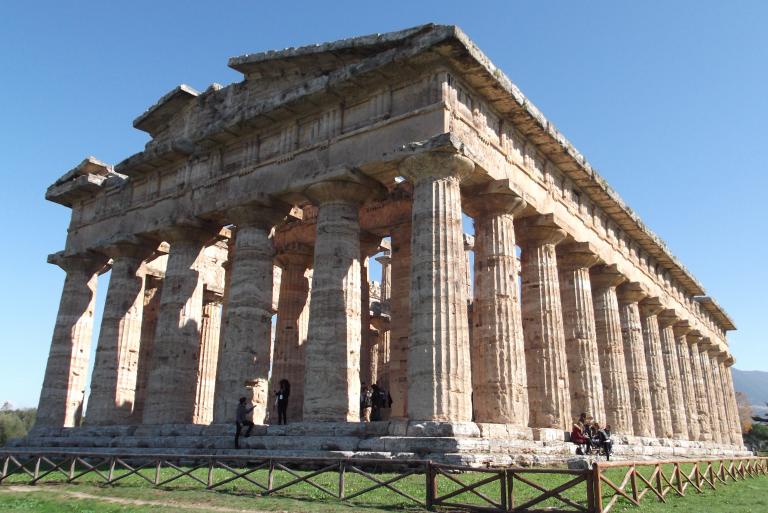
Paestum © Ian Chambers 2016
Whilst our present time would suggest a rise in the self-interest model, from the Neoliberal, free-market capitalist project of the 1980s, to the Presidency of Donald Trump, it is interesting to note that there has been long-term studies into the role of reciprocal fairness in economic situations. One paper, highlighting over 20 years of experimental theoretical simulations, or ‘games’, to unpick the motivation for economic behaviour, takes a rather more optimistic position in concluding that the application of reciprocal fairness models may be successfully used to closely analyse real-world application (Fehr and Schmidt, 2003).
This idea of reciprocity achieved a sophisticated and complex manifestation within the psyche of many ancient peoples, demonstrated throughout their cultural, social and religious behaviours. One such highly civilised and culturally structural rendition occurred during the Classical period of antiquity, most particularly in Imperial Rome. Whilst the machinery of the Roman state may have corrupted its religious urge for political advantage, the culture of the peoples remained faithfully religious at its very heart.
The religious and spiritual concepts of Rome required the model of reciprocal fairness to extend throughout their entire social order. In this manner, the whole body of the Roman people understood that equal and fair exchange was necessary, in principle if not always actuality, in order to maintain unity and cohesion. Once more, it is co-operation that depends upon, and is cohered behind, a cultural collective, an egregore. In consolidating the identity of the peoples of Rome, the myths coalesced to impart congruence and allowed the social group to expand, all the while working for a common good. The moral guidance for this collective benefit is everywhere underscored by the idea of equality, mutual exchange and fairness.
Thus, was the whole nourished by and contributed to the egregore, the national psyche. The tutelary deity and deities of the people, and associated myths, encompass all within the embrace of the body proper, providing an essential spiritual and psychic basis upon which their cultural form may operate, and allowing recourse to the same for moral guidance whenever the people were in need.
The maintaining of harmony between the spiritual and socio-politcal body of peoples was, therefore, vital to the continuance and safe-keeping of the community. Such was the sophistication of the Roman culture that they were able to vocalise such philosophical concepts that their forebears, and contemporaries, were instinctively compelled to adhere to. Like city states before and since, the Romans had developed complex and subtle expressions of their cultural heights, giving name to that which was understood even by primitive minds. The formula to which we refer was called, by the Romans, do ut des – I give that you might give – which was a constituent part of not only state religion, but more particularly in magic (Luck, 2006).
Whilst this notion may have been self-evident to past and present people, the Romans added a certain legal quality to it, with more than a hint of the contractual to the relationship. This formalising of the principle of reciprocity does denude the idea of some of its charm, something that was not lost of the Pauline Christians. Nonetheless, it does mark an historical moment when a people were self-aware enough to cogently enshrine such notions into a formula such as do ut des.
In understanding that the gods and spirits of the world around them would require the mutual attention of the people, the Romans undertook to establish a formal covenant to this effect: the pax deorum. This referred to the state of harmony between the spiritual forces and the cultural body of the Roman populace and was established upon the comprehension that the gods and their myths would be kept immortal and exalted so long as their stories were told, their rituals enacted and their wisdom observed. The Romans equally understood that, to ensure the continued immortality and august status of their spirits, the keeping of the festivals, ceremonies and observances, was to invite the favour of the same gods and spirits. In return for keeping the customs and correct religious practices, the gods would guide, protect, reward and ennoble their worshippers.
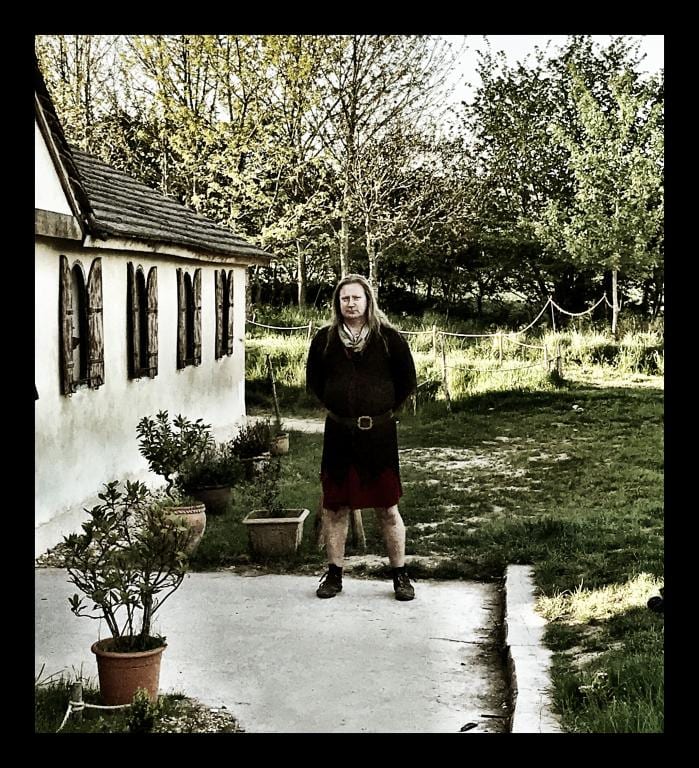
Butser Ancient Farm © Ian Chambers 2016
The Latin pax has a common root to two significance words in the English language – peace and pact. Both of these originate in the Proto-Indo-European language from a meaning of ‘fasten’ or ‘to bind’, which gives us a clear understanding of what is intended. Our common definition of pact includes a bond, or agreement, contract or covenant, all of which is suggestive of two or more things being bound together figuratively under certain conditions being met. Interestingly, peace comes from the same stem, and is understood best through its counterpart, war. Indeed, peace may be thought of as the absence of conflict, and therefore the sense of a treaty, compact, or agreement that combative or negative conditions are halted. In this sense, the opposite of the pax deorum, and which was to be avoided at all costs, was the ira deorum, or ire/anger of the gods – which might easily be equated with the idea of war.
In both cases, the idea of the covenant lends itself perfectly to our understanding of the idea and its inherent dependence upon the divine harmony which is sustained by the loyalty to the bond kept between gods and men for mutual benefit. This posits an interesting situation whereby the gods are not only exalted for their own sake, or because of an immature notion of godhood, but as the recognised aspect behind incorporeal, natural, mythological, spiritual and psychic occurrences. In this sense, the gods may be appeased, if they are wrathful. But the Roman notion is not one of assuaging the gods or somehow appeasing them, as though some terrible vengeance will be wreaked upon them for neglecting their faithful duties as in some Abrahamic traditions. Whilst there is an element of keeping the gods happy and from becoming irate, which would shatter the harmony and balance, the focus is much more strongly upon reciprocity, spiritual fairness and mutuality. After all, it can’t have been lost on the Classical thinkers of the era that a forgotten god is an utterly diminished and impotent deity with little or no power whatsoever.
Bibliography:
Fehr, E. (University of Z. and C. and Schmidt, K. M. (University of M. and C. (2003) ‘Theories of Fairness and Reciprocity – Evidence and Economic Applications’, Mathias Dewatripont, Lars Peter Hansen and Stephen J Turnovsky, Volume 1, p. pp 208 – 257.
Harari, Y. N. (2014) Sapiens: A Brief History of Humankind. English. New York: Harper.
Howard, M. (2004) The Book of Fallen Angels. Capall Bann Publishing.
Li, J. (Chinese A. of S. et al. (2016) ‘Young Children’s Development of Fairness Preference’, Frontiers in Psyhology. Available at: https://dx.doi.org/10.3389%2Ffpsyg.2016.01274.
Luck, G. (2006) Arcana Mundi: Magic and the Occult in the Greek and Roman Worlds. The John Hopkins University Press.
Parry, B. (2007) Tribe: Adventures in a Changing World. First. Michael Joseph.
Tolkien, J. R. R. (1954) The Fellowship of the Ring. First. George Allen & Unwin.

About Ian Chambers
Ian Chambers is a folk sorcerer and witch, practicing the craft of the Cunning Man of old, trying to do the best he can in a crazy, mad and beautiful world. You can read more about the author here.
Previous Post

November 25, 2020
Cain - The Witchfather in Traditional Witchcraft (Part 1)
Next Post

December 1, 2020 AvalonCon Debut in Glastonbury 2021 - Lineup & Tickets Launched
Browse Our Archives
Select a Category 1734 Ancestors Apophatic Sorcery Atramentous Press Beltane Betrayal big dipper Book Book Review Brigit Candlemas Ced Ced Tarot child of promise Christmas Climate Community Compass Conferences Conjuration culture Cultus Sabbati Dance Death Devil Dionysus Double Easter Environment Esotericism Events Experience Fairy Fate Folklore Greek Gods Greek Magical Papyri Green Man Grimoire history Initiation Interviews Jewish Mysticism Judas Kabbalah Legend Lilith Mandrake Books Llewellyn Lore Lucifer Magic Magic in History Series May Day Meditation Merkabah Monkey King Myth Necromancy New Books NEws north star road Oberon Obituary Occult Offerings Opposer Pagan Pax Deorum Pax Diaboli PGM Philosophy Poetry Politics Praxis Punk Witchcraft Ralph Harvey Reviews Richard Gordon Rita Morgan Ronald “Chalky” White Sabbatic Witchcraft Sabbats Sun Wukong Taoist the Regency The Witch Compass Three Hands Press Tradition Traditional Witchcraft Trickster God Tricksters Uncategorized via Negativa White Dragon Winds Witch lore Witchcraft Witchcraft Lore Witches' Sabbath wyrd Yule
Select a Month May 2025 March 2025 February 2025 January 2025 December 2024 July 2024 June 2024 April 2024 March 2024 February 2024 January 2024 December 2023 November 2023 October 2023 September 2023 August 2023 July 2023 December 2022 October 2022 September 2022 August 2022 May 2022 April 2022 March 2022 February 2022 December 2021 July 2021 May 2021 April 2021 February 2021 January 2021 December 2020 November 2020 September 2020 August 2020 July 2020 June 2020 May 2020 April 2020 March 2020 February 2020 January 2020 December 2019 November 2019 October 2019 September 2019 July 2019 June 2019 May 2019 April 2019 March 2019 December 2018 September 2018 August 2018 July 2018 June 2018 May 2018 April 2018 March 2018 February 2018 June 2017 October 2016 September 2016 July 2016 June 2016 April 2016
Follow Us!
TAKE THE
Religious Wisdom Quiz
What happened three days after Jesus was crucified?
Select your answer to see how you score.
A giant earthquake The temple was destroyed He rose from the dead The sea split
Related posts from By The Pale Moonlight

Shattered Illusions: Stories of Pre-Internet Days

Maundy Thursday: Night of the Witches
Traditional Witchcraft and Betrayal...

Witchcraft in Reality: A Rebuttal
TRENDING AT PATHEOS Pagan

I was recently chatting with someone on Instagram. She asked me what...

While there are many people who share their results, the end of...

On July 23, I saw Christopher Nolan's The Odyssey which is Homer’s...

As I write this two big events have just finished up. One...

Restoring the Watershed of Divine Love
Perhaps cooperation is not something we manufacture through legislation, ideology, or moral...

Many UUs don’t pray because of bad experiences in a previous religion,...
view all Pagan blogs
Ad-Free & Subscriber Log-In Subscription Support
- About Us
- 2026 Calendar
- Videos
- Podcasts
- Library of World Religions
- Faith In Media Tracker
- Advertise With Us
- Write for Us
- Privacy Policy
- Terms of Service
- Do Not Sell My Data
- Contact Us
- Radiant Digital
- Manage Newsletter Subscriptions
- Unsubscribe From Notifications
- Sitemap
Copyright 2008-2026, Patheos. All rights reserved.
Subscription Support Ad-Free & Subscriber Log-In
Follow Patheos