
BuddhistCatholicContemplativeEvangelicalGeneral ChristianHinduJewishLatter-day SaintMuslimNew VisionsProgressive Christian
Beliefs
- Buddhist
- Catholic
- Contemplative
- Evangelical
- General Christian
- Hindu
- Jewish
- Latter-day Saint
- More Voices
- Muslim
- New Visions
- Pagan
- Progressive Christian
Topics
- Religion News
- Food and Religion
- Sports and Religion
- Religious Art
- Religious Music and Entertainment
- Religious Events
- History and Religion
- Style and Religion
- Politics and Religion
- Women in Religion
- Recreation Outdoors and Religion
- Business Finance and Religion
- Careers Workplace and Religion
- Education and Religion
- Family Parenting and Religion
- Health Fitness and Religion
- Home and Religion
- Relationships and Religion
- Technology and Religion
- Travel and Religion
Columnists
- Buddhist Columnists
- Business Finance and Religion Columnists
- Careers Workplace and Religion Columnists
- Catholic Columnists
- Contemplative Columnists
- Education and Religion Columnists
- Evangelists Columnists
- Family Parenting and Religion Columnists
- General Christian Columnists
- Health Fitness and Religion Columnists
- Hindu Columnists
- History and Religion Columnists
- Home and Religion Columnists
- Jewish Columnists
- More Voices Columnists
- Latter Day Columnists
- Muslim Columnists
- New Visions Columnists
- Nonreligious Columnists
- Pagan Columnists
- Politics and Religion Columnists
- Progressive Columnists
- Recreation Outdoors and Religion Columnists
- Relationships and Religion Columnists
- Religion News Columnists
- Religious Art Columnists
- Religious Events Columnists
- Religious Music and Entertainment Columnists
- Sports and Religion Columnists
- Style and Religion Columnists
- Technology and Religion Columnists
- Travel and Religion Columnists
- Women in Religion Columnists
Resource Library
- 2026 Calendar
- Library of World Religions
- The 100 Most Holy Places on Earth
- Patheos Answers
- Podcasts
- Videos
- Faith Leaders Database
- Anglican Episcopalian
- Bahai
- Baptist
- Buddhism
- Christianity
- Confucianism
- Eastern Orthodoxy
- Hinduism
- Holiness and Pentecostal
- ISKCON
- Islam
- Judaism
- Lutheran
- Methodist
- The Church of Jesus Christ of Latter-day Saints
- New Age
- Paganism
- Presbytarian and Reformed
- Protestantism
- Religion Behind the Scenes
- Roman Catholic
- Scientology
- Shia Islam
- Sikhism
- Sufism
- Sunni Islam
- Taoism
- Zen
- See all religions
Research Tools
 Ad-Free & Subscriber Log-In Subscription Support
Ad-Free & Subscriber Log-In Subscription Support
Follow Patheos 

- Trending:
- Forgiveness
- |
- Marriage
- |
- Consciousness
- |
- Death Penalty
- |
- Election
- |
- Halloween

- Home
- Pagan
- Losing Your Head At Midsummer – An Ancient Rite Revisited
Losing Your Head At Midsummer – An Ancient Rite Revisited
Last updated on: May 23, 2020 at 10:00 am by Ian Chambers
Losing Your Head At Midsummer – An Ancient Rite Revisited 2020-05-23T10:00:17+00:00 Ian Chambers
Patheos Explore the world's faith through different perspectives on religion and spirituality! Patheos has the views of the prevalent religions and spiritualities of the world.
The following is an extract from Pax Deorum – A Modern Witchcraft Primer, 2018, by Ian Chambers
…Sir Gawain is himself the Verdant One, then he himself becomes the Green Knight. Symbolically, his transformation is effected by the act of cutting off the head of the Green Knight; for in mythic initiation, what we overcome we become. (Howard, 1995)

Headless Midsummer
Midsummer is a time of mirth and merriment and it is believed to be as old as our Stone Age ancestors. As the solar crown reaches the peak of its climb in the heavens and, cresting the zenith, begins its descent into the earth, we reflect upon the significance of beheading myth and folklore around this time.
The beheading of John the Baptist, who’s feast day coincides with the Midsummer around the time of the Summer solstice, aligns him with the Celtic Cult of the Head, which is a feature of the mythologies of the rather generalised grouping called the Celts. This label is a troublesome one for historians and anthropologists as it spans a broad area and time-scale, with obscure and contrived criterion for admission. Nonetheless, there appears to be a precedent for the custom of the ‘beheading game’ in the mythic stories that have been preserved in the British Isles, usually with an oracular status and concerning the transmission of sovereignty.
In the story of Brân the Blessed, as recounted in the collection of Welsh literature known as the Mabinogion, the King, Brân, is wounded in battle in Ireland against a foe who possess the Cauldron of Regeneration or Rebirth (itself a gift from Brân). Brân’s armies were victorious but, like Arthur in the Welsh poem Spoils of Annwfn, only seven survive. The British King Brân is struck by a poisoned arrow, perhaps symbolising Fate and Time and signifying those forces which the strongest and fiercest of warriors cannot defeat. Indeed, the arrow comes to mean so many things in this instance, where it can be seen as solar in nature; the piercing rays of the sun striking the heel, indicating the lowest point and the vulnerable part of an otherwise unconquerable hero, famously in the myth of Achilles (Broadhurst, 2006). That the arrow is poisoned might suggest that the sun’s ray is turned against the solar king, as indeed it is in the instance of Midsummer where, at his absolute peak, the sun’s increase now turns and the season of decline is upon us.
These are all pertinent to our mythic theme at the festival of Midsummer, when the sun reaches its highest point and appears to stand still (solstice), caught in the stasis of majesty as the crown of Sol Invictus, the Unconquerable Sun. A crown at the feet is thought to “…denote renunciation of royalty” which, in the case of Brân and the poisoned arrow, we might consider appropriate as the wounded king instructs his seven attendants to remove his head (his crown) and take it to *Gwynfryn, ‘*White Hill’. We can take this as a clear indication that the oracular head is to be interred in the Underworld, as the solar crown/halo begins its journey of descent ‘over the hill’.
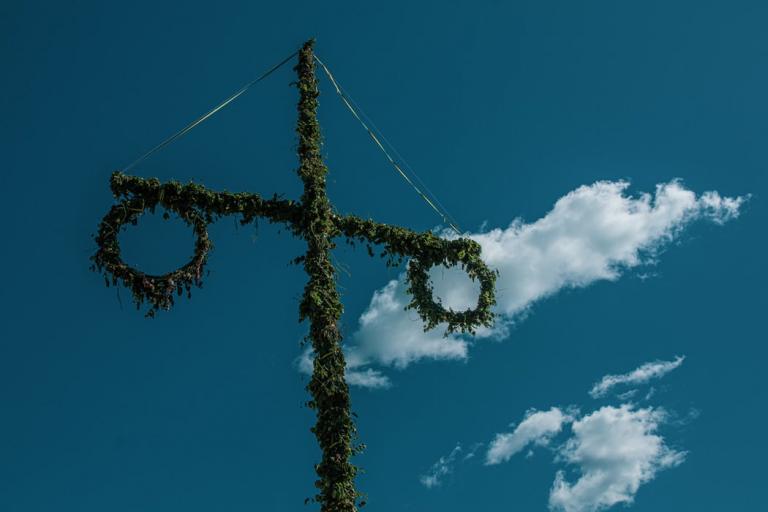
As with the crown, the head comes to reflect rulership, being the seat of mastery of the human frame and action, retaining the life-force of soul and mind. The head is the place of “…both intelligence and folly…” (Cooper, 1992), as it bears both the crown of victory and the fool’s cap. Indeed, “Head-hunters acquire the vital force and fertility of the victim…” (Cooper, 1992), as would those who take the oracular head of a significant individual such as Brân the Blessed, or St John the Baptist.
He must increase, but I must decrease. He that cometh from above is above all: he that is of the earth is earthly, and speaketh of the earth: he that cometh from heaven is above all.
(John 3:30 – 31, KJV)
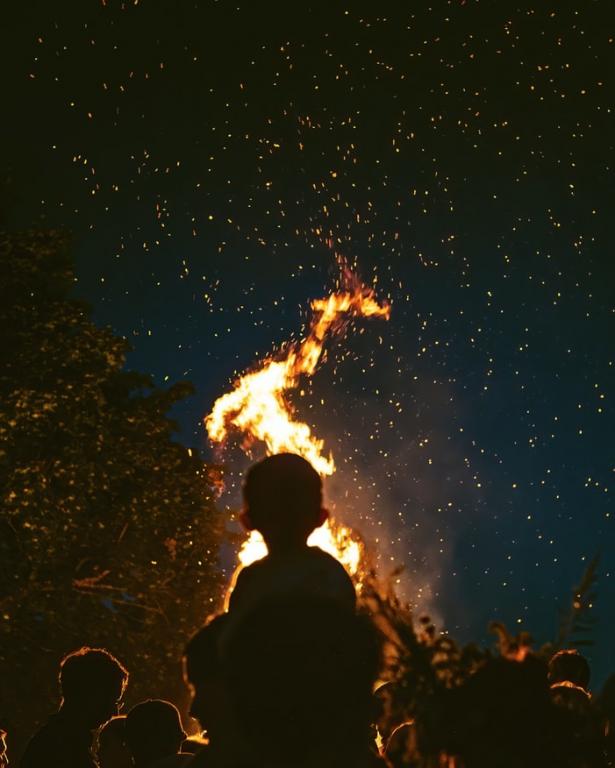
The Feast of St John the Baptist commemorates, in the Christian Calendar, the birth of the Forerunner who heralds Christ by six months, which traditionally subsumed residual pagan festivities that lingered around the winter solstice. Therefore, bonfires were a common feature across Europe at this feast, as a celebration of light and the fulness of the year. As we can see, the parallel feast of St John the Apostle occurs around the Midwinter solstice, placing the two Johns at opposite solstitial gateways.
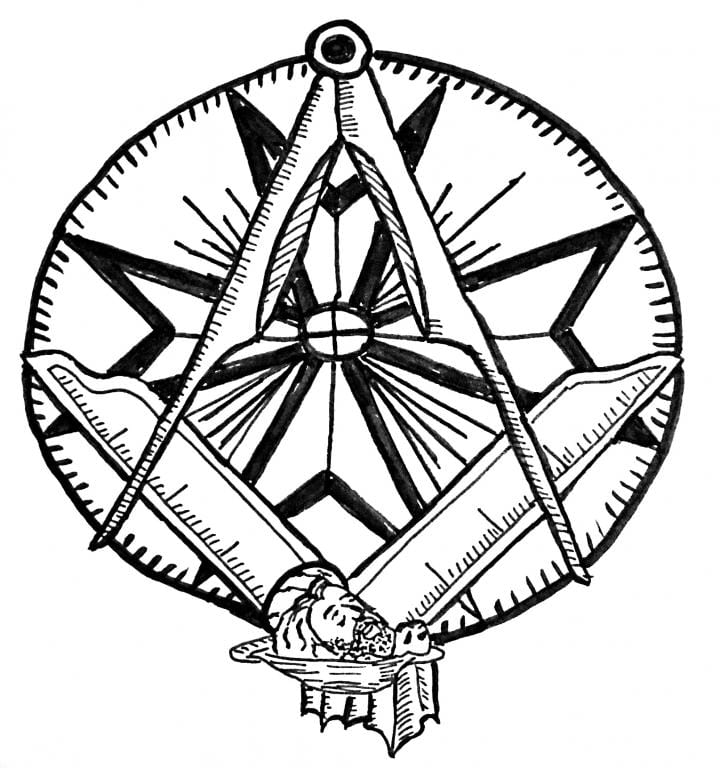
Copyright © Ian Chambers 2016
Becoming Headless
There is a precedent for the ‘Headless’ approach and it can be found in some of the oldest extant magical writings available to us. Discovered in the 18th Century, the Greek Magical Papyri (PGM) are a collection of manuscripts thought to have been composed within a date range from the 2nd Century BCE to the 5th Century CE. One of the best known rituals from the manuscripts collectively called the PGM is the Stele of Jeu, more commonly known as the Rite of the Headless One (Greek Akephalos).
The Rite of the Headless One (PGM V.96-172) is generally assumed by scholars to be an exorcism, although it carries with it the authority of invoking a powerful, headless deity, sometimes thought to be synonymous with Osiris or Amun-Ra. In the rite, the magician calls upon the entity, summoning with incantations most vehemently, and the text identifies this deity as he “… who created earth and heaven, who created night and day… whom none hath ever seen… thou hast made female and male; thou hast revealed both the seed and the fruit; thou hast made humans love each other and hate each other.”(Flowers, 1995).
A rather interesting blog post by Andrew Watt, Wanderings in the Labyrinth, concerns his work with the Rite of the Headless One and its association with the summer solstice, corresponding most closely to the time when the sun appears upon the shoulders of the constellation of Orion. Within this excellent post, Watt identifies (using the wonderful work of Austin Coppock) that the Solstice marks the point when “…the Sun figuratively ‘loses its head’, and starts to fall from the heights of his northern course.” Watt summarises his theory perfectly in the statement that the Headless One’s head is the sun and the day it begins to roll off the shoulders, losing his head, is the summer solstice around the feast of St John the Baptist.
The Headless Rite (Betz, 1996)
I summon you, Headless One, who created earth and heaven, who created night and day,
you who created light snd darkness; you are Osoronnophris whom none has ever seen; you are Iabas; you are Iapos; you have distinguished the just and the unjust; you have made female and male;
you have revealed seed and fruits; you have made men love each other and hate each other.
I am Moses your prophet whom you have transmitted your mysteries
celebrated by Israel; you have revealed the moist and the dry and all nourishment; hear me.
I am the messenger of Pharaoh Osoronnorphris,
this is your true name which has been transmitted to the prophets of Israel. Hear me, ARBATHIAŌ REIBET ATHELEBERSĒTH [ABA] BLATHA ALBEU EBENPHCHI CHITASGOĒ IBAŌTH IAŌ;
listen to me and turn away this daimon.
I call upon thee, awesome and invisible god with an empty spirit, AROGOGOROBRAŌ SOCHOU MODORIŌ PHALARCHAŌ OOO. Holy Headless One, deliver him, NN, from the daimon which restrains him,
ROUBRIAŌ MARI ODAM BAABNABAŌTH ASS ADŌNAI APHNIAŌ ITHŌLĒTH ABRASAX AĒŌŌY; mighty Headless One, deliver him, NN, from the daimon which restrains him,
MABARRAIŌ IOĒL KOTHA ATHORĒBALŌ ABRAŌTH, deliver him, NN, AŌTH ABRAŌTH BASYM ISAK SABAŌTH IAŌ.
He is the lord of the gods; he is the lord of the inhabited world; he is the one whom the winds fear; he is the one who made all things by the command of his voice.
Lord, King, Master, Helper,
Save the soul, IEOU PYR IOU IAŌT IAĒŌ IOOU ABRASAX SABRIAM OO YY EY OO YY ADŌNAIE, immediately, immediately, good messenger of God ANLALA LAI GAIA APA DIACHANNA CHORYN.
When a full awareness of the headless state is attained, recite the following:
I am the headless daimon with my sight in my feet; I am the mighty one who possesses the immortal fire; I am the truth who hates the fact that unjust deeds are done in the world; I am the one who makes the lightning flash and the thunder roll;
I am the one whose sweat falls upon the earth as rain so that it can inseminate it; I am the one whose mouth burns completely; I am the one who begets and destroys;
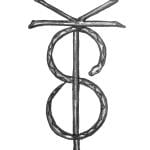
I am the Favour of the Aiôn; my name is a heart encircled by a serpent; come forth and follow.
Bibliography:
Betz, H. D. (1996) The Greek Magical Papyri in Translation – Volume One: Texts with an updated bibliography. 2nd edn. The University of Chicago Press.
Broadhurst, P. (2006) The Green Man and the Dragon. 1st edn. Mythos.
Cooper, J. C. (1992) An Illustrated Encyclopedia of Traditional Symbols. 1st Reprin. Thames & Hudson.
Flowers, S. (1995) Hermetic Magic: The Post Modern Magical Papyrus of Abaris. 1st edn. Samuel Weiser, Inc.
Harding, D. E. (2013) On Having No Head. 1st edn. The Shollond Trust.
Howard, M. (1995) The Sacred Ring. 1st edn. Capall Bann Publishing.
Meyer, M. and Smith, R. (1994) Ancient Christian Magic: Coptic Texts of Ritual Power. 1st edn. Edited by M. Meyer and R. Smith.
About Ian Chambers
Ian Chambers is a traditional witch engrossed in the study and practice of the Art as conveyed by means of the mysteries. By diligent study, research, exploration and direct application of myth and magic, the author has dedicated his life to the Work with many sacrifices along the way. Walking the lonely path, the Covenant of the Wanderer, a Child of the Land of Nod, raising the lantern by which the path of the Chapel Perilous may be illumined and the Castle perceived. You can read more about the author here.
Previous Post
April 14, 2020
St George - A Cainite Myth?
Next Post
June 14, 2020 Apocalypse Then: Reflections upon Gnostic Expressions of Revelation
Browse Our Archives
Select a Category 1734 Ancestors Apophatic Sorcery Atramentous Press Beltane Betrayal big dipper Book Book Review Brigit Candlemas Ced Ced Tarot child of promise Christmas Climate Community Compass Conferences Conjuration culture Cultus Sabbati Dance Death Devil Dionysus Double Easter Environment Esotericism Events Experience Fairy Fate Folklore Greek Gods Greek Magical Papyri Green Man Grimoire history Initiation Interviews Jewish Mysticism Judas Kabbalah Legend Lilith Mandrake Books Llewellyn Lore Lucifer Magic Magic in History Series May Day Meditation Merkabah Monkey King Myth Necromancy New Books NEws north star road Oberon Obituary Occult Offerings Opposer Pagan Pax Deorum Pax Diaboli PGM Philosophy Poetry Politics Praxis Punk Witchcraft Ralph Harvey Reviews Richard Gordon Rita Morgan Ronald “Chalky” White Sabbatic Witchcraft Sabbats Sun Wukong Taoist the Regency The Witch Compass Three Hands Press Tradition Traditional Witchcraft Trickster God Tricksters Uncategorized via Negativa White Dragon Winds Witch lore Witchcraft Witchcraft Lore Witches' Sabbath wyrd Yule
Select a Month May 2025 March 2025 February 2025 January 2025 December 2024 July 2024 June 2024 April 2024 March 2024 February 2024 January 2024 December 2023 November 2023 October 2023 September 2023 August 2023 July 2023 December 2022 October 2022 September 2022 August 2022 May 2022 April 2022 March 2022 February 2022 December 2021 July 2021 May 2021 April 2021 February 2021 January 2021 December 2020 November 2020 September 2020 August 2020 July 2020 June 2020 May 2020 April 2020 March 2020 February 2020 January 2020 December 2019 November 2019 October 2019 September 2019 July 2019 June 2019 May 2019 April 2019 March 2019 December 2018 September 2018 August 2018 July 2018 June 2018 May 2018 April 2018 March 2018 February 2018 June 2017 October 2016 September 2016 July 2016 June 2016 April 2016
Follow Us!
TAKE THE
Religious Wisdom Quiz
"Let your ________ before men, that they may see your good deeds and praise your Father in heaven."
Select your answer to see how you score.
Face Shine Conscience Be Clear Voice Be Raised Light So Shine
Related posts from By The Pale Moonlight

Shattered Illusions: Stories of Pre-Internet Days

Maundy Thursday: Night of the Witches
Traditional Witchcraft and Betrayal...

Witchcraft in Reality: A Rebuttal
TRENDING AT PATHEOS Pagan

I was recently chatting with someone on Instagram. She asked me what...

While there are many people who share their results, the end of...

On July 23, I saw Christopher Nolan's The Odyssey which is Homer’s...

As I write this two big events have just finished up. One...

Restoring the Watershed of Divine Love
Perhaps cooperation is not something we manufacture through legislation, ideology, or moral...

Many UUs don’t pray because of bad experiences in a previous religion,...
view all Pagan blogs
Ad-Free & Subscriber Log-In Subscription Support
- About Us
- 2026 Calendar
- Videos
- Podcasts
- Library of World Religions
- Faith In Media Tracker
- Advertise With Us
- Write for Us
- Privacy Policy
- Terms of Service
- Do Not Sell My Data
- Contact Us
- Radiant Digital
- Manage Newsletter Subscriptions
- Unsubscribe From Notifications
- Sitemap
Copyright 2008-2026, Patheos. All rights reserved.
Subscription Support Ad-Free & Subscriber Log-In
Follow Patheos