
BuddhistCatholicContemplativeEvangelicalGeneral ChristianHinduJewishLatter-day SaintMuslimNew VisionsProgressive Christian
Beliefs
- Buddhist
- Catholic
- Contemplative
- Evangelical
- General Christian
- Hindu
- Jewish
- Latter-day Saint
- More Voices
- Muslim
- New Visions
- Pagan
- Progressive Christian
Topics
- Religion News
- Food and Religion
- Sports and Religion
- Religious Art
- Religious Music and Entertainment
- Religious Events
- History and Religion
- Style and Religion
- Politics and Religion
- Women in Religion
- Recreation Outdoors and Religion
- Business Finance and Religion
- Careers Workplace and Religion
- Education and Religion
- Family Parenting and Religion
- Health Fitness and Religion
- Home and Religion
- Relationships and Religion
- Technology and Religion
- Travel and Religion
Columnists
- Buddhist Columnists
- Business Finance and Religion Columnists
- Careers Workplace and Religion Columnists
- Catholic Columnists
- Contemplative Columnists
- Education and Religion Columnists
- Evangelists Columnists
- Family Parenting and Religion Columnists
- General Christian Columnists
- Health Fitness and Religion Columnists
- Hindu Columnists
- History and Religion Columnists
- Home and Religion Columnists
- Jewish Columnists
- More Voices Columnists
- Latter Day Columnists
- Muslim Columnists
- New Visions Columnists
- Nonreligious Columnists
- Pagan Columnists
- Politics and Religion Columnists
- Progressive Columnists
- Recreation Outdoors and Religion Columnists
- Relationships and Religion Columnists
- Religion News Columnists
- Religious Art Columnists
- Religious Events Columnists
- Religious Music and Entertainment Columnists
- Sports and Religion Columnists
- Style and Religion Columnists
- Technology and Religion Columnists
- Travel and Religion Columnists
- Women in Religion Columnists
Resource Library
- 2026 Calendar
- Library of World Religions
- The 100 Most Holy Places on Earth
- Patheos Answers
- Podcasts
- Videos
- Faith Leaders Database
- Anglican Episcopalian
- Bahai
- Baptist
- Buddhism
- Christianity
- Confucianism
- Eastern Orthodoxy
- Hinduism
- Holiness and Pentecostal
- ISKCON
- Islam
- Judaism
- Lutheran
- Methodist
- The Church of Jesus Christ of Latter-day Saints
- New Age
- Paganism
- Presbytarian and Reformed
- Protestantism
- Religion Behind the Scenes
- Roman Catholic
- Scientology
- Shia Islam
- Sikhism
- Sufism
- Sunni Islam
- Taoism
- Zen
- See all religions
Research Tools
 Ad-Free & Subscriber Log-In Subscription Support
Ad-Free & Subscriber Log-In Subscription Support
Follow Patheos 

- Trending:
- Forgiveness
- |
- Marriage
- |
- Consciousness
- |
- Death Penalty
- |
- Election
- |
- Halloween

- Home
- Pagan
- St George – A Cainite Myth?
St George – A Cainite Myth?
Last updated on: April 14, 2020 at 11:06 pm by Ian Chambers
St George – A Cainite Myth? 2020-04-14T23:06:50+00:00 Ian Chambers
Patheos Explore the world's faith through different perspectives on religion and spirituality! Patheos has the views of the prevalent religions and spiritualities of the world.
First published in The Cauldron #132 , May 2009
Reprinted in The Hedgewytch, May/Beltane 2010
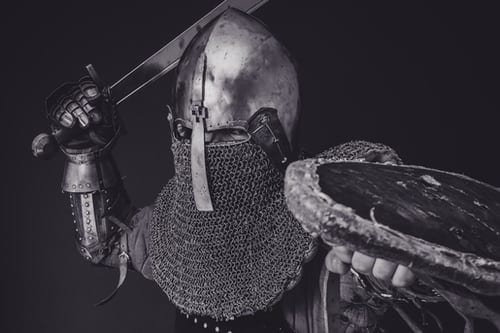
In the legend of St George we are given the familiar story of a hero defeating his particular monster. But does the person of St George conceal a deeper meaning within the folds of the legend? It might seem a little ambitious to connect England’s (and a good many other nations) patron saint to an heretical cult. However, the writer hopes to indicate that the tale incorporates a truth that is inherent in the myth, despite the cross-pollination over the centuries. This article is aimed at investigating the symbolic associations found within the legend and the figure of the saint, with particular emphasis upon the rendition found in Thomas Percy’s Reliquies of Ancient English Poetry (1765), which features a unique telling of the story of George’s birth. Thomas Percy’s Reliquies is the principle source for this study and readers are encouraged to explore the prose for themselves [1]. In this single item of literature, we find George born under auspicious circumstances, referred to as a ‘dragon’ while in the womb, marked at birth with a red cross and a dragon, and raised by a ‘weird woman of the woods’ in a cave.
Neglected as a day of patriotic celebration, St George’s Day (April 23rd) is in the astrological sign of Taurus the Bull, an earth sign ruled by the planet Venus [2]. Associations include Ishtar, Isis, Freyja, Frigg, Pan, Dionysus and, with a serpent reference, Quetzacoatl, the Aztec feathered serpent deity. The symbol of Taurus is the head and horns of a bull. One has only to see this symbol within an occult context and the image of a horned bull god occurs. So we can immediately see that George has a significant place within astrological tradition, linking him with some significant mythological correspondences often associated with the witch cult and the Mysteries.
If we examine this in more detail, we find that Venus was the consort of the Roman deity Vulcan, the lame blacksmith god of fire. Through this connection, Vulcan has been compared with Tubal-Cain, the descendant of the biblical Cain and a Kenite smith deity. Michael Howard and Nigel Aldcroft Jackson identify the image of St George in Rosslyn Chapel, Scotland, reputed resting place of the Grail and haunt of the Knights Templar, with the symbol of the rose, a ‘flower with some Luciferian significance significance. It is the emblem of Venus and Ishtar and the symbol of the bloodline, or ‘Family’ of the Rose’, descended from the Watchers (fallen angels)'[3]. In addition, the same authors establish a connection with the pre-Islamic and Islamic Green Man, a Saint of Sufism, Al-Khidr.
Consider that George, etymologically, means ’tiller of the earth’, or ploughman, from two Greek components. The first to hold the position of ploughman, according to Biblical students, is Cain, as Abel his brother is to herdsmen, and Adam to gardeners. So George equates with Cain and his story, including the serpent in the Garden of Eden, takes on a more mystical appearance. According to the ‘serpent seed’ heresy, the Edenic serpent had sexual congress with Eve and Cain was the result of this union. Curiously, the legend of George’s birth in Percy’s Reliquies similarly presents George as a dragon in the womb [4].
So we can see George as corresponding with Tubal-Cain in the Luciferian tradition, but what of the serpent ad the fact that, in the modern rendition given by Thomas Percy, he is identified as being the dragon? If George and Cain are cognates, then as a metallurgist George is capable of originating both tools (the plough) and weapons (the sword). Furthermore, the dragon is sometimes correlated with the earth. So the myth could represent early agriculturalists (Cain) ‘mastering the dragon’ or putting the earth under his will of the plough. But in Percy’s telling of the myth of George’s birth, we have our hero first represented as a dragon and given an unusual initiation into life. This is, however, only unusual to us but, when compared to other initiatory mythic heroes, George is actually quite the norm in the Mystery Traditions. For example, Dionysus-Zagreus in the Orphic Mysteries was begat upon Persephone in a cave by the god Zeus, disguised as a snake.
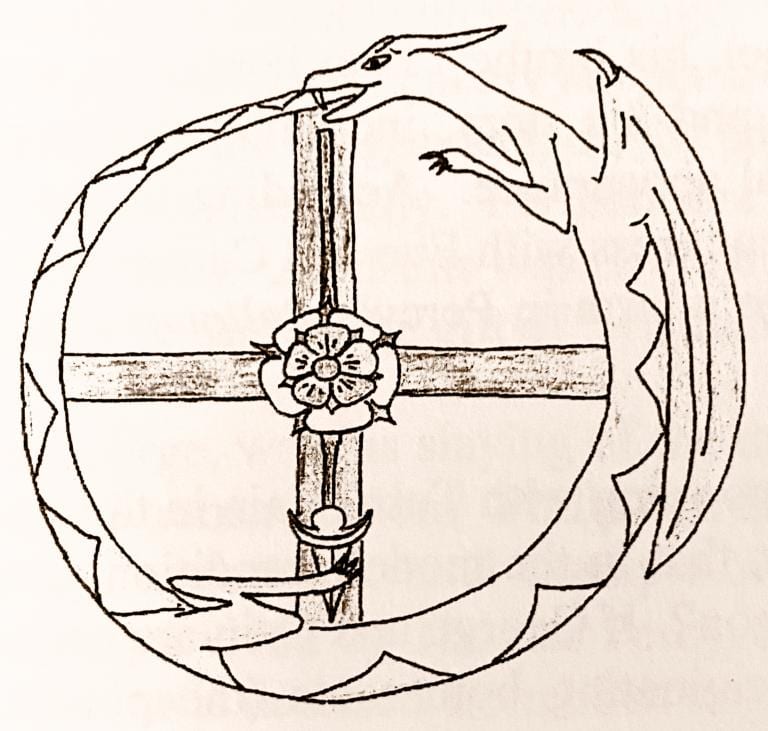
In alchemical and occult circles, the serpent is often depicted entwined around a Tau, or T-shaped cross. Alchemically, the symbol can represent the ‘fixing of the volatile’ and one meaning is that it is concerned with focussing upon an inner issue without any distraction from the conscious mind. One has to consider the alchemist’s objective to transform a base substance into a nobler one. In psychology, this is paralleled with achieving greater union with Carl Jung’s ‘super-conscious’ via the archetypes. Therefore, the term is concerned with making the volatile spirit stable. Alternatively, the symbol of the Tau Cross can be perceived as being representative of spirit being ‘fixed’ in the material. Interestingly, the Bible offers us an image of the serpent on the Tau Cross: “…and the Lord said to Moses, ‘make a saraph and mount it on a pole, and if anyone who has been bitten looks at it, he will recover'”. Moses accordingly made the bronze serpent and mounted it on a pole [5].

Philip Gardiner, best-selling author of The Shining Ones, The Serpent Grail and The Secret of Solomon’s Temple Revealed, connects the Tau Cross with Thor’s Hammer and the serpent of Midgard (Middle Earth, or the world). From there he expands his theory and ends with the early Christians transmuting this (pagan) symbolism to that of the ‘red serpent cross’ of St George [6]. Obviously, the caduceus is perhaps the best known symbol of the serpent cross and it is the wand of the Greek god Hermes (Mercury). The Caduceus may have originated with the myth of Tiresias, who was turned into a woman for seven years. This magical transformation took place after he used his staff to kill a female snake while she was mating. Only when the ritual is reenacted with the male snake can the hero return to his true gender.
Following this theme, we can see that the dragon represents transformation. The symbolism the serpent-dragon is consistently and powerfully charged and concerned, for the most part, with transmutation and hidden knowledge. In the 13th Century Icelandic legend of Sigurd, for example, the hero’s enemy adopts the form of a dragon to protect a hoard of gold [7]. Sigurd kills the dragon and, on the advice of the god Odin, bathes in its blood and thus attains invulnerability. Furthermore, drinking the dragon’s blood conveys the language of the birds. As if this was not enough, roasting and consuming part of the creature’s heart gave Sigurd the gift of ‘wisdom’ or prophetic vision.
So, returning to our hero, St George, was his slaying of the dragon a symbolic representation of his own initiation and transmutation? Philip Gardiner points to the fact that the snake sheds its skin and is therefore a natural example of a creature that is reborn. In our version of St George, as provided by Thomas Percy, the hero is marked by a cross and a dragon, indicating that he is destined from birth to go through this initiation. According to some, the Mark fo Cain was an equal-armed cross that may have been in honour of Tubal-Cain, whom many ascribed to be the ancestor of the biblical nomadic people, the Kenites, who were renowned meta-lsmiths. In another form, the Mark of Cain was a Tau Cross or red serpent. It has been speculated by those who point to the occult knowledge possessed by the Templars that the Mark fo Cain was signified by their adoption of an equal-armed red cross as their emblem, thus indicating the hidden inner knowledge at the core of the Order. Rather curiously, the word ‘Cain’ originates with the Hebrew word ‘Qayin’, with the potential interpretation of ‘spear’, one of the weapons cited as used by St George to famously slay the dragon.
According to the mythologist Joseph Campbell, the mythic dragon is an aspect of the father that must be sacrificed in order for the saviour figure to attain the new world that is to come. He states “…the work of the hero is to slay the tenacious aspect of the father (dragon, tester, ogre king) and release form its ban the vital energies that will feed the universe… the son slays the father, but the son and father are one” [8]. Furthermore, Campbell sheds more light upon the Georgian lore and eliminates any fertility aspects from all reckoning by pointing out that no indigenous culture attempts to control natural events through seasonal ritual. Moreover, the purpose of ritual is representative of total submission to fate, or the inevitable consequence of the natural world and the cycle of the seasons. In fact, seasonal rites are a celebration of the cycle of life and imitation, in some cases, of the dual creative and destructive essences within the natural world, and, indeed, the universe. In this, then, the hidden message within the story of St George and the Dragon?
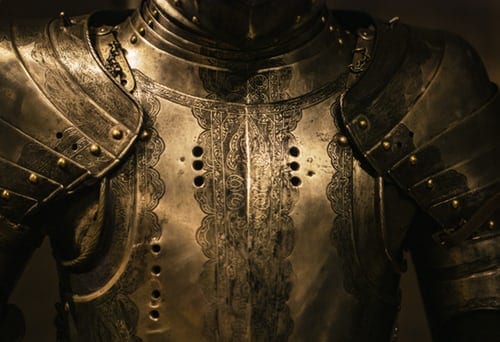
What of the symbolism of the colours within the story of St George? Mike Harris, in an interesting article on polarity magic in a past issue of The Cauldron, made the point that in early Welsh myths, particularly pertaining to the Arthurian mythic cycle, the use of red and white denotes mortals and immortals, or the realm of Faerie [9]. If we suppose, as is popularly imagined, that the dragon slain by St George is red in colour, we can automatically make the opposite supposition that the Saint himself represents the polar, white, aspect. Following Harris’ description, George is, therefore, not a mortal at all but a fairy figure as symbolised in the Welsh mythological tradition. On the other hand, the red dragon represents the mortal world. So, is this polarity magic as Harris suggests? Is the ethereal George overcoming his mortal opposite number, or is something else afoot?
Returning to the relationship with the myth of Cain, if we suppose that the Biblical expulsion from Eden and the fall of the Watchers correlates with the manifestation of a material world from the Platonic World of Forms, or at least the emergence of humankind inot such a realm already conceived by the Demiurge, we can add a spiritual dimension to the story. The Theory of Forms, or ideas, holds that material matter is mimicry of the True Principle. Plato argued that we re aware of an object’s form, that spark of the inner light, as will reunite with the Other. Therefore, we are each a bearer of light, a light bearer (Latin, Lucifer), signalling the means by which ‘enlightenment’ may be attained within.
Another concept Plato introduces is the association of metals with the human soul. In his utopian republic, the ruling classes have gold in the composition of their souls. The next tier is silver and lower classes have the base metals. This brings us neatly back to alchemy and the aim of transmuting base metal to a more noble substance and the symbolism of the transmutation of the soul hidden within the ‘serpent cross’ or ‘fixing the volatile’.
So the legend of St George may be an initiatory myth containing alchemical keys in which a ritual enactment may convey some of the meaning to the participants. Indeed, St George and his black counterpart (the Turkish Knight) once, and still do, battle to death during the annual country theatrics of the mummers play. Perhaps these mystery plays owe more to ancient knowledge and the Mysteries than quaint reminiscence of rural folk tradition. Whether or not an historic George ever existed, then, is of less significance than the mythic figure that has grown up within a rich folklore. It is now the quest of this generation to try and ensure that these lessons are not forgotten and evolve organically to meet the new age. As George slew the dragon, so must we come to terms and assimilate the old; but ever beware that yesterday’s hero is the dragon of tomorrow.
Notes & References:
[1] Google Books has an online version available at www. books.google.co.uk/books [2] The Pillars of Tubal Cain, Michael Howard and Nigel Aldcroft Jackson (Capall Bannister’s 2003) [3] ibid. [4] Thomas Percy (1765) [5] Numbers 21 [6] www.phil.fah-designs.com/gardinerosborn/articles/article-34.html [7] Volsunga Saga [8] The Hero With A Thousand Faces, Joseph Campbell (Fontana Press) [9] The Cauldron #129 (August 2008)
Previous Post

March 25, 2020
A Journey To Spiral Castle in Traditional Witchcraft
Next Post

May 22, 2020 Losing Your Head At Midsummer - An Ancient Rite Revisited
Browse Our Archives
Select a Category 1734 Ancestors Apophatic Sorcery Atramentous Press Beltane Betrayal big dipper Book Book Review Brigit Candlemas Ced Ced Tarot child of promise Christmas Climate Community Compass Conferences Conjuration culture Cultus Sabbati Dance Death Devil Dionysus Double Easter Environment Esotericism Events Experience Fairy Fate Folklore Greek Gods Greek Magical Papyri Green Man Grimoire history Initiation Interviews Jewish Mysticism Judas Kabbalah Legend Lilith Mandrake Books Llewellyn Lore Lucifer Magic Magic in History Series May Day Meditation Merkabah Monkey King Myth Necromancy New Books NEws north star road Oberon Obituary Occult Offerings Opposer Pagan Pax Deorum Pax Diaboli PGM Philosophy Poetry Politics Praxis Punk Witchcraft Ralph Harvey Reviews Richard Gordon Rita Morgan Ronald “Chalky” White Sabbatic Witchcraft Sabbats Sun Wukong Taoist the Regency The Witch Compass Three Hands Press Tradition Traditional Witchcraft Trickster God Tricksters Uncategorized via Negativa White Dragon Winds Witch lore Witchcraft Witchcraft Lore Witches' Sabbath wyrd Yule
Select a Month May 2025 March 2025 February 2025 January 2025 December 2024 July 2024 June 2024 April 2024 March 2024 February 2024 January 2024 December 2023 November 2023 October 2023 September 2023 August 2023 July 2023 December 2022 October 2022 September 2022 August 2022 May 2022 April 2022 March 2022 February 2022 December 2021 July 2021 May 2021 April 2021 February 2021 January 2021 December 2020 November 2020 September 2020 August 2020 July 2020 June 2020 May 2020 April 2020 March 2020 February 2020 January 2020 December 2019 November 2019 October 2019 September 2019 July 2019 June 2019 May 2019 April 2019 March 2019 December 2018 September 2018 August 2018 July 2018 June 2018 May 2018 April 2018 March 2018 February 2018 June 2017 October 2016 September 2016 July 2016 June 2016 April 2016
Follow Us!
TAKE THE
Religious Wisdom Quiz
Who built an ark to survive the great flood?
Select your answer to see how you score.
Abram Shem Noah Enoch
Related posts from By The Pale Moonlight

Shattered Illusions: Stories of Pre-Internet Days

Maundy Thursday: Night of the Witches
Traditional Witchcraft and Betrayal...

Witchcraft in Reality: A Rebuttal
TRENDING AT PATHEOS Pagan

I was recently chatting with someone on Instagram. She asked me what...

While there are many people who share their results, the end of...

On July 23, I saw Christopher Nolan's The Odyssey which is Homer’s...

As I write this two big events have just finished up. One...

Restoring the Watershed of Divine Love
Perhaps cooperation is not something we manufacture through legislation, ideology, or moral...

Many UUs don’t pray because of bad experiences in a previous religion,...
view all Pagan blogs
Ad-Free & Subscriber Log-In Subscription Support
- About Us
- 2026 Calendar
- Videos
- Podcasts
- Library of World Religions
- Faith In Media Tracker
- Advertise With Us
- Write for Us
- Privacy Policy
- Terms of Service
- Do Not Sell My Data
- Contact Us
- Radiant Digital
- Manage Newsletter Subscriptions
- Unsubscribe From Notifications
- Sitemap
Copyright 2008-2026, Patheos. All rights reserved.
Subscription Support Ad-Free & Subscriber Log-In
Follow Patheos