
BuddhistCatholicContemplativeEvangelicalGeneral ChristianHinduJewishLatter-day SaintMuslimNew VisionsProgressive Christian
Beliefs
- Buddhist
- Catholic
- Contemplative
- Evangelical
- General Christian
- Hindu
- Jewish
- Latter-day Saint
- More Voices
- Muslim
- New Visions
- Pagan
- Progressive Christian
Topics
- Religion News
- Food and Religion
- Sports and Religion
- Religious Art
- Religious Music and Entertainment
- Religious Events
- History and Religion
- Style and Religion
- Politics and Religion
- Women in Religion
- Recreation Outdoors and Religion
- Business Finance and Religion
- Careers Workplace and Religion
- Education and Religion
- Family Parenting and Religion
- Health Fitness and Religion
- Home and Religion
- Relationships and Religion
- Technology and Religion
- Travel and Religion
Columnists
- Buddhist Columnists
- Business Finance and Religion Columnists
- Careers Workplace and Religion Columnists
- Catholic Columnists
- Contemplative Columnists
- Education and Religion Columnists
- Evangelists Columnists
- Family Parenting and Religion Columnists
- General Christian Columnists
- Health Fitness and Religion Columnists
- Hindu Columnists
- History and Religion Columnists
- Home and Religion Columnists
- Jewish Columnists
- More Voices Columnists
- Latter Day Columnists
- Muslim Columnists
- New Visions Columnists
- Nonreligious Columnists
- Pagan Columnists
- Politics and Religion Columnists
- Progressive Columnists
- Recreation Outdoors and Religion Columnists
- Relationships and Religion Columnists
- Religion News Columnists
- Religious Art Columnists
- Religious Events Columnists
- Religious Music and Entertainment Columnists
- Sports and Religion Columnists
- Style and Religion Columnists
- Technology and Religion Columnists
- Travel and Religion Columnists
- Women in Religion Columnists
Resource Library
- 2026 Calendar
- Library of World Religions
- The 100 Most Holy Places on Earth
- Patheos Answers
- Podcasts
- Videos
- Faith Leaders Database
- Anglican Episcopalian
- Bahai
- Baptist
- Buddhism
- Christianity
- Confucianism
- Eastern Orthodoxy
- Hinduism
- Holiness and Pentecostal
- ISKCON
- Islam
- Judaism
- Lutheran
- Methodist
- The Church of Jesus Christ of Latter-day Saints
- New Age
- Paganism
- Presbytarian and Reformed
- Protestantism
- Religion Behind the Scenes
- Roman Catholic
- Scientology
- Shia Islam
- Sikhism
- Sufism
- Sunni Islam
- Taoism
- Zen
- See all religions
Research Tools
 Ad-Free & Subscriber Log-In Subscription Support
Ad-Free & Subscriber Log-In Subscription Support
Follow Patheos 

- Trending:
- Forgiveness
- |
- Marriage
- |
- Consciousness
- |
- Death Penalty
- |
- Election
- |
- Halloween

- Home
- Pagan
- Breaking With Tradition: The Future of Witchcraft
Breaking With Tradition: The Future of Witchcraft
Last updated on: February 21, 2020 at 12:10 am by Ian Chambers
Breaking With Tradition: The Future of Witchcraft 2020-02-21T00:10:48+00:00 Ian Chambers
Patheos Explore the world's faith through different perspectives on religion and spirituality! Patheos has the views of the prevalent religions and spiritualities of the world.
First published in The Cauldron No. 150, November 2013
Since the last century, and accelerated by the works of authors such as anthropologist Margaret Murray (1863 – 1963), Charles Godfrey Leland (1824 – 1903) and Gerald Gardner (1884 – 1964), there has been a culture within witchcraft circles for the perpetuation of ‘tradition’, the belief in a continuation of concepts, faith, and even ritual; either passed on directly or ‘retrieved’, especially through folklore. Given the current popularity of Traditional Witchcraft, perhaps it is about time to kick over some sacred cows, as the late Craft moderniser Robert Cochrane once wrote [1]. The proliferation of Traditional Witchcraft over recent years is indicative of a current threading its way through modern movements. Many disaffected with, or unable to find access to (or, indeed, comfort from within), traditional initiatory Wicca have turned their attention to the subtleties that best suit their idiosyncratic and eclectic blend of praxes and concepts. Whilst this is not a bad thing, enabling personal identity and belief, it does muddy the waters. The use of pseudo-archaic phraseology, flowery or even verbose literature reinforces the ‘tradition’, either hinting at provenance or elitism, or both. The thesis presented here is, perhaps, controversial, yet neither radical not novel.
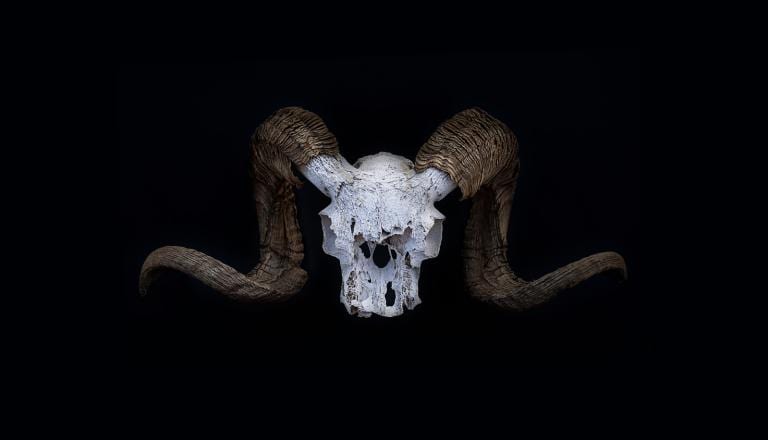
big horn sheep skull on black, Blake Weyland
What do we mean, then, by the original idea of Traditional (capital T) and those traditions operating within it?For clarification upon this confusing subject, we must consider first both Tradition as a proper noun and tradition the regular noun. In his rune work Alu: An Advanced Guide to Operative Runeology, Edred Thorsson (Dr Stephen Flowers) gives a clear overview of the subtle, yet symbiotic, relationship between tradition and Tradition (noun and proper noun). For Thorsson, Tradition is ‘…a permanent set of immutable and transcendent ideas not subject to change through time’, which differs from tradition ‘…which is the historical and often imperfect process of transmitting these ideas through time’. [2]
The elements of a tradition in the Outer initially serve to confirm a new identity, often through the familial unit, connected through that bond, whilst on the Inner it builds the group ergregore.
Anthropology has given us many examples where ‘invented tradition’ occurs, presenting a sentiment of continuance with the past in a short period of time. Invented tradition is described as consisting of practices of a ritual or symbolic nature and imparting values or behaviours through regular patterns of repetition and, therefore, implying some kind of continuity with the past (Hobsbawm, 1983). This is most tacitly witnessed in the Twentieth-Century and post millennium use of Nationalism to establish identity and giving perceived legitimacy to cultural practice, philosophy or belief (Hobsbawm, 1983) [3]. In some instances, this may have occurred deliberately, establishing the sense of a tradition for a particular purpose, frequently and most commonly in order to build a national identity of a people, or class of peoples.
While invented traditions sometimes attempt to establish an historic connection with the past, it might be argued that this link is perhaps less relevant than the strength of the tradition itself, and its effectiveness. Once a tradition is formed, does it matter whether it truly echoes the past? What does this mean for Traditional Witchcraft: is it an ‘invented tradition’ or is it a continuation of an expression of Primordial Tradition of our ancestors?
1960s Traditional Witch magister, Robert Cochrane, in his 1964 Pentagram article, The Craft Today, expressed his exacerbation with the modern witchcraft movement of Wicca. In particular, the initial tone of the piece highlights Cochrane’s frustration with those who longed to reenact or relive some fantasy bygone era; a sentiment that is still present in some popular Craft circles. Indeed, Cochrane makes plain his belief that such people were or are, in actuality, seeking escapism, refusing to face the reality of modern existence.

Tradition (proper noun) comes to denote that which transcends time and space. It occurs as the mystical universal current that emerges at various times to different cultures as a gnostic stream of enlightenment, albeit clothed in the cultural conscious awareness of those within which it comes to settle. This, one might say, is the Source. That great 20th Century mystic, René Guénon (1886 – 1951), writing in 1909, described this occurrence as the Primordial Tradition to which he eventually aligned himself, and from which religious expression finds its foundation. Guénon committed many of his written works to the common symbolism found throughout so many traditions that share this sacred language as a means of communication.
Guénon dedicated himself to the understanding of Traditional symbols through learning to approach traditions within which they are taught, including Buddhism, Hinduism, Catholicism, Sufism, and Gnosticism. Like many mystics before and since, Guénon acknowledged that within the bones of each tradition was to be found the universal kernel of Truth, the Source itself, Wisdom. Through the tried and tested means of a traditional system, one might unlock some of these keys and obtain a glimpse. Throughout Guénon’s work, though, there is a sense of emphasis upon the importance of commitment to a tradition in order that its mystical properties may take effect. That is, one must be immersed in a tradition for its symbols and mythos to present a landscape through which one may navigate successfully.
The transmission of tradition is dependent upon the excellence of exchange between people and generations, and is subject to corruption, superstition and stagnation if it does not evolve with the progress of time, or adapt to the cultural environment.
Within Traditional Witchcraft forums on the interwebs, it is still common to hear people dismissing Cochrane as having fabricated a tradition, or squabbling over the source of his information. This is rather a terrible lapwing and, although it has been repeated time and again, the truth is that Cochrane’s source was The Source, being in many respects inspirational. Those who study such things as Guénon might term this the Primordial Tradition. But, while Cochrane may have tapped into Tradition, he still held within his own personal legacy the keys of a tradition which enabled the Source to find an outlet expressed within the work of his Coven, the Clan of Tubal Cain.
Which leads us to the traditions that developed, and continue to grow, evolve, or emerge, that possess a certain mythos which leads us, like a labyrinth, to the Qutub, point, and egress. While Tradition (proper noun) is free of human endeavours and corruption, traditions (noun) are subject to the nature of humankind with all its imperfections. The transmission of tradition is dependent upon the excellence of exchange between people and generations, and is subject to corruption, superstition and stagnation if it does not evolve with the progress of time, or adapt to the cultural environment. This has been the case with many traditions in the past, including, perhaps, some major religious traditions such as Catholicism.
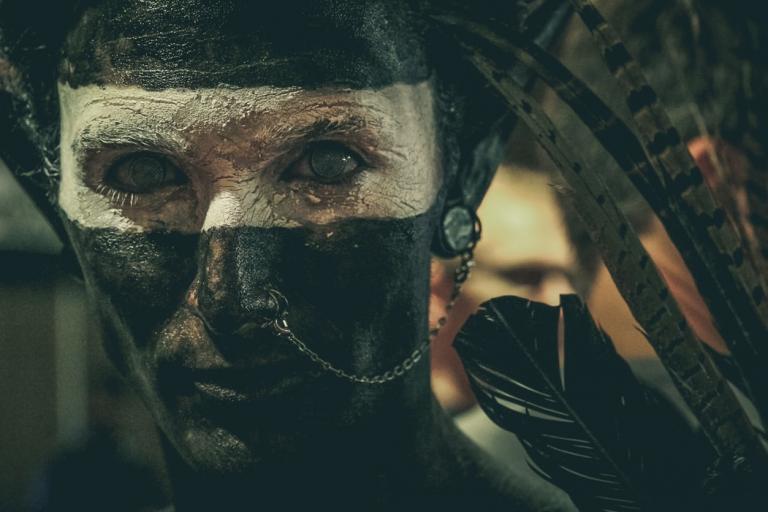
Man with tribal face paint, Scott Umstattd
For Traditional Witchcraft, then, it is clear that this once denoted a Craft that is traditional in the sense of praxes and mythos passed along, containing whispers of keys, whilst simultaneously being concerned with Truth, in possession of that kernel of the Primordial Tradition. Whilst a tradition, be it Clan of Tubal Cain, Cultus Sabbati, or any number of Traditional Witchcraft groups old or new, have their own set of myths, ritual and tradition, one cannot be held to be more valid than another. The truth is that the validity of the tradition lies squarely in its effectiveness through the work. The elements of a tradition in the Outer initially serve to confirm a new identity, often through the familial unit, connected through that bond, whilst on the Inner it builds the group ergregore.
A core mythos, system of symbols and rituals serve to establish the tradition in the mindset, preparing the inductee for the Mysteries proper; performed with true intent, these all coalesce to produce a desired result. The provenance of the tradition rapidly becomes a less relevant consideration to the power it works when producing experiential results. Each idea about the tradition emerge and work upon different levels of our being, like passing through the Mansions of the Interior Castle, or the hekhalot (palaces) of the Merkavah Kabbala, each requiring its own key. We move at our own pace toward initiation into the Primordial Tradition. What truly matters is whether the elements of the tradition work within the individual to induce the mystical experience, or affect the magic we are working. While one may belong to a traditional group, possessed of its tools and myths, rituals and symbols, it is always an individual and personal journey.
Robert Cochrane claimed to have inherited certain traditions but he was also a revolutionary and sought to elevate invented tradition, folk custom, or traditional praxes to a higher realm. For him, what mattered in the traditional practices was if they worked and he challenged modern witchcraft to work through violent and radical change, which examined ritual to determine whether those sacred cows still give milk [4].
[1] The Craft Today, Robert Cochrane, Pentagram 1964 [2] Thorsson, Edred. ALU, An Advanced Guide to Operative Runology (p. 32). Red Wheel Weiser. [3] Eric Hobsbawm, Inventing Traditions, in THE INVENTION OF TRADITION 1-14 (Eric Hobsbawm & Terence Ranger eds., 1983) [4] The Craft Today, Robert Cochrane, Pentagram 1964
Previous Post

January 30, 2020
The Witch's Stang: The Hope of Man from Every Angle
Next Post
March 15, 2020 Pilgrim's Progress: A Journey We All Make Through the Year
Browse Our Archives
Select a Category 1734 Ancestors Apophatic Sorcery Atramentous Press Beltane Betrayal big dipper Book Book Review Brigit Candlemas Ced Ced Tarot child of promise Christmas Climate Community Compass Conferences Conjuration culture Cultus Sabbati Dance Death Devil Dionysus Double Easter Environment Esotericism Events Experience Fairy Fate Folklore Greek Gods Greek Magical Papyri Green Man Grimoire history Initiation Interviews Jewish Mysticism Judas Kabbalah Legend Lilith Mandrake Books Llewellyn Lore Lucifer Magic Magic in History Series May Day Meditation Merkabah Monkey King Myth Necromancy New Books NEws north star road Oberon Obituary Occult Offerings Opposer Pagan Pax Deorum Pax Diaboli PGM Philosophy Poetry Politics Praxis Punk Witchcraft Ralph Harvey Reviews Richard Gordon Rita Morgan Ronald “Chalky” White Sabbatic Witchcraft Sabbats Sun Wukong Taoist the Regency The Witch Compass Three Hands Press Tradition Traditional Witchcraft Trickster God Tricksters Uncategorized via Negativa White Dragon Winds Witch lore Witchcraft Witchcraft Lore Witches' Sabbath wyrd Yule
Select a Month May 2025 March 2025 February 2025 January 2025 December 2024 July 2024 June 2024 April 2024 March 2024 February 2024 January 2024 December 2023 November 2023 October 2023 September 2023 August 2023 July 2023 December 2022 October 2022 September 2022 August 2022 May 2022 April 2022 March 2022 February 2022 December 2021 July 2021 May 2021 April 2021 February 2021 January 2021 December 2020 November 2020 September 2020 August 2020 July 2020 June 2020 May 2020 April 2020 March 2020 February 2020 January 2020 December 2019 November 2019 October 2019 September 2019 July 2019 June 2019 May 2019 April 2019 March 2019 December 2018 September 2018 August 2018 July 2018 June 2018 May 2018 April 2018 March 2018 February 2018 June 2017 October 2016 September 2016 July 2016 June 2016 April 2016
Follow Us!
TAKE THE
Religious Wisdom Quiz
What does Paul tell the Ephesians not to let the sun go down on?
Select your answer to see how you score.
Your sin Your disputes Your anger Your unforgiveness
Related posts from By The Pale Moonlight

Shattered Illusions: Stories of Pre-Internet Days

Maundy Thursday: Night of the Witches
Traditional Witchcraft and Betrayal...

Witchcraft in Reality: A Rebuttal
TRENDING AT PATHEOS Pagan

I was recently chatting with someone on Instagram. She asked me what...

While there are many people who share their results, the end of...

On July 23, I saw Christopher Nolan's The Odyssey which is Homer’s...

As I write this two big events have just finished up. One...

Restoring the Watershed of Divine Love
Perhaps cooperation is not something we manufacture through legislation, ideology, or moral...

Many UUs don’t pray because of bad experiences in a previous religion,...
view all Pagan blogs
Ad-Free & Subscriber Log-In Subscription Support
- About Us
- 2026 Calendar
- Videos
- Podcasts
- Library of World Religions
- Faith In Media Tracker
- Advertise With Us
- Write for Us
- Privacy Policy
- Terms of Service
- Do Not Sell My Data
- Contact Us
- Radiant Digital
- Manage Newsletter Subscriptions
- Unsubscribe From Notifications
- Sitemap
Copyright 2008-2026, Patheos. All rights reserved.
Subscription Support Ad-Free & Subscriber Log-In
Follow Patheos