
BuddhistCatholicContemplativeEvangelicalGeneral ChristianHinduJewishLatter-day SaintMuslimNew VisionsProgressive Christian
Beliefs
- Buddhist
- Catholic
- Contemplative
- Evangelical
- General Christian
- Hindu
- Jewish
- Latter-day Saint
- More Voices
- Muslim
- New Visions
- Pagan
- Progressive Christian
Topics
- Religion News
- Food and Religion
- Sports and Religion
- Religious Art
- Religious Music and Entertainment
- Religious Events
- History and Religion
- Style and Religion
- Politics and Religion
- Women in Religion
- Recreation Outdoors and Religion
- Business Finance and Religion
- Careers Workplace and Religion
- Education and Religion
- Family Parenting and Religion
- Health Fitness and Religion
- Home and Religion
- Relationships and Religion
- Technology and Religion
- Travel and Religion
Columnists
- Buddhist Columnists
- Business Finance and Religion Columnists
- Careers Workplace and Religion Columnists
- Catholic Columnists
- Contemplative Columnists
- Education and Religion Columnists
- Evangelists Columnists
- Family Parenting and Religion Columnists
- General Christian Columnists
- Health Fitness and Religion Columnists
- Hindu Columnists
- History and Religion Columnists
- Home and Religion Columnists
- Jewish Columnists
- More Voices Columnists
- Latter Day Columnists
- Muslim Columnists
- New Visions Columnists
- Nonreligious Columnists
- Pagan Columnists
- Politics and Religion Columnists
- Progressive Columnists
- Recreation Outdoors and Religion Columnists
- Relationships and Religion Columnists
- Religion News Columnists
- Religious Art Columnists
- Religious Events Columnists
- Religious Music and Entertainment Columnists
- Sports and Religion Columnists
- Style and Religion Columnists
- Technology and Religion Columnists
- Travel and Religion Columnists
- Women in Religion Columnists
Resource Library
- 2026 Calendar
- Library of World Religions
- The 100 Most Holy Places on Earth
- Patheos Answers
- Podcasts
- Videos
- Faith Leaders Database
- Anglican Episcopalian
- Bahai
- Baptist
- Buddhism
- Christianity
- Confucianism
- Eastern Orthodoxy
- Hinduism
- Holiness and Pentecostal
- ISKCON
- Islam
- Judaism
- Lutheran
- Methodist
- The Church of Jesus Christ of Latter-day Saints
- New Age
- Paganism
- Presbytarian and Reformed
- Protestantism
- Religion Behind the Scenes
- Roman Catholic
- Scientology
- Shia Islam
- Sikhism
- Sufism
- Sunni Islam
- Taoism
- Zen
- See all religions
Research Tools
 Ad-Free & Subscriber Log-In Subscription Support
Ad-Free & Subscriber Log-In Subscription Support
Follow Patheos 

- Trending:
- Forgiveness
- |
- Marriage
- |
- Consciousness
- |
- Death Penalty
- |
- Election
- |
- Halloween

- Home
- Pagan
- Wyrd Goes Ever As She Shall
Wyrd Goes Ever As She Shall
Last updated on: September 15, 2019 at 9:04 pm by Ian Chambers
Wyrd Goes Ever As She Shall 2019-09-15T21:04:31+00:00 Ian Chambers
Patheos Explore the world's faith through different perspectives on religion and spirituality! Patheos has the views of the prevalent religions and spiritualities of the world.
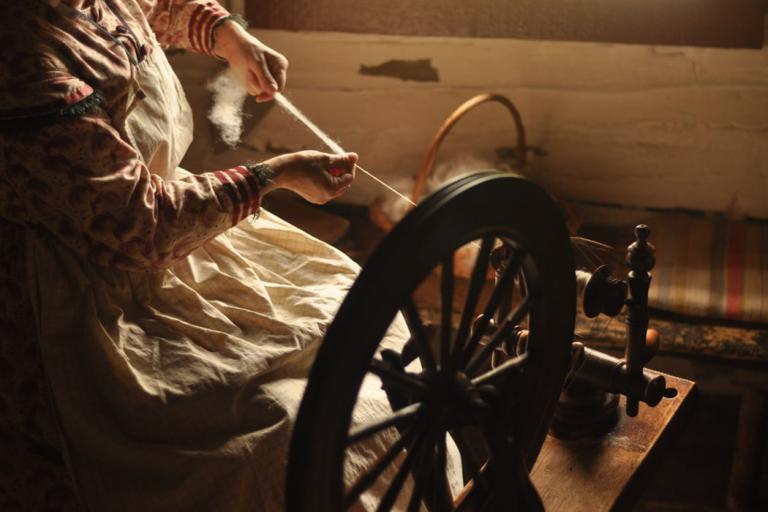
At any given moment in our lives, we might give pause to contemplate the course of events which coalesce in that precise moment. Through the strands of the universal warp and weft which makes up the rich tapestry of life, certain patterns and strands have all happened, seemingly, to bring together the circumstances for each and every moment. When you had a wonderful celebration, carefully planned and carried off, or a misfortune happened as a seemingly random event, all factors conspired as part of the greater cosmos. This bringing together of every weave of the fabric of the universe into a single point where you may, if astute enough, reflect before the whole knot loosens and the threads carry on their way to the next is quite incredible. You are invited, dear reader, to pause to reflect for a moment upon the thought that all events in history, all lives and thoughts which have gone before this moment, when you take in these words from the page, have been leading inexorably to this exact moment! And wonder!
For that brief second, when the awe of the entire commingling of time and space brought a collection of atoms together in such a meaningful way as to enable consciousness, which you identify as ‘I’, to receive the ideas conveyed by these words, you were aware of Wyrd! You have just experienced what it is to be cognisant of what the Northern peoples, of which Anglo-Saxons are but one, identified as Wyrd.
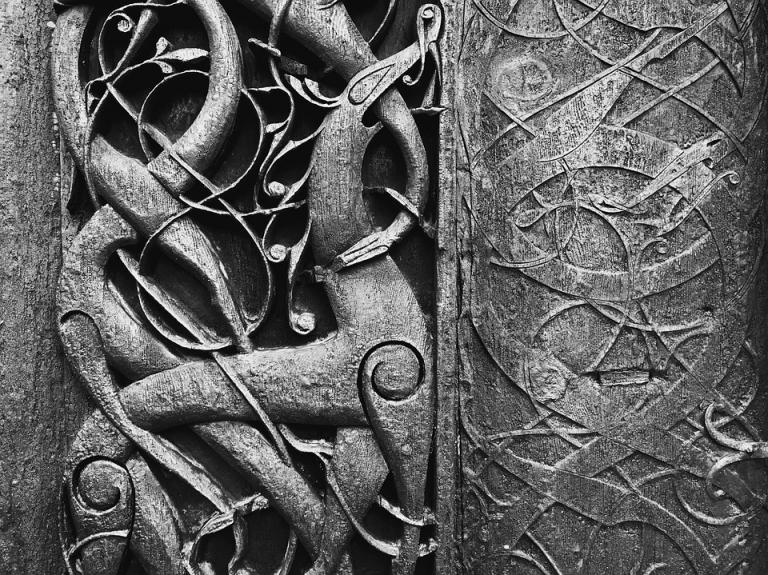
When we learn to be aware of Wyrd in our lives, we experience a shift in perspective which then also enables certain other skills to develop. In our ancestral past, the telling of omens was often regarded as a skillset belonging to the soothsayer, while the sorcerer manipulated the world to bring about certain desired outcomes. Clairvoyance, bilocation, casting lots, charming, bewitchment and other powers are often attributed to sorcerers or witchcraft. The question as to how these technologies work is an old one, and impart a certain amount of superstition and cynicism. If, however, your worldview accepts a cosmology which is built around the observance of fate and Wyrd, and the likelihoods and observance of patterns, such things become inevitable facets of the greater whole.
For example, if we work to increase the probability of an event coming to pass by our careful observation of patterns and behaviours, antecedents, then our magic becomes more effective. Some might argue that casting a spell in the first place increases the likelihood of an event or desired outcome, but through working with Wyrd we might make our spell more potent and, in some instances, the result almost inevitable. Similarly, if we have developed a reliable dictionary of omens and signs through which we can identify patterns in the course of fate, our skill at foretelling is significantly improved. But, some things can’t be changed, right? This is true, and armed with this knowledge allows us to work around those immovable obstructions and achieve better results.
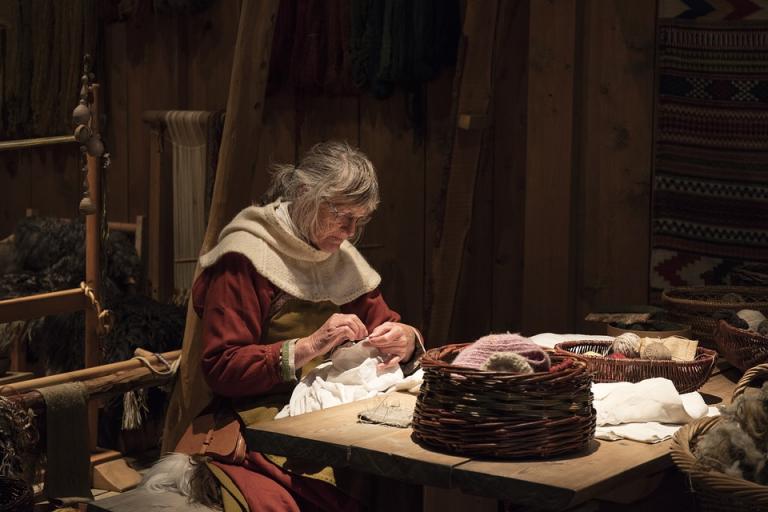
Wyrd is an expression of the fabric of time and space, woven throughout and intersecting everything within creation. Bosworth Toller Anglo-Saxon Dictionary defines it as ‘what happens, fate, fortune, chance… what is done, a deed, an action…’. Proto Indo European roots indicate the word’s origin to mean ‘to rotate, turn, to wind’. The Anglo-Saxon Wyrd is a feminine verbal noun (a noun derived from a verb) and as such came to mean, by the 14th Century, “having the power to control fate…”[1].
In our modern parlance, Wyrd becomes weird, in which it still has the connection with fate and destiny in that it denotes something which is markedly noteworthy, out of the ordinary or remarkable for one reason or another. We call weird that which stands out of time and space and, therefore, appears before us as a thing recognised as fated to be distinguished by its weirdness. The weird is the unusual, the out of place, the unordinary, the supernatural or mysterious.
In identifying Wyrd with the series of events which naturally occur in conformity with patterns, we must be careful to distinguish between this and pre-determined fate or destiny. Wyrd is most usefully referred to poetically and metaphorically as a web. However, the analogy of a tapestry works best for our kenning here. The pattern that Wyrd weaves is predicated upon that which has come before it, just as a weaver must work the yarn into the warp of the fabric as it has been set up. Therefore, what comes before has the most significant bearing upon that which is becoming, that is Wyrd. Whilst there is a foreseeable probability of events coming to pass, these are not fixed as the past. Rather, the threads are bringing the patterns into fulfilment and becoming. As Bill Griffiths, in his Aspects of Anglo-Saxon Magic, writes:
This sympathetic sense of immediate unity leaves a more open set of possibilities than a predetermined fate…[2]
The image of a web of threads, or a weaving analogy, are prevalent throughout Northern European myth and folklore. Indeed, Professor of Psychology and expert in shamanic consciousness, Brian Bates laid much of the early groundwork in our understanding and popularity of Wyrd today through his seminal first work, Way of Wyrd[3] in the early 1980s. Following this Castenada-esque journey through Anglo-Saxon sorcerous beliefs, Bates followed up with a non-fiction work outlining his concept for the Anglo-Saxon worldview and magics, including Wyrd. In this work, references to the weavers, the norns, and the analogy of weaving, as well as knots and binding abound. Furthermore, the concept of binding and bonds has persevered in witchcraft even today, with binding spells being among the popular ways to work magic. As a means of directly working the strands of Wyrd, it is a perfectly appropriate technique for spell casting.
Spellcasting in Wyrd was often conceived of as placing or releasing bonds from a person. Odin was depicted as able to place binding spells on people… and these were imagined sometimes as knots… Odin is shown beside a kind of knot in the form of three triangles, linked together…[4]
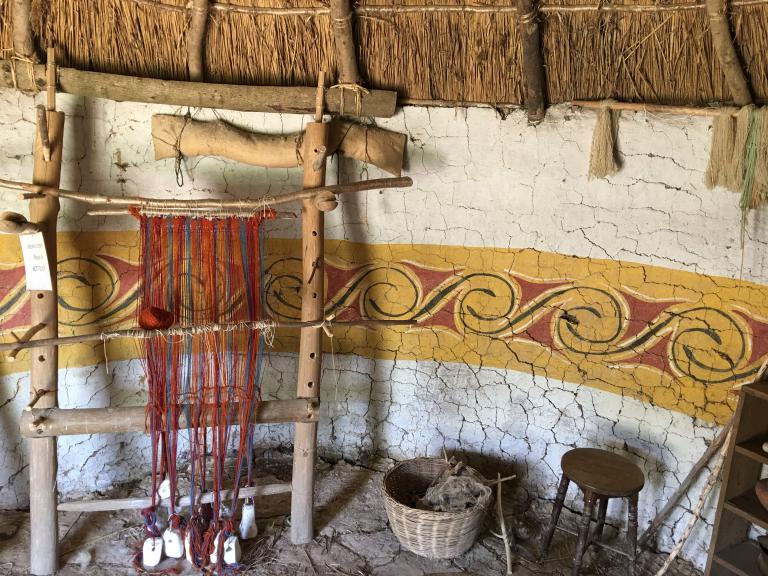
Working with the threads of Wyrd, placing or undoing knots, weaves perfectly into cord magic and the traditional use of knotted lengths of twine or yarn. One such example are the witches associated with Cornish coastal towns such as Boscastle and who would sell sailors knotted string in which they had bound the winds.
Such sympathetic magics work in accordance with the principles of Wyrd and the manipulation of the patterns and probabilities which coalesce, bringing together the weight of the past which descends to that singular point. From that moment, Wyrd continues incessantly upon its way with whatever slight adjustment, or shift, casting new shadows and designs.
Every one of our choices is a part of the path that leads us to where we want to be in five, ten, twenty years. Everything matters: every choice, however trivial, is still a real choice on the Wyrd.[5]
Footnotes
[1] https://www.etymonline.com/word/weird?ref=etymonline_crossreference/p>
[2] Bill Griffiths, Aspects of Anglo-Saxon Magic, (Norfolk: Anglo-Saxon Books, 2003)
[3] Brian Bates, Way of Wyrd: Tales of an Anglo-Saxon Sorcerer, (London: Century, 1983)
[4] Brian Bates, The Wisdom of the Wyrd: Teachings for Today from our Ancient Past (London: Rider & Co., 1996)
[5] Tom Graves, Positively Wyrd: Harnessing the Chaos in Your LIfe (Glastonbury: Gothic Image, 1995)
About Ian Chambers
Ian Chambers is a folk sorcerer and witch, practicing the craft of the Cunning Man of old, trying to do the best he can in a crazy, mad and beautiful world. You can read more about the author here.
Previous Post

September 8, 2019
Castles in the Sky
Next Post
October 3, 2019 What We Knew In The Night: Book Review
Browse Our Archives
Select a Category 1734 Ancestors Apophatic Sorcery Atramentous Press Beltane Betrayal big dipper Book Book Review Brigit Candlemas Ced Ced Tarot child of promise Christmas Climate Community Compass Conferences Conjuration culture Cultus Sabbati Dance Death Devil Dionysus Double Easter Environment Esotericism Events Experience Fairy Fate Folklore Greek Gods Greek Magical Papyri Green Man Grimoire history Initiation Interviews Jewish Mysticism Judas Kabbalah Legend Lilith Mandrake Books Llewellyn Lore Lucifer Magic Magic in History Series May Day Meditation Merkabah Monkey King Myth Necromancy New Books NEws north star road Oberon Obituary Occult Offerings Opposer Pagan Pax Deorum Pax Diaboli PGM Philosophy Poetry Politics Praxis Punk Witchcraft Ralph Harvey Reviews Richard Gordon Rita Morgan Ronald “Chalky” White Sabbatic Witchcraft Sabbats Sun Wukong Taoist the Regency The Witch Compass Three Hands Press Tradition Traditional Witchcraft Trickster God Tricksters Uncategorized via Negativa White Dragon Winds Witch lore Witchcraft Witchcraft Lore Witches' Sabbath wyrd Yule
Select a Month May 2025 March 2025 February 2025 January 2025 December 2024 July 2024 June 2024 April 2024 March 2024 February 2024 January 2024 December 2023 November 2023 October 2023 September 2023 August 2023 July 2023 December 2022 October 2022 September 2022 August 2022 May 2022 April 2022 March 2022 February 2022 December 2021 July 2021 May 2021 April 2021 February 2021 January 2021 December 2020 November 2020 September 2020 August 2020 July 2020 June 2020 May 2020 April 2020 March 2020 February 2020 January 2020 December 2019 November 2019 October 2019 September 2019 July 2019 June 2019 May 2019 April 2019 March 2019 December 2018 September 2018 August 2018 July 2018 June 2018 May 2018 April 2018 March 2018 February 2018 June 2017 October 2016 September 2016 July 2016 June 2016 April 2016
Follow Us!
TAKE THE
Religious Wisdom Quiz
What is Christian stewardship?
Select your answer to see how you score.
Hiding talents Caring for God's gifts Taking from the poor Ignoring others
Related posts from By The Pale Moonlight

Shattered Illusions: Stories of Pre-Internet Days

Maundy Thursday: Night of the Witches
Traditional Witchcraft and Betrayal...

Witchcraft in Reality: A Rebuttal
TRENDING AT PATHEOS Pagan

I was recently chatting with someone on Instagram. She asked me what...

While there are many people who share their results, the end of...

On July 23, I saw Christopher Nolan's The Odyssey which is Homer’s...

As I write this two big events have just finished up. One...

Restoring the Watershed of Divine Love
Perhaps cooperation is not something we manufacture through legislation, ideology, or moral...

Many UUs don’t pray because of bad experiences in a previous religion,...
view all Pagan blogs
Ad-Free & Subscriber Log-In Subscription Support
- About Us
- 2026 Calendar
- Videos
- Podcasts
- Library of World Religions
- Faith In Media Tracker
- Advertise With Us
- Write for Us
- Privacy Policy
- Terms of Service
- Do Not Sell My Data
- Contact Us
- Radiant Digital
- Manage Newsletter Subscriptions
- Unsubscribe From Notifications
- Sitemap
Copyright 2008-2026, Patheos. All rights reserved.
Subscription Support Ad-Free & Subscriber Log-In
Follow Patheos