
BuddhistCatholicContemplativeEvangelicalGeneral ChristianHinduJewishLatter-day SaintMuslimNew VisionsProgressive Christian
Beliefs
- Buddhist
- Catholic
- Contemplative
- Evangelical
- General Christian
- Hindu
- Jewish
- Latter-day Saint
- More Voices
- Muslim
- New Visions
- Pagan
- Progressive Christian
Topics
- Religion News
- Food and Religion
- Sports and Religion
- Religious Art
- Religious Music and Entertainment
- Religious Events
- History and Religion
- Style and Religion
- Politics and Religion
- Women in Religion
- Recreation Outdoors and Religion
- Business Finance and Religion
- Careers Workplace and Religion
- Education and Religion
- Family Parenting and Religion
- Health Fitness and Religion
- Home and Religion
- Relationships and Religion
- Technology and Religion
- Travel and Religion
Columnists
- Buddhist Columnists
- Business Finance and Religion Columnists
- Careers Workplace and Religion Columnists
- Catholic Columnists
- Contemplative Columnists
- Education and Religion Columnists
- Evangelists Columnists
- Family Parenting and Religion Columnists
- General Christian Columnists
- Health Fitness and Religion Columnists
- Hindu Columnists
- History and Religion Columnists
- Home and Religion Columnists
- Jewish Columnists
- More Voices Columnists
- Latter Day Columnists
- Muslim Columnists
- New Visions Columnists
- Nonreligious Columnists
- Pagan Columnists
- Politics and Religion Columnists
- Progressive Columnists
- Recreation Outdoors and Religion Columnists
- Relationships and Religion Columnists
- Religion News Columnists
- Religious Art Columnists
- Religious Events Columnists
- Religious Music and Entertainment Columnists
- Sports and Religion Columnists
- Style and Religion Columnists
- Technology and Religion Columnists
- Travel and Religion Columnists
- Women in Religion Columnists
Resource Library
- 2026 Calendar
- Library of World Religions
- The 100 Most Holy Places on Earth
- Patheos Answers
- Podcasts
- Videos
- Faith Leaders Database
- Anglican Episcopalian
- Bahai
- Baptist
- Buddhism
- Christianity
- Confucianism
- Eastern Orthodoxy
- Hinduism
- Holiness and Pentecostal
- ISKCON
- Islam
- Judaism
- Lutheran
- Methodist
- The Church of Jesus Christ of Latter-day Saints
- New Age
- Paganism
- Presbytarian and Reformed
- Protestantism
- Religion Behind the Scenes
- Roman Catholic
- Scientology
- Shia Islam
- Sikhism
- Sufism
- Sunni Islam
- Taoism
- Zen
- See all religions
Research Tools
 Ad-Free & Subscriber Log-In Subscription Support
Ad-Free & Subscriber Log-In Subscription Support
Follow Patheos 

- Trending:
- Forgiveness
- |
- Marriage
- |
- Consciousness
- |
- Death Penalty
- |
- Election
- |
- Halloween

- Home
- Pagan
- Castles in the Sky
Castles in the Sky
Last updated on: November 2, 2019 at 6:46 pm by Ian Chambers
Castles in the Sky 2019-11-02T18:46:48+00:00 Ian Chambers
Patheos Explore the world's faith through different perspectives on religion and spirituality! Patheos has the views of the prevalent religions and spiritualities of the world.
- Within Caer Sidhi doth our tale commence,
That spectral Castle, spiralling abode
Where Pale-Faced, the white Goddess shines from whence,
- Leading Her wild raid from a western road
Gathering up her children home again.
She summons the winds, from the west comes Node,
- Tettens and his twin Luci make the twain,
While in the South comes Carenos, carefree
lord of woodlands, wild hunter ‘neath the wain.
- When the King, Arthur, held council courtly,
And the knave, Robin, that noble green jack,
Played fool and free as the rascal dirty.
- Here begin we, revolving with Caer Sidi,
Before we may hear cry of child Pryderi.
© Ian Chambers 2018 (from an unpublished poem)
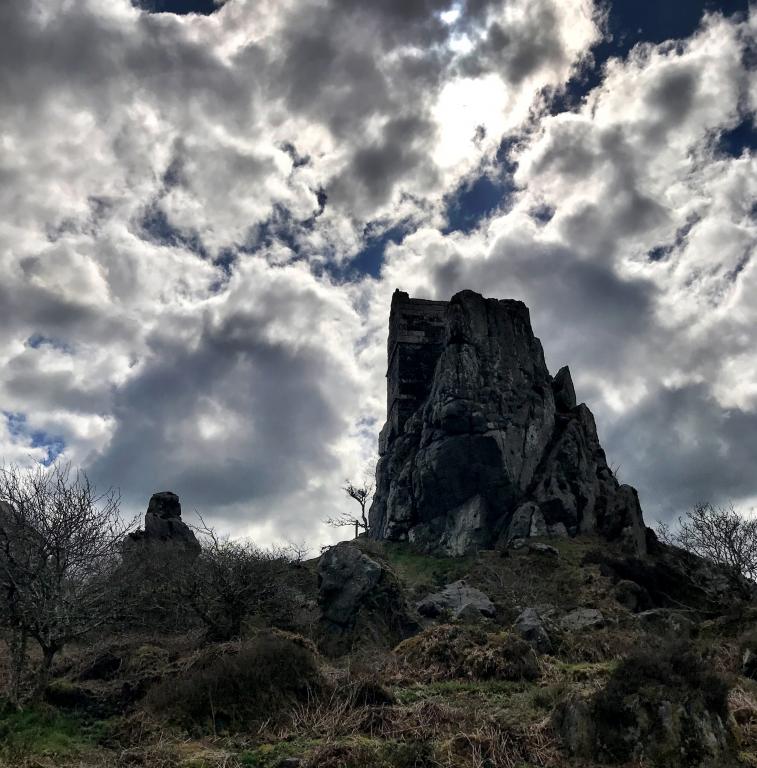
© Ian Chambers 2018
The Castle in Traditional Witchcraft and Old Craft Traditions holds an especial place, a sanctified and revered, even spectral and mythic, position. Little discussed, it is frequently overlooked or forgotten in Modern Traditional Witchcraft. Yet, within some Old Craft traditions, the Castle is perhaps of importance.
Within the corpus of medieval literary texts preserving romantic and chivalric tales, the motif of the Castle frequently represents the Otherworld, a place set apart and frequently a test of the hero’s mettle, virtue and spiritual purpose, the prize a thinly veiled metaphor for enlightenment, through (divine) love.
Caer Sidi, Caer Arianrhod, Revolving Castle, Spiral Castle, and myriad other names, has its place as a typical fairy castle of the type most often found in the Celtic countries. From the Spoils of Annwn, to the Grail quest of Chretien’s Percival, the Castle is a clearly defined symbol of the sacred enclosure, the mystical Otherworld, fata morgana, which houses the Grail. As a walled city, a protected, enclosed, space, it has its guardians which form the cosmological map of the mythos, while its principle is the Rex Nemorensis, the Fisher King, the prototype of whom is seen especially well in the legendary ancestor King of Britain, Bendigeidfran, Brân the Blessed.
CASTLE: Shares the symbolism of the enclosure and of the walled garden, defended city and represents the difficult to obtain; spiritual testing… BRIDGE symbolism is also involved in crossing the moat to the castle.[1]
BRIDGE: Communication between heaven and earth, one realm and another; uniting man with the divinity… In the primordial state, in the Golden Age, man could cross at will, as there was no death; the bridge is now crossed only at death, or in mystical states, or in initiation ceremonies, or by solar heroes… The Bridge Perilous is also the way to enlightenment, victory over death and division in the realm of differentiation.
ALDER: Associated with death and with the smith’s fire and the power of evaporation. Celtic: The fairy tree; divination, resurrection.

He who would be chief, let him be a bridge.[2]
Brân is useful here for a number of reasons. He is the Alder god, representing imperishable wood which doesn’t rot in water. The wood of the Alder is also said to appear red as blood when it is cut. When his people were making a raid on the Otherworld, upon reaching an impassible river, the King Brân used his own body to span the two sides and allow his people safe passage, uttering the above phrase in doing so. Symbolically, we see here the ancestor of the chiefs taking upon himself the task of maintaining the connection between the realm of man and the Otherworld, speaking the words which embody that aspect of the myth and asserting his credentials as psychopomp. In death, like Brân after his beheading, the tutelary head resides therein as guardian and keeper, permitting his kin entrance to the deathly halls. In life, he is the bridge which carries his own across the river in safety and his people are assured of their protection in this life and the next.
As a wounded hero, he is the prototype of the Fisher King of Grail myth, denoted as he is by the epithet ‘Pierced thigh’. According to legend, his head is interred beneath the White Tower, which keeps his sacred Raven, waiting to rise again to defend his peoples. In the Grail myth, he awaits his replacement who will ask the right question and restore the wasteland, taking upon themselves the mantle of chief until he, in turn, is challenged and relinquishes to his younger and more able.
He is the Saturnian aspect and also the Solar Hero, journeying through the heavens on adventures, taking his band of noble kinsmen between the worlds. Undoubtedly, it is Brân who leads the assault upon the halls of Annwn in the poem attributed to Taliesin, Preiddeu Annwfn, and it is the same seven who survive the Otherworld raid who accompany Brân’s oracular head upon return to Albion.

So, the Castle is the Otherworld itself, the quest and attainment, the abode of the discarnate kin, the collective ancestral spirit of the clan, the repository of all that is the Grail, spiritual enlightenment. The journey to the Castle is perilous precisely because one may only catch sight of it through the murky depths of the unconscious mind, the vision of the imagination, through either physical death or else mystical attainment.
In keeping with the mythic tradition of paradox, the Castle is four square yet “spins without motion between three elements” which most fittingly repeat the Celtic proclivity for triads.
Taliesin, called by the Welsh , “Chief of the Bards,” (AD 600), referring to himself in the character of the incarnate Sun, states:
“Bum bont ar Dri Gair” – /|\
“I have been a bridge on Three Words” – /|\
The Light of Britannia, Owen Morgan, 1894
These three elements contain much reference in poetry and tradition, through three dimensional space which produces the four quarters of the compass. Alchemically, these are Sulphur, Mercury and Salt.
SULPHUR: in Alchemy, sulphur is the Spirit, ‘non-burning fire’… Sulphur fixes the volatile Quicksilver, but requires the interplay between two generative forces as it remains limited and fruitless until dissolved by quicksilver.
QUICKSILVER: It is the soul, the Queen, the feminine, fluid, volatile… dissolution and death being necessary for, and leading to, rebirth and resurrection, hence the aqua vitae.
SALT: Life; immortality; incorruptibility; permanence; fidelity; friendship…Alchemic: Rectification; clarification; the fixed; the Cubic Stone; the body uniting the passive and active, soul and spirit; ‘wherever there is metal there are sulphur, quicksilver and salt, the three are spirit, soul and body, the nature of metal and man… Salt is not merely the physical but also the “astral” body. Sulphur produces combustion, Quicksilver evaporation, Salt… serves to “fix” the volatile spirit (Valentinus). Celtic: The incorruptible spirit, with earth as the corruptible body.[3]
It is important to understand that what renaissance Rosicrucians and Alchemists called the corpus is not restricted in meaning to the physical body, the manifest vessel of the flesh, but the hyle or eidos, form and embodiment, the vessel of the soul and spirit and, therefore, Salt and the alchemical tria prima is a much better fit. Alchemy, of course, makes mention of the Three Primes (tria prima), four basic elements and seven planetary metals respectively. This, naturally, gives us the order of 1734.
The earth’s anima is also divided into seven corresponding feminine emanations, called the Seven Atlantides, comprehended in three principal feminine consorts… The masculine triad is symbolised by the sign /|\… the female by \|/. The masculine emanations, considered collectively, are referred to as Tau, which is a corruption of the Druidic Tâd (Father), and whose three emanations are Creator, Decorator and Heroism. The sign is now represented thus: ☥ … It was also the sacred protective “mark of Cain” (Nôd in Welsh, and it was to the Land of Nod that Cain went).[4]
[1] J. C. Cooper, An Illustrated Encyclopaedia of Traditional Symbols (London: Thames And Hudson, 1992)
[2] Y Mabinogi, second branch
[3] J. C. Cooper, An Illustrated Encyclopaedia of Traditional Symbols (London: Thames And Hudson, 1992)
[4] O. Morgan, The Light of Britannia (1894)
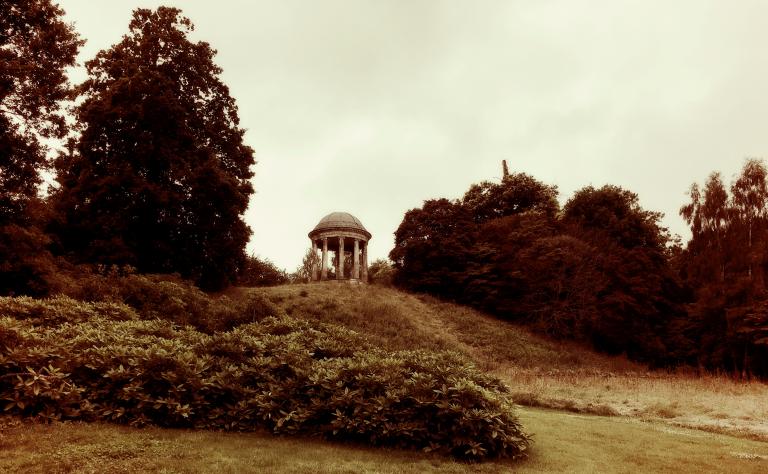
© Ian Chambers 2019
About Ian Chambers
Ian Chambers is a folk sorcerer and witch, practicing the craft of the Cunning Man of old, trying to do the best he can in a crazy, mad and beautiful world. He is currently working on his first book, Pax Deorum. You can read more about the author here.
Previous Post

July 26, 2019
Witchcraft Against Climate Change
Next Post
September 15, 2019 Wyrd Goes Ever As She Shall
Browse Our Archives
Select a Category 1734 Ancestors Apophatic Sorcery Atramentous Press Beltane Betrayal big dipper Book Book Review Brigit Candlemas Ced Ced Tarot child of promise Christmas Climate Community Compass Conferences Conjuration culture Cultus Sabbati Dance Death Devil Dionysus Double Easter Environment Esotericism Events Experience Fairy Fate Folklore Greek Gods Greek Magical Papyri Green Man Grimoire history Initiation Interviews Jewish Mysticism Judas Kabbalah Legend Lilith Mandrake Books Llewellyn Lore Lucifer Magic Magic in History Series May Day Meditation Merkabah Monkey King Myth Necromancy New Books NEws north star road Oberon Obituary Occult Offerings Opposer Pagan Pax Deorum Pax Diaboli PGM Philosophy Poetry Politics Praxis Punk Witchcraft Ralph Harvey Reviews Richard Gordon Rita Morgan Ronald “Chalky” White Sabbatic Witchcraft Sabbats Sun Wukong Taoist the Regency The Witch Compass Three Hands Press Tradition Traditional Witchcraft Trickster God Tricksters Uncategorized via Negativa White Dragon Winds Witch lore Witchcraft Witchcraft Lore Witches' Sabbath wyrd Yule
Select a Month May 2025 March 2025 February 2025 January 2025 December 2024 July 2024 June 2024 April 2024 March 2024 February 2024 January 2024 December 2023 November 2023 October 2023 September 2023 August 2023 July 2023 December 2022 October 2022 September 2022 August 2022 May 2022 April 2022 March 2022 February 2022 December 2021 July 2021 May 2021 April 2021 February 2021 January 2021 December 2020 November 2020 September 2020 August 2020 July 2020 June 2020 May 2020 April 2020 March 2020 February 2020 January 2020 December 2019 November 2019 October 2019 September 2019 July 2019 June 2019 May 2019 April 2019 March 2019 December 2018 September 2018 August 2018 July 2018 June 2018 May 2018 April 2018 March 2018 February 2018 June 2017 October 2016 September 2016 July 2016 June 2016 April 2016
Follow Us!
TAKE THE
Religious Wisdom Quiz
Which mountain is traditionally believed to be where Noah's Ark came to rest?
Select your answer to see how you score.
Mount Ararat Mount Carmel Mount Sinai Mount Hermon
Related posts from By The Pale Moonlight

Maundy Thursday: Night of the Witches
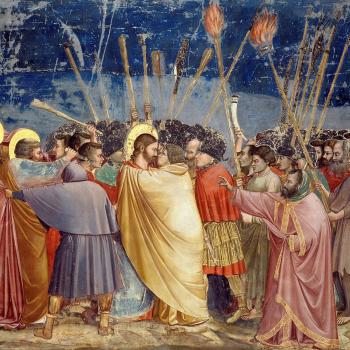
Traditional Witchcraft and Betrayal...

Witchcraft in Reality: A Rebuttal
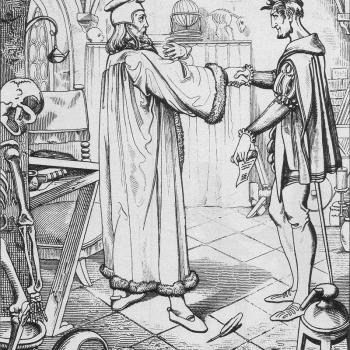
The Devil and the Sun King: The Affair...
TRENDING AT PATHEOS Pagan

I was recently chatting with someone on Instagram. She asked me what...

While there are many people who share their results, the end of...

On July 23, I saw Christopher Nolan's The Odyssey which is Homer’s...

As I write this two big events have just finished up. One...

Restoring the Watershed of Divine Love
Perhaps cooperation is not something we manufacture through legislation, ideology, or moral...

Many UUs don’t pray because of bad experiences in a previous religion,...
view all Pagan blogs
Ad-Free & Subscriber Log-In Subscription Support
- About Us
- 2026 Calendar
- Videos
- Podcasts
- Library of World Religions
- Faith In Media Tracker
- Advertise With Us
- Write for Us
- Privacy Policy
- Terms of Service
- Do Not Sell My Data
- Contact Us
- Radiant Digital
- Manage Newsletter Subscriptions
- Unsubscribe From Notifications
- Sitemap
Copyright 2008-2026, Patheos. All rights reserved.
Subscription Support Ad-Free & Subscriber Log-In
Follow Patheos