
BuddhistCatholicContemplativeEvangelicalGeneral ChristianHinduJewishLatter-day SaintMuslimNew VisionsProgressive Christian
Beliefs
- Buddhist
- Catholic
- Contemplative
- Evangelical
- General Christian
- Hindu
- Jewish
- Latter-day Saint
- More Voices
- Muslim
- New Visions
- Pagan
- Progressive Christian
Topics
- Religion News
- Food and Religion
- Sports and Religion
- Religious Art
- Religious Music and Entertainment
- Religious Events
- History and Religion
- Style and Religion
- Politics and Religion
- Women in Religion
- Recreation Outdoors and Religion
- Business Finance and Religion
- Careers Workplace and Religion
- Education and Religion
- Family Parenting and Religion
- Health Fitness and Religion
- Home and Religion
- Relationships and Religion
- Technology and Religion
- Travel and Religion
Columnists
- Buddhist Columnists
- Business Finance and Religion Columnists
- Careers Workplace and Religion Columnists
- Catholic Columnists
- Contemplative Columnists
- Education and Religion Columnists
- Evangelists Columnists
- Family Parenting and Religion Columnists
- General Christian Columnists
- Health Fitness and Religion Columnists
- Hindu Columnists
- History and Religion Columnists
- Home and Religion Columnists
- Jewish Columnists
- More Voices Columnists
- Latter Day Columnists
- Muslim Columnists
- New Visions Columnists
- Nonreligious Columnists
- Pagan Columnists
- Politics and Religion Columnists
- Progressive Columnists
- Recreation Outdoors and Religion Columnists
- Relationships and Religion Columnists
- Religion News Columnists
- Religious Art Columnists
- Religious Events Columnists
- Religious Music and Entertainment Columnists
- Sports and Religion Columnists
- Style and Religion Columnists
- Technology and Religion Columnists
- Travel and Religion Columnists
- Women in Religion Columnists
Resource Library
- 2026 Calendar
- Library of World Religions
- The 100 Most Holy Places on Earth
- Patheos Answers
- Podcasts
- Videos
- Faith Leaders Database
- Anglican Episcopalian
- Bahai
- Baptist
- Buddhism
- Christianity
- Confucianism
- Eastern Orthodoxy
- Hinduism
- Holiness and Pentecostal
- ISKCON
- Islam
- Judaism
- Lutheran
- Methodist
- The Church of Jesus Christ of Latter-day Saints
- New Age
- Paganism
- Presbytarian and Reformed
- Protestantism
- Religion Behind the Scenes
- Roman Catholic
- Scientology
- Shia Islam
- Sikhism
- Sufism
- Sunni Islam
- Taoism
- Zen
- See all religions
Research Tools
 Ad-Free & Subscriber Log-In Subscription Support
Ad-Free & Subscriber Log-In Subscription Support
Follow Patheos 

- Trending:
- Forgiveness
- |
- Marriage
- |
- Consciousness
- |
- Death Penalty
- |
- Election
- |
- Halloween

- Home
- Pagan
- Considering An Historic Witchcraft
Considering An Historic Witchcraft
Last updated on: September 2, 2018 at 10:47 am by Ian Chambers
Considering An Historic Witchcraft 2018-09-02T10:47:06+00:00 Ian Chambers
Patheos Explore the world's faith through different perspectives on religion and spirituality! Patheos has the views of the prevalent religions and spiritualities of the world.

A lot has changed with witchcraft, both socially and individually. Historic witchcraft may, in fact, be sufficiently removed from its modern counterpart as to be unrecognisable in a time when there has never been more positive media exposure as with the rise of the aesthetic, social and lifestyle witchcrafts which affirm individuality and “…empower us to grow, change and heal.”[1]
There are some common and easily identified mistakes with this vogue understanding of witchcraft, which is little helped by some quarters of Traditional Witchcraft, who see the label as a license to cherry-pick in the name of eclecticism, and also some public faces of Wicca, who fail to look past there own nose and definitions/opinions. In addition, those few traditions, from both ends of the spectrum, which have survived from the middle of the last century have been seen to assume a position of provenance over the rest of us as to be quite supercilious and, therefore, removed from the greater community. This little post is likely to be contentious to some in either camp, for which I make no apology.
Many years ago, the internet was a steam powered tractor unit that required a delicate and rehearsed ritual in order to engage it, demanding patience and hard work as the screeching wail emitted from the idol heralded the evocation to physical manifestation of a screen image, appearing before you pixelated line by pixelated line. It was a simpler time, when a myriad of cables and plugs abounded and command of such wire trickery bestowed upon the user the magisterial title of ‘web master’. Meanwhile, in another room, with a separate interface, there were those wizards amongst us who were adept at surfing the web, like a keyboard hunter with the dexterity to type with more than a single digit and fire out code and sentences in the blink of an eye. Those of us who had dedicated our time to the diligent scouring of the first incarnation of the internet were able to perform feats that would now be curtailed by the algorithms, privacy policies and incessant need to harvest user data to target advertising, thereby crippling exploratory uses of the search engine and limiting it only to those things that the now mature internet deems worthy of your puny mortal brain.
Back in those heady days, before vastly more powerful internet computers were placed in all of our pockets, along with all of the music ever, I stumbled across an anonymous webpage that fascinated and imprinted its simple message upon me. It was a glamorous affair for those days, mostly black with some crude pixels, the odd banner ad no doubt enabling the ownership of the web address for free. It was mostly text and precious little of that. In tone, it was quite critical of modern renditions of witchcraft, perhaps rose-tinted memory masks a downright scathing timbre within the stark message. However, one thing stuck in my mind to this day. It simply stated: if you want to do real witchcraft, first learn to get out of your body, with the caveat to not be alarmed or afraid if, in doing so, an actual disincarnate witch turns up in the dead of night wondering why you called.
The point of this is to illustrate one of the most basic and fundamental things which was once a staple in the esoteric and occult worlds, with magic orders and organisations teaching astral vision, use of the etheric double, energy work and such like. I’m sure you’re thinking, this all sounds far removed from the historic witch. Isobel Gowdie was hardly crouching in her dank, infested mud hovel practicing the Middle Pillar Exercise, or awakening her chakras as she scrabbled around in the dirt for any root which might contain sufficient calorific value to justify another breath. Clearly, these people had more things on their minds. Didn’t they?
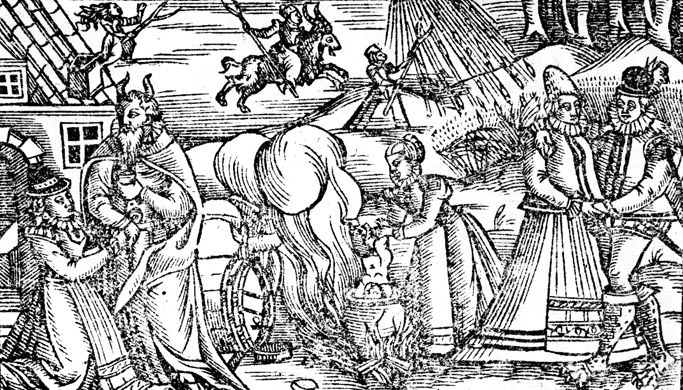
Peter Binsfeld, c. 1540 – 1598
As a former student of Medieval History at the University of Wales, one of the most important things I have taken away, and which was instilled from some of the first lectures, is that we cannot (indeed must not) view a culture separated from us by time and distance from a place of morality and current mores. That is to say, we may not measure the ethics, politics, social makeup or traditions of peoples living in the past, or another culture entirely, using our own worldview as a measure. This is one of those lessons that may be applied in life to a good many circumstances and is not limited to history but necessary in sociology as a whole. We may not judge another’s culture or tradition as morally incorrect because we do not partake of it, nor can we wholly understand it from the outside alone.
Habitus: is a system of embodied dispositions, tendencies that organise the ways in which individuals perceive the world around them and react to it. These dispositions are usually shared by people with similar background, as the habitus is acquired through mimesis [2].
The habitus which was shared by the individuals of 17th Century self-confessed witch Isobel Gowdie suggests a worldview that was in close proximity to the deceased, which in itself is sufficient relationship with the ‘other’ or ‘unseen’ to equate perfectly with a fairy belief and witchcraft (Lecouteux, 1992). Death was a constant companion to Gowdie and her contemporaries, haunting the very landscape in which she lived and was as close as the wind on the cheek. Indeed, academics have postulated that the supernatural phenomenon reported in this period all indicates a relationship with death, the veil between the two worlds being so thin as to be, on ocassion, unrecognisable (Wilby, 2005). Through this, we have those cunning folk and witches, such as Bessie Dunlop, who report meeting with a familiar spirit, or fairy, being the image and apparent personality of the deceased[3].
Claude Lecouteux, professor of medieval literature and civilisation at the Sorbonne, emphasises this relationship with the dead as the ‘otherworld’ itself, together with the medieval notion of the ‘double’ as an aspect of the makeup of the soul. Through the evidence of the reports of witches, werewolves and fairies (coincidentally the title of one of his books), Lecouteux, along with Wilby, identifies the otherworld as a place of the dead, fairies and associated spirits. It is suggested that the successful magician or witch can externalise, or else work the imagination upon, the double and may similarly impact upon the double or unseen aspect of another. These individuals were capable, spontaneously or intentionally, of leaving the physical body, now in a state of catalepsy, and travel as the ‘double’, even transforming into the shapes of other creatures. Various reports of witches assuming animal form and receiving injury whilst in this shape, and which later appeared on the entranced body, are suggestive of the link between the double and the physical. Accounts of the infamous Witches’ Sabbath, then, are almost certainly experiences of a congregation occurring whilst travelling in the double.
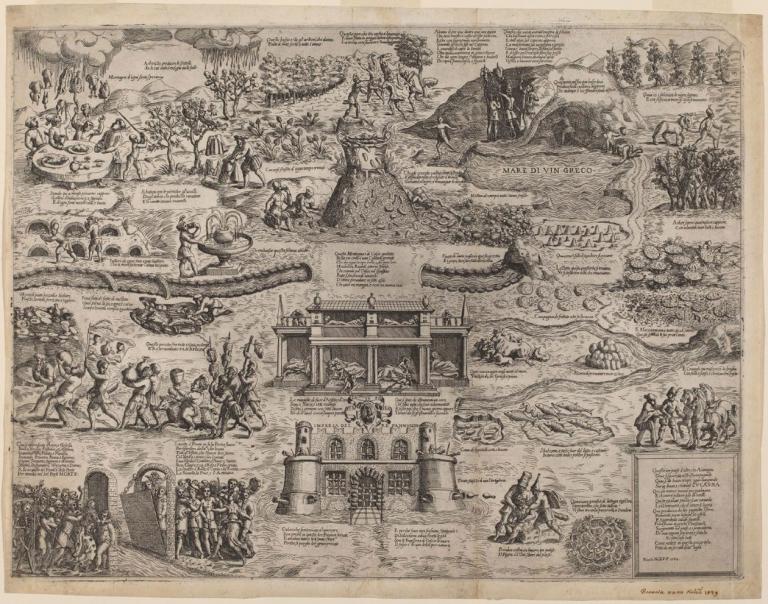
Nelli, Niccolò (c. 1530 – 1576 or 1585) “The Land of Cockaigne”, 1564
Furthermore, oneiric vision and otherworld work is regarded as working upon the same or related planes, while the depth of altered states of consciousness occurred with a frequency and tendency that would be unprecedented in our own reality. Consider the constant of hunger, the daily struggle to obtain sustenance, tiredness and fatigue which would accompany such a lifestyle in abject poverty, as well as the proximity of illness and disease that poor sanitation and hygiene brings, we can perhaps understand the proclivity to engage with the world of ‘other’ and the spirits of the deceased in the realm of the imagination. Indeed, we can evidence such a tendency in the literature, tradition and folklore of utopian ‘otherworlds’ wherein all was a reverse of the reality of the physical. One such is the medieval tradition of the Land of Cockaigne, a mystical utopian reality, a world of plenty where there is an abundance of food and drink, sexual liberty, all social rules are turned on their head. Such a world would appeal greatly to the Gowdies and Dunlops who fortune treated so poorly. Another incidence of the otherworld is the land of faery itself, where the night train of the dead and unseen spirits revel in a topsy turvy world, described as being the opposite of the mundane world in that night is day, winter is summer, etc.
So different are the worlds of the historic witch to that of the modern counterpart, separated not only by time but by realities, existing in more than different times but utterly alien realms. Furthermore, our understanding of the historic place of witchcraft in our modern mind has altered completely within the bounds of our shifting social environment. No longer is the divide between the physical and unseen a thin veneer, nor the ‘other’ perceived as removed from the harsh realities of life. The new lifestyle identity witchcraft is developing exponentially, with YouTube channels, Instagram pages, and even cosmetic purveyors Sephora getting in on the trend with its $42 ‘Starter Witch Kit‘, whatever the hell that is!
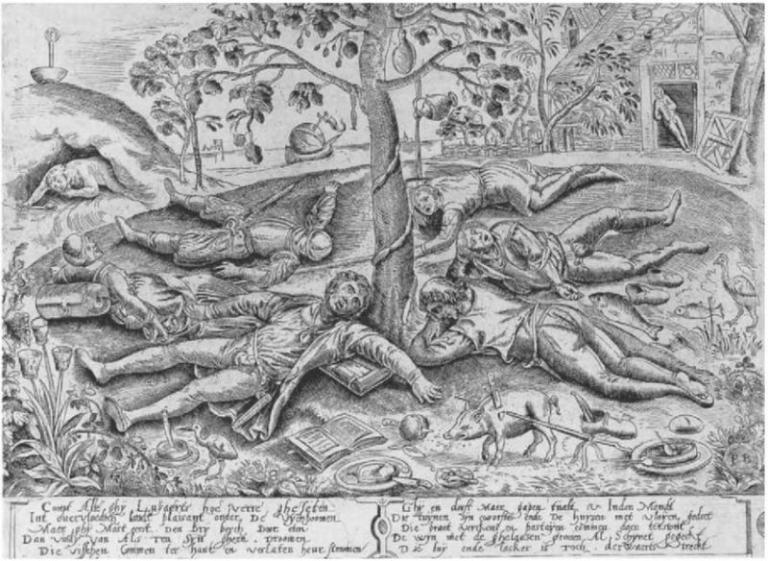
Pieter Baltsen, Land of Cockaign circa 1560 CE
[1] Witchcraft: A Beginners Guide to Witchcraft, Sophie Cornish 2015. This is an introduction to witchcraft, used interchangeably in the description with ‘wicca’ and identified as being “based in the spirituality of our ancestors who worshipped the Goddess, God and natural universe,” which historic late medieval, early modern witches almost certainly never did.
[2] https://en.wikipedia.org/wiki/Habitus_(sociology)
[3] Cunning Folk and Familiar Spirits, Emma Wilby
[4] Witches, Werewolves and Fairies: Shapeshifters and Astral Doubles in the Middle Ages, Claude Lecouteux (Fr. 1995, En. 2003)
About Ian Chambers
Ian Chambers is a student of esoteric magic, engrossed in the study and practice of the Art as conveyed by means of the Western Mysteries. By diligent study, research, exploration and direct application of myth and magic, the author has dedicated his life to the Work with many sacrifices along the way. With a love of Qabalah, Arthurian myth, folklore and historic witchcraft, Ian pursues a magical path which illuminates the soul. You can read more about the author here.
Previous Post
August 20, 2018
Flags, Flax and Fodder - A Benediction Explored
Next Post

December 16, 2018 Wyrd Witchcraft
Browse Our Archives
Select a Category 1734 Ancestors Apophatic Sorcery Atramentous Press Beltane Betrayal big dipper Book Book Review Brigit Candlemas Ced Ced Tarot child of promise Christmas Climate Community Compass Conferences Conjuration culture Cultus Sabbati Dance Death Devil Dionysus Double Easter Environment Esotericism Events Experience Fairy Fate Folklore Greek Gods Greek Magical Papyri Green Man Grimoire history Initiation Interviews Jewish Mysticism Judas Kabbalah Legend Lilith Mandrake Books Llewellyn Lore Lucifer Magic Magic in History Series May Day Meditation Merkabah Monkey King Myth Necromancy New Books NEws north star road Oberon Obituary Occult Offerings Opposer Pagan Pax Deorum Pax Diaboli PGM Philosophy Poetry Politics Praxis Punk Witchcraft Ralph Harvey Reviews Richard Gordon Rita Morgan Ronald “Chalky” White Sabbatic Witchcraft Sabbats Sun Wukong Taoist the Regency The Witch Compass Three Hands Press Tradition Traditional Witchcraft Trickster God Tricksters Uncategorized via Negativa White Dragon Winds Witch lore Witchcraft Witchcraft Lore Witches' Sabbath wyrd Yule
Select a Month May 2025 March 2025 February 2025 January 2025 December 2024 July 2024 June 2024 April 2024 March 2024 February 2024 January 2024 December 2023 November 2023 October 2023 September 2023 August 2023 July 2023 December 2022 October 2022 September 2022 August 2022 May 2022 April 2022 March 2022 February 2022 December 2021 July 2021 May 2021 April 2021 February 2021 January 2021 December 2020 November 2020 September 2020 August 2020 July 2020 June 2020 May 2020 April 2020 March 2020 February 2020 January 2020 December 2019 November 2019 October 2019 September 2019 July 2019 June 2019 May 2019 April 2019 March 2019 December 2018 September 2018 August 2018 July 2018 June 2018 May 2018 April 2018 March 2018 February 2018 June 2017 October 2016 September 2016 July 2016 June 2016 April 2016
Follow Us!
TAKE THE
Religious Wisdom Quiz
What does the name "Moses" mean?
Select your answer to see how you score.
Saved Judge Delivered Drawn out (of water)
Related posts from By The Pale Moonlight
Shattered Illusions: Stories of Pre-Internet Days

Maundy Thursday: Night of the Witches
Traditional Witchcraft and Betrayal...

Witchcraft in Reality: A Rebuttal
TRENDING AT PATHEOS Pagan

I was recently chatting with someone on Instagram. She asked me what...

While there are many people who share their results, the end of...

On July 23, I saw Christopher Nolan's The Odyssey which is Homer’s...

As I write this two big events have just finished up. One...

Restoring the Watershed of Divine Love
Perhaps cooperation is not something we manufacture through legislation, ideology, or moral...

Many UUs don’t pray because of bad experiences in a previous religion,...
view all Pagan blogs
Ad-Free & Subscriber Log-In Subscription Support
- About Us
- 2026 Calendar
- Videos
- Podcasts
- Library of World Religions
- Faith In Media Tracker
- Advertise With Us
- Write for Us
- Privacy Policy
- Terms of Service
- Do Not Sell My Data
- Contact Us
- Radiant Digital
- Manage Newsletter Subscriptions
- Unsubscribe From Notifications
- Sitemap
Copyright 2008-2026, Patheos. All rights reserved.
Subscription Support Ad-Free & Subscriber Log-In
Follow Patheos