
BuddhistCatholicContemplativeEvangelicalGeneral ChristianHinduJewishLatter-day SaintMuslimNew VisionsProgressive Christian
Beliefs
- Buddhist
- Catholic
- Contemplative
- Evangelical
- General Christian
- Hindu
- Jewish
- Latter-day Saint
- More Voices
- Muslim
- New Visions
- Pagan
- Progressive Christian
Topics
- Religion News
- Food and Religion
- Sports and Religion
- Religious Art
- Religious Music and Entertainment
- Religious Events
- History and Religion
- Style and Religion
- Politics and Religion
- Women in Religion
- Recreation Outdoors and Religion
- Business Finance and Religion
- Careers Workplace and Religion
- Education and Religion
- Family Parenting and Religion
- Health Fitness and Religion
- Home and Religion
- Relationships and Religion
- Technology and Religion
- Travel and Religion
Columnists
- Buddhist Columnists
- Business Finance and Religion Columnists
- Careers Workplace and Religion Columnists
- Catholic Columnists
- Contemplative Columnists
- Education and Religion Columnists
- Evangelists Columnists
- Family Parenting and Religion Columnists
- General Christian Columnists
- Health Fitness and Religion Columnists
- Hindu Columnists
- History and Religion Columnists
- Home and Religion Columnists
- Jewish Columnists
- More Voices Columnists
- Latter Day Columnists
- Muslim Columnists
- New Visions Columnists
- Nonreligious Columnists
- Pagan Columnists
- Politics and Religion Columnists
- Progressive Columnists
- Recreation Outdoors and Religion Columnists
- Relationships and Religion Columnists
- Religion News Columnists
- Religious Art Columnists
- Religious Events Columnists
- Religious Music and Entertainment Columnists
- Sports and Religion Columnists
- Style and Religion Columnists
- Technology and Religion Columnists
- Travel and Religion Columnists
- Women in Religion Columnists
Resource Library
- 2026 Calendar
- Library of World Religions
- The 100 Most Holy Places on Earth
- Patheos Answers
- Podcasts
- Videos
- Faith Leaders Database
- Anglican Episcopalian
- Bahai
- Baptist
- Buddhism
- Christianity
- Confucianism
- Eastern Orthodoxy
- Hinduism
- Holiness and Pentecostal
- ISKCON
- Islam
- Judaism
- Lutheran
- Methodist
- The Church of Jesus Christ of Latter-day Saints
- New Age
- Paganism
- Presbytarian and Reformed
- Protestantism
- Religion Behind the Scenes
- Roman Catholic
- Scientology
- Shia Islam
- Sikhism
- Sufism
- Sunni Islam
- Taoism
- Zen
- See all religions
Research Tools
 Ad-Free & Subscriber Log-In Subscription Support
Ad-Free & Subscriber Log-In Subscription Support
Follow Patheos 

- Trending:
- Forgiveness
- |
- Marriage
- |
- Consciousness
- |
- Death Penalty
- |
- Election
- |
- Halloween

- Home
- Pagan
- Warlock – Breaker of God’s Covenant
Warlock – Breaker of God’s Covenant
Last updated on: August 7, 2018 at 6:39 pm by Ian Chambers
Warlock – Breaker of God’s Covenant 2018-08-07T18:39:50+00:00 Ian Chambers
Patheos Explore the world's faith through different perspectives on religion and spirituality! Patheos has the views of the prevalent religions and spiritualities of the world.
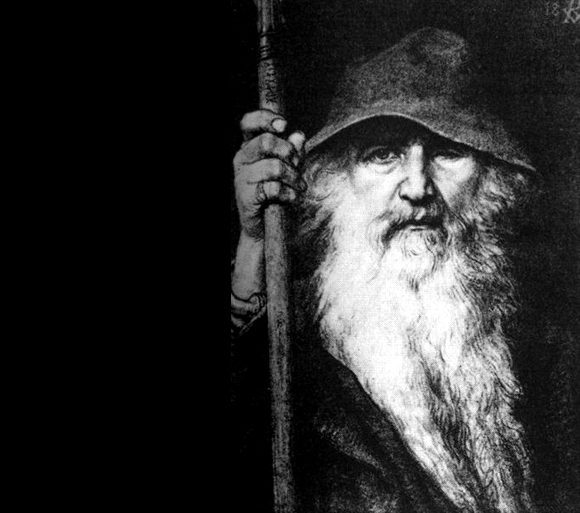
Odin, the archetypical warlock, was also called “oath-breaker” Image: Odin the Wanderer, George von Rosen (1886)
“Lo, I have not been mindful of the sons of men, but the tribe of Cain hath sorely angered me.”
Genesis A & B Book 20. Line 1255
Warlock = from OE wærloga, one who is false to his covenant
The AS Genesis B Text (part of the Caedmon MS) recounts the story of Cain and Abel and attributes earthly sin to Cain for the slaying of his brother. This is a remarkable rendition of the Biblical story in that it colours Anglo-Saxon perceptions and likely has a profound affect upon the Craft, as well as the cultural view of those within it. One such example is the word to denote a male sorcerer of the line of Cain: warlock!
Generally taken to translate as ‘oath breaker’, from wær – covenant, and loga – false. Literally, one who is false to his covenant. However, the terms is used to denote a compact with the devil and wærlogan is used in one passage to denote the people before the flood, perhaps antideluvian giants or Watchers, while another passage clearly uses the term to denote the apostate angels (wérloga) in the AS Genesis. So the term was used in Old English context not specifically to identify any oath-breaker, but was pertinent to the Divil and the Watchers, apostate angels, Luciferian individuals, who had broken the Covenant of Yahweh; or, indeed, preceded the Covenant made with Noah after the Flood.
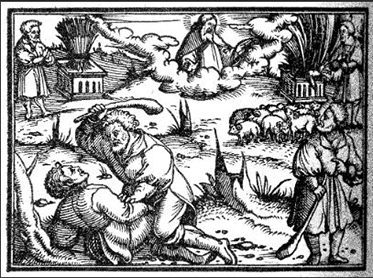
Cain and Abel, 1564 Woodcut, from Die Gantze Bibel, printed in Germany by Christoph Froschauer. Courtesy of the Digital Image Archive, Pitts Theology Library, Candler School of Theology, Emory University, Atlanta, Georgia.
In the Anglo Saxon Genesis, the tribes of Cain are condemned as enemies of the Biblical God, and the offspring that result as a product of the sons of men (tribes of Seth) who took wives from among the Watchers (Tribes of Cain) are called wærlogan. This AS word for the Nephilim often gets translated as faithless spirits, or those who are false to the Covenant – i.e. treaty breakers (a cardinal crime amongst the AS people). The Covenant in question here, especially within this context, is that which is made between Noah and Jehovah. Therefore, the apostate angels and all subsequent sorcerers who are not of Jehovah’s Covenant are wærlogan, Warlocks. Witch, Wiccan, Hell-rūne, heretics are also such believing in that which is contra to the proscribed doctrine of faith that is upheld by the Christian church.
That the AS Genesis B, of the Caedmon MS, recalls the fall of Lucifer and the Kin of Cain as ‘enemies of God’, it is demonstrable through these texts that such a Covenant as exists between Abraham, Moses and Noah with Yahweh never is in place with the angels, Cain or his offspring. The Genesis B work is interesting in that it reflects a very subtle suggestion of Northern traditions (the Devil tempting Eve sharing much with Loki) as well as a hint at Gnosticism. Estimated around 1000 CE, the work tells of two falls. One, of the Angel who opposed God at the start of Genesis, the second of the leader of the host of Angels God subsequently creates. This second is a Demiurgic figure who shares the Throne and shines brighter than the stars with a radiant crown. Furthermore, the AS Genesis B work has two trees within Eden which all men must eat from, the tree of life and that of death. It is the latter which the adversary offers to Eve.
In the AS Genesis, the term that is used that gets translated as Covenant is Treowraeden: “as I teach you, maintain our state of mutual faithfulness.” Gen 2305. Treow (Truth and tree) ræden = condition, stipulation. The word means properly the conditions of our faith, truth, ‘tend the tree’.

There are many speculations upon the internet about the origin of Warlock and its original AS meaning as Covenant Breaker. These are mostly misled and overlook the fact that anybody regarded in the past as performing magick, consorting with devils, or in any way doing something that was against church doctrine was breaking the Covenant with Jehovah; therefore, a Warlock. Many point to the proliferation of this word in Scottish records over English to suggest that it is a word not of Anglo origin. This linguistic error ignores the abundance of Anglo-Saxon words that form the Scots language – to know is to Ken! Indeed, Scots derives in the most part from Anglo-Saxon spoken by Lowland peoples and called, to differentiate from the native Gaelic highland peoples, Ynglis. “Northumbrian Old English had been established in South-Eastern Scotland as far as the River Forth by the 7th Century”.
If, as many state on the internet, Warlock was used widely in Scottish literature, especially quoting Burns (whose language belies predominantly Anglo Saxon Scots), we must look at its meaning. Whilst the word may have been used to denote ‘sorcerer’, more correctly it is being used to identify those whose practice is ungodly, therefore having broken the Covenant of God – Warlock! Any heretical praxis or belief is against the commandments of Jehovah and, by proxy, breaks that oath. In defence of this definition, the truth is that the word has its original attested scholarly translation and it holds.
Where it is interesting is in that it denotes those who oppose the will of Jehovah, those evolutionary spirits who descend from Cain, used in the later literature (especially of Scotland, but also of Old English) to denote those who compact with the Devil – which is a clear breaking of oath with God. Indeed, in a great many witchcraft trials recorded in Scotland, the pact features very strongly. In a number of such cases, the supplicant is first asked to forego their Baptism, which by the very act is a breaking of the church Covenant.
Often, people have quoted Scottish literature and claim that the use of warlock as breaker of Covenant is unattested. 1) Within the Anglo Saxon Genesis manuscript, this word is well attested in the definition of that which breaks the oath or Covenant of God. 2) Later literature and usage in Scotland is consistent with this meaning (not by way of denoting specifically an incantor or sorcerer):
In Scott’s novel, Redgauntlet ( 1824), we have:
“Now this was a tune my gudesire learned frae a warlock, that heard it when they were worshipping Satan at their meetings…”
This is a prime example of the explicit meaning of the word warlock, as attested in the Anglo Saxon texts preserved in the Caedmon MS. Here, the ‘warlock’ is someone who worships Satan, and we are reminded of Genesis B where waerlogan is employed to denote Satan, and his fallen angels, the daughters of Cain and their offspring – all who fraternise with the Devil. No modern example could be more complete of the consistent use of an ancient word.
“I will delate you for a warlock to the privy council!” said Sir John. “I will send you to your master, the devil, with the help of a tar-barrel and a torch!”
The use of the word and its meaning as oath-breaker or liar is no better attested than in Wulfstan’s Homilies.:
“…do not in any way be perjurers or deceivers, violators of agreements or liars…”
Homilies, ed. Bethurum, p. 183
Here, violators of agreements and liars are translated from the Old English wedlogan and wordlogan – one who is false to an agreements, and one who is false to his word. The linguistic evidence, therefore, is clear that wǽr-loga is one who is “false to his Covenant, faithless, a perfidious person”.
This will all be likely refuted and raged against amongst Wiccan and Pagan communities trying to reclaim a word that, as has been demonstrated, was not lost. Rather, what is occurring is a semantic shift whereby the word is adopting a new meaning amongst these modern movements, who are looking to establish tradition to solidify the claims. His is no bad thing.
However, for those of the Old Craft, the word Warlock to denote those ‘Kin of Cain’ is far more pertinent. Indeed, one might refer to a classical Gnostic as being a warlock; those who regarded Jehovah as a false God held no stock in His Covenant. More on this required, perhaps…?


About Ian Chambers
Ian Chambers is a folk sorcerer engrossed in the study and practice of the Art as conveyed through the mysteries. By diligent study, research, exploration and direct application of myth and magic, the author has dedicated his life to the Work with many sacrifices along the way. You can read more about the author here.
Previous Post

July 26, 2018
Blood Moon: The Lunar Eclipse At Lammas
Next Post

August 20, 2018 Flags, Flax and Fodder - A Benediction Explored
Browse Our Archives
Select a Category 1734 Ancestors Apophatic Sorcery Atramentous Press Beltane Betrayal big dipper Book Book Review Brigit Candlemas Ced Ced Tarot child of promise Christmas Climate Community Compass Conferences Conjuration culture Cultus Sabbati Dance Death Devil Dionysus Double Easter Environment Esotericism Events Experience Fairy Fate Folklore Greek Gods Greek Magical Papyri Green Man Grimoire history Initiation Interviews Jewish Mysticism Judas Kabbalah Legend Lilith Mandrake Books Llewellyn Lore Lucifer Magic Magic in History Series May Day Meditation Merkabah Monkey King Myth Necromancy New Books NEws north star road Oberon Obituary Occult Offerings Opposer Pagan Pax Deorum Pax Diaboli PGM Philosophy Poetry Politics Praxis Punk Witchcraft Ralph Harvey Reviews Richard Gordon Rita Morgan Ronald “Chalky” White Sabbatic Witchcraft Sabbats Sun Wukong Taoist the Regency The Witch Compass Three Hands Press Tradition Traditional Witchcraft Trickster God Tricksters Uncategorized via Negativa White Dragon Winds Witch lore Witchcraft Witchcraft Lore Witches' Sabbath wyrd Yule
Select a Month May 2025 March 2025 February 2025 January 2025 December 2024 July 2024 June 2024 April 2024 March 2024 February 2024 January 2024 December 2023 November 2023 October 2023 September 2023 August 2023 July 2023 December 2022 October 2022 September 2022 August 2022 May 2022 April 2022 March 2022 February 2022 December 2021 July 2021 May 2021 April 2021 February 2021 January 2021 December 2020 November 2020 September 2020 August 2020 July 2020 June 2020 May 2020 April 2020 March 2020 February 2020 January 2020 December 2019 November 2019 October 2019 September 2019 July 2019 June 2019 May 2019 April 2019 March 2019 December 2018 September 2018 August 2018 July 2018 June 2018 May 2018 April 2018 March 2018 February 2018 June 2017 October 2016 September 2016 July 2016 June 2016 April 2016
Follow Us!
TAKE THE
Religious Wisdom Quiz
Which Psalm begins with the words, "My God, my God, why have you forsaken me?", later quoted by Jesus?
Select your answer to see how you score.
Psalm 46 Psalm 22 Psalm 1 Psalm 110
Related posts from By The Pale Moonlight

Shattered Illusions: Stories of Pre-Internet Days

Maundy Thursday: Night of the Witches
Traditional Witchcraft and Betrayal...

Witchcraft in Reality: A Rebuttal
TRENDING AT PATHEOS Pagan

I was recently chatting with someone on Instagram. She asked me what...

While there are many people who share their results, the end of...

On July 23, I saw Christopher Nolan's The Odyssey which is Homer’s...

As I write this two big events have just finished up. One...

Restoring the Watershed of Divine Love
Perhaps cooperation is not something we manufacture through legislation, ideology, or moral...

Many UUs don’t pray because of bad experiences in a previous religion,...
view all Pagan blogs
Ad-Free & Subscriber Log-In Subscription Support
- About Us
- 2026 Calendar
- Videos
- Podcasts
- Library of World Religions
- Faith In Media Tracker
- Advertise With Us
- Write for Us
- Privacy Policy
- Terms of Service
- Do Not Sell My Data
- Contact Us
- Radiant Digital
- Manage Newsletter Subscriptions
- Unsubscribe From Notifications
- Sitemap
Copyright 2008-2026, Patheos. All rights reserved.
Subscription Support Ad-Free & Subscriber Log-In
Follow Patheos