
BuddhistCatholicContemplativeEvangelicalGeneral ChristianHinduJewishLatter-day SaintMuslimNew VisionsProgressive Christian
Beliefs
- Buddhist
- Catholic
- Contemplative
- Evangelical
- General Christian
- Hindu
- Jewish
- Latter-day Saint
- More Voices
- Muslim
- New Visions
- Pagan
- Progressive Christian
Topics
- Religion News
- Food and Religion
- Sports and Religion
- Religious Art
- Religious Music and Entertainment
- Religious Events
- History and Religion
- Style and Religion
- Politics and Religion
- Women in Religion
- Recreation Outdoors and Religion
- Business Finance and Religion
- Careers Workplace and Religion
- Education and Religion
- Family Parenting and Religion
- Health Fitness and Religion
- Home and Religion
- Relationships and Religion
- Technology and Religion
- Travel and Religion
Columnists
- Buddhist Columnists
- Business Finance and Religion Columnists
- Careers Workplace and Religion Columnists
- Catholic Columnists
- Contemplative Columnists
- Education and Religion Columnists
- Evangelists Columnists
- Family Parenting and Religion Columnists
- General Christian Columnists
- Health Fitness and Religion Columnists
- Hindu Columnists
- History and Religion Columnists
- Home and Religion Columnists
- Jewish Columnists
- More Voices Columnists
- Latter Day Columnists
- Muslim Columnists
- New Visions Columnists
- Nonreligious Columnists
- Pagan Columnists
- Politics and Religion Columnists
- Progressive Columnists
- Recreation Outdoors and Religion Columnists
- Relationships and Religion Columnists
- Religion News Columnists
- Religious Art Columnists
- Religious Events Columnists
- Religious Music and Entertainment Columnists
- Sports and Religion Columnists
- Style and Religion Columnists
- Technology and Religion Columnists
- Travel and Religion Columnists
- Women in Religion Columnists
Resource Library
- 2026 Calendar
- Library of World Religions
- The 100 Most Holy Places on Earth
- Patheos Answers
- Podcasts
- Videos
- Faith Leaders Database
- Anglican Episcopalian
- Bahai
- Baptist
- Buddhism
- Christianity
- Confucianism
- Eastern Orthodoxy
- Hinduism
- Holiness and Pentecostal
- ISKCON
- Islam
- Judaism
- Lutheran
- Methodist
- The Church of Jesus Christ of Latter-day Saints
- New Age
- Paganism
- Presbytarian and Reformed
- Protestantism
- Religion Behind the Scenes
- Roman Catholic
- Scientology
- Shia Islam
- Sikhism
- Sufism
- Sunni Islam
- Taoism
- Zen
- See all religions
Research Tools
 Ad-Free & Subscriber Log-In Subscription Support
Ad-Free & Subscriber Log-In Subscription Support
Follow Patheos 

- Trending:
- Forgiveness
- |
- Marriage
- |
- Consciousness
- |
- Death Penalty
- |
- Election
- |
- Halloween

- Home
- Pagan
- The Angelic System of Dr John Dee and Me…
The Angelic System of Dr John Dee and Me…
Last updated on: June 4, 2018 at 7:00 pm by Ian Chambers
The Angelic System of Dr John Dee and Me… 2018-06-04T19:00:27+00:00 Ian Chambers
Patheos Explore the world's faith through different perspectives on religion and spirituality! Patheos has the views of the prevalent religions and spiritualities of the world.
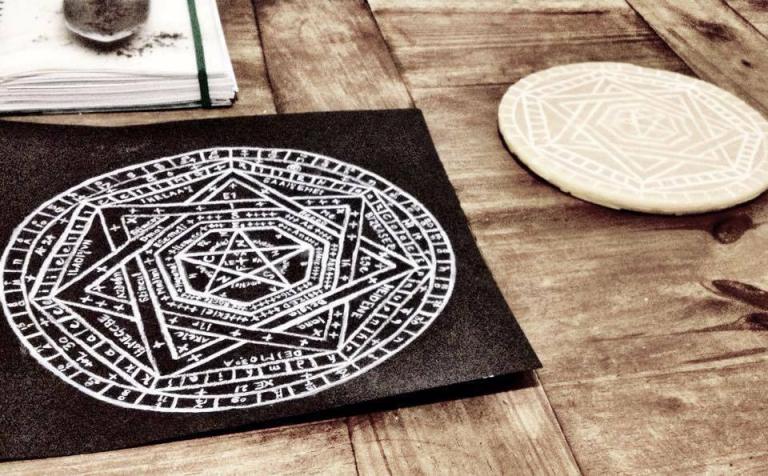
The author’s work upon the wax Sigillum Dei Aemeth.
I have a confession to make: Several years ago, and without any indication or prior warning, I found myself engulfed in the Angelic system of Dr John Dee, Elizabethan polymath, alchemist and mystic.
In the journey through paganism and witchcraft, I had become fairly confident in my area of study and practice. Furthermore, I was grounded in my path and was able to read and discover peripheral works and see how thy might relate or syncretise, or even describe a similar experiences through an alternative lens. Having always liked my magic intuitive, grass roots, pagan oriented, I had never harboured any desire, unconscious or otherwise, of exploring the complex and difficult system of magic of the Golden Age of Egland, much less that Angelic system communicated and recorded in the several diaries of Dr John Dee. That was all to change when I was utterly compelled, like a dessert wanderer thoroughly parched and drawn magnetically to the oasis by an irresistible force. A system of magic was calling me and, even today, I have been its reluctant adherent in private, little discussing it but studying and preparing painstakingly and in a reclusive state.

Jemaa el Fanaa, photographer Ian Chambers
The journey began, for me, half a decade or so ago in the heart of the ancient red walled North African city of Marrakech, Morocco, whilst holidaying amongst the souks and heritage site of the Jamaa el Fnaa. This atmospheric bazaar is a hive of activity, a street food haven, with huddled orange juice vendors, snake charmers, story-tellers, Berber wanderers and drummers, and stores where everything and anything can be bought. Making my way through the hustle and bustle of the souks as we made our way to the Jamaa, I noticed something unusual at one of the stalls. Conscious of the danger of stopping and showing the slightest hint of interest, which would draw a vendor immediately to you with a barrage of English learned from tourists and the hard sale (“lovely jubbley” belying too much Only Fools and Horses, whilst I constantly get beckoned with the call “Scottish” because of my Viking heritage plastered all over my pasty skin tone and ginger beard). Haggling is a national sport, and can be quite fun, but when not something you are prepared for, a courteous “non, merci”, avoiding eye contact and keep walking is the best tactic and you get left alone. The objects I was looking at in a wicker bin were leaves of parchment, yellowed and frayed in places, upon which was Arabic script. Something about the writing intrigued me and was possessed of a certain familiarity, although I could never hope to decipher the text. I was left to peruse at my leisure and, when a vedor approached and I asked what the pages were, he informed me casually that they are pages from an Arabic book on astrology. My heart leapt at these words, part in horror that they had separated the sheets of a book to sell pages that were rendered useless in isolation, partly it was the bibliophile in me simply dumbstruck that a book had been defaced. I could only think of one book of Arabic astrology, the Picatrix, but I knew there were many. Perhaps this was an, as yet, undiscovered tome. The pages were inexpensive, and I had a good friend in the city who would most likely be prepared to translate it for me. And yet I chose to continue to the Cafe Paris for a coffee and to enjoy the daily ritual of the Jemaa el Fanaa as so many writers had done before.
This was the least surprising part of the holiday, in fact, as it was just prior to our arrival in Marrakech that I found myself, out of nowhere, submerged in the world of Dee’s angelic magic, called now Enochian. Since that time, I have devoured all texts I could find, worked tirelessly on fashioning the tools of the art, visited the British Library to study Dee’s physical writings themselves, and have become obsessed – but not to the point of delusion that some may find clouding their vision.
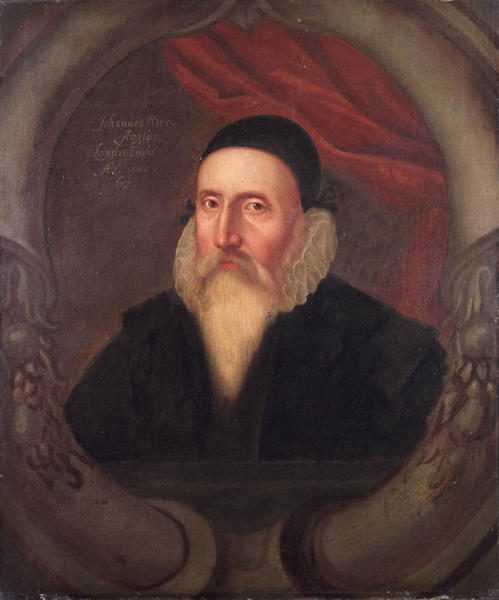
Portrait of John Dee belonging to his grandson, Rowland Dee, and later Elias Ashmole. Public Domain.
When discussing John Dee and his legacy, there are a few fallacies that should be laid to rest. The first of these is the name of the system itself, which John Dee and Edward Kelley would simply refer to as ‘angelic’. There was the mystery of the Book of Enoch and scholars of the Biblical works often had the desire to attain the original and unique texts which would provide a system in order to achieve the highest mysticism and commune directly with God and his angels. It would be centuries before the Books of Enoch were discovered and translated. It is believed that the Book of Enoch was first written down around 300BC and completed by the time of Christ. The earliest parts of the book talk of the Watchers, fallen angels, and shares a great deal of myth with the visions of Ezekiel. Like Ezekiel, Enoch is taken on many flights by the angelic forces and imparted with wisdom reserve for those mystics who have attained the highest heaven, Holy of Holies. The Book of Enoch was not included in the Biblical canon, but remained a folk memory and a legend which, in Dee’s time, was much sought after as a sourcebook for mystical traditions. The Merkabah and Hekhalot traditions of Jewish mysticism and Qabbalah have been discussed previously, and much of this material might have been sought after by Dee and his associates. The connection between his system, delivered by the angels who claimed to be those self same who taught Adam in the garden, and who delivered the alphabet and proto-language of the angels, and the mystical Enoch are evident. However, it was not something Dee would claim in his lifetime and, therefore, he never is recorded as referring to the system or subsequent alphabet as ‘Enochian’.
Another myth, which might come as a shock to many a pagan and occultist who have made the journey to visit the British Museum, is that the items in display in London likely never belonged to Dee. The obsidian mirror is most certainly ‘Aztec’ in origin, and is a fascinating artefact. However, even if it was owned by Dee or Kelley, we know without doubt that it was not used in their scrying sessions with the angels. The shewstones used are described in detail in several places. The writing on the wood and leather case for the obsidian mirror is inscribed by Horace Walpole, who acquired the object from Lady Elizabeth Germain, who herself obtained it from the Earl of Peterborough. How it came into the possession of the 17th Century Earl is unknown, but at some point it attained the legend of having been John Dee’s scrying mirror. In itself, this could be convincing except for the fact that we have descriptions in his own hand and this artefact is not it. It’s possible he once owned it as a curiosity, but it is not the stone he used with Edward Kelley in their scrying sessions with the angels.
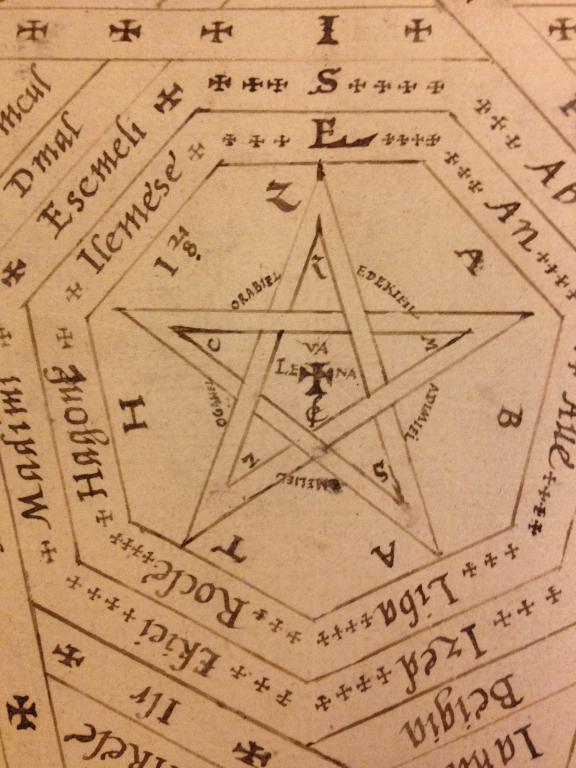
Detail of John Dee’s Sigillum Dei Aemeth. Photography by the author. Sloane MS 3188, (1582)
The next most remarkable, and identifiable, artefacts on display in the collection attributed to John Dee are the wax Sigillum Dei Aemeth, the True Seal of God. This includes the large piece which is placed upon the table, beneath the shewstone, while the smaller pieces were placed beneath the four legs of the table. These wax seals are close copies of the ones described and shown in John Dee’s writings and, by the museum’s own admission in its Curator’s comments, it cannot be known for certain that these were even made in Dee’s lifetime. There has been speculation from experts that they may have even been fashioned by Elias Ashmole, a likely contender for the origin of the seals as he studied and promoted Dee’s work extensively set both student and, perhaps, practitioner.
The gold amulet, which shows the Watchtowers, later influenced modern Wicca and shares visual and descriptive characteristics with Merkabah (chariot) and apocolyptic (‘revelatory’) traditions, biblical books and mysticism. However, the engraving upon the amulet has areas which, upon study, are incorrect. This indicates, as the Curator’s comments observe, that it is likely copied from a false depiction, most probably given by Casaubon in 1659 CE.
All of that aside, they are fascinating objects that are best described as having been ‘associated’ with Dr John Dee, rather than suggesting that the pieces themselves were ever used by him and his scryers (Later sessions were sans Kelley) as a part of his system.
A highly religious individual, prayer played a regular part in Dee’s practice and the conflict between his puritanical faith and Kelley’s unsavoury pursuits, such as necromancy, play out as they travelled Europe receiving messages from the angels. In many ways, to describe Dee and his colleagues work with the angels is to conjure the image of a prophet in a very real sense, in the ranks of Moses, Noah, Ezekial, Enoch.
One of the real resurgences in the study and use of Dee and Kelley’s material came when the Golden Dawn rediscovered the manuscripts pertaining to the system and attempted to fashion a workable system of their own. Following rapidly upon this, Aleister Crowley develop his own method and use, in particular of the Aethyrs. Indeed, his recording of parts of the Cry of the Aethyrs is part of the surviving cylinders that preserved the voice of Crowley. Taken directly from the Enochian magic system of Dee as delivered by the angelic forces, Crowley’s operations upon the Aethyrs, in the North African Algeria with Victor Neuberg, provoked visionary experiences which he describes in The Vision and the Voice. Most significant of Crowley’s experiences relate to Babalon and crossing the Abyss, which was an important revelation in the magical career of Crowley. There is much to absorb and study in the Vision of the 12th Aethyr of Crowley, with the appearance of Babalon as Mother of Abominations and the mysterious Daughter of Fortitude which manifested in the scrying sessions of John Dee, unsettling the man.
There is a vast world to discuss and study in terms of the Enochian system of magic communicated to Dr John Dee and Edward Kelley, Alchemist, and many books and occultists casually referred to the men in comments which demonstrate little understanding of the subject. When a magical system chooses you, as I have learned first hand, there is little point in resisting until it may have had its way with you. For me, the Enochian system is something I have studied in all seriousness and absolute sincerity, as a powerful and effective practice. After more than five years, I have yet to undertake a full working with the system, undertaking the path of the purist and working diligently to understand and prepare myself fully, with the correct and necessary items, before communing with the angels themselves.

The angelic script as delivered to John Dee & Edward Kelley. Photography by the author. Sloane MS 3188, (1582)
About Ian Chambers
Ian Chambers is a traditional witch engrossed in the study and practice of the Art as conveyed by means of the mysteries. By diligent study,research, exploration and direct application of myth and magic, the author has dedicated his life to the Work with many sacrifices along the way. Walking the lonely path, the Covenant of the Wanderer, a Child of the Land of Nod, raising the lantern by which the path of the Chapel Perilous may be illumined and the Castle perceived. You can read more about the author here.
Previous Post
May 29, 2018
Working Magic With The Angelic Forces
Next Post
June 7, 2018 The Welsh Occult Conference 2018
Browse Our Archives
Select a Category 1734 Ancestors Apophatic Sorcery Atramentous Press Beltane Betrayal big dipper Book Book Review Brigit Candlemas Ced Ced Tarot child of promise Christmas Climate Community Compass Conferences Conjuration culture Cultus Sabbati Dance Death Devil Dionysus Double Easter Environment Esotericism Events Experience Fairy Fate Folklore Greek Gods Greek Magical Papyri Green Man Grimoire history Initiation Interviews Jewish Mysticism Judas Kabbalah Legend Lilith Mandrake Books Llewellyn Lore Lucifer Magic Magic in History Series May Day Meditation Merkabah Monkey King Myth Necromancy New Books NEws north star road Oberon Obituary Occult Offerings Opposer Pagan Pax Deorum Pax Diaboli PGM Philosophy Poetry Politics Praxis Punk Witchcraft Ralph Harvey Reviews Richard Gordon Rita Morgan Ronald “Chalky” White Sabbatic Witchcraft Sabbats Sun Wukong Taoist the Regency The Witch Compass Three Hands Press Tradition Traditional Witchcraft Trickster God Tricksters Uncategorized via Negativa White Dragon Winds Witch lore Witchcraft Witchcraft Lore Witches' Sabbath wyrd Yule
Select a Month May 2025 March 2025 February 2025 January 2025 December 2024 July 2024 June 2024 April 2024 March 2024 February 2024 January 2024 December 2023 November 2023 October 2023 September 2023 August 2023 July 2023 December 2022 October 2022 September 2022 August 2022 May 2022 April 2022 March 2022 February 2022 December 2021 July 2021 May 2021 April 2021 February 2021 January 2021 December 2020 November 2020 September 2020 August 2020 July 2020 June 2020 May 2020 April 2020 March 2020 February 2020 January 2020 December 2019 November 2019 October 2019 September 2019 July 2019 June 2019 May 2019 April 2019 March 2019 December 2018 September 2018 August 2018 July 2018 June 2018 May 2018 April 2018 March 2018 February 2018 June 2017 October 2016 September 2016 July 2016 June 2016 April 2016
Follow Us!
TAKE THE
Religious Wisdom Quiz
Elisha purified a pot of stew that had been poisoned with what?
Select your answer to see how you score.
Arsenic Bad Cheese Wild Gourds Wild Mushrooms
Related posts from By The Pale Moonlight

Maundy Thursday: Night of the Witches

The Devil in Witchcraft - The Witch Compass...
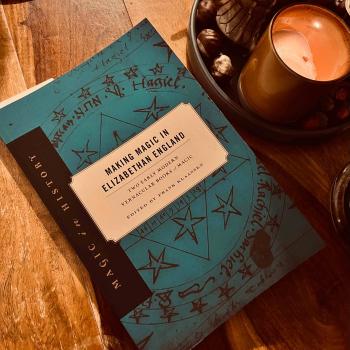
Book Review: Making Magic in Elizabethan England
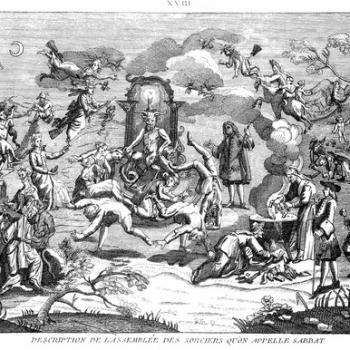
We need to talk about the Witchcraft Act...
TRENDING AT PATHEOS Pagan

I was recently chatting with someone on Instagram. She asked me what...

While there are many people who share their results, the end of...

On July 23, I saw Christopher Nolan's The Odyssey which is Homer’s...

As I write this two big events have just finished up. One...

Restoring the Watershed of Divine Love
Perhaps cooperation is not something we manufacture through legislation, ideology, or moral...

Many UUs don’t pray because of bad experiences in a previous religion,...
view all Pagan blogs
Ad-Free & Subscriber Log-In Subscription Support
- About Us
- 2026 Calendar
- Videos
- Podcasts
- Library of World Religions
- Faith In Media Tracker
- Advertise With Us
- Write for Us
- Privacy Policy
- Terms of Service
- Do Not Sell My Data
- Contact Us
- Radiant Digital
- Manage Newsletter Subscriptions
- Unsubscribe From Notifications
- Sitemap
Copyright 2008-2026, Patheos. All rights reserved.
Subscription Support Ad-Free & Subscriber Log-In
Follow Patheos