
BuddhistCatholicContemplativeEvangelicalGeneral ChristianHinduJewishLatter-day SaintMuslimNew VisionsProgressive Christian
Beliefs
- Buddhist
- Catholic
- Contemplative
- Evangelical
- General Christian
- Hindu
- Jewish
- Latter-day Saint
- More Voices
- Muslim
- New Visions
- Pagan
- Progressive Christian
Topics
- Religion News
- Food and Religion
- Sports and Religion
- Religious Art
- Religious Music and Entertainment
- Religious Events
- History and Religion
- Style and Religion
- Politics and Religion
- Women in Religion
- Recreation Outdoors and Religion
- Business Finance and Religion
- Careers Workplace and Religion
- Education and Religion
- Family Parenting and Religion
- Health Fitness and Religion
- Home and Religion
- Relationships and Religion
- Technology and Religion
- Travel and Religion
Columnists
- Buddhist Columnists
- Business Finance and Religion Columnists
- Careers Workplace and Religion Columnists
- Catholic Columnists
- Contemplative Columnists
- Education and Religion Columnists
- Evangelists Columnists
- Family Parenting and Religion Columnists
- General Christian Columnists
- Health Fitness and Religion Columnists
- Hindu Columnists
- History and Religion Columnists
- Home and Religion Columnists
- Jewish Columnists
- More Voices Columnists
- Latter Day Columnists
- Muslim Columnists
- New Visions Columnists
- Nonreligious Columnists
- Pagan Columnists
- Politics and Religion Columnists
- Progressive Columnists
- Recreation Outdoors and Religion Columnists
- Relationships and Religion Columnists
- Religion News Columnists
- Religious Art Columnists
- Religious Events Columnists
- Religious Music and Entertainment Columnists
- Sports and Religion Columnists
- Style and Religion Columnists
- Technology and Religion Columnists
- Travel and Religion Columnists
- Women in Religion Columnists
Resource Library
- 2026 Calendar
- Library of World Religions
- The 100 Most Holy Places on Earth
- Patheos Answers
- Podcasts
- Videos
- Faith Leaders Database
- Anglican Episcopalian
- Bahai
- Baptist
- Buddhism
- Christianity
- Confucianism
- Eastern Orthodoxy
- Hinduism
- Holiness and Pentecostal
- ISKCON
- Islam
- Judaism
- Lutheran
- Methodist
- The Church of Jesus Christ of Latter-day Saints
- New Age
- Paganism
- Presbytarian and Reformed
- Protestantism
- Religion Behind the Scenes
- Roman Catholic
- Scientology
- Shia Islam
- Sikhism
- Sufism
- Sunni Islam
- Taoism
- Zen
- See all religions
Research Tools
 Ad-Free & Subscriber Log-In Subscription Support
Ad-Free & Subscriber Log-In Subscription Support
Follow Patheos 

- Trending:
- Forgiveness
- |
- Marriage
- |
- Consciousness
- |
- Death Penalty
- |
- Election
- |
- Halloween
 By Athame and Stang
- Home
- Pagan
- Into the Craft: My Personal History
Into the Craft: My Personal History
Last updated on: November 11, 2016 at 6:35 pm by Kelden
Into the Craft: My Personal History 2016-11-11T18:35:29-05:00 Kelden
Patheos Explore the world's faith through different perspectives on religion and spirituality! Patheos has the views of the prevalent religions and spiritualities of the world.
Ever since I was a small child I have been enamored with all things “spooky.” Whether it had to do with Witches, ghosts, fairies, or other assorted magical beings, I was completely obsessed. My mother believes that this otherworldly predisposition may have something to do with my birth-date being close to Halloween. This is quite possible, as a flip through my baby book will show you that my birthdays were always Witch themed. But my “spooky” interests weren’t limited to any specific time of year. In fact, in addition to Halloween there were two other major factors that contributed to my early fascination with Witchcraft.
One such influence were the fairy-tales that I, like most other children, grew up with. However, unlike most children, I wanted nothing to do with ditsy princesses or handsome knights. It was the evil queens, dark fairies, and decrepit hags I was drawn to. Despite their reputation as being the adversaries of all things good and holy, I saw them as strong women imbued with otherworldly powers to change their lives and manifest their desires. Unlike their goodly counterparts, these ladies didn’t need anyone to save them, because they were their own heroes. So, while others may have been afraid of Witches and the darkness in which they roamed, I embraced it. Through these characters I learned to draw on my own power to stand up for myself, effect change, and to be fearless.
Another influence was the relationship I had with nature. I spent a lot of time playing in the woods behind my house, and it was there that I’d have my first experiences with spirits and the Gods. I wasn’t interested in playing sports or video games, instead I’d rather put on my favorite black cloak and disappear into the woods. In that enchanted realm, I’d run through the trees, build fairy houses, speak with the deer, and collect plants, rocks, and feathers. Communing with spirits, animals, and fairies during these times was commonplace. Through these conversations I learned about the sacredness of nature and the connection between all things. My mother had taught me about God and brought me to church, but it was only among the trees that I ever truly felt connected to anything spiritual.
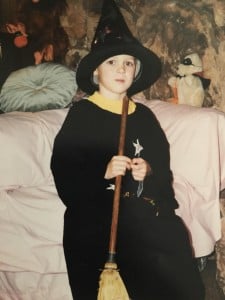
Baby Kelden in typical Witch regalia. (From author’s personal photo collection)
In fifth grade I discovered Wicca while researching Witchcraft on the internet. The website I stumbled upon is long gone, but I distinctly remember the flashy moving pentacles and awful wind-chime music playing in the background. Despite my firm belief in Witchcraft, I was still astounded to learn that I wasn’t alone. I read with great fervor about this religion called Wicca, mesmerized by the list of its common beliefs. Needless to say, I took down every last detail that website had to offer me and committed it to memory.
Soon after my initial exposure, as per instruction, I erected my first altar. It was a small wooden table (originally for my sister’s dolls), onto which I placed a red candle for the God and a green candle for the Goddess, a glass goblet, and a black handled kitchen knife. I vividly remember my mother asked me about it and in a matter-of-fact tone I told her:
“It’s an altar to honor the God and Goddess of nature.”
She was a little less than enthused but certainly didn’t stop me by any means. In fact, she bought me my first two books, The Everything Wicca and Witchcraft Book and The Little Giant Encyclopedia of Spells and Magic.
Embarrassingly enough, I was so enthusiastic about my discovery of Wicca that I tried converting a good number of students in my fifth grade class.
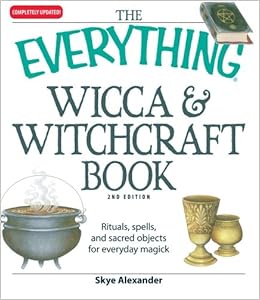
Photo courtesy of Amazon.com
Sixth grade was the definitely height of my love affair with Wicca, which in hindsight this makes perfect sense. Middle school was hell for me. I didn’t have many friends and I was the subject of frequent bullying. But Wicca gave me a sense of empowerment that helped me through that nightmare time. It didn’t matter that I wasn’t popular or that I was relentlessly ridiculed, because I was a part of something mysterious and magical that those assholes would never be. I was Wiccan and I was proud!
To Ride a Silver Broomstick was my bible and I wore my Teen Witch Kit pentacle to school with great delight. Study Hall was spent doodling altar layouts, copying down correspondences, and writing spells. When assigned to write a short story for class, I wrote about a group of friends working together as a coven which, embarrassingly enough, I read aloud to the class.
The level of openness I had about being Wiccan did lead to trouble at times. There was a group of girls who constantly hounded me with bible quotes, the school principle told me he couldn’t help me if I wasn’t going to fit in with the mainstream, the boys in the locker room were afraid I’d hex them, and I know someone stole The Grimoire of Lady Sheba out of my locker!
But nothing could deter me. I felt an incredibly deep connection to nature and the Gods and after a crappy day at school I always knew I could go home and find comfort in the woods behind my house or in the pages of my books.
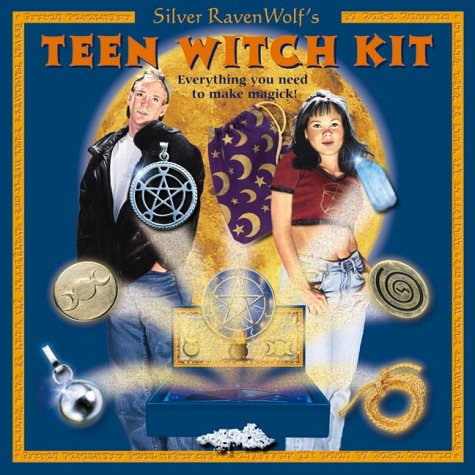
Photo courtesy of Amazon.com
Despite my sixth grade Wiccan bliss, as I grew older, I became increasingly dissatisfied for a number of reasons. Firstly, I began to see Wicca as a very materialistic religion. This was a direct result of encountering other Witches online who, instead of discussing experience and practice, only wanted to talk about their tools, their altars, and their recent purchases. Secondly, I started to become more aware of hypocrisy and drama. Wicca claimed to be such a tolerant and accepting religion yet I was seeing a lot of bashing, not only of other religions (particularly Christianity), but of other Wiccans. Thirdly, as a I began college and started being more academically critical, I started to question a lot of what was being presented in the books I was reading. I was fed up with claims I knew were inaccurate, such as that Wicca is the oldest religion in the world or that those killed during the so called Burning Times were actually Witches. And so finally, after much frustration I gave up on Wicca, so to speak. In reality, however, I only really dropped the label, as my practices obviously continued to be very Wiccan oriented. But I didn’t really understand that at the time.
It wasn’t until a few years later that I stumbled upon new websites and suddenly a flame sparked back to life. I found wonderful blogs written by Witches who were academic, well researched, and informative. Through their writing, I began to realize that there was way more to Wicca than what I had originally thought and what I had encountered. This in turn brought another realization that while I had been criticizing Wicca for supposedly lacking academic credibility, I had been living in my own ignorance. I had been frustrated with the information being presented in books, yet instead of doing my own research, seeking answers to my questions, and helping to clear up misinformation, I had just given up.
But no longer! There was a whole history of modern Witchcraft that I had missed, and I wanted to know everything.
I began my quest by going back to start, reading the works of Gardner, Valiente, the Farrars, and others. From there I extended both backwards and forwards in time, examining where the different parts of Wicca came from, how they’ve evolved, and where they were headed. It was during this time that I discovered the idea of Traditional Witchcraft, and I was immediately drawn in, feeling a comforting sense of familiarly, often described as “coming home.” There was only one problem. I quickly caught on to the fact that Traditional Witchcraft is often presented as being in direct opposition to Wicca. However, as my research continued, despite what others were claiming, I began to see many similarities between the two paths.
For me, I see Traditional Witchcraft as a set of base practices that have been attributed to Witches throughout time and across cultures. These practices include things like, working with spirits, healing, cursing, working with herbs, divining the future, and spirit flight. Obviously, Wicca as a specific form of Witchcraft contain many (if not all) of these practices. After all, if Gardner had gotten his fragmented tradition from an older coven, wouldn’t that make it some form of “Traditional” Witchcraft? Even within specific forms of Trad Craft (such as Cochrane’s) I’ve noticed overlaps and parallels to Wiccan practices.
Of course all of this has proved to be a very unpopular opinion to hold as suggesting any commonalities will surely leave you swiftly reprimanded. I’d like to make it clear that I’m not trying to say that Traditional Witchcraft and Wicca are the same. Nor am I necessarily trying to say that either has influenced the other. What I am saying is that when we stop slinging mud and take a deeper look at the history of Witchcraft, we can see the common roots they share.
And so here I am today, writing about my practice, what I’ve learned so far, and the questions I still have.
Previous Post

August 6, 2016
Introduction
Next Post
August 20, 2016 The Stang
Browse Our Archives
Select a Category Uncategorized
Select a Month April 2020 February 2020 January 2020 December 2019 October 2019 September 2019 August 2019 July 2019 June 2019 May 2019 April 2019 February 2019 January 2019 December 2018 November 2018 October 2018 September 2018 August 2018 July 2018 June 2018 May 2018 April 2018 March 2018 February 2018 January 2018 December 2017 November 2017 October 2017 August 2017 May 2017 April 2017 March 2017 February 2017 January 2017 December 2016 November 2016 October 2016 September 2016 August 2016
Follow Us!
TAKE THE
Religious Wisdom Quiz
What did Jesus use to heal a blind man in John 9?
Select your answer to see how you score.
Mud and saliva His robe A fig leaf Olive oil
Related posts from By Athame and Stang

A Walpurgisnacht Ritual of Transvection, Or A Journey...

Suspicious Witchy Authors: Community Reactions And My Final...
The Witch Father And Mother: Gender In Traditional...

I Spent A Week Becoming A Witch: A...
TRENDING AT PATHEOS Pagan

When we talk about Greek religion, we often begin with the dodekatheion—the...

I was recently chatting with someone on Instagram. She asked me what...

While there are many people who share their results, the end of...

On July 23, I saw Christopher Nolan's The Odyssey which is Homer’s...

As I write this two big events have just finished up. One...

Restoring the Watershed of Divine Love
Perhaps cooperation is not something we manufacture through legislation, ideology, or moral...
view all Pagan blogs
Ad-Free & Subscriber Log-In Subscription Support
- About Us
- 2026 Calendar
- Videos
- Podcasts
- Library of World Religions
- Faith In Media Tracker
- Advertise With Us
- Write for Us
- Privacy Policy
- Terms of Service
- Do Not Sell My Data
- Contact Us
- Radiant Digital
- Manage Newsletter Subscriptions
- Unsubscribe From Notifications
- Sitemap
Copyright 2008-2026, Patheos. All rights reserved.
Subscription Support Ad-Free & Subscriber Log-In
Follow Patheos