
BuddhistCatholicContemplativeEvangelicalGeneral ChristianHinduJewishLatter-day SaintMuslimNew VisionsProgressive Christian
Beliefs
- Buddhist
- Catholic
- Contemplative
- Evangelical
- General Christian
- Hindu
- Jewish
- Latter-day Saint
- More Voices
- Muslim
- New Visions
- Pagan
- Progressive Christian
Topics
- Religion News
- Food and Religion
- Sports and Religion
- Religious Art
- Religious Music and Entertainment
- Religious Events
- History and Religion
- Style and Religion
- Politics and Religion
- Women in Religion
- Recreation Outdoors and Religion
- Business Finance and Religion
- Careers Workplace and Religion
- Education and Religion
- Family Parenting and Religion
- Health Fitness and Religion
- Home and Religion
- Relationships and Religion
- Technology and Religion
- Travel and Religion
Columnists
- Buddhist Columnists
- Business Finance and Religion Columnists
- Careers Workplace and Religion Columnists
- Catholic Columnists
- Contemplative Columnists
- Education and Religion Columnists
- Evangelists Columnists
- Family Parenting and Religion Columnists
- General Christian Columnists
- Health Fitness and Religion Columnists
- Hindu Columnists
- History and Religion Columnists
- Home and Religion Columnists
- Jewish Columnists
- More Voices Columnists
- Latter Day Columnists
- Muslim Columnists
- New Visions Columnists
- Nonreligious Columnists
- Pagan Columnists
- Politics and Religion Columnists
- Progressive Columnists
- Recreation Outdoors and Religion Columnists
- Relationships and Religion Columnists
- Religion News Columnists
- Religious Art Columnists
- Religious Events Columnists
- Religious Music and Entertainment Columnists
- Sports and Religion Columnists
- Style and Religion Columnists
- Technology and Religion Columnists
- Travel and Religion Columnists
- Women in Religion Columnists
Resource Library
- 2026 Calendar
- Library of World Religions
- The 100 Most Holy Places on Earth
- Patheos Answers
- Podcasts
- Videos
- Faith Leaders Database
- Anglican Episcopalian
- Bahai
- Baptist
- Buddhism
- Christianity
- Confucianism
- Eastern Orthodoxy
- Hinduism
- Holiness and Pentecostal
- ISKCON
- Islam
- Judaism
- Lutheran
- Methodist
- The Church of Jesus Christ of Latter-day Saints
- New Age
- Paganism
- Presbytarian and Reformed
- Protestantism
- Religion Behind the Scenes
- Roman Catholic
- Scientology
- Shia Islam
- Sikhism
- Sufism
- Sunni Islam
- Taoism
- Zen
- See all religions
Research Tools
 Ad-Free & Subscriber Log-In Subscription Support
Ad-Free & Subscriber Log-In Subscription Support
Follow Patheos 

- Trending:
- Forgiveness
- |
- Marriage
- |
- Consciousness
- |
- Death Penalty
- |
- Election
- |
- Halloween

- Home
- Hindu
- Travel and Religion
- India’s True Need: Jobs Over Temples
India’s True Need: Jobs Over Temples
Last updated on: October 24, 2024 at 8:47 am by Neil Ghosh
India’s True Need: Jobs Over Temples 2024-10-24T08:47:29-04:00 Neil Ghosh
Patheos Explore the world's faith through different perspectives on religion and spirituality! Patheos has the views of the prevalent religions and spiritualities of the world.
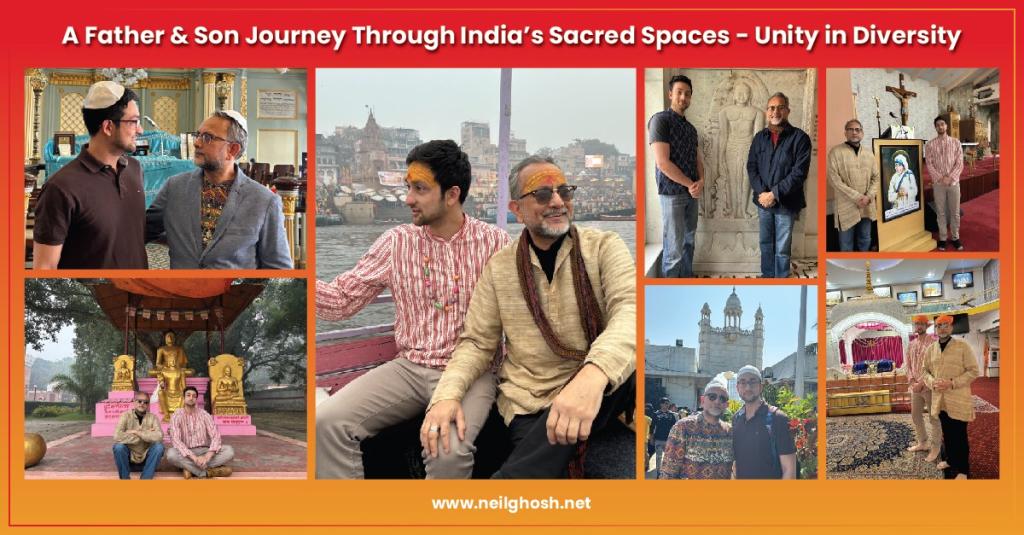
Journey Through India’s Sacred Spaces. Courtesy Neil Ghosh
How Do We Create More Jobs? This is India’s central economic challenge—not building more temples! In my Patheos article from October 2, I wrote about my whirlwind tour of India with my son, Ryan Ghosh, in January 2024. We experienced the richness of India’s spiritual diversity firsthand as we traveled across the country, visiting temples, mosques, synagogues, gurudwaras, and many other religious sites, including a glimpse of the Ram Mandir, the controversial Hindu temple in Ayodhya, built on the ruins of a destroyed 16th-century mosque.
However, we also sensed a growing tension between Hindus and Muslims, highlighting the challenges of maintaining religious harmony in some regions. Despite the outward appearance of harmony, undercurrents of discord were driven by economic frustrations and societal tensions.
What India truly needs isn’t more religious monuments—it needs jobs.
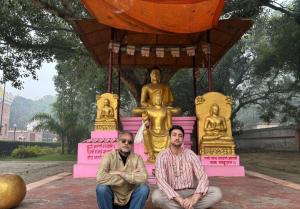
Neil Ghosh and Ryan Ghosh under the Bodhi Tree in Sarnath, India. Courtesy of Neil Ghosh
The real driving force behind the Indian electorate today is the need for economic opportunities rather than temple-building.
Since our visit, India held a general election in which approximately 642 million people voted, a significant turnout among over 968 million eligible voters. For the first time since the Hindu nationalist Bharatiya Janata Party (BJP) came to power in 2014, it failed to secure a majority on its own, winning only 240 seats—a sharp decline from the 303 seats it claimed in 2019. Notably, the highest-ever participation of women voters, with 312 million women casting ballots, signaled an electorate focused on tangible economic concerns.
Recent elections have underscored that most voters are primarily concerned with bread-and-butter economic issues. According to a Reuters article, in Modi’s stronghold, voters chose jobs over a new Hindu temple.
One voter, a 55-year-old farmer named Nankan Yadav, switched to the opposition after voting for the BJP in two previous elections. “Everyone loves Lord Ram, but without work and income, what can one do?” Yadav lamented. Inflation and unemployment emerged as the central concerns for voters like Yadav, who reflected a broader national sentiment.
A survey of 20,000 voters by the CSDS-Lokniti polling agency for “The Hindu” newspaper showed that 30% of voters cited inflation as their primary concern, up from 20% before the election, while 27% identified unemployment as a key issue. This signals a shift in voter priorities, from religious and cultural issues to the more pressing need for economic relief.
Despite India’s vast working-age population of nearly one billion, only 430 million jobs exist. Particularly alarming is the youth unemployment rate: as of December 2022, 45.8% of people under the age of 25 were unemployed, according to the Center for Monitoring Indian Economy (CMIE). The lack of jobs for the young—who make up more than 40% of India’s population—is a critical concern for the country’s future.
While India’s spiritual diversity is a source of pride, it is clear that fostering religious harmony is vital for its economic health.
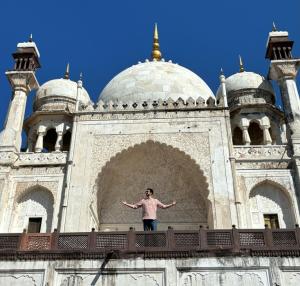
Bibi Ka Maqbara, Aurangabad, India. Courtesy Neil Ghosh
Here’s why religious harmony can help drive economic prosperity:
Social Stability: When conflicts and tensions are reduced, an atmosphere conducive to economic activity emerges. Businesses are more likely to invest in regions that are socially stable.
Inclusive Development: Economic growth is more sustainable when it includes all sections of society. When all religious groups have equal opportunities to participate in economic activities, the economy becomes more balanced and robust.
Tourism: Religious harmony enhances India’s appeal as a tourist destination. In 2024, travel and tourism revenues are projected to reach nearly $24 billion, and the World Travel and Tourism Council expects this sector to grow to $420 billion by 2031, contributing 7.2% of the GDP.
Global Image and Foreign Investment: India’s image as a nation where various religious communities coexist peacefully enhances its international standing. A positive global perception is crucial for attracting foreign direct investment (FDI), which is expected to reach $100 billion this year.
Workforce Productivity and Innovation: A harmonious work environment free from religious discrimination encourages a more productive workforce. Additionally, diverse perspectives brought by people from various backgrounds can foster creativity and innovation.
Market Expansion and Consumer Confidence: Religious harmony contributes to an expansive and confident consumer base. When communities are not embroiled in conflict, they can focus on economic activities, leading to increased consumption and a more vibrant market.
Reduction of Economic Disparities: Conflicts based on religious differences can exacerbate economic disparities, leading to social unrest and inefficiencies. By addressing disparities and promoting harmony, equitable economic growth can be achieved.
Resilience in Times of Crisis: A society characterized by religious harmony is more resilient during economic or social crises. This resilience is crucial for maintaining economic stability and ensuring rapid recovery.
Leveraging Diversity for Global Trade: India’s diverse cultural and religious traditions can be leveraged for global trade relations. Understanding and respecting different religions and cultures fosters better international partnerships and opens new markets.
Educational and Human Capital Development: Religious harmony creates a peaceful and stable educational environment, essential for developing human capital. A well-educated and skilled workforce is key to economic growth and innovation.

Kailasa temple, Ellora, India. Courtesy of Neil Ghosh
Religious harmony in India is not just a source of spiritual inspiration; it is an essential component for fostering a stable, inclusive, and dynamic economy. It helps attract investment, encourages tourism, enhances global trade, and ensures sustainable development. For India to continue on its path of growth and prosperity, fostering religious harmony is not just a social imperative—it is an economic necessity.
As my son and I witnessed during our travels, India’s strength lies not in its monuments but in its diverse people — united in their diversity and their common desire for economic opportunities which would help tie it all together.
I’d love to hear your thoughts! Do you have any personal experiences or ideas to share? Join the conversation by leaving a comment below—I’m looking forward to your insights!
Hindu
Buddhism
Politics and Religion
About Neil Ghosh
Neil Ghosh has a mission: To give a voice to the voiceless. Neil has forged a path from a childhood in Kolkata to the boardrooms of multinational companies and from leadership roles in global nonprofits to building homes for vulnerable children in Morocco and India. He combines business skills with boundless compassion to build partnerships that foster sustainable development. As an advocate for marginalized populations, the underrepresented, and people facing injustice, Neil has appeared in print, broadcast, and online media in the United States and abroad, including CNN, Devex, the Washington Post, Economic Times, Voice of America, the Australian, the Huffington Post, and Stanford Social Innovation Review. You can read more about the author here: www.neilghosh.net You can read more about the author here. You can read more about the author here.
Previous Post

October 1, 2024
Exploring India’s Religious Harmony: A Father-Son Journey
Next Post

November 5, 2024 Remembering Quincy Jones: The Genius Behind a Musical Legacy
Recent Comments
"Though humble and lowly, one's feet are the most trusted vehicles for every pilgrim. Visiting ..."
Why Every Major Religion Pays Attention ..."
"Recent migrants, newly arrived refugees, early settlers, and original inhabitants are all fellow pilgrims on ..."
America at 250: The Country We ..."
"This is such a meaningful and heartfelt read, you’ve shared the idea of religious harmony ..."
Exploring India’s Religious Harmony: A Father-Son ..."
"Doing Dignity is a meaningful project. Living in dignity and dying in dignity is a ..."
What Bhutan Taught Me About Joy ..."
Browse Our Archives
Select a Category Uncategorized
Select a Month August 2026 July 2026 December 2025 August 2025 July 2025 June 2025 May 2025 April 2025 March 2025 February 2025 December 2024 November 2024 October 2024 September 2024 August 2024
Follow Us!
TAKE THE
Religious Wisdom Quiz
Who said: "Dear friends, do not be surprised at the fiery ordeal that has come on you to test you"?
Select your answer to see how you score.
John Peter James Paul
Related posts from Building Bridges
Family
Why Every Major Religion Pays Attention to Feet
Family
Three Days Attempting to Reach Mary Magdalene's Cave

Family
America at 250: The Country We Are Still...
Family
What Bhutan Taught Me About Joy After Two...
TRENDING AT PATHEOS Travel and Religion

In "Irreplaceable," our book on vocation and technology, Trevor Sutton and I...

I was strolling through the top floor of the brand new Parthenon...

What Does Gêvâh Mean For Kimberley Guifoyle &...
This week, a lot of the news is focused on Kimberly Guilfoyle....

INNER CIRCLE: Profound Mystery (Of Christ In All...
Ephesians 5:31-32 “For this reason, a man will leave his father and...

Do Not Rejoice When Your Enemy Falls: The...
Turning an execution into a public spectacle is a disturbing expression of...

'The Chosen' S6 Trailer: The Passion Gets Very...
Not many watching 'The Chosen' worry about spoilers, but just because they...
view all Travel and Religion blogs
What Are Your Thoughts?leave a comment
Ad-Free & Subscriber Log-In Subscription Support
- About Us
- 2026 Calendar
- Videos
- Podcasts
- Library of World Religions
- Faith In Media Tracker
- Advertise With Us
- Write for Us
- Privacy Policy
- Terms of Service
- Do Not Sell My Data
- Contact Us
- Radiant Digital
- Manage Newsletter Subscriptions
- Unsubscribe From Notifications
- Sitemap
Copyright 2008-2026, Patheos. All rights reserved.
Subscription Support Ad-Free & Subscriber Log-In
Follow Patheos