
BuddhistCatholicContemplativeEvangelicalGeneral ChristianHinduJewishLatter-day SaintMuslimNew VisionsProgressive Christian
Beliefs
- Buddhist
- Catholic
- Contemplative
- Evangelical
- General Christian
- Hindu
- Jewish
- Latter-day Saint
- More Voices
- Muslim
- New Visions
- Pagan
- Progressive Christian
Topics
- Religion News
- Food and Religion
- Sports and Religion
- Religious Art
- Religious Music and Entertainment
- Religious Events
- History and Religion
- Style and Religion
- Politics and Religion
- Women in Religion
- Recreation Outdoors and Religion
- Business Finance and Religion
- Careers Workplace and Religion
- Education and Religion
- Family Parenting and Religion
- Health Fitness and Religion
- Home and Religion
- Relationships and Religion
- Technology and Religion
- Travel and Religion
Columnists
- Buddhist Columnists
- Business Finance and Religion Columnists
- Careers Workplace and Religion Columnists
- Catholic Columnists
- Contemplative Columnists
- Education and Religion Columnists
- Evangelists Columnists
- Family Parenting and Religion Columnists
- General Christian Columnists
- Health Fitness and Religion Columnists
- Hindu Columnists
- History and Religion Columnists
- Home and Religion Columnists
- Jewish Columnists
- More Voices Columnists
- Latter Day Columnists
- Muslim Columnists
- New Visions Columnists
- Nonreligious Columnists
- Pagan Columnists
- Politics and Religion Columnists
- Progressive Columnists
- Recreation Outdoors and Religion Columnists
- Relationships and Religion Columnists
- Religion News Columnists
- Religious Art Columnists
- Religious Events Columnists
- Religious Music and Entertainment Columnists
- Sports and Religion Columnists
- Style and Religion Columnists
- Technology and Religion Columnists
- Travel and Religion Columnists
- Women in Religion Columnists
Resource Library
- 2026 Calendar
- Library of World Religions
- The 100 Most Holy Places on Earth
- Patheos Answers
- Podcasts
- Videos
- Faith Leaders Database
- Anglican Episcopalian
- Bahai
- Baptist
- Buddhism
- Christianity
- Confucianism
- Eastern Orthodoxy
- Hinduism
- Holiness and Pentecostal
- ISKCON
- Islam
- Judaism
- Lutheran
- Methodist
- The Church of Jesus Christ of Latter-day Saints
- New Age
- Paganism
- Presbytarian and Reformed
- Protestantism
- Religion Behind the Scenes
- Roman Catholic
- Scientology
- Shia Islam
- Sikhism
- Sufism
- Sunni Islam
- Taoism
- Zen
- See all religions
Research Tools
 Ad-Free & Subscriber Log-In Subscription Support
Ad-Free & Subscriber Log-In Subscription Support
Follow Patheos 

- Trending:
- Forgiveness
- |
- Marriage
- |
- Consciousness
- |
- Death Penalty
- |
- Election
- |
- Halloween

- Home
- Progressive Christian
- Travel and Religion
- 7 Things Parents Can Do To Teach Kids To Reject Hate
7 Things Parents Can Do To Teach Kids To Reject Hate
Last updated on: September 11, 2024 at 8:31 am by Neil Ghosh
7 Things Parents Can Do To Teach Kids To Reject Hate 2024-09-11T08:31:21-04:00 Neil Ghosh
Patheos Explore the world's faith through different perspectives on religion and spirituality! Patheos has the views of the prevalent religions and spiritualities of the world.
On August 12, 2017, a white supremacist drove his car into a crowd of counter-protesters in Charlottesville, Virginia, tragically killing 32-year-old Heather Heyer. Needing to understand, and moved to act, I traveled to Charlottesville the day after her death, and spoke with residents. Recently, I returned, and also spoke with Heather’s mother and with a former white supremacist and author of “My Life After Hate”. I asked both how to teach our children to choose love over hate.
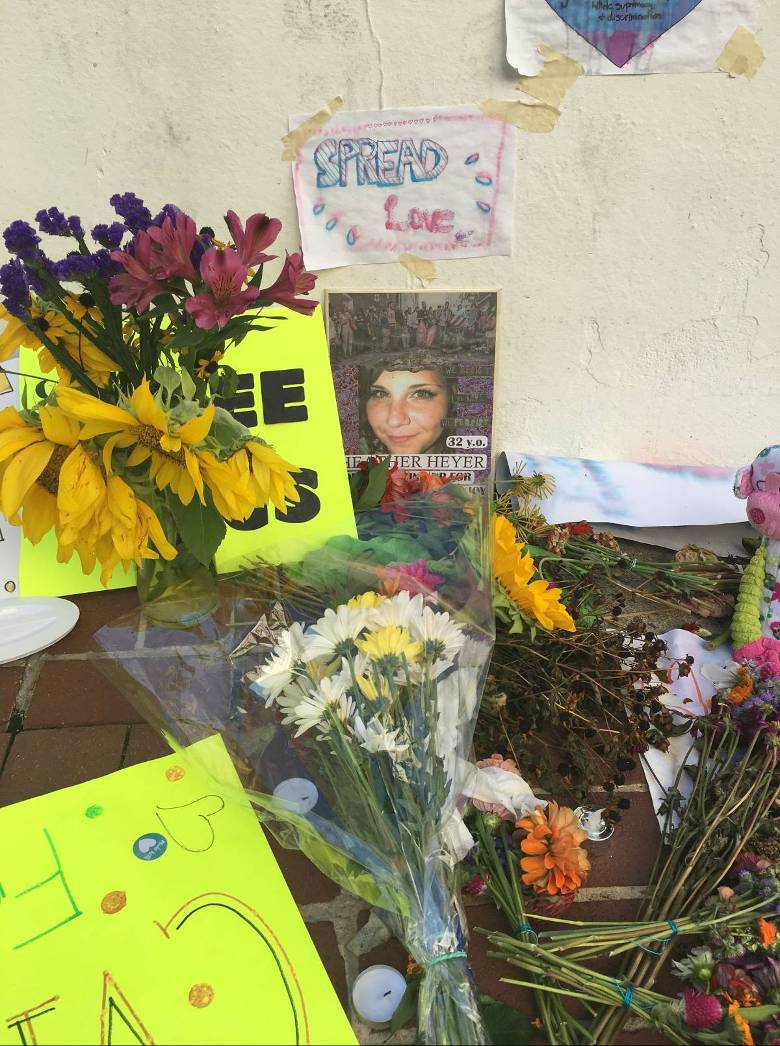
A memorial display is created after the tragic killing of 32-year-old Heather Heyer./ Photo by author
The events of August 12, 2017, shook the nation. They also left a deep impression on me. So deep that I first went there to speak with residents on August 13. Seven years later, in June 2024, I returned to Charlottesville, this time with my son, Ryan Ghosh, who represents the same generation as Heather Heyer. It is their generation, just now emerging into positions of leadership and making its voice heard, that will dispel the hatred that breeds such tragedies. I wanted to see the situation through Ryan’s eyes.
This visit was not just a journey into the past but a step forward – toward a future where such hatred is no longer a force in society.
In this article, I will share what I learned from the residents of Charlottesville, what I learned from the mother of Heather Heyer, from a former white supremacist activist, and from Ryan.
Three vantage points
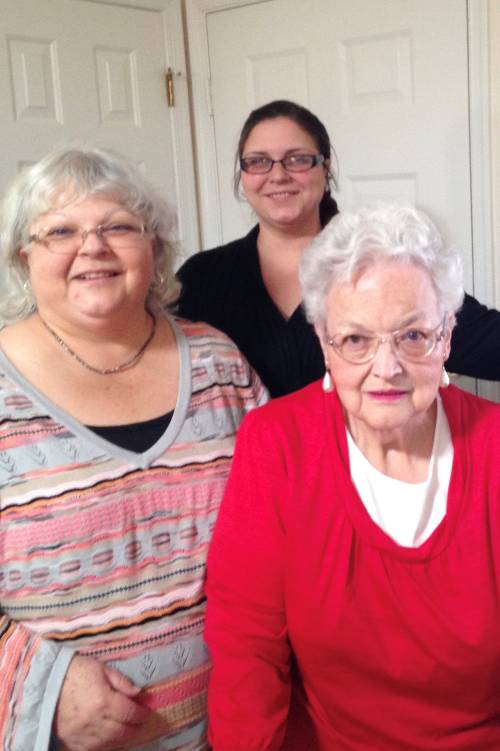
Susan Bro with Heather and her mother. Photo courtesy of the Bro family.
Susan Bro, a former teacher, is Heather Heyer’s mother. Susan taught Heather to treat all human beings fairly. She stressed the importance of empathy and compassion. Heather soaked up those lessons, insisting on fairness from a very early age and realizing that dehumanizing any human is simply wrong. Heather learned so well in fact that she would even correct her mother from time to time. For her part, Susan also emphasized the importance of learning from our children, as she learned from her daughter.
For a brief period during Heather’s kindergarten, she was the only White kid in an all-Black school in Farmville, Virginia, a rural town outside of Richmond. It was not easy. She faced constant bullying from classmates and had to endure the humiliating ridicule of a Black teacher. Later Susan and Heather learned that as recently as 1951, African American students had had to fight for access to equal education in the county, only to face blatant racism from the white students and teachers.
This whole experience (although not pleasant) taught Heather what it feels like to be in a minority. (Farmville schools ultimately were forced to desegregate in 1964, but separation continues in that today most white children attend private school)
Arno Michaelis once helped found a neo-Nazi skinhead organization. Today, he is a speaker and the author of My Life After Hate, a book recounting his journey out of racist extremism. He is also the
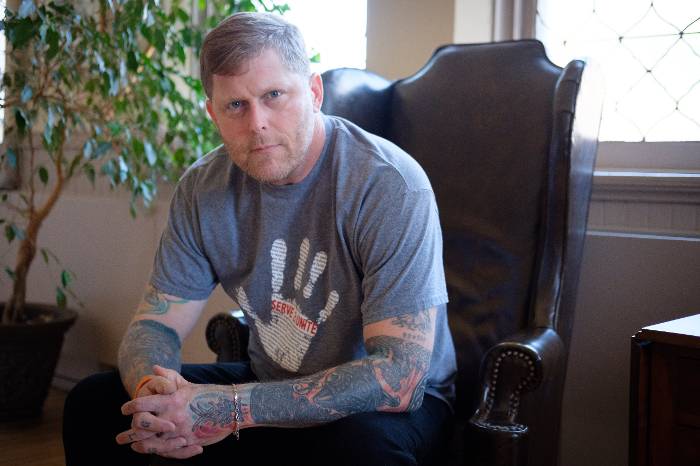
Arno Michaelis poses for an image. Photo courtesy of Arno Michaelis.
founder of the organization of the same name that seeks to help others free themselves from extremist groups. He also works with Serve2Unite, an organization that engages young people of all backgrounds as peacemakers. Our discussion reinforced the importance of teaching our children to reject hate and embrace a more inclusive worldview.
Arno’s journey is inspiring and instructive. Growing up in a comfortable midwestern family, he nevertheless slid into the racist subculture that feeds on youthful alienation and anger. Through his rock band, he glorified white supremacy and promoted violence as its way in the world. While he never killed anyone, he admits to having beaten people, and “left them for dead.” Then, through a series of direct encounters with people of different ethnicities, he began to question his prejudices. He formed bonds beyond his skin color, and shed the fear of otherness that lay at the root of his violent allegiances. His activism for peace and understanding takes a similar approach, relying on interventions to encourage and support those willing to make the next step, and enlisting the participation of other former extremists.
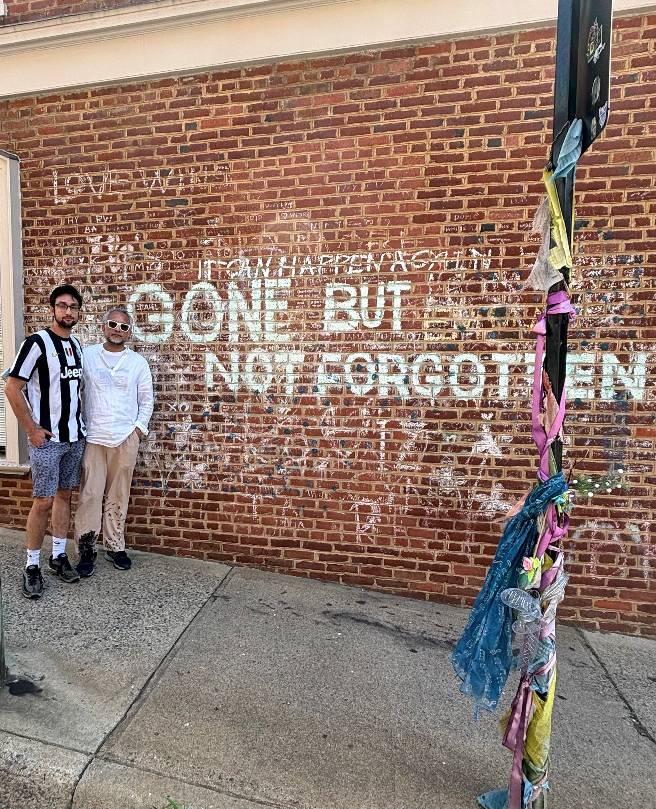
Author and son Ryan Ghosh pose at the site of the tragedy. Image by author.
As my son, Ryan Ghosh and I reflected on the 2017 incident, it left a deep impression on us both. I observed Ryan’s response, sensing his generation’s thirst for justice, inclusivity, peace, and love. We felt the pain of Heather’s family and friends at the loss of someone so hopeful, loving, and courageous in the face of racist hatred and violence. We discussed the lesson I learned from Ryan’s grandmother (my mother, Nilima Ghosh) on transforming anger into obligation (I have elaborated on this lesson in the article, “Turning Anger Into Obligation: 8 Actions We Can Take”.)
After a time, Ryan shared a poignant piece of advice: “Teach your children about compassion from a very young age. Tell them that we all, irrespective of how we look and where we come from, have the same fears, feelings, and aspirations.”
Building bridges
In recent years, hate speech, extremism, and violence have surged in the United States. According to The Marshall Project, hate crimes reported to the FBI increased from over 8,000 in 2020 to nearly 11,000 in 2021. Crimes against Asian Americans, Pacific Islanders, Sikhs, and bisexual individuals more than doubled. Meanwhile, hate crimes against Black, White, and LGBTQ+ people made up nearly half of all incidents. The U.S. Department of Homeland Security identified white supremacists as the most persistent and lethal threat in America.
When I first heard the news of the Charlottesville attack, I was overwhelmed by grief, sadness, anger, and confusion. To find peace, I drove to
Charlottesville, hoping to gain clarity and respond to the powerful urge to do something. I spoke with residents of all ages and ethnicities, including a 10-year-old girl walking with her mother.
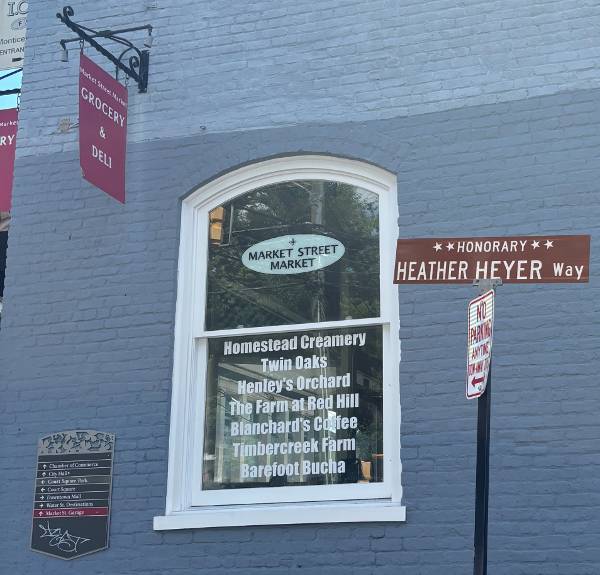
The street is now renamed Heather Heyer Way in honor of the victim, a sign that this community will not allow her sacrifice to have been in vain. Image courtesy of author.
They were equally horrified, and through these conversations, common themes emerged: “learn from our history,” “build bridges,” and “teach our kids to reject hate.”
The street I visited in 2017 is now Heather Heyer Way, a sign that this community will not allow her sacrifice to have been in vain. As Ryan and I walked along it, we were heavy-hearted about her death, but inspired by the street name. We could sense a determination to share what we heard: learn from our history, build bridges, and, most importantly, teach our kids to reject hate.
The last one is easier said than done, you might say. But it’s not as daunting as many think. Susan Bro and Arno Michaelis shared seven concrete steps–simple but effective actions–that parents can take to teach their children to reject hate:
- Don’t shield your children from other children who are different: Today’s classrooms are more diverse than ever before, and instructors should be more willing to encourage individuality and support divergence. Lend your voice to those efforts.
- Avoid defining identity solely by group: National identity and race are human constructs, not biological realities. Teach your children that we are first and foremost all human beings, and global citizens.
- Reject extremism: Emphasize that all human beings share an equal capacity to harm or to heal, and that all of us can be seduced by extremism. Arno clarified that there are Black, Latino, and even Indian members of the white nationalist movement, showing that hate is not confined to one demographic.
- Don’t blame others for personal problems: Encourage your children to take responsibility for their actions and to avoid blaming others for their problems. It is a common practice among many politicians to blame one group for economic or other social ills in order to divide the country. Don’t let them.
- Engage with diversity: Foster an environment where your children interact with people of different ethnicities, religions, nationalities, and identities from an early age. Exposure to diverse perspectives is crucial in building empathy and understanding.
- Set an example: Arno emphasized the importance of being and staying happy. He identified three ingredients of happiness: Kindness, Forgiveness, and Gratitude. He said, “If we are genuinely happy, there is no reason to hate others.”
- Learn from your children. Susan emphasized that we could learn a lot from our children. When required, we must have the courage and humility to tell our children, “I am sorry; I was wrong.”
Progressive Christian
More Voices
Relationships and Religion
About Neil Ghosh
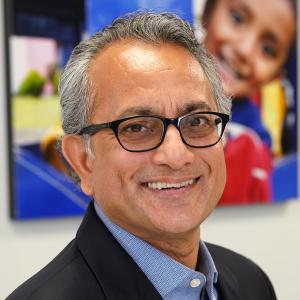
Neil Ghosh has a mission: To give a voice to the voiceless. Neil has forged a path from a childhood in Kolkata to the boardrooms of multinational companies and from leadership roles in global nonprofits to building homes for vulnerable children in Morocco and India. He combines business skills with boundless compassion to build partnerships that foster sustainable development. As an advocate for marginalized populations, the underrepresented, and people facing injustice, Neil has appeared in print, broadcast, and online media in the United States and abroad, including CNN, Devex, the Washington Post, Economic Times, Voice of America, the Australian, the Huffington Post, and Stanford Social Innovation Review. You can read more about the author here.
Previous Post
August 13, 2024
Bangladesh Taps Nobel Laureate Muhammad Yunus for Stability
Next Post

October 1, 2024 Exploring India’s Religious Harmony: A Father-Son Journey
Recent Comments
"Though humble and lowly, one's feet are the most trusted vehicles for every pilgrim. Visiting ..."
Why Every Major Religion Pays Attention ..."
"Recent migrants, newly arrived refugees, early settlers, and original inhabitants are all fellow pilgrims on ..."
America at 250: The Country We ..."
"This is such a meaningful and heartfelt read, you’ve shared the idea of religious harmony ..."
Exploring India’s Religious Harmony: A Father-Son ..."
"Doing Dignity is a meaningful project. Living in dignity and dying in dignity is a ..."
What Bhutan Taught Me About Joy ..."
Browse Our Archives
Select a Category Uncategorized
Select a Month August 2026 July 2026 December 2025 August 2025 July 2025 June 2025 May 2025 April 2025 March 2025 February 2025 December 2024 November 2024 October 2024 September 2024 August 2024
Follow Us!
TAKE THE
Religious Wisdom Quiz
I am a small member of the body, yet I boast great things. I am a fire, a world of iniquity. What am I?
Select your answer to see how you score.
The eye The hand The heart The tongue
Related posts from Building Bridges

Family
Why Every Major Religion Pays Attention to Feet
Family
Three Days Attempting to Reach Mary Magdalene's Cave

Family
America at 250: The Country We Are Still...

Family
What Bhutan Taught Me About Joy After Two...
TRENDING AT PATHEOS Travel and Religion

I was strolling through the top floor of the brand new Parthenon...

What Does Gêvâh Mean For Kimberley Guifoyle &...
This week, a lot of the news is focused on Kimberly Guilfoyle....

INNER CIRCLE: Profound Mystery (Of Christ In All...
Ephesians 5:31-32 “For this reason, a man will leave his father and...

Do Not Rejoice When Your Enemy Falls: The...
Turning an execution into a public spectacle is a disturbing expression of...

'The Chosen' S6 Trailer: The Passion Gets Very...
Not many watching 'The Chosen' worry about spoilers, but just because they...

The purpose-driven labor priest
A labor activist reads Rick Warren and it gets me wondering about...
view all Travel and Religion blogs
What Are Your Thoughts?leave a comment
Ad-Free & Subscriber Log-In Subscription Support
- About Us
- 2026 Calendar
- Videos
- Podcasts
- Library of World Religions
- Faith In Media Tracker
- Advertise With Us
- Write for Us
- Privacy Policy
- Terms of Service
- Do Not Sell My Data
- Contact Us
- Radiant Digital
- Manage Newsletter Subscriptions
- Unsubscribe From Notifications
- Sitemap
Copyright 2008-2026, Patheos. All rights reserved.
Subscription Support Ad-Free & Subscriber Log-In
Follow Patheos