
BuddhistCatholicContemplativeEvangelicalGeneral ChristianHinduJewishLatter-day SaintMuslimNew VisionsProgressive Christian
Beliefs
- Buddhist
- Catholic
- Contemplative
- Evangelical
- General Christian
- Hindu
- Jewish
- Latter-day Saint
- More Voices
- Muslim
- New Visions
- Pagan
- Progressive Christian
Topics
- Religion News
- Food and Religion
- Sports and Religion
- Religious Art
- Religious Music and Entertainment
- Religious Events
- History and Religion
- Style and Religion
- Politics and Religion
- Women in Religion
- Recreation Outdoors and Religion
- Business Finance and Religion
- Careers Workplace and Religion
- Education and Religion
- Family Parenting and Religion
- Health Fitness and Religion
- Home and Religion
- Relationships and Religion
- Technology and Religion
- Travel and Religion
Columnists
- Buddhist Columnists
- Business Finance and Religion Columnists
- Careers Workplace and Religion Columnists
- Catholic Columnists
- Contemplative Columnists
- Education and Religion Columnists
- Evangelists Columnists
- Family Parenting and Religion Columnists
- General Christian Columnists
- Health Fitness and Religion Columnists
- Hindu Columnists
- History and Religion Columnists
- Home and Religion Columnists
- Jewish Columnists
- More Voices Columnists
- Latter Day Columnists
- Muslim Columnists
- New Visions Columnists
- Nonreligious Columnists
- Pagan Columnists
- Politics and Religion Columnists
- Progressive Columnists
- Recreation Outdoors and Religion Columnists
- Relationships and Religion Columnists
- Religion News Columnists
- Religious Art Columnists
- Religious Events Columnists
- Religious Music and Entertainment Columnists
- Sports and Religion Columnists
- Style and Religion Columnists
- Technology and Religion Columnists
- Travel and Religion Columnists
- Women in Religion Columnists
Resource Library
- 2026 Calendar
- Library of World Religions
- The 100 Most Holy Places on Earth
- Patheos Answers
- Podcasts
- Videos
- Faith Leaders Database
- Anglican Episcopalian
- Bahai
- Baptist
- Buddhism
- Christianity
- Confucianism
- Eastern Orthodoxy
- Hinduism
- Holiness and Pentecostal
- ISKCON
- Islam
- Judaism
- Lutheran
- Methodist
- The Church of Jesus Christ of Latter-day Saints
- New Age
- Paganism
- Presbytarian and Reformed
- Protestantism
- Religion Behind the Scenes
- Roman Catholic
- Scientology
- Shia Islam
- Sikhism
- Sufism
- Sunni Islam
- Taoism
- Zen
- See all religions
Research Tools
 Ad-Free & Subscriber Log-In Subscription Support
Ad-Free & Subscriber Log-In Subscription Support
Follow Patheos 

- Trending:
- Forgiveness
- |
- Marriage
- |
- Consciousness
- |
- Death Penalty
- |
- Election
- |
- Halloween

- Home
- Muslim
- Travel and Religion
- Bangladesh Taps Nobel Laureate Muhammad Yunus for Stability
Bangladesh Taps Nobel Laureate Muhammad Yunus for Stability
Last updated on: September 10, 2024 at 5:16 pm by Neil Ghosh
Bangladesh Taps Nobel Laureate Muhammad Yunus for Stability 2024-09-10T17:16:51-04:00 Neil Ghosh
Patheos Explore the world's faith through different perspectives on religion and spirituality! Patheos has the views of the prevalent religions and spiritualities of the world.
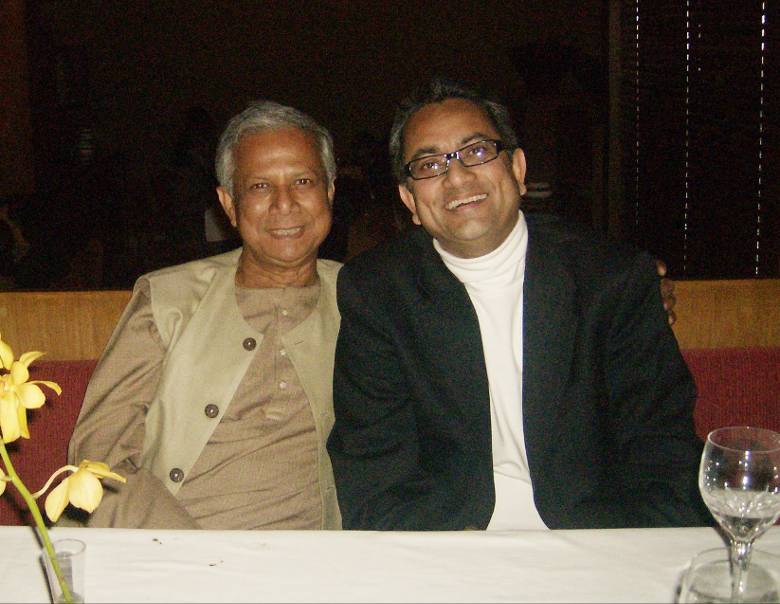
Muhammad Yunus and Neil Ghosh at an event in Kolkata, India. Photo courtesy of Neil Ghosh.
Muhammad Yunus takes oath as head of Bangladesh’s interim government.
This is important news to me for many reasons:
- I got to know Muhammad Yunus over the years, and hold him in high esteem.
- We have family friends in Bangladesh—they are both Muslims and Hindus.
- My father and his family came to India from Bangladesh.
- Bangladesh is the world’s eighth most populous country, a majority-Muslim nation strategically located between India and China.
- Most importantly, it’s time to build bridges and stop the violence.
An Amazing Human Being
I am thrilled that the student leaders, the military, and the President of Bangladesh have appointed the Nobel laureate Muhammad Yunus to lead an interim government in Bangladesh following a mass uprising that drove the former Prime Minister, Sheikh Hasina, from power.
In a significant turn of events. This development comes just months after Yunus was sentenced to six months in jail in January 2024 for allegedly violating the country’s labor laws. The case against Yunus sparked global concern, with more than 1700 global leaders and Nobel laureates including former U.S. President Barack Obama, and former U.N. Secretary-General Ban Ki-moon, among others, expressing deep concern over the threats to democracy and human rights in Bangladesh. In an open letter, these global leaders underscored their apprehension about the legal actions taken against Yunus, viewing them as part of a broader challenge to democratic principles in the country.
Yunus is an amazing human being, known for his humility, empathy, intelligence and impact. I got to know him when he served as a member of our Advisory Board at SNV Netherlands Development Organization. But for many of my friends and colleagues in the United States, he is not very well known, despite having won a Nobel Prize (much like Democratic Vice-Presidential candidate Tim Walz). Let me share what I know about Muhammad Yunus.
Yunus is admired for lifting millions out of poverty with his pioneering micro-credit bank. He defied conventional banking wisdom in structuring its credit program and started the Grameen Bank pilot program in 1977. Rather than demanding large, lump-sum payments, he instituted a daily payment program of small amounts that small borrowers could afford. How did Grameen know what the borrowers could afford? The answer was revolutionary: trust. First and foremost, Yunus trusts the poor.
He believes that in terms of human capability, there is no difference between a poor person and a very privileged person. All human beings are packed with unlimited potential. He argues that poverty is not created by the individual but by the system. Once the poor fall outside the system, it is very difficult to return to it, and the system begins to work against them. Through Grameen, Yunus proved that microcredit can end poverty for many and reduce its severity for others.
But the bank was only the beginning. To help the poor stay in touch with the system, he created a cell-phone company called Grameen Phone. His organization brought phones to the villages of Bangladesh and gave loans to poor women to buy cell phones. He also created Grameen Shakti (Grameen Energy), which has popularized solar energy and biogas for home use, as well as environmentally friendly cookstoves. This is important in Bangladesh, where 70 percent of the population does not have access to electricity.
The stories of Yunus’s ingenuity and success are endless, and to me, they share a common thread: Trust.
The Power of Trust
Yunus is relying on trust to bring stability to Bangladesh at this critical juncture. He has trusted the student leaders and the entire population to do the right thing.
“Let us make the best use of our new victory,” he said in an appeal to students. “Let us not let this slip away because of our mistakes. I fervently appeal to everybody to stay calm. Please refrain from all kinds of violence. I appeal to all students, members of all political parties and non-political people to stay calm. This is our beautiful country with lots of exciting possibilities.”
That trust appears to be reciprocated by the population.
According to a report on NPR from streets of Dhaka, the nation’s capital, residents seemed happy with his appointment.
“In Bangladesh, if you have to define a good person, someone we can trust and move forward, someone who we can call reliable, the first name that will come up will is Dr. Muhammad Yunus,” said Fakruddin Abu Saeed, a 27-year-old consultant to nonprofits. “We are hoping that Dr. Muhammad Yunus will help Bangladesh move forward from the challenge it is facing.”
Challenges Ahead
“My best wishes to Professor Muhammad Yunus on the assumption of his new responsibilities,” India Prime Minister Modi wrote on the social media platform X. “India remains committed to working with Bangladesh to fulfil the shared aspirations of both our peoples for peace, security and development.”
Crucial partners, including the United States and the Indian government of Prime Minister Narendra Modi have welcomed Yunus’ appointment. But within Bangladesh, much remains unclear:
–What, exactly, is Yunus’ mandate?
–How long will he remain in this position?
–Will he organize and oversee new elections?
–Or will he be empowered to enact more substantial political and economic reforms?
–Who will he select as his lieutenant to carry out his plans?
–Can he bring the radical elements of the society under control?
–How will he resolve the divisions in Bangladeshi society?
After 15 years of rule by Sheikh Hasina and her Awami League party and a summer of upheaval that has left governing institutions in tatters, Bangladesh faces a crossroads. While there have been advances in economic areas at the macro level, many ordinary Bangladeshis remain trapped in poverty. Cronyism and corruption are rife in the country’s political life, symbolized by a quota system that has reserved more than half of all government jobs for veterans of the War of Independence. High inflation and youth unemployment were also triggers for the recent uprising, along with the government’s violent crackdowns on criticism and dissent using police and paramilitary proxies.
In an interview with Karan Thapar, a renowned television journalist in India, Shafqat Munir, a Senior Fellow at the Bangladesh Institute of Peace and Security Studies, expressed strong support for Professor Muhammad Yunus’s recent appointment as the interim leader of Bangladesh. Munir emphasized that Yunus is an ideal choice at this critical juncture, describing him as a global icon capable of unifying the nation, advancing crucial reforms, and ensuring the path to a free and fair election.
Munir also welcomed recent remarks by Indian Prime Minister Narendra Modi, highlighting the urgent need for India to signal its support for the people of Bangladesh. He stressed that the relationship between India and Bangladesh should be grounded in the ties between the Republic of India and the People’s Republic of Bangladesh rather than being influenced by any single individual or political party. Acknowledging India’s significant role during the Bangladesh War of Liberation, Munir underscored both nations’ need to maintain solid and collaborative relations.
Stopping the Violence
Stopping the cycle of political violence is critical to creating stability. Attacks on minority communities, mainly Hindu, must stop immediately. I am deeply concerned about the implications in India. In many parts of India, the country of my birth, communities that had co-existed in harmony have descended into violent sectarian fighting. Rising Hindu nationalism leaves Muslims fearful in India. I have written about this in my earlier article “Turning Anger Into Obligation: 8 Actions We Can Take”
Yunus has been quick to recognize the damage caused by violence. He condemned attacks on the minority communities in the violence-hit nation, terming them as “heinous”. Yunus, a Nobel laureate, also urged the students, who are at the forefront of the protests, to protect all Hindu, Christian, and Buddhist families from harm.
In addressing students, he said, “Violence is our enemy. Please don’t create more enemies. Be calm and get ready to build the country.”
“Are they not the people of this country? You have been able to save the country; can’t you save some families? You must say, “‘No one can harm them. They are my brothers. We fought together, and we will stay together.’”
Observers take heart from the example of Muslim madrassa students who formed human shields around Hindu temples to protect them from rioters. This is a sign of communities building bridges across traditional ethnic and religious fault lines, to heal the collective.
What lessons can we learn from watching the events unfolding in Bangladesh?
- Even a democratically elected leader can slowly but surely turn away from democratic processes to stay in power and become a dictator.
- Citizens can’t just survive on bread alone! Freedom of speech, freedom of assembly and freedom of the press are equally important.
- Power corrupts, and absolute power corrupts absolutely.
- No matter how oppressive the regime is, the oppressed will wake up sooner or later.
Transforming into something beautiful
We are all hoping for the situation to normalize and for Bangladesh to continue its economic development with fair elections, law and order and respect for the rights of all minorities
In the NPR sampling of the Dhaka vox populi, grandmother and housewife Mina Sultana Neelu echoed that praise and hope: “Dr. Yunus is our proud son,” she said. “If our country can move forward holding his hand, then I think our country will transform into something beautiful.”
Muslim
Hindu
Politics and Religion
SNV Netherlands Development Organisation
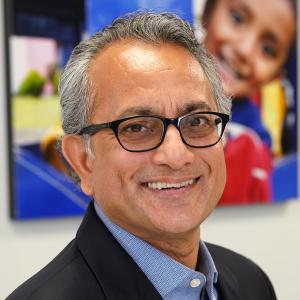
About Neil Ghosh
Neil Ghosh has a mission: To give a voice to the voiceless. Neil has forged a path from a childhood in Kolkata to the boardrooms of multinational companies and from leadership roles in global nonprofits to building homes for vulnerable children in Morocco and India. He combines business skills with boundless compassion to build partnerships that foster sustainable development. As an advocate for marginalized populations, the underrepresented, and people facing injustice, Neil has appeared in print, broadcast, and online media in the United States and abroad, including CNN, Devex, the Washington Post, Economic Times, Voice of America, the Australian, the Huffington Post, and Stanford Social Innovation Review. See here for full bio – www.neilghosh.net See here for other publications – neilghosh.net/publications/ You can read more about the author here.
Previous Post

August 5, 2024
Turning Anger Into Obligation: 8 Actions We Can Take
Next Post

September 10, 2024 7 Things Parents Can Do To Teach Kids To Reject Hate
Recent Comments
"Though humble and lowly, one's feet are the most trusted vehicles for every pilgrim. Visiting ..."
Why Every Major Religion Pays Attention ..."
"Recent migrants, newly arrived refugees, early settlers, and original inhabitants are all fellow pilgrims on ..."
America at 250: The Country We ..."
"This is such a meaningful and heartfelt read, you’ve shared the idea of religious harmony ..."
Exploring India’s Religious Harmony: A Father-Son ..."
"Doing Dignity is a meaningful project. Living in dignity and dying in dignity is a ..."
What Bhutan Taught Me About Joy ..."
Browse Our Archives
Select a Category Uncategorized
Select a Month August 2026 July 2026 December 2025 August 2025 July 2025 June 2025 May 2025 April 2025 March 2025 February 2025 December 2024 November 2024 October 2024 September 2024 August 2024
Follow Us!
TAKE THE
Religious Wisdom Quiz
How many people were saved in Noah's Ark?
Select your answer to see how you score.
10 12 6 8
Related posts from Building Bridges
Family
Why Every Major Religion Pays Attention to Feet
Family
Three Days Attempting to Reach Mary Magdalene's Cave
Family
America at 250: The Country We Are Still...
Family
What Bhutan Taught Me About Joy After Two...
TRENDING AT PATHEOS Travel and Religion

In "Irreplaceable," our book on vocation and technology, Trevor Sutton and I...

I was strolling through the top floor of the brand new Parthenon...

What Does Gêvâh Mean For Kimberley Guifoyle &...
This week, a lot of the news is focused on Kimberly Guilfoyle....

INNER CIRCLE: Profound Mystery (Of Christ In All...
Ephesians 5:31-32 “For this reason, a man will leave his father and...

Do Not Rejoice When Your Enemy Falls: The...
Turning an execution into a public spectacle is a disturbing expression of...

'The Chosen' S6 Trailer: The Passion Gets Very...
Not many watching 'The Chosen' worry about spoilers, but just because they...
view all Travel and Religion blogs
What Are Your Thoughts?leave a comment
Ad-Free & Subscriber Log-In Subscription Support
- About Us
- 2026 Calendar
- Videos
- Podcasts
- Library of World Religions
- Faith In Media Tracker
- Advertise With Us
- Write for Us
- Privacy Policy
- Terms of Service
- Do Not Sell My Data
- Contact Us
- Radiant Digital
- Manage Newsletter Subscriptions
- Unsubscribe From Notifications
- Sitemap
Copyright 2008-2026, Patheos. All rights reserved.
Subscription Support Ad-Free & Subscriber Log-In
Follow Patheos