
BuddhistCatholicContemplativeEvangelicalGeneral ChristianHinduJewishLatter-day SaintMuslimNew VisionsProgressive Christian
Beliefs
- Buddhist
- Catholic
- Contemplative
- Evangelical
- General Christian
- Hindu
- Jewish
- Latter-day Saint
- More Voices
- Muslim
- New Visions
- Pagan
- Progressive Christian
Topics
- Religion News
- Food and Religion
- Sports and Religion
- Religious Art
- Religious Music and Entertainment
- Religious Events
- History and Religion
- Style and Religion
- Politics and Religion
- Women in Religion
- Recreation Outdoors and Religion
- Business Finance and Religion
- Careers Workplace and Religion
- Education and Religion
- Family Parenting and Religion
- Health Fitness and Religion
- Home and Religion
- Relationships and Religion
- Technology and Religion
- Travel and Religion
Columnists
- Buddhist Columnists
- Business Finance and Religion Columnists
- Careers Workplace and Religion Columnists
- Catholic Columnists
- Contemplative Columnists
- Education and Religion Columnists
- Evangelists Columnists
- Family Parenting and Religion Columnists
- General Christian Columnists
- Health Fitness and Religion Columnists
- Hindu Columnists
- History and Religion Columnists
- Home and Religion Columnists
- Jewish Columnists
- More Voices Columnists
- Latter Day Columnists
- Muslim Columnists
- New Visions Columnists
- Nonreligious Columnists
- Pagan Columnists
- Politics and Religion Columnists
- Progressive Columnists
- Recreation Outdoors and Religion Columnists
- Relationships and Religion Columnists
- Religion News Columnists
- Religious Art Columnists
- Religious Events Columnists
- Religious Music and Entertainment Columnists
- Sports and Religion Columnists
- Style and Religion Columnists
- Technology and Religion Columnists
- Travel and Religion Columnists
- Women in Religion Columnists
Resource Library
- 2026 Calendar
- Library of World Religions
- The 100 Most Holy Places on Earth
- Patheos Answers
- Podcasts
- Videos
- Faith Leaders Database
- Anglican Episcopalian
- Bahai
- Baptist
- Buddhism
- Christianity
- Confucianism
- Eastern Orthodoxy
- Hinduism
- Holiness and Pentecostal
- ISKCON
- Islam
- Judaism
- Lutheran
- Methodist
- The Church of Jesus Christ of Latter-day Saints
- New Age
- Paganism
- Presbytarian and Reformed
- Protestantism
- Religion Behind the Scenes
- Roman Catholic
- Scientology
- Shia Islam
- Sikhism
- Sufism
- Sunni Islam
- Taoism
- Zen
- See all religions
Research Tools
 Ad-Free & Subscriber Log-In Subscription Support
Ad-Free & Subscriber Log-In Subscription Support
Follow Patheos 

- Trending:
- Forgiveness
- |
- Marriage
- |
- Consciousness
- |
- Death Penalty
- |
- Election
- |
- Halloween
 Brian McLaren
- Home
- Progressive Christian
- Politics and Religion
- The Conservative Evangelical Project: An Unexpected Grief
The Conservative Evangelical Project: An Unexpected Grief
Last updated on: October 31, 2016 at 5:25 pm by Brian McLaren
The Conservative Evangelical Project: An Unexpected Grief 2016-10-31T17:25:57-04:00 Brian McLaren
Patheos Explore the world's faith through different perspectives on religion and spirituality! Patheos has the views of the prevalent religions and spiritualities of the world.
I just took my first sabbatical. Turning 60 seemed like a good time to get off the road, quiet down, take stock, recharge. It was all I had hoped for. I rested. Walked. Rode my bike. Fished. Played my guitar. Finished a book. Stayed out of airports. Binge-watched a couple TV series with my wife. Worked with a coach and developed a set of priorities and plans for the decade ahead.
But unexpectedly, near the end of my sabbatical, I was overtaken by an unexpected grief. If I were grieving the end of this once-in-a-lifetime gift of rest, that would have been expected. But I knew there was more going on, something deeper that was crying for articulation.
It took a while for the source of my grief to surface. It had to do with the book I had just finished.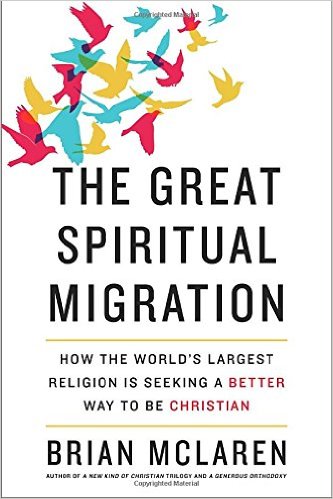
The Great Spiritual Migration is about three shifts or movements that many Christians are experiencing: a move away from defining our faith as a system of beliefs and toward a love-centered way of life; a move away from conceiving of God as a violent Supreme Being who favors “us” at the expense of “them” and toward a vision of God as the healing and reconciling Spirit embodied in Jesus; and a move from the church as organized religion to organizing religion—organizing spiritual activists who will work for the common good.
As I was wrestling these thoughts into their final form, I was watching Trumpism mobilize people in exactly the opposite direction, a reverse migration if you will, with Evangelical Christians serving as Trump’s most dependable base. And that, I think, explained the source of my sadness: I was losing the last shreds of my innocence about my religious heritage. I was feeling at a deeper level how much Evangelicalism had harmed me, and with me, many others.
Long-forgotten memories began coming back to me. Some were related to my family, like memories of disciplining my children with patriarchal fervor, following “Focus on the Family” guidelines that were the norm in my Evangelical tribe but now filled me with intense regret. Some were related to my career as a pastor, like preaching sermons that evaded inconvenient truths and repeated convenient falsehoods, or giving people pastoral counsel I then considered “biblical” but now considered downright hurtful. As these memories would arise, I would literally wince, sometimes groan, sometimes pray, “Lord, have mercy.”
Somehow, my grief was intensified by watching my adult kids raise their kids … without the slightest connection to the Conservative Evangelical Project. It wasn’t that I was sad about this, but the reverse: I was happy. Relieved. Grateful. My beloved grandkids, I realized, were better off than their parents or grandfather because they weren’t being indoctrinated in a belief system and political atmosphere that would denigrate others and make the world a worse place.
This persistent, profound grief was telling me that I needed to admit something to myself that I had never before admitted: the Evangelicalism that I had been a part of and that was a huge part of me had done me much harm, more than I had realized. My many years in the pastorate, my many books, my busy speaking schedule, I realized, have been an extended attempt to heal from the damage that was done to me by good people who were loyally trying to carry on a once-good tradition that had now gone undeniably wrong.
Around this time in the summer of 2016, we were all touched by photographs coming out of Syria, and a new realization hit me: I had written a book about a “great spiritual migration,” but perhaps what I hadn’t fully acknowledged was the degree to which we spiritual migrants are actually refugees, spiritual refugees. We are safe in our homes, but escaping the “failed state” of a war-torn religion whose leaders—through some combination of ego, incompetence, fear, and greed—have misled us. We are spiritually homeless, landless, displaced, feeling a combination of hope and desperation about our prospects for building a better future.
I am now on a book tour to talk to clergy and lay leaders around the country and beyond about The Great Spiritual Migration. I am rested, recharged, and eager to get back to work and back on the road. This unexpected grief will help me, I know, speak with more intensity and integrity about the great migration we find ourselves in, a journey that feels increasingly to be a matter of spiritual life and death.
Previous Post

October 28, 2016
Q & R: Why Celebrate a Swing of the Pendulum?
Next Post

July 5, 2017 Why Pastors and Priests Are Leaving the Church (Part 1)
Browse Our Archives
Select a Category Faith and Climate Uncategorized
Select a Month November 2017 September 2017 July 2017 October 2016 June 2016 April 2016 March 2016 February 2016 January 2016 December 2015 November 2015 October 2015 September 2015 August 2015 May 2015 April 2015 January 2015 November 2014 October 2014 September 2014 August 2014 July 2014 June 2014 May 2014 April 2014 March 2014 February 2014 January 2014 December 2013 November 2013 October 2013 September 2013 August 2013 July 2013 June 2013 May 2013 April 2013 March 2013 February 2013 January 2013 November 2012 October 2012 April 2012 February 2012 January 2012 December 2011 November 2011 June 2011 June 2010
Follow Us!
TAKE THE
Religious Wisdom Quiz
Which book comes before Amos in the Old Testament?
Select your answer to see how you score.
Micah Joel Hosea Obadiah
Related posts from Brian McLaren

When Patriarchy Is the Problem (Not the Solution)

The Last Reformation … and the Next Reformation
The 'Alt-Right' Has Created Alt-Christianity
Why Pastors and Priests Are Leaving the Church...
TRENDING AT PATHEOS Progressive Christian

Why Christians Have a Sacred Duty to Vote:...
The Bible offers strong support for the sacred duty to vote. Here...

What Being a Modern-Day Apostle Means to Me
In my last column, I discussed the ins and outs of modern-day...

Did Ancient China Once Worship the God of...
Across human history, a common thread weaves through the origins of the...

Love Your Neighbor – Including Earth-Kin: Lev. 19,...
God’s command to love your neighbor means acting in an ethical and...

Lead a Church Study of “Jesus and Lao...
Guest writer Jack Thomas (The Irreverent Reverend) reflects on leading his church...

Principles for Understanding the Apostolic Ministry Today
Whenever people discover that my formal ministry title is "apostle," as in...
view all Progressive Christian blogs
Ad-Free & Subscriber Log-In Subscription Support
- About Us
- 2026 Calendar
- Videos
- Podcasts
- Library of World Religions
- Faith In Media Tracker
- Advertise With Us
- Write for Us
- Privacy Policy
- Terms of Service
- Do Not Sell My Data
- Contact Us
- Radiant Digital
- Manage Newsletter Subscriptions
- Unsubscribe From Notifications
- Sitemap
Copyright 2008-2026, Patheos. All rights reserved.
Subscription Support Ad-Free & Subscriber Log-In
Follow Patheos